
Weight build-up
Phil Poffenbarger
WHEN FINISHING A MODEL, the weight to be added is often important in determining whether or not your project will be a successful flier. It is possible to ruin an otherwise sound project by a poor choice of finishing method.
Weight is often cited as one of the principal reasons for selecting one method or material over another, but usually little consideration is given to the total added weight that comes from balsa preparation, the material, and priming. Often, it is not possible to make a wise choice of finishing method from available information. Instead, we rely upon our past experiences and the experiences of our RC colleagues. These hands-on observations are helpful, but they are not always accurate.
Results of a controlled experiment show just how much weight various covering/prepping materials add to our models.
In planning that next model, it would be beneficial to be able to estimate accurately the expected weight build-up of one method versus another. This might give us greater versatility in our choice of projects. For these reasons an experiment was designed to accurately measure weight build-up of various finishing techniques. It was hoped that the data would provide a basis for comparing one method with another, giving the aeromodeler a clearer perspective of the differences and similarities between several popular approaches.
One thing must be made clear before proceeding: weight alone should not be the only factor in selecting a finishing method. Strength, durability, type of aircraft modeled, desired appearance, time of application, availability of materials and tools, and your personal skill and preference all influence the decision.
The experiment
Five finishing materials were selected: silk, aluminum MonoKote, Super Coverite, Micafilm, and glass cloth. These covering materials were applied in standard fashion, with and without Balsarite treatment of the balsa, and all conditions were those of a controlled experimental laboratory.
The silk was purchased at a local fabric shop. On a weight basis it compared identically to K&B silk. Aluminum MonoKote (Top Flite Models), Super Coverite, and pre-primed Coverite Micafilm were purchased at a local hobby shop. Two types of glass cloth were selected: lightweight (0.6 oz./sq. yd.) purchased from Dan Parsons Products, and medium (1.5 oz./sq. yd.) purchased from Sig Manufacturing Co.
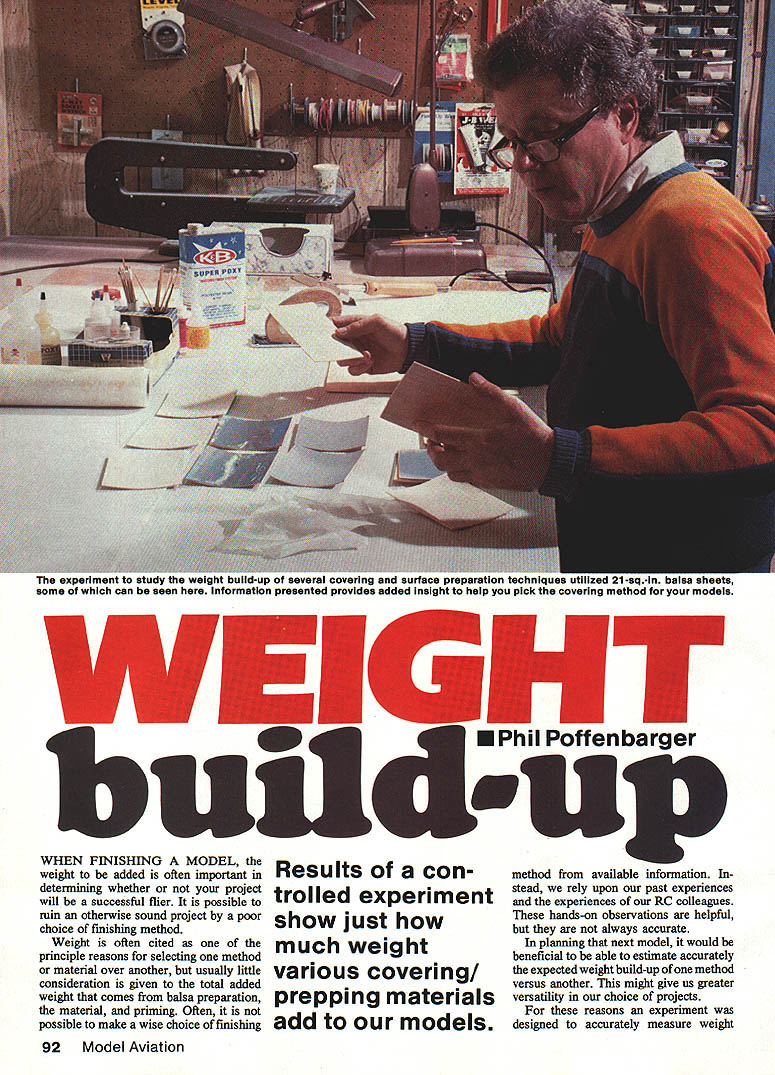
In order to make critical analytical comparisons, 30 test sheets of 1/16 balsa were prepared, each measuring 5 1/4 x 4 in. (21 sq. in.). These test sheets were labeled and each carefully weighed on an analytical balance sensitive to one milligram (Mettler Analytical Balance). In addition, three blank test sheets were weighed throughout the experiment, but they were not treated in any other way. These blank balsa sheets served as an internal check (control) on possible weight gain or loss due to humidity changes.
The results of the experiment are summarized in Table 1. For the iron-on coverings, two sub-groups were analyzed: one with no balsa preparation (except sanding), the other with Balsarite treatment. The second column lists the weight build-up following the Balsarite application. This amounts to 0.32 gm/21 sq. in., or about 1 oz. total for a 60-size plane with an estimated 2,100 sq. in. total surface area. For the silk-and-dope method, the balsa was prepared with three coats of Sig balsa filler and sanded between each coat.
The third column lists the added weight from application of the covering. The pre-primed Micafilm added about 1 gm/test sheet, or up to 3.5 oz./2,100-sq.-in. plane. I had difficulty working with Micafilm because my iron was set too hot. Adhesion was much improved, but not perfect, after cooling the iron to 250°F. Balsarite improved adhesion, and as shown in Table 1, it will add little to the final total weight (about 1 oz.).
Aluminum MonoKote was surprisingly heavy. In retrospect, a non-metallic MonoKote variety also should have been tested. According to this experiment, if every square inch of a .60-size (2,100 sq. in.) plane were covered with aluminum MonoKote, the total add-on weight would be 5.5 oz.
Super Coverite was lighter than expected, though the addition of Balsarite preparation of the balsa brings it very close to aluminum MonoKote in overall weight build-up. Super Coverite was a joy to work with as compared to the other methods of finishing, and the recommended primer (Primex) is very light.
With respect to silk and dope, it can be seen that the lightness of silk is overcome by the heaviness of the filler for balsa preparation, and the clear dope used in both the application and priming steps.
Fibreglassing was performed with polyester thinned with MEK (methyl ethyl ketone) and applied with a soft brush. Excess resin was blotted with tissue paper (little or no sanding is needed with this approach). Comparison of the 0.6 oz./sq. yd. with the 1.5-oz. cloth shows that the medium-weight cloth absorbs considerably more resin and primer, giving rise to a 2.5-oz. additional build-up over the 0.6-oz. cloth. The most surprising discovery, though, was that fibreglassing did not result in a greatly increased weight build-up compared to the other methods. (This is most certainly due to the method of resin application, which is very satisfactory and highly recommended. If resin is poured on, not blotted, or not thinned, a heavy resin residue will accumulate, and sanding will be difficult.)
Recently, the application of glass cloth with cyanoacrylate (CyA) glues has been recommended as a much lighter method. Using CyA with the 1.5-oz. cloth did not result in much of a weight saving; however, it was apparent that the gray primer could be sanded off better, because the cloth weave was less visible than with the blotted-resin technique. The CyA method requires excellent ventilation and a lot of skill to avoid bumps and thread problems; however, keep in mind that this is an experiment on weight build-up, not a critical comparison of ease of application of finishing techniques.
Perhaps the most striking result of this experiment on weight build-up is the finding that there is not a great weight penalty to pay for fiberglassing, particularly if a proper technique is followed. The method of thinning the catalyzed resin with MEK, and of blotting excess resin before it has cured, has been covered in previous issues of Model Aviation. It is not necessary to apply a heavy resin coat on most balsa-sheeted surfaces. The penalty paid in added weight far exceeds the minimal benefit of added strength. Furthermore, the 0.6-oz. glass cloth is quite sufficient for surfacing planes.
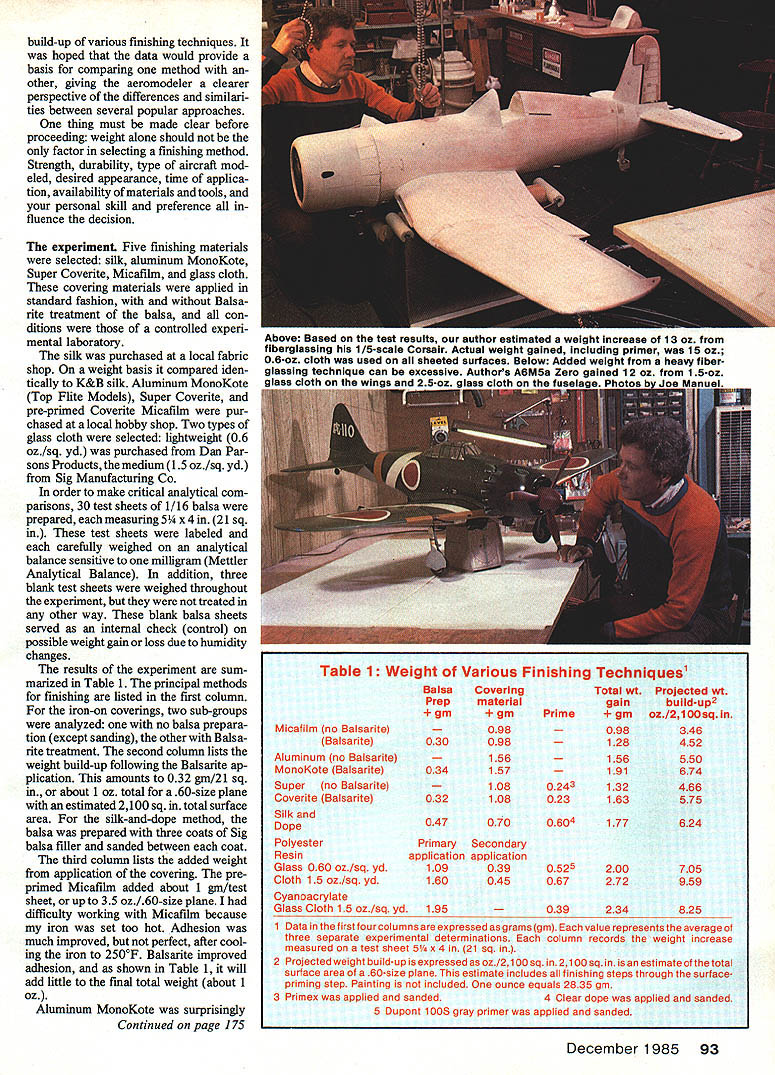
Comparing this fiberglassing technique to Super Coverite, for example, one would predict that the finish of a fiberglassed plane would weigh 22.7% more. To carry this comparison one step further, suppose you had built a 1/5-scale DeHavilland Beaver and had used Balsarite, Super Coverite, and Primex as the finishing technique—and then you found that the finish failed to achieve the aluminum-sheeted appearance you desired. In planning the strategy for your second model of this plane, you could estimate a 22.7% increase in the weight of finishing materials if the lightweight glass cloth approach was selected. This might be easily accommodated.
Another obvious conclusion to be drawn from this experiment is that most finishing techniques add comparable amounts of weight, regardless of the material or method. Sure, Micafilm (pre-primed in this case) is lighter than fiberglassing with 1.5-oz. glass cloth. But keep in mind that this data is expressing only a small percentage of the total weight of your aircraft. If this hypothetical 60-size plane weighed 8 lb. (128 oz.), the finishing materials' add-on weight would vary from 3.5% (Micafilm) to 7.5% (1.5-oz. glass cloth) of the total. That is usually a tolerable range for most model aircraft.
An important consideration, based upon these results, is the application of this data to your next project. Of course, your finishing techniques will differ from the conditions of this experiment, but probably not sufficiently to alter the outcome significantly. In applying this data, you will only need to estimate the total surface area of your aircraft to be covered, and apply the estimate as follows:
X = Weight (oz.) increase estimate W = Observed weight (oz.) in experiment A = Estimated surface area of your plane
X = (W)(A) / 2100
Don't forget to add both the top and bottom wing surface areas, plus the tail surfaces and a guess of the fuselage area. This calculation may help you select one method over another.
It is clear, however, that weight alone is not the only important influencing factor in selecting a finishing method. As stated before, your personal preference, your desire for a special effect, your skill and tools at hand, your hope for durability, and even the weather conditions under which you work are all influences. This experiment will simply remove possible preconceptions about the weight build-up as applied in your decision-making process.
Weight from paint was not included in this experiment simply because this would add too many complexities to the design of the experiment. There are a wide variety of paints available to us, and this should be the subject of a future experiment. Basically, however, white paints are heavy, and clear is the lightest. Pigment adds weight, and paint can add on the ounces in an unsuspected manner. It will be most interesting and technically challenging to critically compare the two-part epoxies, polyester resins, lacquers, enamels, one-part epoxies, polys, and so on.
Table 1: Weight of Various Finishing Techniques
Columns: Balsa prep + gm, Covering material + gm, Prime + gm, Total wt. + gm, Projected wt. build-up (oz./2,100 sq. in.)
- Micafilm (no Balsarite): Balsa prep 0.00, Covering 0.98, Prime —, Total 0.98 gm, Projected 3.46 oz.
- Micafilm (Balsarite): Balsa prep 0.30, Covering 0.98, Prime —, Total 1.28 gm, Projected 4.52 oz.
- Silk and Dope: Balsa prep 0.47, Covering 0.70, Prime 0.60, Total 1.77 gm, Projected 6.24 oz.
- Polyester (primary application): Balsa prep —, Covering 1.09, Prime 0.39, Total 2.07 gm, Projected 7.05 oz.
- Glass cloth, 0.6 oz./sq. yd.: Balsa prep 1.09, Covering 0.39, Prime —, Total 2.07 gm, Projected 7.05 oz.
- Glass cloth, 1.5 oz./sq. yd.: Balsa prep 1.60, Covering 0.45, Prime 0.67, Total 2.72 gm, Projected 9.59 oz.
- Cyanoacrylate on glass cloth, 1.5 oz./sq. yd.: Balsa prep 1.95, Covering 0.39, Prime —, Total 2.34 gm, Projected 8.25 oz.
Footnotes:
- Data in the first four columns are expressed as grams (gm). Each value represents the average of three separate experimental determinations. Each column records the weight increase measured on a test sheet 5 1/4 x 4 in. (21 sq. in.).
- Projected weight build-up is expressed as oz./2,100 sq. in.; 2,100 sq. in. is an estimate of the total surface area of a 60-size plane. This estimate includes all finishing steps through the surface-priming step. Painting is not included. One ounce equals 28.35 gm.
- Prime was applied and sanded.
- Clear dope was applied and sanded.
- Dupont 100S gray primer was applied and sanded.
Transcribed from original scans by AI. Minor OCR errors may remain.

