
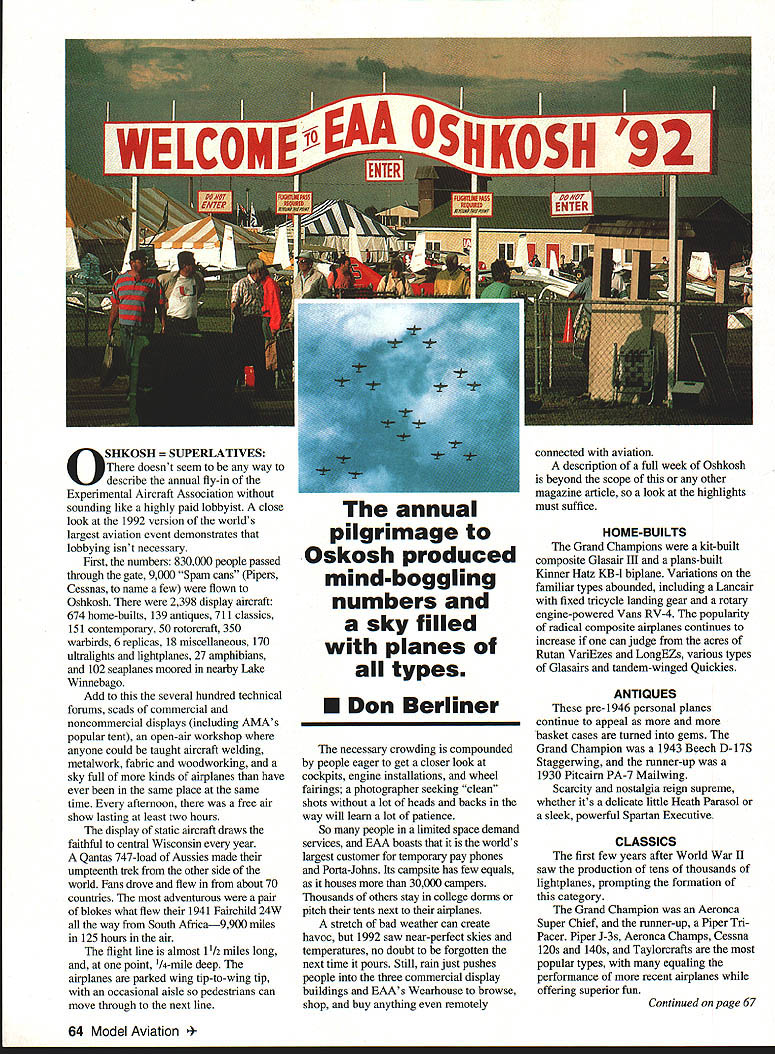
Welcome to EAA Oshkosh '92
Oshkosh — Superlatives
There doesn't seem to be any way to describe the annual fly-in of the Experimental Aircraft Association without sounding like a highly paid lobbyist. A close look at the 1992 version of the world's largest aviation event demonstrates that lobbying isn't necessary.
First, the numbers:
- Attendance: 830,000 people passed through the gate.
- Aircraft flown to Oshkosh: 9,000 "spam cans" (Pipers, Cessnas, to name a few).
- Display aircraft: 2,398 total, comprising:
- 674 home-builts
- 139 antiques
- 711 classics
- 151 contemporary
- 50 rotorcraft
- 350 warbirds
- 6 replicas
- 18 miscellaneous
- 170 ultralights and lightplanes
- 27 amphibians
- 102 seaplanes moored in nearby Lake Winnebago
Add to this the several hundred technical forums, scads of commercial and noncommercial displays (including AMA's popular tent), an open-air workshop where anyone could learn aircraft welding, metalwork, fabric covering, and woodworking, and a sky full of more kinds of airplanes than have ever been in the same place at the same time. Every afternoon there was a free air show lasting at least two hours.
The display of static aircraft draws the faithful to central Wisconsin every year. A Qantas 747-load of Australians made their umpteenth trek from the other side of the world. Fans drove and flew in from about 70 countries. The most adventurous were two pilots who flew their 1941 Fairchild 24W all the way from South Africa — 9,900 miles in 125 hours in the air.
The flight line is almost 1-1/2 miles long and, at one point, 1/4 mile deep. The airplanes are parked wing-tip to wing-tip, with occasional aisles so pedestrians can move through to the next line.
The necessary crowding is compounded by people eager to get a closer look at cockpits, engine installations, and wheel fairings; a photographer seeking "clean" shots without a lot of heads and backs in the way will learn a lot of patience.
So many people in a limited space demand services, and EAA boasts that it is the world's largest customer for temporary pay phones and Porta-Johns. Its campsite has few equals; it houses more than 30,000 campers. Thousands of others stay in college dorms, on farms, or pitch tents next to their airplanes.
A stretch of bad weather can create havoc, but 1992 saw near-perfect skies and temperatures, no doubt to be forgotten the next time it pours. Still, rain just pushes people into the three commercial display buildings and EAA's Warehouse to browse, shop, and buy anything even remotely connected with aviation.
A description of a full week of Oshkosh is beyond the scope of this or any other magazine article, so a look at the highlights must suffice.
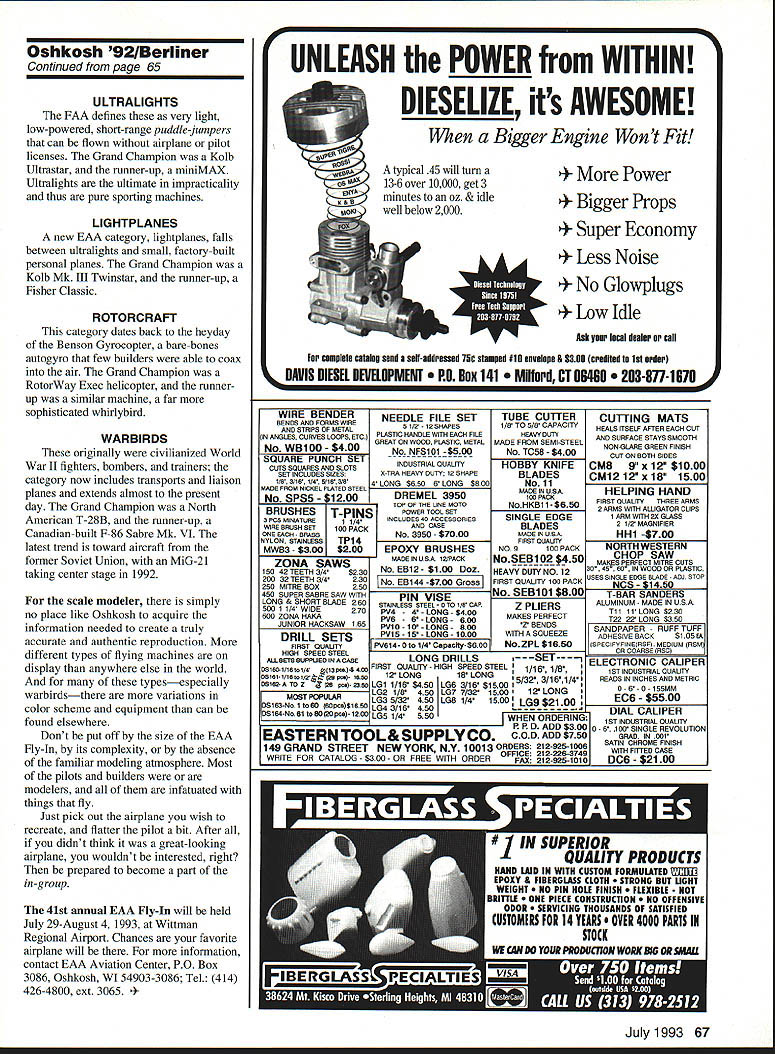
The annual pilgrimage to Oshkosh produced mind-boggling numbers and a sky filled with planes of all types. — Don Berliner
HOME-BUILTS
The Grand Champions were a kit-built composite Glasair III and a plans-built Kinner Hatz KB-1 biplane. Variations on the familiar types abounded, including a Lancair with fixed tricycle landing gear and a rotary engine–powered Vans RV-4. The popularity of radical composite airplanes continues to increase, judging from the acres of Rutan VariEzes, LongEZs, various types of Glasairs, and tandem-winged Quickies.
ANTIQUES
Pre-1946 personal planes continue to appeal as more and more basket cases are turned into gems. The Grand Champion was a 1943 Beech D-17S Staggerwing, and the runner-up was a 1930 Pitcairn PA-7 Mailwing. Scarcity and nostalgia reign supreme, whether it's a delicate little Heath Parasol or a sleek, powerful Spartan Executive.
CLASSICS
The first few years after World War II saw the production of tens of thousands of lightplanes, prompting the formation of this category. The Grand Champion was an Aeronca Super Chief, and the runner-up, a Piper Tri-Pacer. Piper J-3s, Aeronca Champs, Cessna 120s and 140s, and Taylorcrafts are the most popular types, with many equaling the performance of more recent airplanes while offering superior fun.
ULTRALIGHTS
The FAA defines these as very light, low-powered, short-range puddle-jumpers that can be flown without aircraft or pilot licenses. The Grand Champion was a Kolb Ultrastar, and the runner-up was a miniMAX. Ultralights are the ultimate in impracticality and thus are pure sporting machines.
LIGHTPLANES
A new EAA category, lightplanes fall between ultralights and small, factory-built personal planes. The Grand Champion was a Kolb Mk. III Twinstar, and the runner-up, a Fisher Classic.
ROTORCRAFT
This category dates back to the heyday of the Benson Gyrocopter, a bare-bones autogyro that few builders were able to coax into the air. The Grand Champion was a RotorWay Exec helicopter, and the runner-up was a similar machine, a far more sophisticated whirlybird.
WARBIRDS
These originally were civilianized World War II fighters, bombers, and trainers; the category now includes transports and liaison planes and extends almost to the present day. The Grand Champion was a North American T-28B, and the runner-up, a Canadian-built F-86 Sabre Mk. VI. The latest trend is toward aircraft from the former Soviet Union — a MiG-21 took center stage in 1992.
For the scale modeler, there is simply no place like Oshkosh to acquire the information needed to create a truly accurate and authentic reproduction. More different types of flying machines are on display than anywhere else in the world. And for many of these types—especially warbirds—there are more variations in color scheme and equipment than can be found elsewhere.
Don't be put off by the size of the EAA Fly-In, by its complexity, or by the absence of the familiar models and atmosphere. Most of the pilots and builders were or are modelers, and all of them are infatuated with the things that fly.
Just pick out the airplane you wish to recreate, and flatten the pilot a bit. After all, if you didn't think it was a great-looking airplane, you wouldn't be interested, right? Then be prepared to become part of the in-group.
The 41st annual EAA Fly-In will be held July 29–August 4, 1993, at Wittman Regional Airport. Chances are your favorite airplane will be there. For more information, contact EAA Aviation Center, P.O. Box 3086, Oshkosh, WI 54903-3086; Tel.: (414) 426-4800, ext. 3065.
Transcribed from original scans by AI. Minor OCR errors may remain.

