
What Handicap?
Two men who can neither hear nor speak are now successful RC pilots
Bill Mol
During the formal opening of the Hill Country (TX) Aeromodelers' new flying field, two men approached Monte Dove, the club's chief instructor pilot. One of the men handed Monte a note: "We are interested in joining your club. Do you fly control line here?"
Monte started to explain that this was an RC flying club only, and was well into his explanation when he was handed another note: "We both can neither speak nor hear. Will you explain by return note?"
Momentarily perplexed, Monte reached for the pad and penciled his reply. He told them that there were no plans for a CL circle at this time, then asked if they might be interested in learning to fly RC.
As this unusual dialog continued, Monte discovered that both were longtime modelers, and yes, they were interested. The club had some trainers with buddy-box transmitters on hand that day, and demonstration flights were offered to spectators. Both men were offered demonstration flights, flew an RC aircraft for the first time, and were hooked at once.
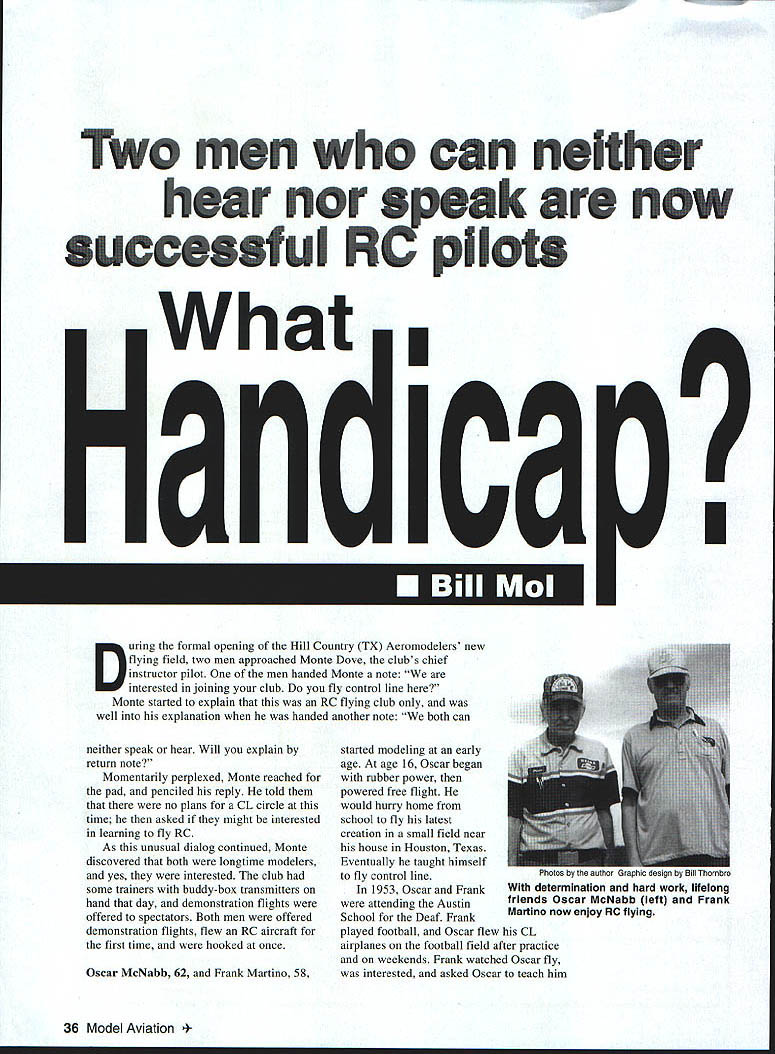
Oscar McNabb, 62, and Frank Martino, 58, started modeling at an early age. At 16, Oscar began with rubber power, then powered free flight. He would hurry home from school to fly his latest creation in a small field near his house in Houston, Texas. Eventually he taught himself to fly control line.
In 1953, Oscar and Frank were attending the Austin School for the Deaf. Frank played football, and Oscar flew his CL airplanes on the football field after practice and on weekends. Frank watched Oscar fly, was interested, and asked Oscar to teach him. This started a lifelong friendship.
They learned to check and set their models' engine operation by feeling the vibration, and determined when the engine quit visually (and by feeling the lines slacken). Both built and flew a number of CL models of that era.
Frank moved to Austin from Houston in 1989 and contacted Oscar to pursue their mutual hobby. Unfortunately, they discovered that CL had lost its popularity, and finding a place to fly was a problem.
On April 9, 1994, they read the feature story in the Austin American Statesman about the new model field opening at Mary Moore Searight Park in South Austin. That's what brought them to the field.
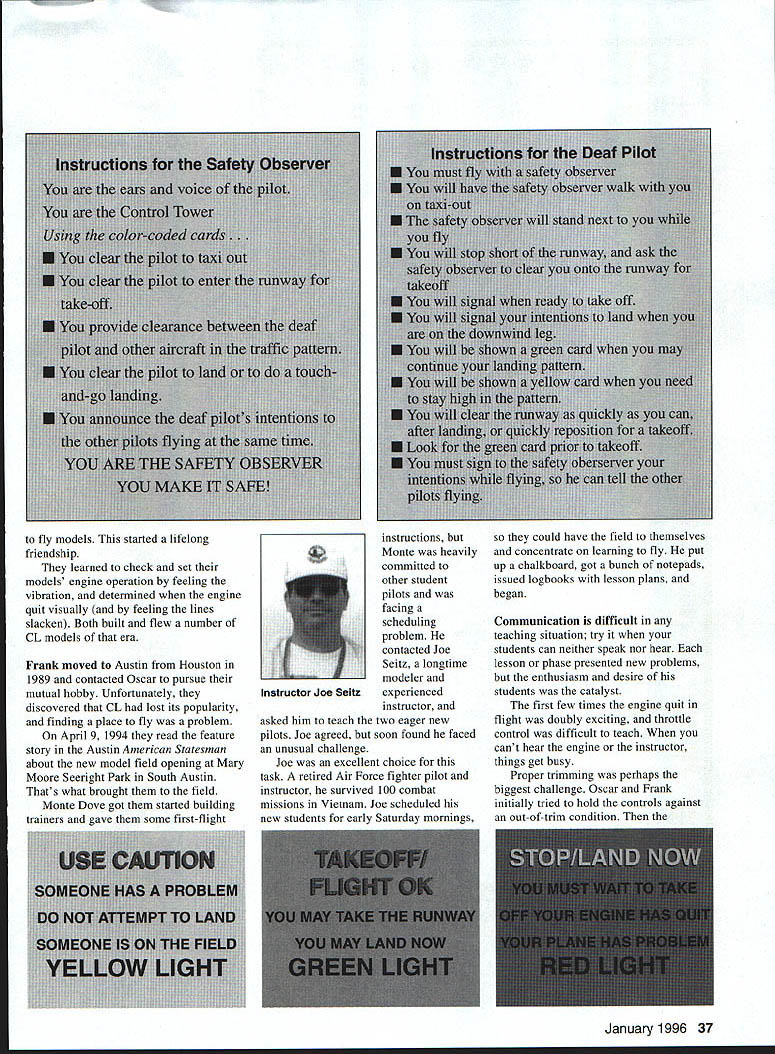
Monte Dove got them started building trainers and gave them some first-flight instructions, but he was heavily committed to other students and was facing a scheduling problem. He contacted Joe Seitz, a longtime modeler and experienced instructor, and asked him to teach the two eager new pilots. Joe agreed, but soon found he faced an unusual challenge.
Joe was an excellent choice for this task. A retired Air Force fighter pilot and instructor, he survived 100 combat missions in Vietnam. Joe scheduled his new students for early Saturday mornings so they could have the field to themselves and concentrate on learning to fly.
Communication is difficult in any teaching situation; try it when your students can neither speak nor hear. Each lesson or phase presented new problems, but the enthusiasm and desire of his students was the catalyst.
The first few times the engine quit in flight were doubly exciting, and throttle control was difficult to teach. When you can't hear the engine or the instructor, things get busy.
Proper trimming was perhaps the biggest challenge. Oscar and Frank initially tried to hold the controls against an out-of-trim condition. The tendency was to overtrim. Much "chalk talk" and note-writing ensued.
Joe was learning, too. He began to pick up sign language, then the deaf alphabet. It was encouraging to see the progress being made, and the pleasure each man took in this learning process. There were some close calls, mishaps, and a lot of landing gear repairs, but these were to be expected in any checkout situation.
Oscar was the first to solo, after some six months of learning. But as more pilots presented new problems, it was obvious that Oscar and Frank would need a safety observer for every flight, and Joe would not always be there.
Using his fighter-pilot know-how, Joe devised a solution. He produced three cards, bordered heavily by green, yellow, and red, with instructions for the pilots and the safety observer. The pilots memorized the cards, and the safety observer held them in his hand.
- Green card: Clears the pilot to take off and land.
- Yellow card: Instructs the pilot not to attempt a landing.
- Red card: Tells the pilot to stop on the ground, or to "Land Now!" (engine quit or aircraft problem).
The system worked, and two more RC devotees are now enjoying our hobby. This success story took courage and desire on the part of the pilots, and dedication and hard work on the part of the instructor. It's hard to tell who learned the most, or who got the most satisfaction out of the project. The club is proud of its two new pilots, both of whom are excellent builders. They already have backup airplanes and are looking into scale modeling.
The color-coded cards and associated procedures are innovations that may help and encourage others to pursue a hobby that they might have thought was beyond their reach. It is hoped that other clubs will use these guidelines to open some doors and explore some options.
Transcribed from original scans by AI. Minor OCR errors may remain.

