


What Junior Problem?
Jim Simpson
Background
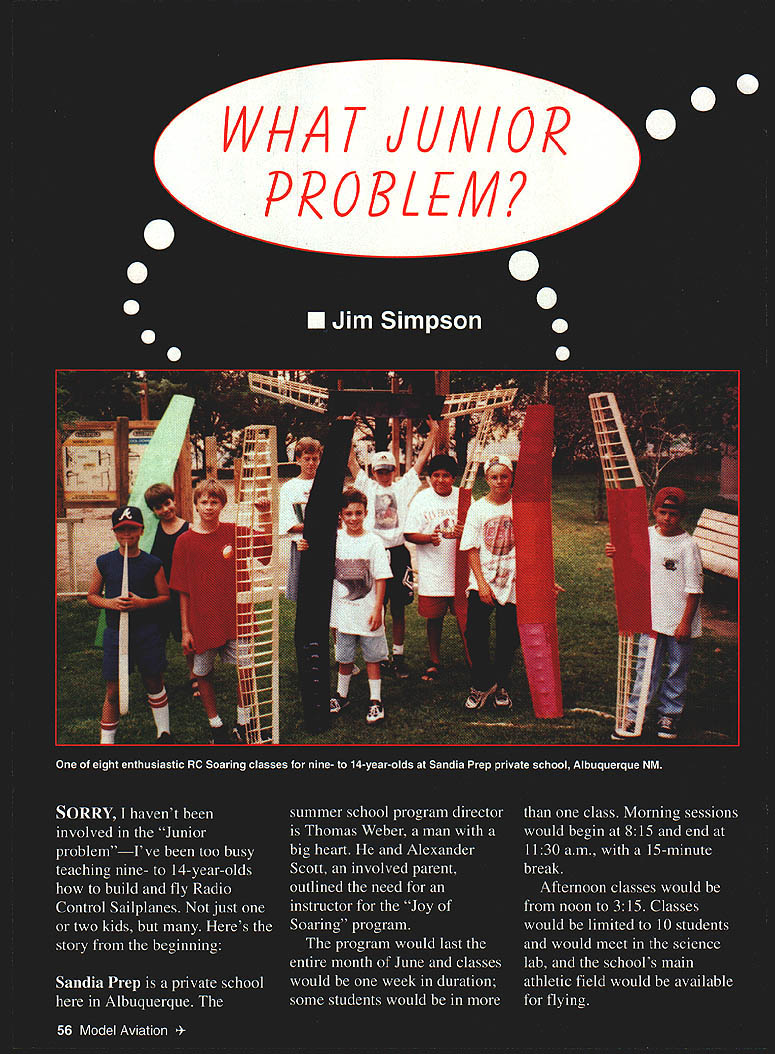
Sandia Prep is a private school in Albuquerque. The summer school program director, Thomas Weber, and an involved parent, Alexander Scott, outlined the need for an instructor for the "Joy of Soaring" program.
- The program ran the entire month of June.
- Classes were one week in duration (some students attended more than one week).
- Morning sessions: 8:15–11:30 a.m., with a 15-minute break.
- Afternoon sessions: 12:00–3:15 p.m.
- Class size: limited to 10 students.
- Location: science lab for building; the school's main athletic field available for flying.
The original instructor was unavailable, and the planned flying (slope soaring) depended on unpredictable wind. I stepped in and proposed thermal soaring instead.
Choosing the Model
I've built more than 100 Gentle Lady sailplanes and recommend that kit to RC beginners. However, the Gentle Lady is not time-friendly for a classroom. I chose the House of Balsa 2 x 6 model, built one myself, and developed a "what else is needed?" list for the school.
It took a day to build the airplane and another day to cover it. In addition to the equipment the school would furnish, each student received a list of additional materials required to fly the model by RC.
First Day and Classroom Setup
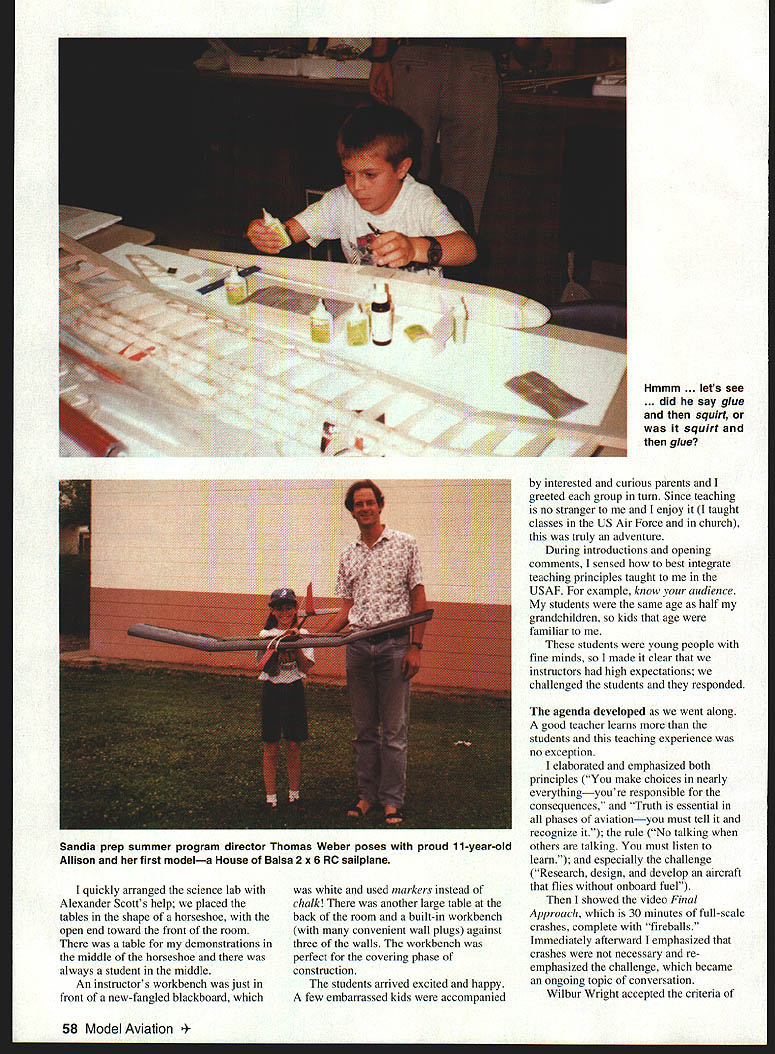
June 3 was a beautiful day. I arrived early with videos and hand tools. Thomas Weber greeted me while supervising the registration table and answering parents' questions. Alexander Scott helped arrange the science lab: tables in a horseshoe with an instructor's demonstration table in the middle. There was always a student in the middle for demonstrations.
The instructor's workbench sat in front of a new-fangled blackboard that was white and used markers instead of chalk. A large table at the back of the room and a built-in workbench (with many wall plugs) around three walls were perfect for the covering phase of construction.
The students arrived excited and happy. A few embarrassed kids came with curious parents. Since teaching is no stranger to me (I taught in the USAF and in church), this was truly an adventure.
Teaching Principles and Agenda
I drew on USAF teaching principles:
- Know your audience.
- Set high expectations and challenge the students.
- Emphasize principles and rules:
- "You make choices in nearly everything — you're responsible for the consequences."
- "Truth is essential in all phases of aviation — you must tell and recognize it."
- "No talking when others are talking. You must listen to learn."
- Present a challenge: "Research, design, and develop an aircraft that flies without onboard fuel."
I showed the video Final Approach (30 minutes of full-scale crashes and fireballs) and immediately emphasized that crashes were not necessary, reinforcing the challenge.
I used historical perspective (Wilbur Wright's flight criteria) to frame the goal of aircraft that require no onboard fuel and to broaden the students' view of aeronautical progress.
The students were quiet, polite, attentive, bright, and articulate — they mainly lacked experience, which the program intended to provide. I focused on transferring clear pictures from my mind to theirs, speaking in their language and recognizing their potential.
Delta Darts were not considered. These students owned computers and routinely beat difficult games; they needed a challenging RC building and flying experience.
Guest Speakers and Motivation
To stretch and motivate the students, I recruited guest speakers:
- Brian McFarland (son of the school's athletic director), an Academy cadet and modeler, answered questions and impressed the class.
- Pete Young (columnist and USAF colonel, MIT background) presented "Success... The 3 R's":
- Design it Right
- Build it Right
- Fly it Right
We left the 3 R's on the board for the entire program and referred to them often.
Building Phase
Each student had a 2 x 4-foot plain ceiling tile as a building board. We provided a kit (included in tuition), pins, a single-edge razor blade, and sandpaper.
By midweek we made sanding blocks. As students punched out die-cut parts, I compared their task to construction workers building a fine arts center: both were solving 3-D puzzles, but the students' pieces were different sizes and shapes. The comparison resonated with them.
Parents were very supportive. Many said it was the first time their children were anxious to get to school.
Process Improvements and Tools
We learned and improved quickly:
- Initially, time was wasted digging through parts boxes. From week two on, parts were separated and bundled the first time out of the box.
- I taught time-saving and labor-saving techniques applicable to the 2 x 6.
- By the end of week two I had a new aircraft design in mind that would reduce build time and better serve the program.
- I used a Dremel jigsaw to cut nose blocks and wingtips, trim wing panel ends, and a 12-inch 3/16-inch drill bit to drill holes for Sullivan pushrods and wing hold-down dowels.
- To prevent disasters, I installed dihedral braces and radios myself when necessary.
Support from Hobby Shops and Volunteers
Local hobby shops and friends provided tremendous support:
- Hobbies 'n' Stuff supplied an in-store computer sailplane simulator. Those who used it learned flying technique more easily. Owner Stan Johnson came to help the students.
- Southwest Hobbies offered a 10% discount and lent three new Monokits so everyone had one to use when needed.
- Many friends visited and helped for hours or days.
- Alexander Scott provided weeks of help and logistical support.
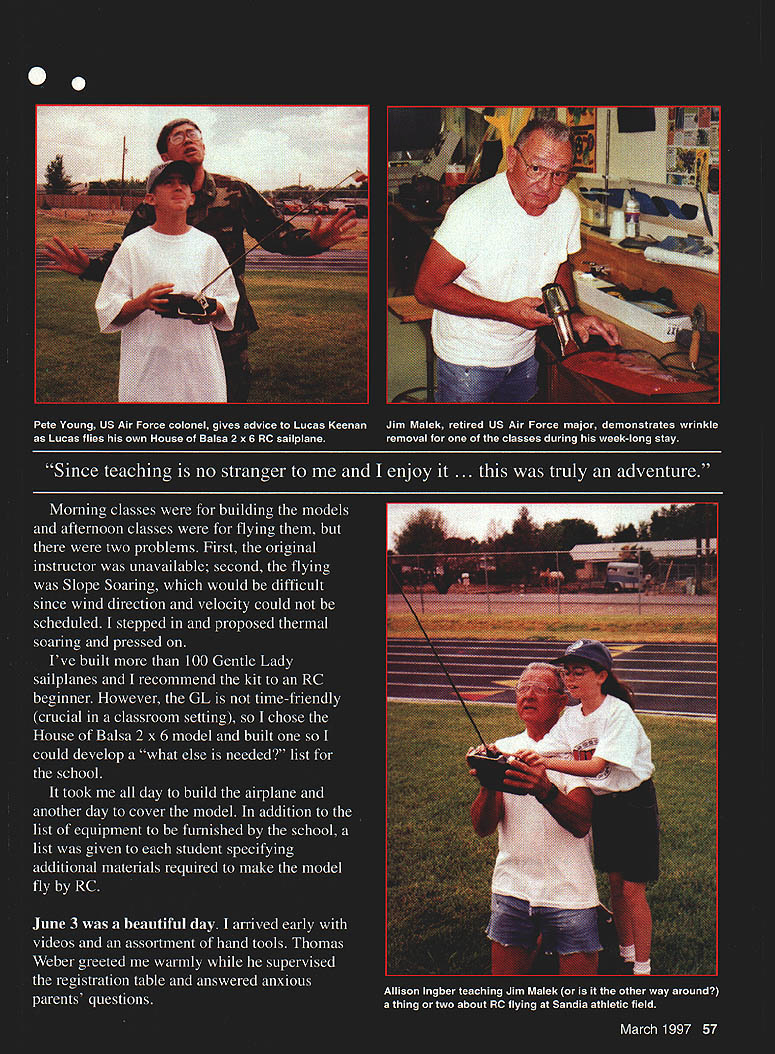
- Jim Malek and his son Chris came to help for a week. Jim (a retired USAF major) and I have known each other 34 years; his kind, grandfatherly manner especially helped Allison, the only girl in the program.
- Chris Malek (33) related well to the students and became chief flight instructor because of his good eyes and excellent flying ability.
A memorable incident: the first day we went flying Bobby Harms (14) was delayed getting to the field by radio problems. I had just launched my plane when I heard a literal squeal and saw a plane coming in low, tail-high, headed straight for Bobby. Chris grabbed the transmitter out of Bobby's hand, throttled down, and landed the plane. That sealed Chris' status in the students' eyes.
Pat Tritle, a fellow professional modeler, came the last two days to help when I had to be away. Pat, Gary Kyle, Ted Guy, and others also fly indoor models in the Sandia Prep gym every other Friday night, dazzling students, parents, and school officials.
Thomas Weber provided ongoing school and logistical support and assigned two girls, Emily and Sheila, to help when available. Emily ran the lunchroom, Sheila ran after-school activities, and Emily later took a 2 x 6 kit to build on her own.
Student Instructors and Results
I trained top students to be instructors with the catch phrase "Cooperate and Graduate." Student instructors provided great help.
- Lucas Keenan was the first to finish and fly. Initially reluctant, after flying the 2 x 6 he logged 20 flights in a week and later started on a Spirit while helping others. He had previously built a Gentle Lady alone.
- Bobby Harms also became a student instructor and learned quickly, flying like a veteran after a few flights.
In one month we created a group of young modelers larger than the local soaring club. I suspect the prospect of these kids showing up at a club contest worries some of the older pilots.
Club Formation and Events
Sandia Prep was delighted with the program. The school will allow the same classroom every Wednesday all summer, permit students to bring a lunch and stay all day, and allow continued use of the athletic field for flying.
- A club, the Sandia Sailplaners, will be formed in honor of the school activity.
- AMA membership is $15 for students and includes Model Aviation; we plan to charter the group.
- Thomas Weber will help print and mail a newsletter. He hopes next summer's program will be twice as big and twice as long.
Mentors are needed. The Albuquerque Soaring Association voted to affiliate the Sandia Sailplaners to provide mentors. The Association will add a class for new students at the monthly Hiss-and-Boink event.
Hiss-and-Boink (H&B) details:
- For two-meter sailplanes, run on a football field.
- Two classes: Gentle Ladies (now Rudder-and-Elevator-only) and all other models.
- We use two upstart-size hi-start launchers hung on each goalpost crossbar so fliers can launch from either direction.
- Objective: get at least four minutes flying time, then land along a 50-foot piece of fabric tape (like an airliner landing on a runway centerline).
- Scoring:
- 100 points for having the nose over the tape on landing; lose 1 point per inch away from the tape.
- 1 point per second of flying time up to four minutes; no penalty for overflight.
- Scores totaled for three rounds.
- No landing points for "boinks" (ground-loops that end inverted) or models that shed parts.
Last year 36 pilots flew in at least one H&B. In nearly two years of operation, the best percentage of successful landings was only about 20%, which shows how challenging the event is. I expect our students will learn and eventually outperform many older pilots.
Conclusion and Contact
I encourage you to contact local schools to run similar programs. Feel free to contact me as necessary.
— Jim Simpson 604 San Juan de Rio Rio Rancho NM 87124 Tel. and Fax: (505) 891-1336
Transcribed from original scans by AI. Minor OCR errors may remain.

