
What one industry member is doing to Recruit Beginners
Many manufacturers in the model industry (such as Sig, Midwest, Atronics, etc.) actively support their own programs or those of others to get newcomers into model aviation. Here's how one of those manufacturers, Cox Hobbies, has been helping to encourage youth interest by planting seeds for future growth via air shows, materials for schools, and special model flying sessions.
In today's fast-paced and ever-changing world, where can we turn for strategies that will make young people want to build model airplanes, engage their imaginations, and stimulate a possibly lifelong interest in aviation?
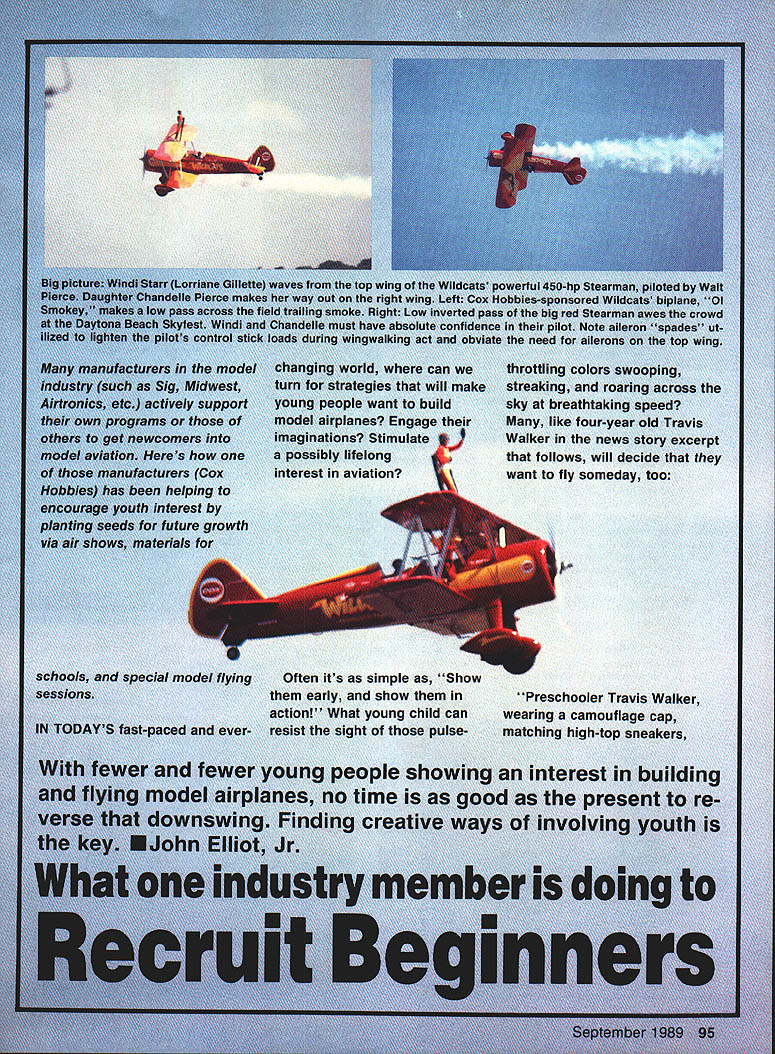
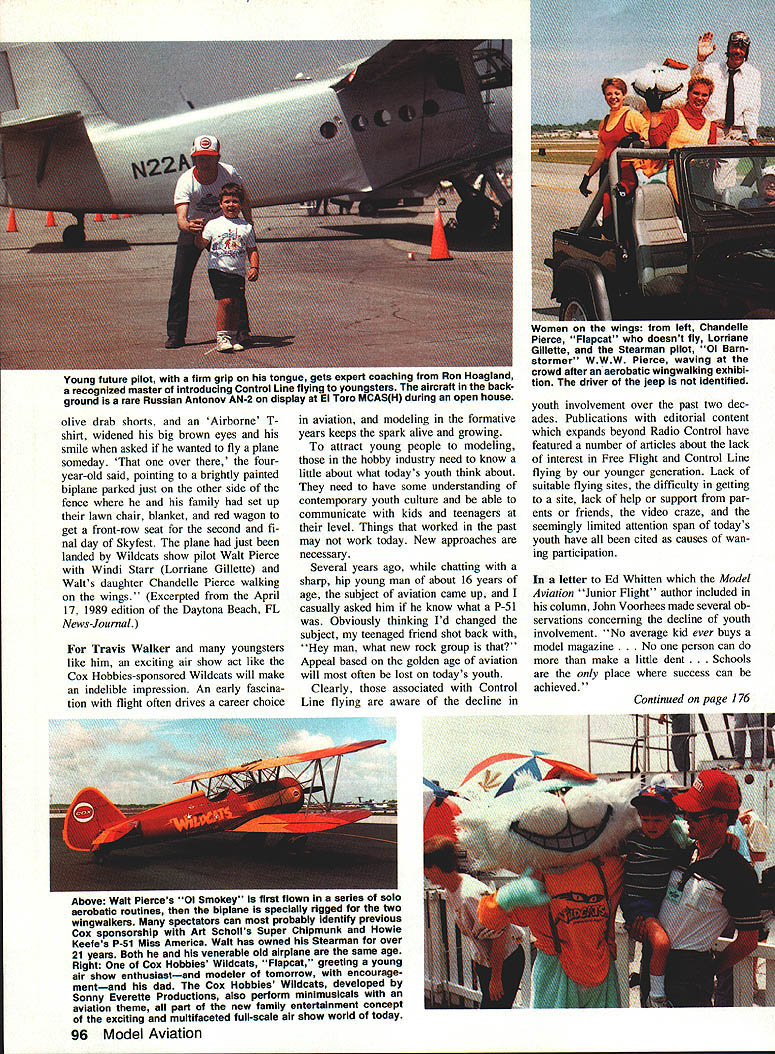
Often it's as simple as: show them early, and show them in action. What young child can resist the sight of thrilling colors swooping, streaking, and roaring across the sky? Many, like four-year-old Travis Walker in the news story excerpt that follows, will decide they want to fly someday, too.
With fewer young people showing an interest in building and flying model airplanes, no time is as good as the present to reverse that downswing. Finding creative ways of involving youth is the key. — John Elliot, Jr.
Appeal based on the “golden age” may be lost
Several years ago, while chatting with a sharp, hip young man of about 16, the subject of aviation came up and I casually asked him if he knew what a P-51 was. Obviously thinking I'd changed the subject, my teenaged friend shot back, "Hey man, what new rock group is that?"
Appeal based on the golden age of aviation will most often be lost on today's youth.
Decline in youth involvement — causes
Those associated with Control Line flying are aware of the decline in youth involvement over the past two decades. Publications with editorial content that expands beyond Radio Control have featured articles about the lack of interest in Free Flight and Control Line flying among our younger generation. The reasons cited for waning participation include:
- Lack of suitable flying sites.
- Difficulty in getting to a site.
- Lack of help or support from parents or friends.
- The video craze and competing entertainments.
- The seemingly limited attention span of today's youth.
In a letter to Ed Whitten (included in his "Junior Flight" column), John Voorhees made several observations concerning the decline of youth involvement: "No average kid ever buys a model magazine ... No one person can do more than make a little dent ... Schools are the only place where success can be achieved."
Industry and schools — opportunities
Voorhees' comments are well taken. These are real problems faced by people working to increase youth involvement in modeling. However, every problem holds an opportunity—in Cox Hobbies' sponsorship of the Wildcats and in other similar programs, we see industry and organizations working those opportunities.
As Voorhees maintains, schools can be a bulwark of modeling education. Some intermediate school educators have initiated programs that use model engines, planes, cars, and boats for hands-on learning. Unfortunately, many of these programs are underfunded, implemented with little or no budget, and largely supported by a core of dedicated instructors. Cox Hobbies has made a priority of supplying materials for these special classes, enabling them to survive on the shoestring budgets educators have been allocated.
In contrast, a look at the school curriculum in Korea shows that its emerging industrial giant places a much higher value on model aviation education. Korea obviously considers model aviation a steppingstone to careers in aviation and has incorporated these classes into its educational program.
Air shows and the Cox Flying Circle
The air show industry has made tremendous strides in the past two decades, with an abundance of full-scale shows presented as family entertainment. These air shows provide a natural arena for showcasing model aviation to youth. The ICAS (International Council of Air Shows) listed over 300 productions for the 1989 season in the U.S.; they should be fertile ground in which to seek out budding model and full-size aviation talent.
Most AMA show teams do outstanding RC demonstrations, but radio control is sophisticated and often fairly expensive and tends to appeal mainly to adults. To attract the younger generation, show teams need something to which young people can relate. Kids are galvanized by Control Line because it's something they see they can do.
Cox has developed a program known as the Cox Flying Circle, which features hands-on activities that give young people the sensation and thrill of actually flying a Control Line model airplane. The company has been extremely active at many events and at the Nats. With the assistance of local Control Line clubs, the Cox Flying Circle has appeared at local air shows, on military installations, and at municipal airports in southern California.
Now, through its sponsorship of the Wildcats, Cox will be taking the Flying Circle across the country. AMA Control Line clubs have expressed considerable interest in participating with Cox. It's an excellent opportunity for club members to meet potential modelers at aviation-oriented events where the audience is receptive to what the hobby has to offer. Clubs can circulate brochures and flyers about their organization and activities.
Conclusion — recruiting the next generation
If you look, you'll find quite a few Travis Walkers out there in training to be future control pilots. Though four-year-old Travis hasn't flown his first Control Line airplane yet, he's been to his first air show—and been romanced by the smoke and noise of the Wildcats. I hope that improves his chances of choosing a more active life—maybe one that includes model aviation.
Control Line has had a glorious little infusion of new blood in recent years. If we want to see the sport grow, we'll need to explore creative ways of involving young people. It's up to us!
Transcribed from original scans by AI. Minor OCR errors may remain.

