
Wholly Toledo
Jim Haught
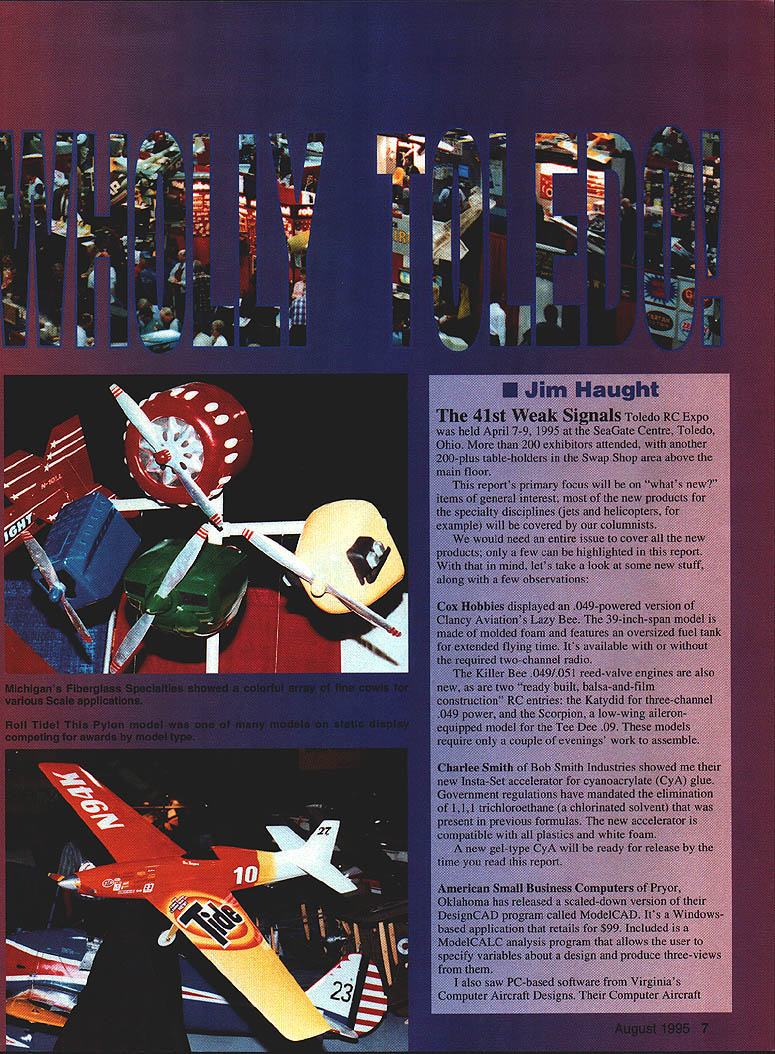
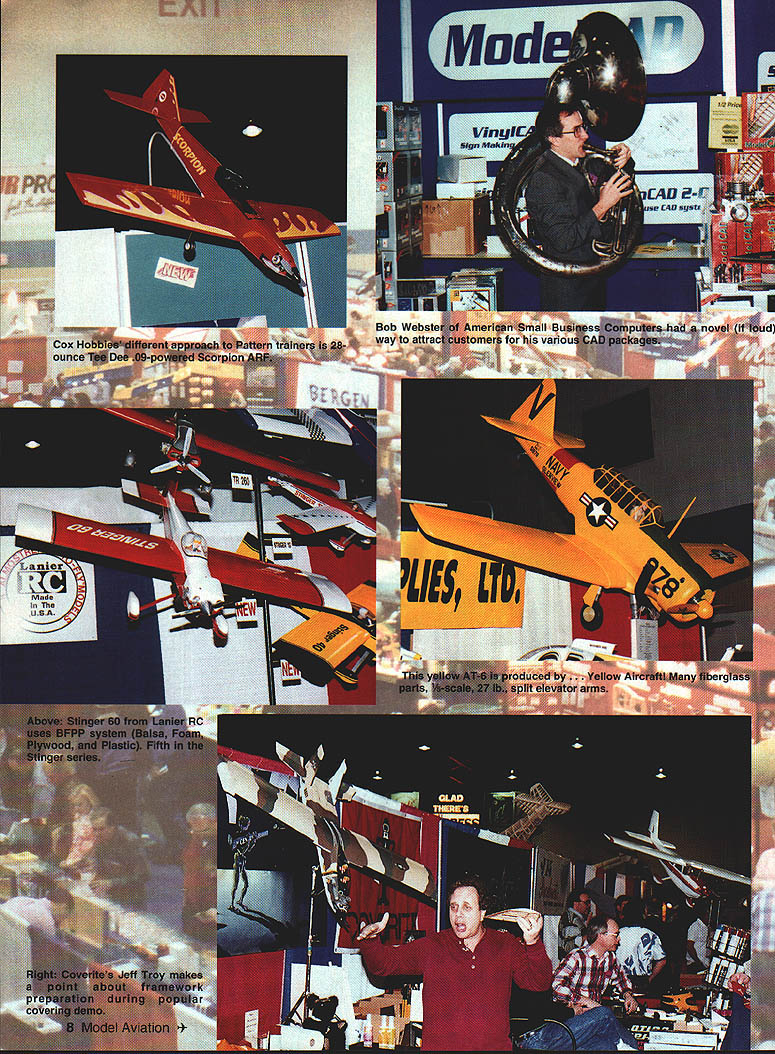
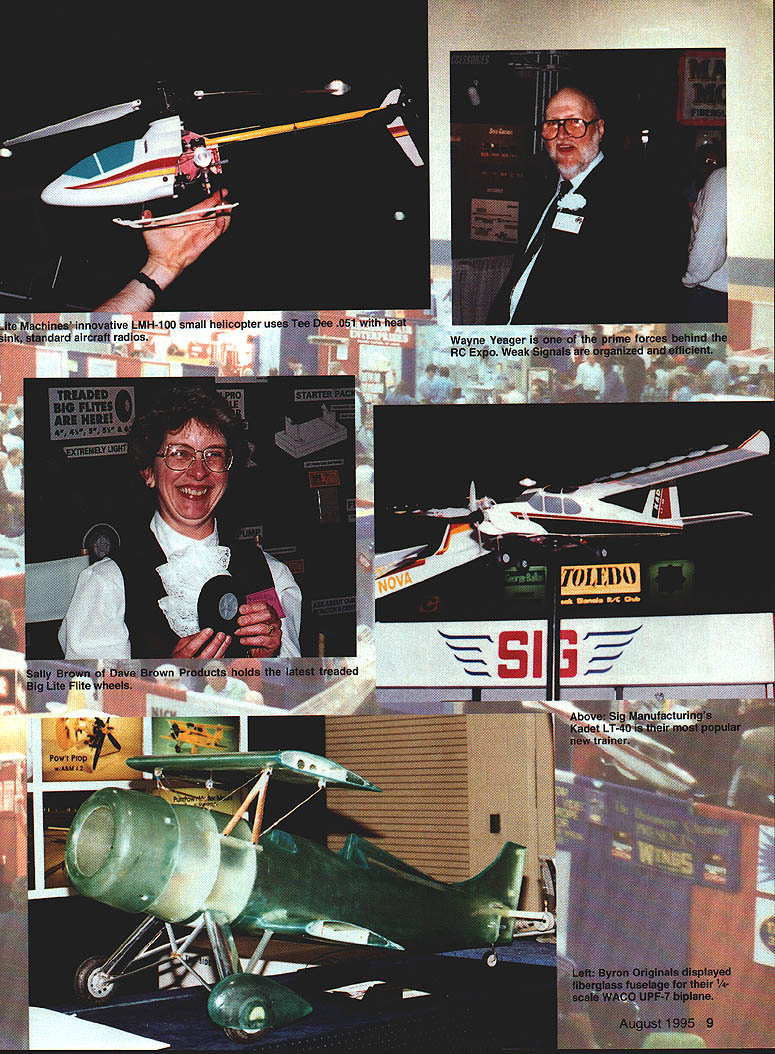
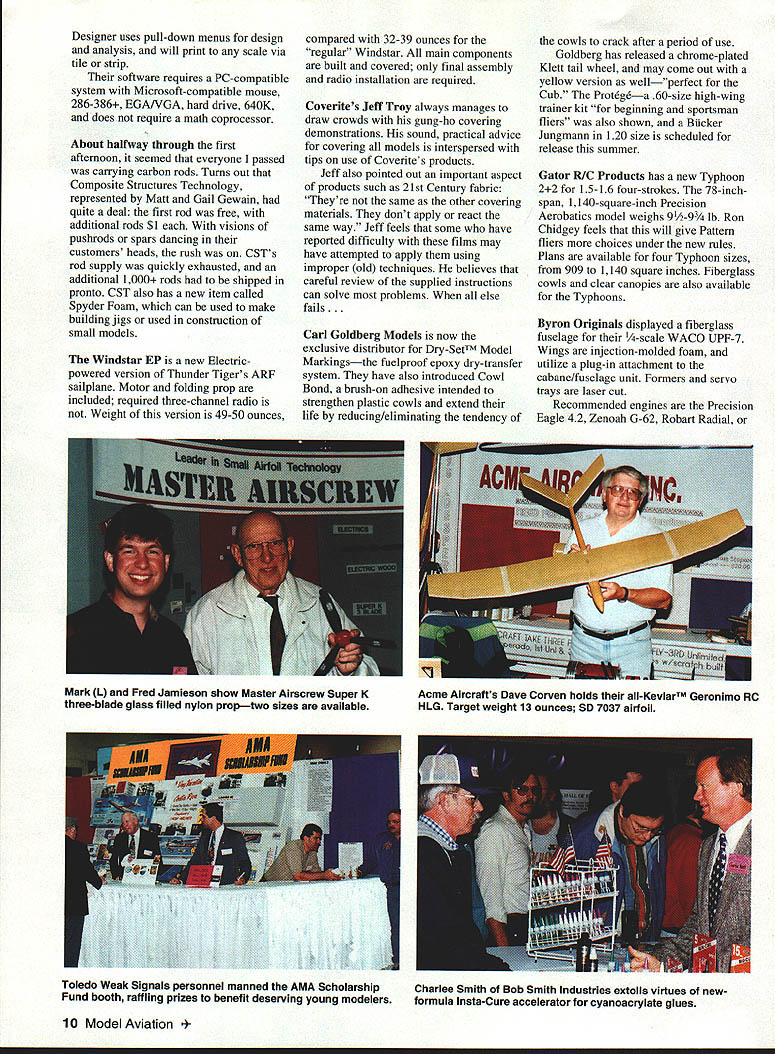
The 41st Weak Signals Toledo RC Expo was held April 7–9, 1995 at the SeaGate Centre, Toledo, Ohio. More than 200 exhibitors attended, with another 200-plus table-holders in the Swap Shop area above the main floor. This report highlights notable "what's new?" items of general interest; specialty-discipline products (jets, helicopters, etc.) will be covered by columnists.
Event notes
- Friday ticket sales were reported as “the best ever” and overall attendance was up, according to Exposition Directors Rick Lederman and Wayne Yeager.
- Weak Signals personnel manned an AMA Scholarship Fund booth, raffling prizes to benefit deserving young modelers.
- Thanks to the Weak Signals staff and the Toledo Radisson hotel for their support and assistance.
Highlights — new products and equipment
- Cox Hobbies displayed a .049-powered version of Clancy Aviation's Lazy Bee. The 39-inch-span model is molded foam with an oversized fuel tank for extended flying time; available with or without the required two-channel radio.
- Killer Bee .049/.051 reed-valve engines are new, along with two “ready-built, balsa-and-film construction” RC entries: the Katydid (three-channel, .049 power) and the Scorpion (low-wing, aileron-equipped, for Tee Dee .09). These require only a couple of evenings’ assembly.
- Charles Smith of Bob Smith Industries demonstrated a new accelerator for cyanoacrylate (CYA) glue. Government regulations have eliminated 1,1,1-trichloroethane from previous formulas; the new accelerator is compatible with plastics and white foam. A new gel-type CYA was also announced for imminent release.
- American Small Business Computers (Pryor, Oklahoma) released ModelCAD, a scaled-down Windows version of DesignCAD priced at $99. It includes ModelCALC for specifying design variables and producing three-view prints. System requirements: IBM-compatible PC (286–386+), EGA/VGA, hard drive, 640K RAM, Microsoft-compatible mouse; no math coprocessor required.
- Computer Aircraft Designs (Virginia) showed their Computer Aircraft Designer software, which uses pull-down menus for design and analysis and prints to any scale via tile or strip.
- Composite Structures Technology (CST), represented by Matt and Gail Gewain, drew large interest in carbon rods — an introductory offer (first rod free, additional rods $1) quickly exhausted inventory; an additional 1,000 rods were shipped. CST also introduced Spyder Foam for building jigs and small-model construction.
- Thunder Tiger’s Windstar EP: an electric-powered ARF sailplane version. Motor and folding prop are included; a three-channel radio is required. EP weight: about 49–50 oz (regular Windstar: 32–39 oz). Main components are built and covered; final assembly and radio installation required.
- Coverite’s Jeff Troy demonstrated covering techniques and advised on new materials such as 21st Century fabric, stressing that these films require different application methods than older coverings and that following supplied instructions usually solves application problems.
- Carl Goldberg Models became the exclusive distributor for Dry-Set™ model markings (a fuelproof epoxy dry-transfer system) and introduced Cowl Bond, a brush-on adhesive to strengthen plastic cowls and reduce cracking. Goldberg also released a chrome-plated Klett tail wheel (a yellow version may follow). A .60-size high-wing trainer kit for beginning/sportsman fliers was shown; a Bücker Jungmann in 1.20 size is scheduled for release this summer.
- Gator R/C Products introduced the Typhoon for .22 and .15–.16 four-strokes. The 78-inch-span Precision Aerobatics model (1,140 sq in) weighs about 9½ lb and is intended to offer pattern fliers more choices under new rules. Plans are available for four Typhoon sizes (909–1,140 sq in). Fiberglass cowls and clear canopies available.
- Byron Originals displayed a fiberglass fuselage for a 1/4-scale WACO UPF-7. Wings are injection-molded foam with a plug-in cabane/fuselage unit; formers and servo trays are laser-cut. Recommended engines include the Precision Eagle .42, Zenoah G-62 and Robart Radial .10.
- Fred Jamieson demonstrated Master Airscrew Super K three-blade, glass-filled nylon props — two sizes available.
- Acme Aircraft introduced Geronimo, an all-Kevlar™ V-tail RC hand-launched glider (HLG). Target weight for the 60-inch-span model is 13 oz, using an SD 7037 airfoil with a 394 sq in wing. List price: $195; fuselage available separately for $95. (Acme’s Geronimo target specs and components were on display.)
- Wayne Siewert of Aerotech Models introduced Servo Slow by ICW Designs — a servo-speed controller using a switch combination to set delay from no delay up to 10 seconds. List price: $34.95.
- Hap Miller of Miller RC Products showed a prototype all-in-one 1/2A starter/battery combo: a compact starter connected to a small 12V flat battery with supports, ideal for travel. No release date announced.
- Klotz Special Formula Products announced Nitroil™ — a nitro/lubricant premix for alcohol-burning two-stroke glow engines (22% Klotz Techniplate synthetic lubricant, 78% nitromethane). Adding 8 oz Nitroil to a gallon of factory-blended glow fuel increases nitro content by ~5%. Nitroil available in 16-oz bottles; Great Planes named a full-line distributor for Klotz products.
- Jon Bartoshek of Texas JBK Products plans to expand fuel distribution, targeting 50,000 gallons/year and reintroducing Blue Flame Premium Gold fuels. Blue Flame (castor-based) runs 0–35% nitro with 20% lubricant; Premium Gold uses synthetics, 5–35% nitro.
- Dave Draper of Hitec RCD described the Spectra synthesized RF module (for Hitec Prism and selected Futaba transmitters). Spectra allows selection among fifty 72-MHz frequencies by changing receiver crystals and works in PPM and PCM. Module price: $199.95; set of four random receiver crystals: $39.95.
Miscellaneous observations
- The show floor was bustling; about halfway through the first afternoon many attendees were carrying carbon rods after CST’s promotional deal.
- A final sampling of booths and workers reflected a healthy state for the hobby and the Expo.
Closing
Thanks to all the Weak Signals volunteers for their hard work and organization. The 1996 RC Expo will be held April 12–14 at the SeaGate Centre, Toledo, Ohio.
Transcribed from original scans by AI. Minor OCR errors may remain.

