
WHY CAN'T THERE BE A WORLD CHAMPIONSHIP FOR PYLON?
Harold deBolt, Chairman, FAI Pylon Racing Committee
Pylon fliers will find this to be a thoughtful, provocative analysis of a baffling problem. Its conclusions and recommendations, at long last, provide us with something positive to chew on. Just maybe...
Background
Formula One racing is the predominant pylon event in the U.S.A. A number of years ago Formula One reached its peak in participation and has held that level to this date. At the time Formula One was growing, FAI Pylon, following in its footsteps, was interesting to many of our racing people. But then the two paths parted. While Formula One continued to attract new people, FAI Pylon declined in the United States until it was only a memory.
The demise was not because modelers no longer wished to race in other ways than Formula One; look at what happened with 1/4‑Midget and various forms of Sport Pylon. With the addition of these events we have far more people racing than ever before. Something had to happen to FAI Pylon to cause our people to lose interest in it. We lost a lot more than just another racing event when FAI Pylon went down the tube.
FAI and World Championships
The Fédération Aéronautique Internationale (FAI) is the only governing body that can establish an aeronautical event for competition among member countries at the world level. Only the FAI can establish recognized World Championships for aeronautical competitions, including all model categories. The U.S.A. is one of the leading nations in the FAI's activities, and without the support of one of its leaders, some FAI events just do not happen. There has never been a World Championship for RC Pylon racing. Many other events you are aware of have enjoyed the status of a World Championship; the pylon racing people have never gained that prestige.
Unless the leading nations work enthusiastically with an event, the necessary work just does not get done. Things remain stalemated.
Stagnation and opportunity
It is now being said that pylon racing in the U.S.A. has become stagnant. Sure, we have a great many people enjoying racing, but some of the excitement and enthusiasm is missing. Perhaps it is because we have reached a peak in Formula One, our premier event. We now have the most beautiful racing machines ever seen going like the devil. We have proved that it can be done. All that remains is to see who can go fastest.
However, it could also be because, once you are at the top in Formula One in this country, you have nowhere else to go. If there was a World Championship, that would be a real goal to strive for—a positive challenge to achievement.
History and rule changes
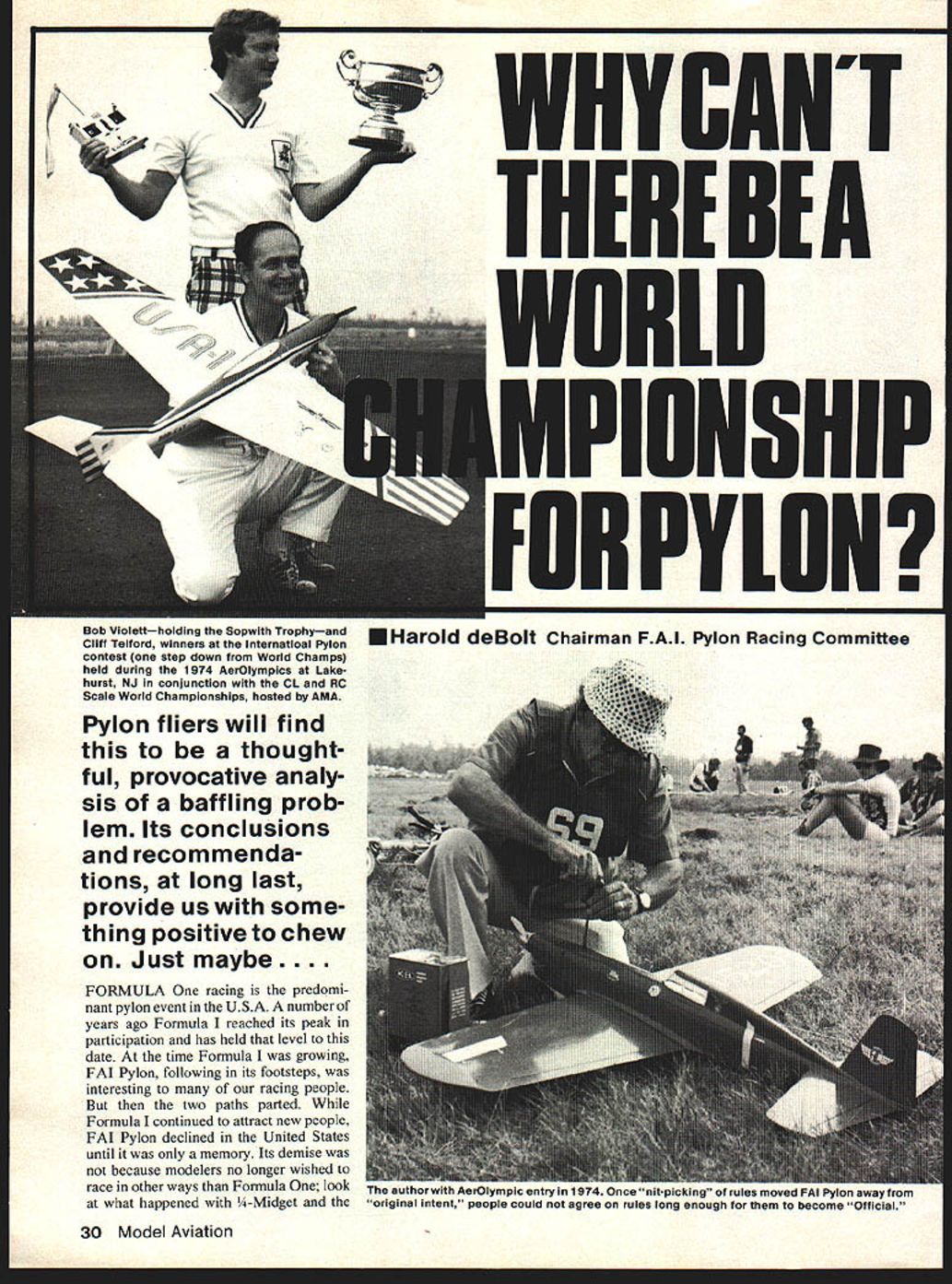
In the early '70s, RC Pylon Racing had a big future on the international scene and was a regular part of the Nats schedule. The U.S. dominated several major meets involving contestants from various countries. The team of Bob Violett and Cliff Telford was tops, with notable wins at several Nats, at races held in conjunction with the 1971 RC Aerobatics World Championships in Doylestown, PA, and the AerOlympics at Lakehurst, NJ.
Then, suddenly, as a result of major FAI rules changes in the mid-1970s, U.S. participation in such events dropped to zero and the promise of the first official world championships being scheduled evaporated. The FAI rules, which had been official, were returned to provisional status—to make them easier to change, so that a popular following might be built up again.
Current efforts and leadership
U.S. interest, with the help of pylon pioneer Hal deBolt as new chairman of the FAI's Pylon Racing Subcommittee—with the backing of the NMPRA (National Miniature Pylon Racing Association)—is once again present and in a position of leadership. The goal is a new set of more universally acceptable rules within the next couple of years and the first world championships as soon as possible (in 1984 according to current FAI requirements).
The AMA does work for us, even if behind the scenes. Right now our AMA sees good for the racing fraternity, for a number of reasons, in FAI Pylon. This view is also held by the Model Aeronautic Association of Canada, the New Zealand and Australian Model Aeronautical Associations, as well as some other countries. It is felt that an interesting FAI Pylon event would add to the enthusiasm of racing and that the stature gained from associated international events and World Championships would be beneficial to all of modeling.
Research and appointment
Some months ago the AMA asked the author to make a basic investigation of FAI Pylon in this country. The results reflected everything from apathy, to a genuine lack of knowledge of the event, to enthusiasm for anything which would add interest to racing and create a World Championship. Quite often, something that starts out as a minor job turns into a major chore. As I dug into the research it was evident that the basics for some excellent racing were there, and via the AMA program and my work, I wound up as the Chairman of the FAI's Pylon Racing Committee. I am not afraid of work. So, with the help of many others, we will get some action in FAI Pylon, whether it be good or, from some standpoints, bad!
Nature of FAI Pylon and the problem of specialization
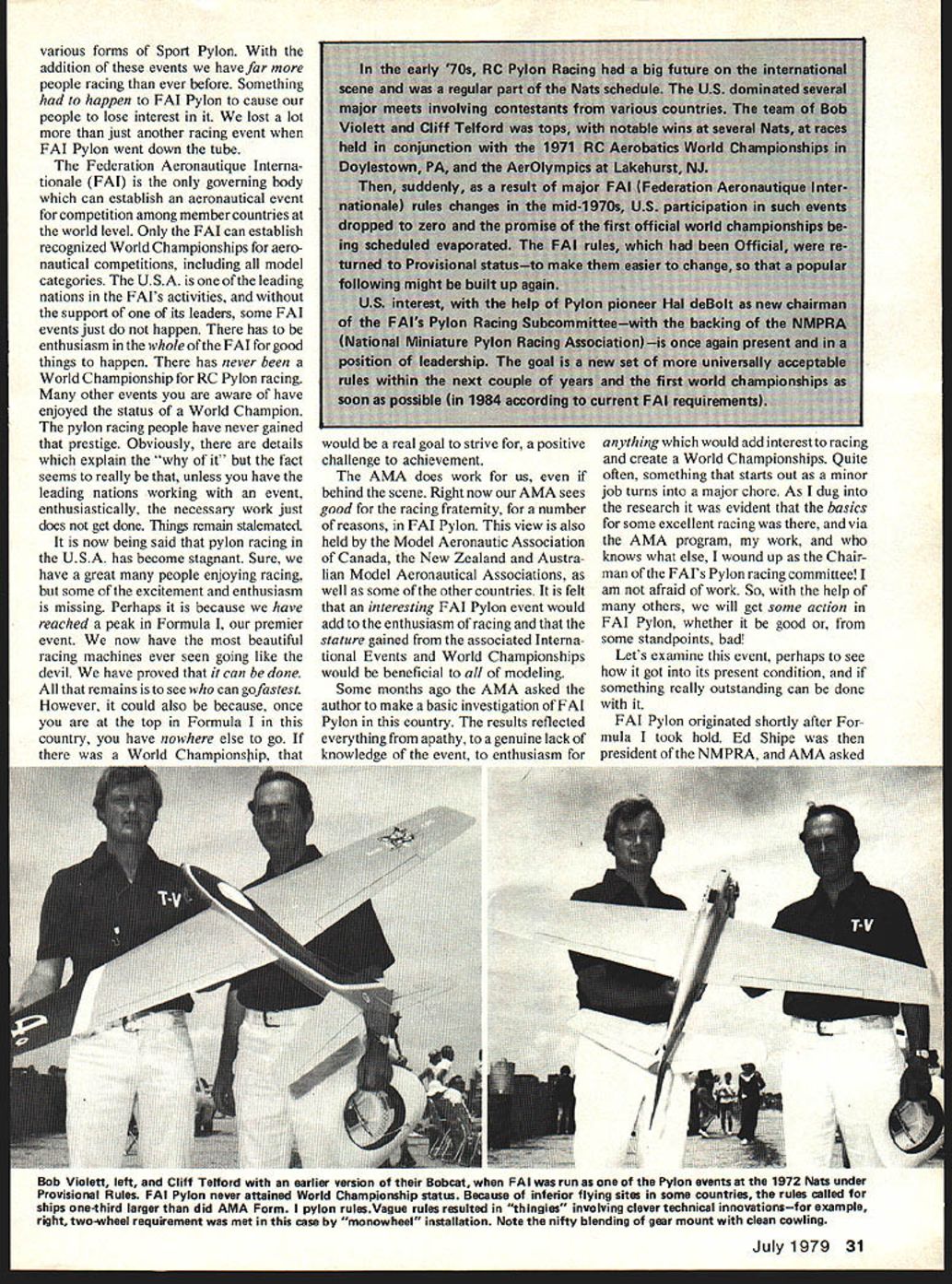
FAI Pylon originated shortly after Formula One took hold. Ed Shipe was then president of the NMPRA, and the AMA asked the NMPRA to conceive rules for a World-class racing event. I was a NMPRA vice-president, so Ed and I took on the task and put the first rules together. The first draft was based on Formula One using an alky engine. This could not be sold because of the marginal flying fields in many countries. The second draft did sell. We simply enlarged the plane by one-third to get the takeoff and landing characteristics needed for small fields.
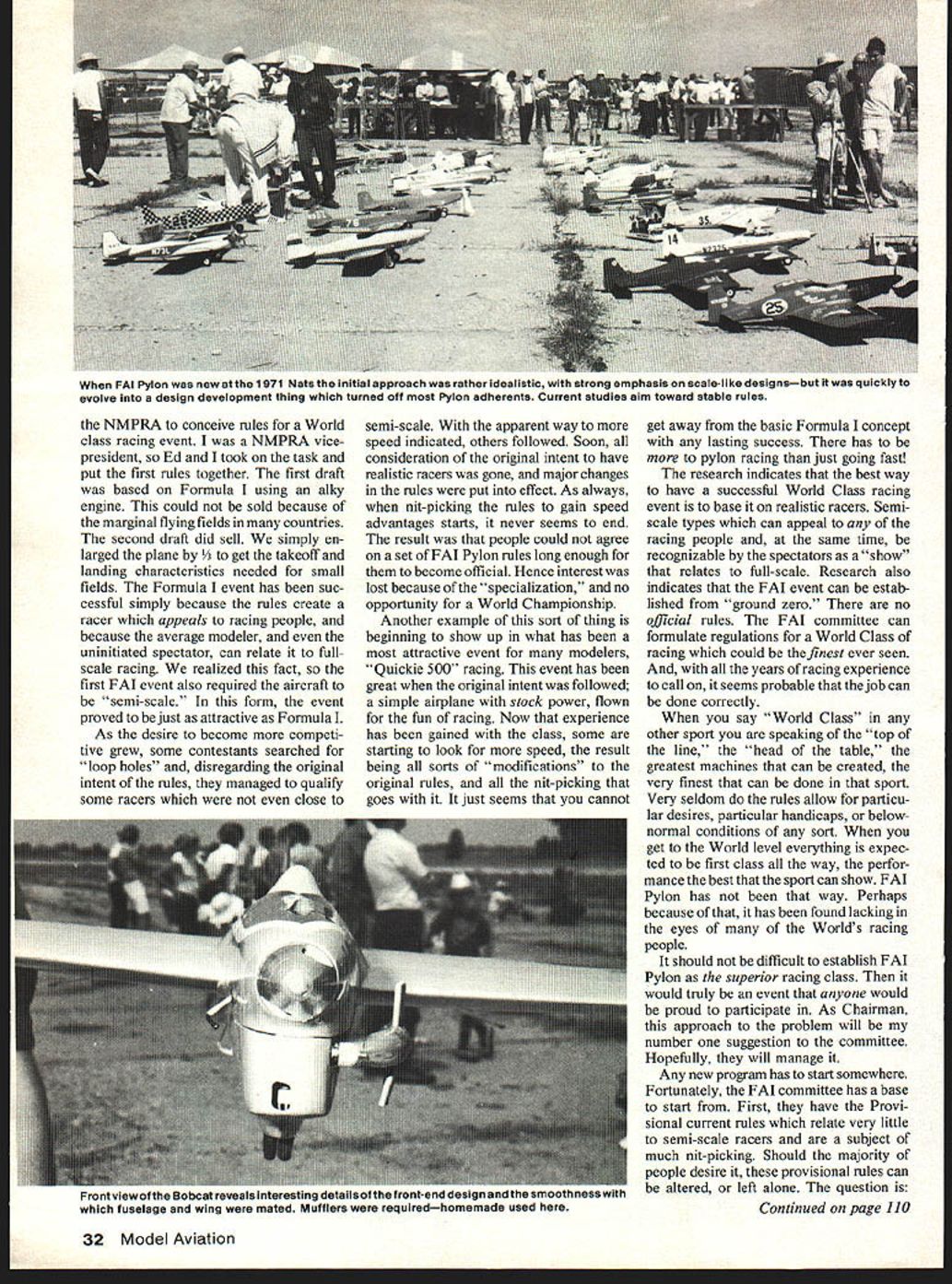
The Formula One event has been successful because the rules create a racer which appeals to racing people, and because the average modeler, and even the uninitiated spectator, can relate it to full-scale racing. We realized this fact, so the first FAI event also required the aircraft to be "semi-scale." In this form, the event proved to be just as attractive as Formula One.
As the desire to become more competitive grew, some contestants searched for loopholes and, disregarding the original intent of the rules, they managed to qualify some racers which were not even close to semi-scale. With the apparent way to more speed indicated, others followed. Soon, all consideration of the original intent to have realistic racers was gone, and major changes in the rules were put into effect. As always, when nit-picking the rules to gain speed advantages starts, it never seems to end. The result was that people could not agree on a set of FAI Pylon rules long enough for them to become official. Hence interest was lost because of the specialization, and no opportunity for a World Championship.
Another example of this sort of thing is beginning to show up in what has been a most attractive event for many modelers, "Quickie 500" racing. This event has been great when the original intent was followed—a simple airplane with stock power, flown for the fun of racing. Now that experience has been gained with the class, some are starting to look for more speed, the result being all sorts of modifications to the original rules, and all the nit-picking that goes with it. It just seems that you cannot get away from the basic Formula One concept with any lasting success. There has to be more to pylon racing than just going fast!
Proposal: a World-class, semi-scale-based event
Research indicates that the best way to have a successful World-class racing event is to base it on realistic racers—semi-scale types which can appeal to any racing people and, at the same time, be recognizable by spectators as a show that relates to full-scale. Research also indicates that the FAI event can be established from "ground zero." There are no official rules. The FAI committee can formulate regulations for a World-class of racing which could be the finest ever seen. With all the years of racing experience to call on, it seems probable that the job can be done correctly.
When you say "World-class" in any other sport you are speaking of the top of the line, the head of the table—the greatest machines that can be created, the very finest that can be done in that sport. Very seldom do the rules allow for particular desires, particular handicaps, or below-normal conditions of any sort. When you get to the World level everything is expected to be first class all the way, the performance the best that the sport can show. FAI Pylon has not been that way. Perhaps because of that, it has been found lacking in the eyes of many of the world's racing people.
It should not be difficult to establish FAI Pylon as the superior racing class. Then it would truly be an event that anyone would be proud to participate in. As Chairman, this approach to the problem will be my number one suggestion to the committee.
Any new program has to start somewhere. Fortunately, the FAI committee has a base to start from:
- The provisional current rules, which relate very little to semi-scale racers and are a subject of much nit-picking. These provisional rules can be altered, or left alone. The question is: what good will come from such action?
- A proposal accepted by the FAI for study from the New Zealand membership. Basically, except for some minor details, this proposal would require a racer very similar to our Formula One. In its favor, it is not the first such proposal to be made. In the past, similar proposals have enjoyed considerable support, but never enough to become provisional.
This would seem to be a logical base to work from. Already there is considerable interest within the organization for such a type of racing. Probably, at this date, the most outstanding class of pylon racing in the world is the American Formula One. The acceptance of the New Zealand proposal, with minor revisions, would allow Formula One aircraft to compete in FAI Pylon. This, of course, would bring in the semi-scale aspect. But perhaps of even more importance, it would make the FAI event attractive to a great number of the world's finest racing people. Participation is what the event needs!
However, such an event would not automatically be a World-class event superior to all others. A critical question can be asked of established racing people: would you be interested in an event that allows Formula One racers to compete, and yet has the potential for an even superior racer? Would you be interested in flying a craft even more realistic than Formula One, and possibly possessing even finer performance? Intriguing question, isn't it?
We could write a set of rules for semi-scale racers that would allow a Formula One design to participate, and then—by a simple alteration of the description of the racer—open the door to many aerodynamically more appealing, more interesting types of air racers. The variety of racing aircraft would be expanded greatly. From this, some outstanding designs could surely be found. The change would be simple: the FAI machine could be patterned after any aircraft that was ever involved in air racing. This would be the finest form of pylon racing we could create, considering all factors involved.
Design possibilities
Discussing these changes locally, one avid racing type immediately started dreaming of the many fine racer designs used in the Thompson races, particularly those powered with radial engines. The first question, of course, is how to write the fuselage cross-section rules so that this sort of craft would not be handicapped. The answer was for him to find the way and submit it to his AMA FAI representative. Otherwise, simply thumbing through some of the better full-scale racing manuals should whet the appetites of the most ardent modelers. There is such a great variety of designs, it would be hard to know where to begin, and the end might never come in any one modeler's lifetime!
Just looking at the Keith Rider racers, Mew Gulls, and my favorite Caudron should show the possibilities such a new event could provide. We can have a true World-class of pylon racing, if you and the rest of the world would like it.
How to get started and upcoming events
For those interested in getting started in FAI Pylon, I do not know of an FAI event scheduled for 1979 in the U.S.A. However, if you care to travel, there are opportunities:
- Italy will host an International Class race for the Sopwith Trophy in 1979.
- In September 1980 there will be an International Class race for the Trophy in Canada; the location will be Calgary, Alberta.
A very active FAI group is considering the Calgary race and you can imagine that the welcome to contestants will be outstanding!
But, alas, there cannot be a World Championship—yet. When the first one does come, perhaps the U.S.A. could be host....
Transcribed from original scans by AI. Minor OCR errors may remain.

