
Why not Model ...
Editor's note: This is the first in a three-part bimonthly series on subjects that are worth considering for scale construction projects. Photos courtesy Scale Model Research.
Have you ever seen an airplane flying during an air show, at a fly-in, or sitting just inside a hangar at your local airport that you would love to model? I have, many times.
— Stan Alexander
Jet models fascinate most modelers, as well as the viewing public. They have a unique sound, powered by ducted fans or one of the new turbines. To combine this technology with classic designs of the 1950s–1960s is the desire of many scale modelers. One of the graceful classics of the post-World War II era, the Hawker Hunter will not only give you a model that will fly well, with great moments, you also won't see a dozen copies on the flightline.
Near the end of World War II, every country was feverishly working on a new mode of propulsion: turbine jet power. While the United States developed a series of fighters, bombers, fighter-bombers, and reconnaissance aircraft, other countries also developed different aircraft for individual missions.
One British aviation giant took a different path during this time, knowing that the British Empire (almost bankrupt after WWII) had to develop a multi-role aircraft to make the most of what was available. Enter the Hawker Aircraft Company.
Hawker had been instrumental in providing the Allies with the Hurricane and Sea Fury; both were excellent weapon platforms. Hawker also produced the pre-WWII Hart, Demon, Fury, Hector, and Hind, as well as many other Royal Air Force aircraft. During this time the RAF was contracting for a replacement aircraft for the Meteor and the Vampire.
The Hawker Hunter played a vital role in the defense of Great Britain during the Cold War in the 1950s. It was a jack-of-all-trades at a time when many aircraft were specially designed for limited requirements.
In producing their first jet fighter, Hawker built a winner. It was eventually used all over the world in many roles, including fighter, ground-attack, trainer, and photo-reconnaissance. The Hunter's airframe was stressed to +7G and −3.75G.
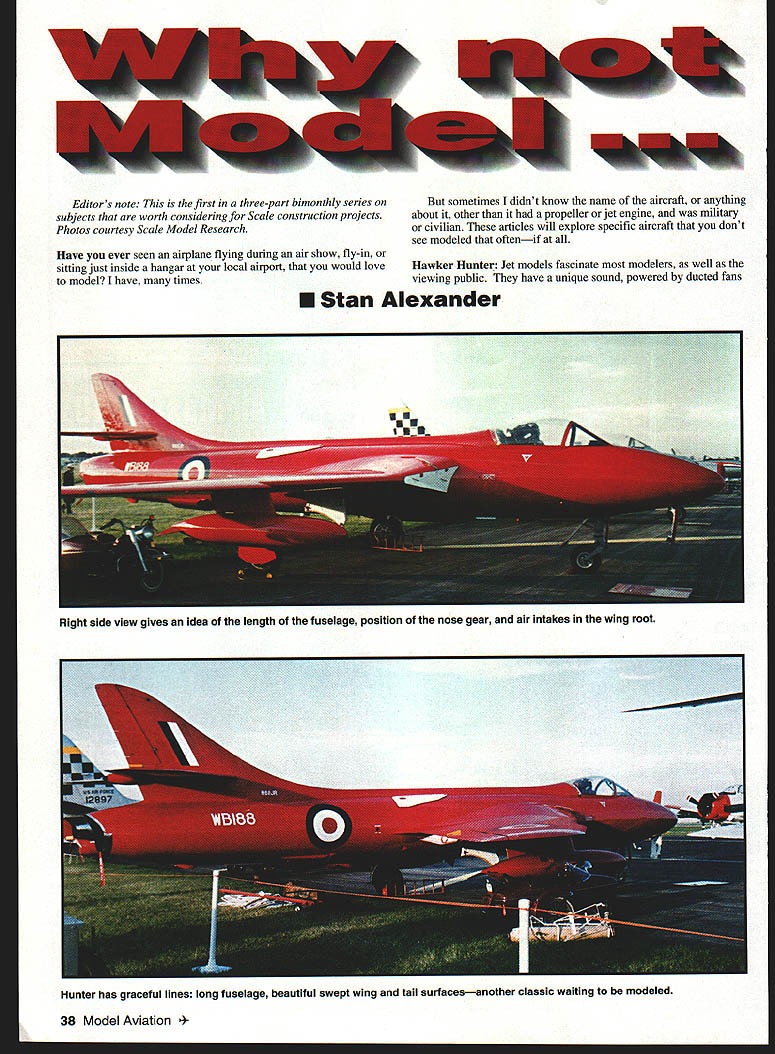
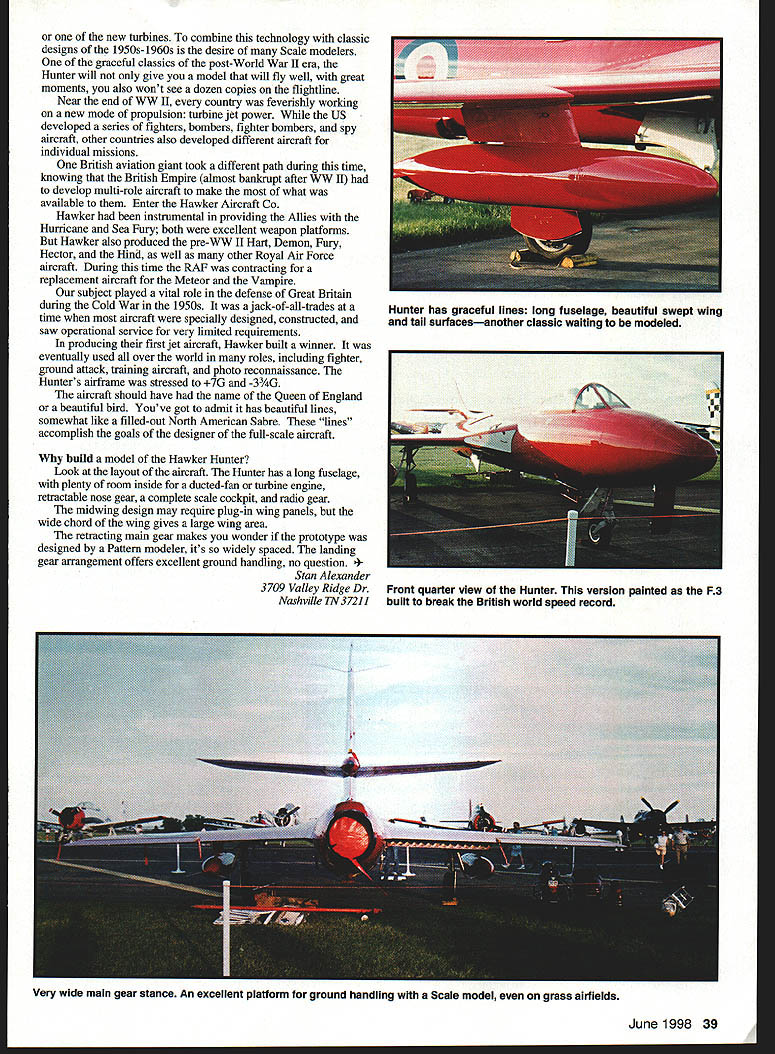
The aircraft should have had the name of the Queen of England or a beautiful bird—you've got to admit it has beautiful lines, somewhat like a filled-out North American Sabre. These lines accomplish the goals of the original designers.
Why build a model of the Hawker Hunter?
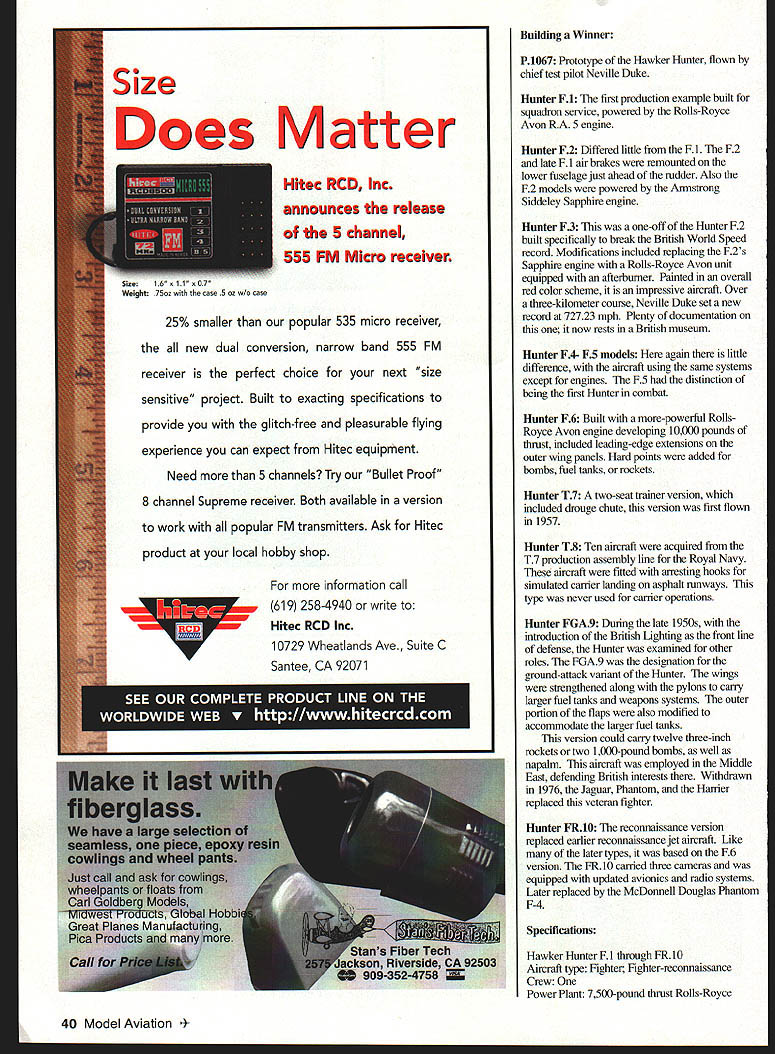
- Layout: The Hunter has a long fuselage with plenty of room inside for a ducted-fan or turbine engine, retractable nose gear, a complete scale cockpit, and radio gear.
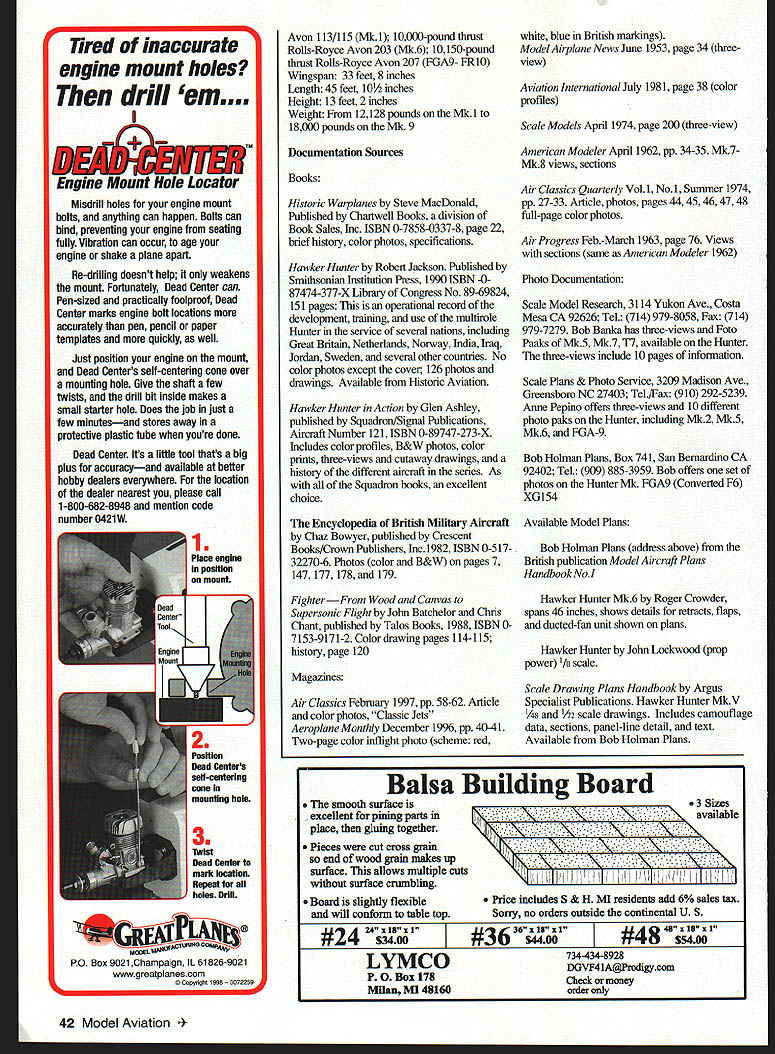
- Wing and handling: The midwing design may require plug-in wing panels, but the wing's wide chord gives a large wing area. The retracting main gear is widely spaced, offering excellent ground handling.
- Rarity and appeal: It's a graceful classic that many modelers will find rewarding to build and fly, and you are unlikely to see dozens of them on the flightline.
Stan Alexander 3709 Valley Ridge Dr. Nashville, TN 37211
Building a Winner
- P.1067: Prototype of the Hawker Hunter, flown by chief test pilot Neville Duke.
- Hunter F.1: The first production example built for squadron service, powered by the Rolls-Royce Avon R.A.5 engine.
- Hunter F.2: Differed little from the F.1. The F.2 and late F.1 air brakes were remounted on the lower fuselage just ahead of the rudder. The F.2 models were powered by the Armstrong Siddeley Sapphire engine.
- Hunter F.3: A one-off based on the F.2, built specifically to break the British world speed record. Modifications included replacing the Sapphire engine with a Rolls-Royce Avon unit equipped with an afterburner. Painted overall red, Neville Duke set a new three-kilometer record at 727.23 mph. Plenty of documentation exists; the aircraft now rests in a British museum.
- Hunter F.4, F.5: Little difference between these models; they used similar systems except for engine variations. The F.5 was the first Hunter to see combat.
- Hunter F.6: Built with a more powerful Rolls-Royce Avon engine developing about 10,000 lb of thrust. It included leading-edge extensions on the outer wing panels and hard points for bombs, fuel tanks, or rockets.
- Hunter T.7: A two-seat trainer version, which included a drogue chute; first flown in 1957.
- Hunter T.8: Ten T.7 aircraft were modified for the Royal Navy and fitted with arrestor hooks for simulated carrier landings on airfields; used for carrier operations.
- Hunter FGA.9: With the introduction of the English Electric Lightning as a front-line interceptor, the Hunter was adapted for ground-attack duties. The FGA.9 featured strengthened wings, pylons for larger fuel tanks and weapons, and modified outer wing panels to accommodate larger tanks. This version could carry twelve 3-inch rockets or two 1,000-pound bombs, as well as napalm. It was employed in the Middle East defending British interests and was withdrawn in 1976, replaced by the Jaguar, Phantom, and Harrier.
- Hunter FR.10: Reconnaissance version based on the F.6. The FR.10 carried three cameras and was equipped with updated avionics and radio systems. It was later replaced by the McDonnell Douglas Phantom F-4.
Specifications
Hawker Hunter (F.1 through FR.10)
- Aircraft type: Fighter; Fighter-reconnaissance
- Crew: One
- Power plant:
- Rolls-Royce Avon engine, approximately 7,500 lb thrust (Avon 113/115 — Mk.1)
- Avon variants producing ~10,000 lb thrust (Avon 203 — Mk.6)
- Rolls-Royce Avon 207 (FGA.9–FR.10)
- Wingspan: 33 ft 8 in
- Length: 45 ft 10.5 in
- Height: 13 ft 2 in
- Weight: From 12,128 lb (Mk.1) to about 18,000 lb (Mk.9)
Documentation Sources
Books
- MacDonald, Steve. Historic Warplanes. Chartwell Books (Book Sales, Inc.). ISBN 0-7858-0337-8. Page 22 — brief history, color photos, specifications.
- Jackson, Robert. Hawker Hunter. Smithsonian Institution Press, 1990. ISBN 0-87474-377-X. Library of Congress No. 89-69824. 151 pages. Operational record of the Hunter's development, training, and service with several nations. No color photos except the cover; 126 photos and drawings. Available from Historic Aviation.
- Ashley, Glen. Hawker Hunter in Action. Squadron/Signal Publications. Aircraft Number 121. ISBN 0-89747-273-X. Includes color profiles, b&w photos, color prints, three-views, cutaway drawings, and a service history.
- Bowyer, Chaz. The Encyclopedia of British Military Aircraft. Crescent Books/Crown Publishers, Inc., 1982. ISBN 0-517-32270-6. Photos (color and b&w) on pages 7, 147, 177–179.
- Batchelor, John and Chant, Chris. Fighter — From Wood and Canvas to Supersonic Flight. Tablo Books, 1988. ISBN 0-7153-9717-2. Color drawing pages 114–115; history on page 120.
Magazines
- Air Classics, February 1997, pp. 58–62. Article and color photos, "Classic Jets."
- Aeroplane Monthly, December 1996, pp. 40–41. Two-page color inflight photo (scheme: red, white, blue in British markings).
- Model Airplane News, June 1953, p. 34 (three-view).
- Aviation International, July 1981, p. 38 (color profiles).
- Scale Models, April 1974, p. 200 (three-view).
- American Modeler, April 1962, pp. 34–35. Mk.7–Mk.8 views and sections.
- Air Classics Quarterly, Vol. 1, No. 1, Summer 1974, pp. 27–33. Article and photos; pages 44–48 include full-page color photos.
- Air Progress, Feb.–March 1963, p. 76. Views with sections (same as American Modeler 1962).
Photo Documentation
- Scale Model Research, 3114 Yukon Ave., Costa Mesa, CA 92626. Tel: (714) 979-8058; Fax: (714) 979-7279. Bob Boka has three-views and photo paks for Mk.5, Mk.7, etc. The three-views include 10 pages of information.
- Scale Plans & Photo Service, 3290 Madison Ave., Greensboro, NC 27403. Tel/Fax: (910) 292-5239. Anne Pepe offers three-views and 10 different photo paks on the Hunter, including Mk.2, Mk.5, Mk.6, and FGA-9.
- Bob Holman Plans, Box 741, San Bernardino, CA 92402. Tel: (909) 885-3959. Bob offers a photo set on the Hunter Mk. FGA.9 (converted F.6) XG154.
Available Model Plans
- Bob Holman Plans (address above) — from the British publication Model Aircraft Plans Handbook No. 1.
- Hawker Hunter Mk.6 by Roger Crowder — spans 46 inches; shows details for retracts, flaps, and a ducted-fan unit.
- Hawker Hunter by John Lockwood — prop-powered, 1/4 scale.
- Scale Drawing Plans Handbook by Argus Specialist Publications — Hawker Hunter Mk.V 1/48 and 1/32 scale drawings. Includes camouflage data, sections, parts, panel-line detail, and text. Available from Bob Holman Plans.
Transcribed from original scans by AI. Minor OCR errors may remain.

