
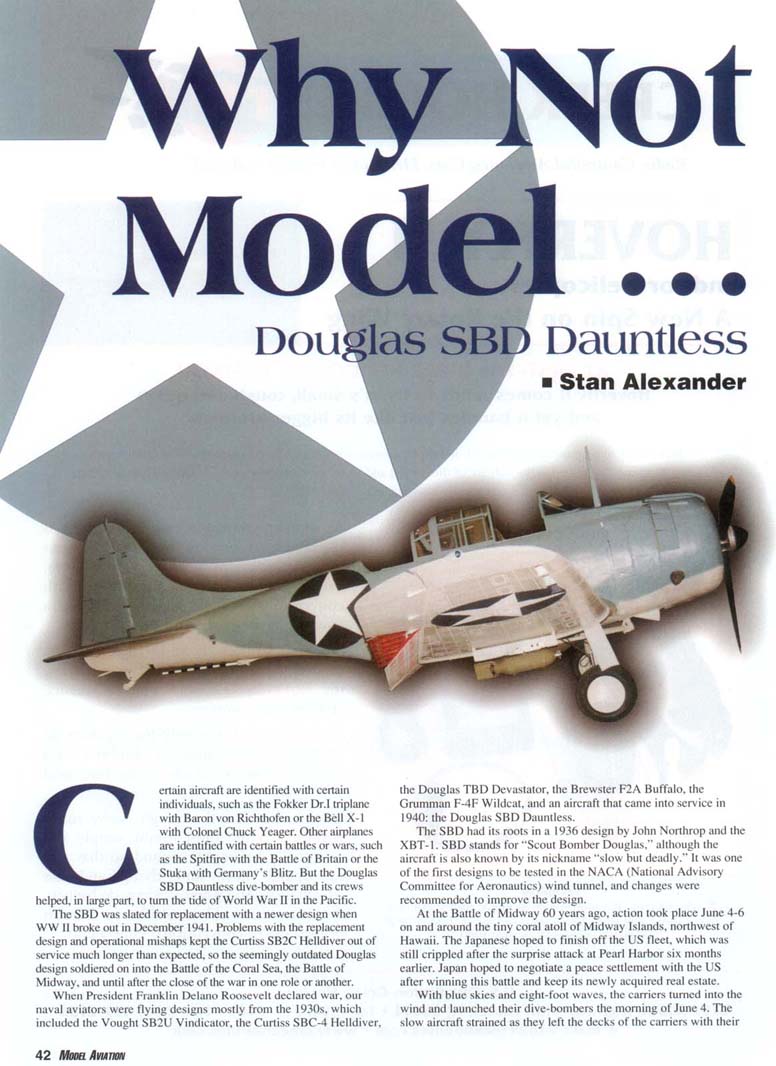
Why Not Model ...
Douglas SBD Dauntless
Stan Alexander
Certain aircraft are identified with certain individuals, such as the Fokker Dr.I triplane with Baron von Richthofen or the Bell X-1 with Colonel Chuck Yeager. Other airplanes are identified with certain battles or wars, such as the Spitfire with the Battle of Britain or the Stuka with Germany's Blitz. The Douglas SBD Dauntless dive-bomber and its crews helped, in large part, to turn the tide of World War II in the Pacific.
The SBD was slated for replacement with a newer design when World War II broke out in December 1941. Problems with the replacement design and operational mishaps kept the Curtiss SB2C Helldiver out of service much longer than expected, so the seemingly outdated Douglas design soldiered on into the Battle of the Coral Sea, the Battle of Midway, and until after the close of the war in one role or another.
When President Franklin Delano Roosevelt declared war, our naval aviators were flying designs mostly from the 1930s, which included the Vought SB2U Vindicator, the Curtiss SBC-4 Helldiver, the Douglas TBD Devastator, the Brewster F2A Buffalo, the Grumman F4F Wildcat, and an aircraft that came into service in 1940: the Douglas SBD Dauntless.
The SBD had its roots in a 1936 design by John Northrop and the XBT-1. SBD stands for "Scout Bomber Douglas," and the aircraft was also nicknamed "Slow But Deadly." It was one of the first designs to be tested in the NACA (National Advisory Committee for Aeronautics) wind tunnel; changes were recommended to improve the design.
At the Battle of Midway (June 4–6, 1942), action took place on and around the tiny coral atoll of Midway Islands, northwest of Hawaii. The Japanese hoped to finish off the U.S. fleet, which was still crippled after the surprise attack at Pearl Harbor six months earlier. With blue skies and eight-foot waves, the carriers turned into the wind and launched their dive-bombers the morning of June 4. The slow SBDs strained as they left the decks of the carriers with their pilots, gunners, and heavy bomb loads destined for the Japanese carriers and task force.
When the U.S. squadrons spotted the Japanese fleet, they began their attack runs. Pilots reduced engine rpm, set flaps and dive brakes, checked the target again, and looked for fighters one more time. Then it was time to follow the leader into the 70° dive. Committed at this point, pilots hung in their harnesses with the Japanese carrier decks in their sights. Each pilot had to hit those man-made "meatball" targets, pull out of the dive without blacking out, and scoot home. That scene was repeated several times during the battle as pilots found and attacked the enemy.
Midway was a turning point in World War II and a defining moment in U.S. naval history: our forces tactically and strategically defeated a task force that had destroyed much of the Pacific fleet at Pearl Harbor. The Japanese must have wondered what had happened to cause such a turn of events. Our armed forces' bravery in the Pacific, superior intelligence, very old torpedo bombers, and a dive-bomber that was scheduled to be replaced helped change the course of history. Loved by its crews and feared by the enemy, the SBD proved to be one of the best dive-bombers of WWII by its operational record.
The U.S. Navy, the Army Air Forces, and the Marines operated the aircraft during the war. After WWII it was also used by allies, including France. The SBD was responsible for more enemy tonnage sunk than any other aircraft in WWII and is credited with shooting down 138 enemy aircraft.
The SBD was a low-wing, metal-covered monoplane with retractable landing gear. Like other dive-bombers of that era, the cockpit had a second seat facing rearward; it initially had one .30-caliber machine gun in the rear, later upgraded to two .30-caliber guns. The SBD had two forward-firing .50-caliber machine guns to complement its offensive armament.
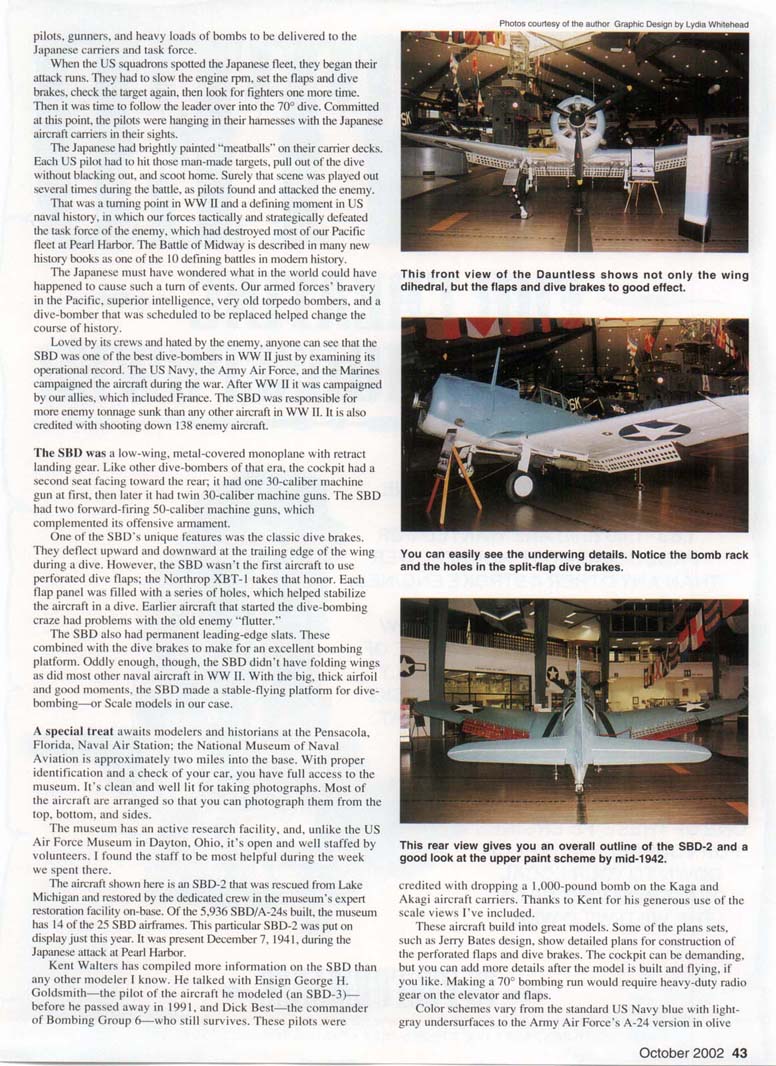
One of the SBD's unique features was its classic dive brakes. They deflect upward and downward at the trailing edge of the wing during a dive. The SBD wasn't the first aircraft to use perforated dive flaps—the Northrop XBT-1 takes that honor—but each flap panel on the SBD was filled with a series of holes that helped stabilize the aircraft in a dive. Earlier dive-bombers had problems with control "flutter," which these features addressed.
The SBD also had permanent leading-edge slats. These, combined with the dive brakes, made an excellent bombing platform. Oddly, the SBD did not have folding wings like most other naval aircraft in WWII. With a big, thick airfoil and good moments, the SBD made a stable-flying platform for dive-bombing—or for scale models.
A special treat awaits modelers and historians at the Naval Air Station Pensacola, Florida: the National Museum of Naval Aviation is approximately two miles into the base. With proper identification and a check of your car, you have full access to the museum. It's clean and well lit for taking photographs. Most of the aircraft are arranged so that you can photograph them from the top, bottom, and sides. The museum has an active research facility, and unlike the U.S. Air Force Museum in Dayton, Ohio, it's open and well staffed by volunteers. I found the staff to be most helpful during the week we spent there.
The aircraft shown here is an SBD-2 that was rescued from Lake Michigan and restored by the museum's expert restoration facility on base. Of the 5,936 SBD/A-24s built, the museum has 14 of the 25 SBD airframes. This particular SBD-2 was put on display in 1997 and was present December 7, 1941, during the Japanese attack at Pearl Harbor.
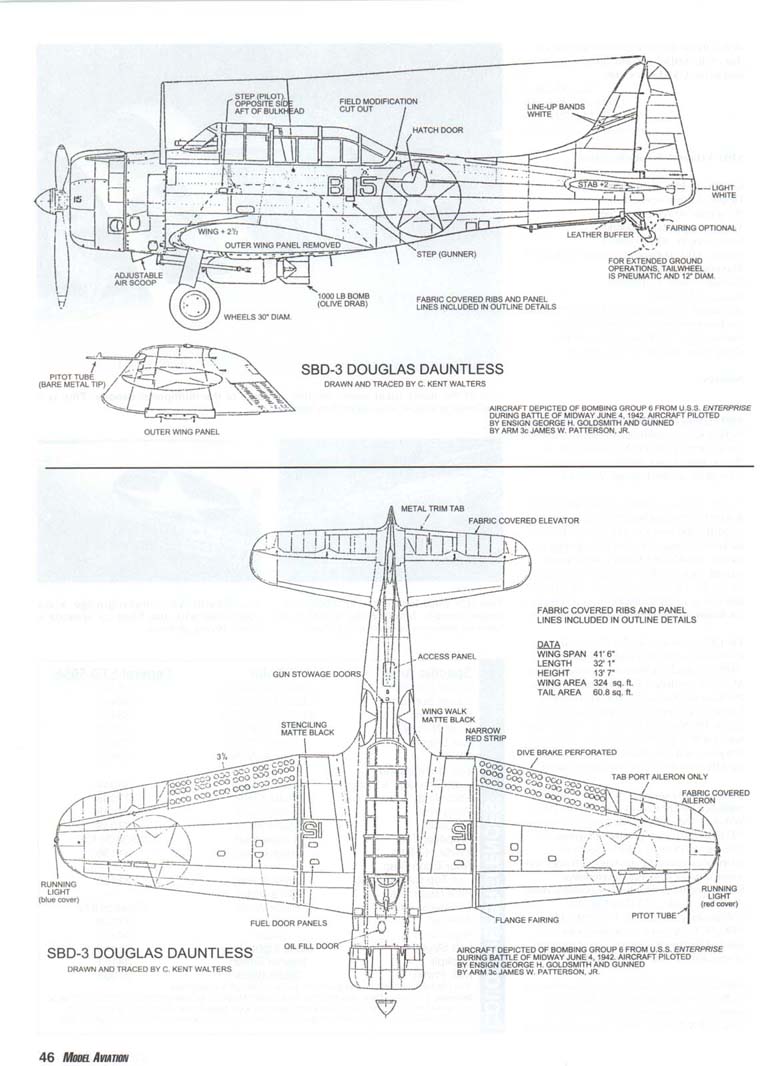
Kent Walters has compiled more SBD information than any other modeler I know. He talked with Ensign George H. Goldsmith—the pilot of the SBD-3 he modeled—before Goldsmith passed away in 1991, and with Dick Best—the commander of Bombing Group 6—who still survives. These pilots were credited with dropping 1,000-pound bombs on the Kaga and Akagi aircraft carriers. Thanks to Kent for his generous use of the scale views included here.
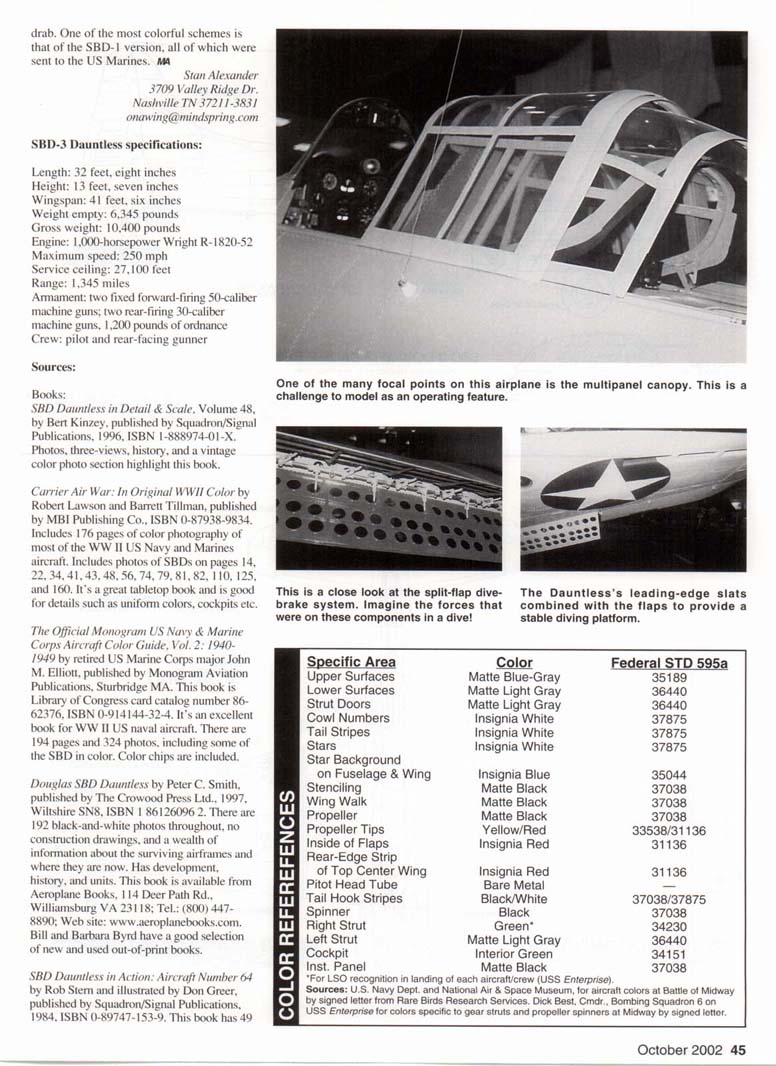
These aircraft build into great models. Some plan sets, such as those by Jerry Bates, show detailed construction for the perforated flaps and dive brakes. The cockpit can be demanding, but you can add more details after the model is built. Modeling a 70° bombing run would require heavy-duty rigging on the elevator and flaps.
Color schemes vary from the standard U.S. Navy blue with light-gray undersurfaces to the Army Air Forces' A-24 version in olive drab. One of the most colorful schemes is that of the SBD-1 version; all SBD-1s were assigned to the U.S. Marines.
Stan Alexander 3709 Valley Ridge Dr Nashville, TN 37211-3831 onawing@mindspring.com
SBD-3 Dauntless specifications:
- Length: 32 feet, 8 inches
- Height: 13 feet, 7 inches
- Wingspan: 41 feet, 6 inches
- Wing area: 324 sq. ft.
- Tail area: 60.8 sq. ft.
- Weight (empty): 6,345 pounds
- Gross weight: 10,400 pounds
- Engine: 1,000-horsepower Wright R-1820-52
- Maximum speed: 250 mph
- Service ceiling: 27,100 feet
- Range: 1,345 miles
- Armament: two fixed forward-firing .50-caliber machine guns; two rear-firing .30-caliber machine guns; up to 1,200 pounds of ordnance
- Crew: pilot and rear-facing gunner
Sources
Books and publications:
- SBD Dauntless in Detail & Scale, Volume 48, by Bert Kinzey. Squadron/Signal Publications, 1996. ISBN 1-888974-01-X. Photos, three-views, history, and a vintage color photo section.
- Carrier Air War: In Original WWII Color by Robert Lawson and Barrett Tillman. MBI Publishing Co. ISBN 0-87938-983-4. 176 pages of color photography; includes SBD photos on multiple pages.
- The Official Monogram U.S. Navy & Marine Corps Aircraft Color Guide, Vol. 2: 1940–1949 by John M. Elliott. Monogram Aviation Publications. Library of Congress card number 86-62376. ISBN 0-914144-32-4. 194 pages, 324 photos, color chips included.
- Douglas SBD Dauntless by Peter C. Smith. The Crowood Press Ltd., 1997. ISBN 1-861269-62-2. 192 black-and-white photos; development, history, units, and surviving airframes.
- SBD Dauntless in Action: Aircraft Number 64 by Rob Stem, illustrated by Don Greer. Squadron/Signal Publications, 1984. ISBN 0-89747-153-9. 49 pages, including line drawings, black-and-white photos, and color side views.
- U.S. Navy Dive and Torpedo Bombers of WWII by Barrett Tillman and Robert L. Lawson. BAI Publishers. ISBN 0-7603-0959-0. 128 pages; includes a chapter dedicated to the SBD and other dive/torpedo bombers.
Other references:
- National Museum of Naval Aviation Aircraft Collection. Produced by the Naval Aviation Museum Foundation. Available from the Flightdeck Museum Shop at NAS Pensacola; call (800) AIR-NAVY. The Douglas SBD is featured on page 19. Museum website: www.naval-air.org/museum_info/museum_info.asp.
- Photo Documentation: Bob’s Aircraft Documentation, 3114 Yukon Ave., Costa Mesa, CA 92626. Tel.: (714) 979-8058; Fax: (714) 979-7279. Bob Banta has Foto Paks for SBD-3, -4, and -5, interior and instrument Foto Paks, and three-views.
- Scale Plans & Photo Service, 3209 Madison Ave., Greensboro, NC 27403. Tel./Fax: (336) 292-5239.
- Aeroplane Books (for out-of-print titles): Aeroplane Books, 114 Deer Path Rd., Williamsburg, VA 23188; Tel.: (800) 447-8890; www.aeroplanebooks.com.
Color References
Specific Area — Color — Federal STD 595a
- Upper Surfaces — Matte Blue-Gray — 35189
- Lower Surfaces — Matte Light Gray — 36440
- Strut Doors — Matte Light Gray — 36440
- Cowl Numbers — Insignia White — 37875
- Tail Stripes — Insignia White — 37875
- Stars — Insignia White — 37875
- Star Background on Fuselage & Wing — Insignia Blue — 35044
- Stenciling — Matte Black — 37038
- Wing Walk — Matte Black — 37038
- Propeller — Matte Black — 37038
- Propeller Tips — Yellow / Red — 33538 / 31136
- Inside of Flaps — Insignia Red — 31136
- Rear-Edge Strip of Top Center Wing — Insignia Red — 31136
- Pitot Head Tube — Bare Metal
- Tail Hook Stripes — Black / White — 37038 / 37875
- Spinner — Black — 37038
- Right Strut — Green* — 34230
- Left Strut — Matte Light Gray — 36440
- Cockpit — Interior Green — (code as shown)
- Instrument Panel — Matte Black — 37038
*Right strut painted green for LSO recognition during carrier landings (USS Enterprise).
Sources: U.S. Navy Department and National Air & Space Museum; aircraft colors at the Battle of Midway verified by letter from Rare Birds Research Services. Colors for gear struts and propeller spinners at Midway verified by signed letter from Dick Best, Cmdr., Bombing Squadron 6, USS Enterprise.
Drawing notes (from C. Kent Walters)
Aircraft depicted: SBD-3 Douglas Dauntless of Bombing Group 6 from USS Enterprise during the Battle of Midway, June 4, 1942. Aircraft piloted by Ensign George H. Goldsmith and gunned by ARM3c James W. Patterson, Jr.
Callouts and features:
- STEP (PILOT) — opposite side aft of bulkhead
- FIELD MODIFICATION — cut out
- HATCH DOOR
- LINE-UP BANDS — white
- WING incidence +2½°
- OUTER WING PANEL removed (in drawing)
- STEP (GUNNER)
- 1,000-lb bomb (olive drab)
- WHEELS 30" diameter
- FABRIC-COVERED ribs and panel lines included in outline details
- ADJUSTABLE AIR SCOOP
- PITOT TUBE (bare metal tip)
- OUTER WING PANEL
- A metal trim tab
- FABRIC-COVERED elevator
- ACCESS PANEL
- GUN STOWAGE DOORS
- STENCILING — matte black
- WING WALK — matte black
- NARROW red strip
- DIVE BRAKE — perforated
- TAB — port aileron only
- FABRIC-COVERED aileron
- RUNNING LIGHT (blue cover)
- RUNNING LIGHT (red cover)
- FUEL DOOR PANELS
- OIL FILL DOOR
- FLANGE FAIRING
Drawing data:
- Wingspan: 41' 6"
- Length: 32' 1"
- Height: 13' 7"
- Wing area: 324 sq. ft.
- Tail area: 60.8 sq. ft.
Drawn and traced by C. Kent Walters.
Kits, plans & services
- Diels Engineering, Inc., Box 263, Amherst, OH 44001. E-mail: dielsengr@kellnet.com. Offers a 20%-inch-span free-flight rubber model kit. Many kit-cutting businesses offer pre-cut wood kits; some offer fiberglass fuselages.
- Jerry Bates Plans, 102 Glenwood St., Mobile, AL 36606. Tel.: (334) 478-6720. Web: www.scaleaero.com/jerrybates.htm. Two sets of plans for the SBD: 1/5.5 scale (85" span) and 1/5 scale (100" span), with multiviews and documentation. Details show flap and dive-brake construction and leading-edge slats.
- Bob Holman Plans, Box 741, San Bernardino, CA 92402. Tel.: (909) 885-3959; Fax: (909) 889-9307. E-mail: bhplans@aol.com. Sets include a 69-inch wingspan and a 73-inch-span model. Kent Walters has won the Masters several times building models from these modified plans.
- Photo packs and three-views: Scale Plans & Photo Service (Greensboro, NC) and Bob’s Aircraft Documentation (Costa Mesa, CA) provide interior and instrument Foto Paks and three-views. Contact details above in Sources.
End of article.
Transcribed from original scans by AI. Minor OCR errors may remain.

