
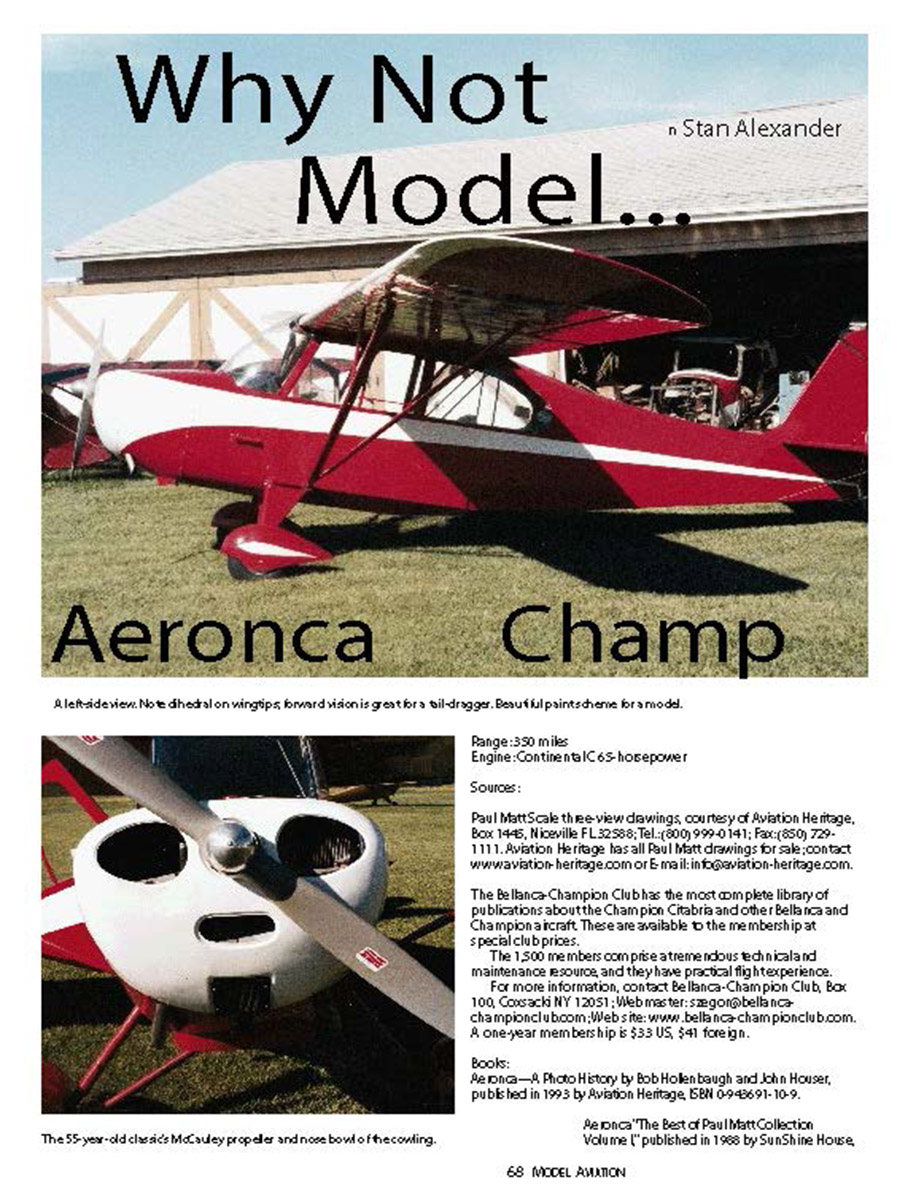
Why Not Model... Aeronca Champ
by Stan Alexander
Quick specs
- Range: 350 miles
- Engine: Continental C65 — 65 horsepower
Sources
Organizations
- Aviation Heritage
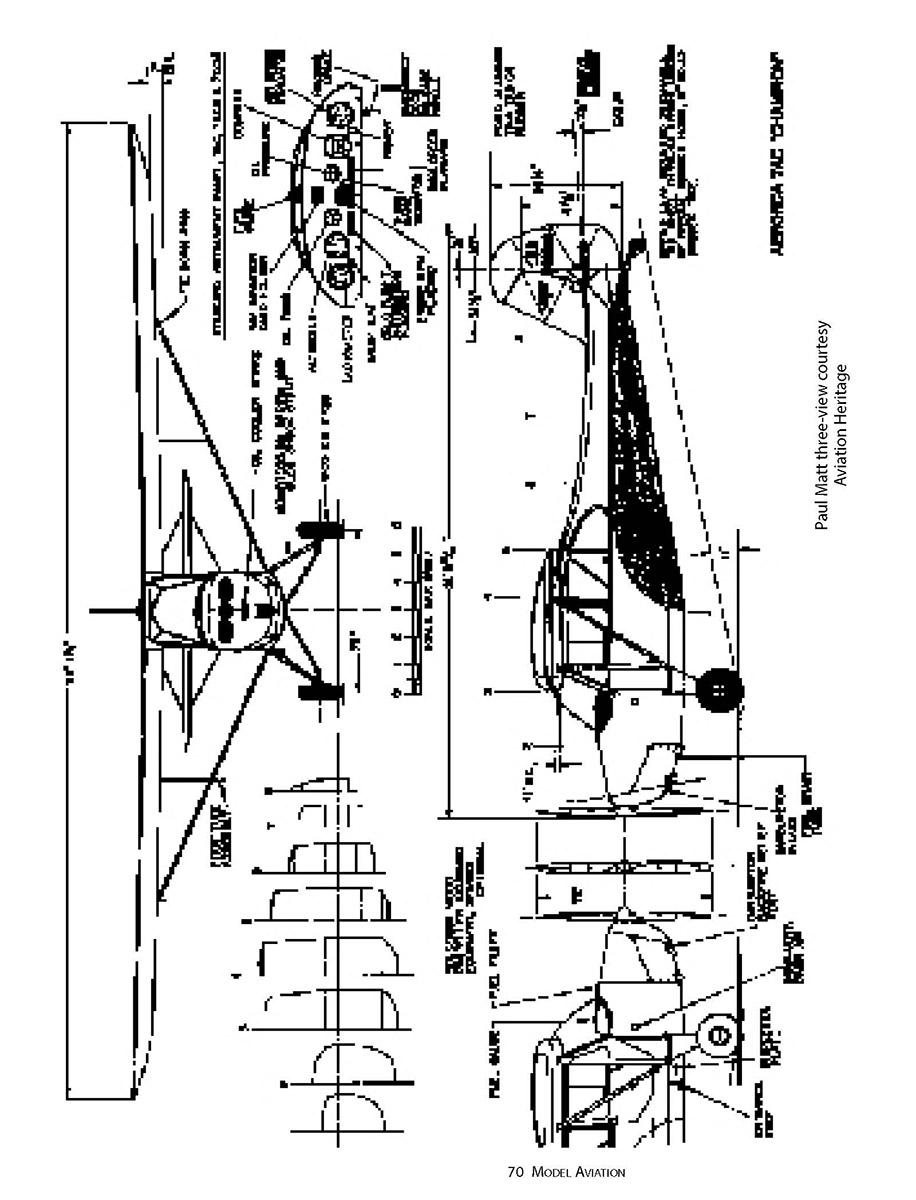
- Paul Matt scale three-view drawings, courtesy of Aviation Heritage.
- Address: Box 1465, Niceville, FL 32588
- Tel: (800) 999-0141; Fax: (850) 729-1111
- Web: www.aviation-heritage.com
- Email: info@aviation-heritage.com
- Bellanca-Champion Club
- Maintains a comprehensive library on the Champion, Citabria, and other Bellanca/Champion aircraft; publications available to members at special club prices.
- Membership: one year $33 US, $41 foreign.
- Contact: Bellanca-Champion Club, Box 100, Coeymans, NY 12051
- Webmaster: szegon@bellanca-championclub.com
- Web: www.bellanca-championclub.com
Books
- Aeronca — A Photo History by Bob Hollenbaugh and John Houser, Aviation Heritage, 1993. ISBN 0-964691-10-9.
- Aeronca: The Best of Paul Matt Collection Volume II, Sunshine House (now Aviation Heritage), 1988. ISBN 0-943691-02-8.
Magazines
- Air Progress, September 1984, p. 74 — article and color photos.
- Sport Aviation, June 1997, pp. 28–32 — "The Aeronca Champ" by Budd Davidson; article, color photos, comparison ratings.
Documentation sources
- Scale Plans & Photo Service
- Address: 3209 Madison Ave., Greensboro, NC 27403
- Tel/Fax: (336) 292-5239
- Offers 14 different photo packs and Champ three-views.
- Scale Model Research
- Address: 3114 Yukon Ave., Costa Mesa, CA 92626
- Tel: (714) 979-8058; Fax: (714) 979-7279
- Offers 27 different photo packs and three-view documentation.
Kits
- Hobby Lobby
- Address: 5614 Franklin Pike Cir., Brentwood, TN 37027
- Tel: (615) 373-1444
- Email: 74164.2423@compuserve.com
- Web: www.hobby-lobby.com
- Precedent 1/4-scale Aeronca Champ kit: 105-inch wingspan, 65-inch length, three-section wing; recommended 4-stroke power.
- Ikon N'Wst
- Address: 3806 Chase Rd., Post Falls, ID 83854
- Tel: (800) 327-7198
- Champ kit: 106-inch wingspan, 65-inch length, ~15 pounds. Company describes it as a "really large stick model." Catalog $5.
Plans
- Bob Holman Plans
- Box 741, San Bernardino, CA 92402
- Tel: (909) 885-3959; Email: BHPLANS@aol.com
- Nexus Publications plans for the Aeronca Champ — RC 1132, 71-inch span.
- Bill Northrop's Plan Service
- Address: 2019 Doral Ct., Henderson, NV 89014-1075
- Tel: (702) 896-2162
- Plans for the Champ — 71-inch span by Cal Smith, two-inch scale.
- R/C Modeler magazine
- Box 487, Sierra Madre, CA 91025
- Telephone orders only: (800) 523-1736
- Plans for a 1/3-scale Champ with a 141-inch span, for a .40–.50cc engine.
- Flying Models magazine
- Box 700, Newton, NJ 07860-0700, Dept. 1437
- Tel: (800) 474-6995 for ordering plans.
- Has Paul Del Gatto 51-inch-span plan #CF-9 and Doc Mathews 52½-inch-span Aeronca Champ plan #CF585.
Article
After World War II, the civil aviation market experienced its largest growth to date. With returning military pilots, increased airline service, and many people eager to learn to fly, business opportunities seemed endless. However, manufacturers quickly learned that new designs weren't as easy to sell as hoped—largely because ex-military aircraft were sold for less than $1,000.
First built in 1944 by the Aeronca Aircraft Corporation, the Champion was used in a variety of roles, much as Piper's J-3 Cub was. Aeronca built more than 10,000 Champions during the six-year span that it sold the little two-seater.
Most Champions were powered by 65-horsepower Continental engines. The earliest models lacked electrical systems and lights; later models could be purchased with additional upgrades. The first military order for the Champion was from the US Army Air Forces; later that same batch was sold to the newly created US Air Force. Those aircraft trained new pilots and were then turned over to Civil Air Patrol units to give students their first experience in an airplane.
The Champion is a natural for modelers—especially those who want a high-wing scale model other than a J-3 Cub. Color schemes are more varied with the Champion, since the stock scheme uses two hues (orange and yellow). Some Aeronca models have slightly more horsepower than the Cub. The two models' wingspans are almost the same (the Champion's is roughly one inch shorter), while the Cub's overall length is more than a foot longer than the Champion's.
Some modelers say the Champion looks "cubish"; if so, it's because the Cub and the Champion share similar construction: steel-tube frame and fabric covering. Even the landing gear has approximately the same track. Although the Cub has a true flat-bottom airfoil, the Champion came with an undercambered 1/4-inch (NACA 4412) airfoil.
Another difference is seating: the pilot or student can sit in the front seat of the Champion; this does not make a significant difference to the center of gravity. The center-of-gravity location is more critical to the aircraft's balance in most two-place aircraft.
Several models of the Champ (as it became widely known) were built, varying in optional equipment and engines. For those who want to try full-scale aviation, the Champ is an inexpensive civil aircraft option, with a typical price range of $12,000–$22,000. Those interested may also want to check out newer versions called Citabrias. The Citabria is one of the few 1930–1950–era aircraft still being produced with many modifications; it has been known for its aerobatic capabilities since the first examples came off the line. A new Citabria can cost around $100,000.
You are almost guaranteed to see several excellent examples of the Aeronca Champ at local EAA fly-ins or large national events such as AirVenture Oshkosh or Sun 'n Fun. A few Champs will look much the same as they did from the factory, but most will have different color schemes and owner customizations. Aircraft that still look original—even by judges' standards—usually place for trophies at these events.
Personal account — Dave McIlvaine's Champ
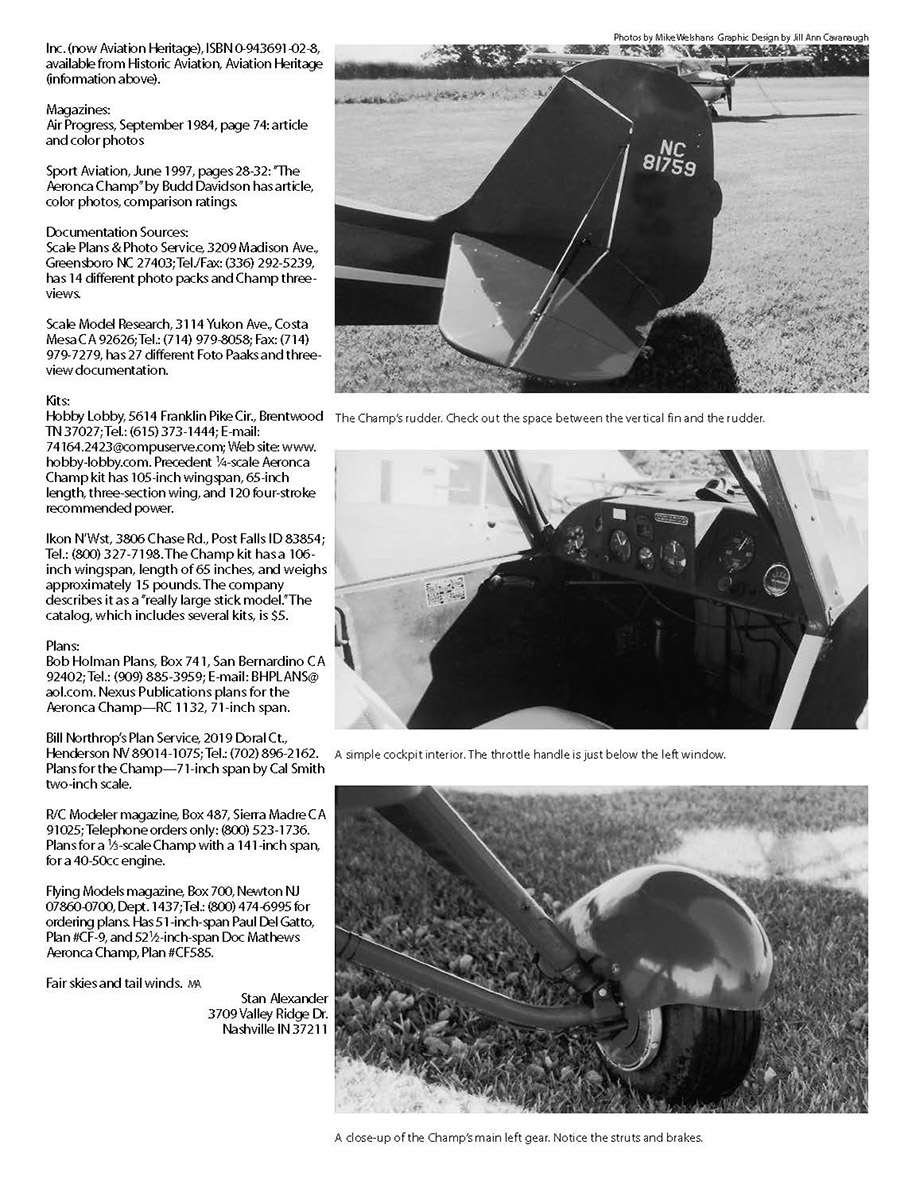
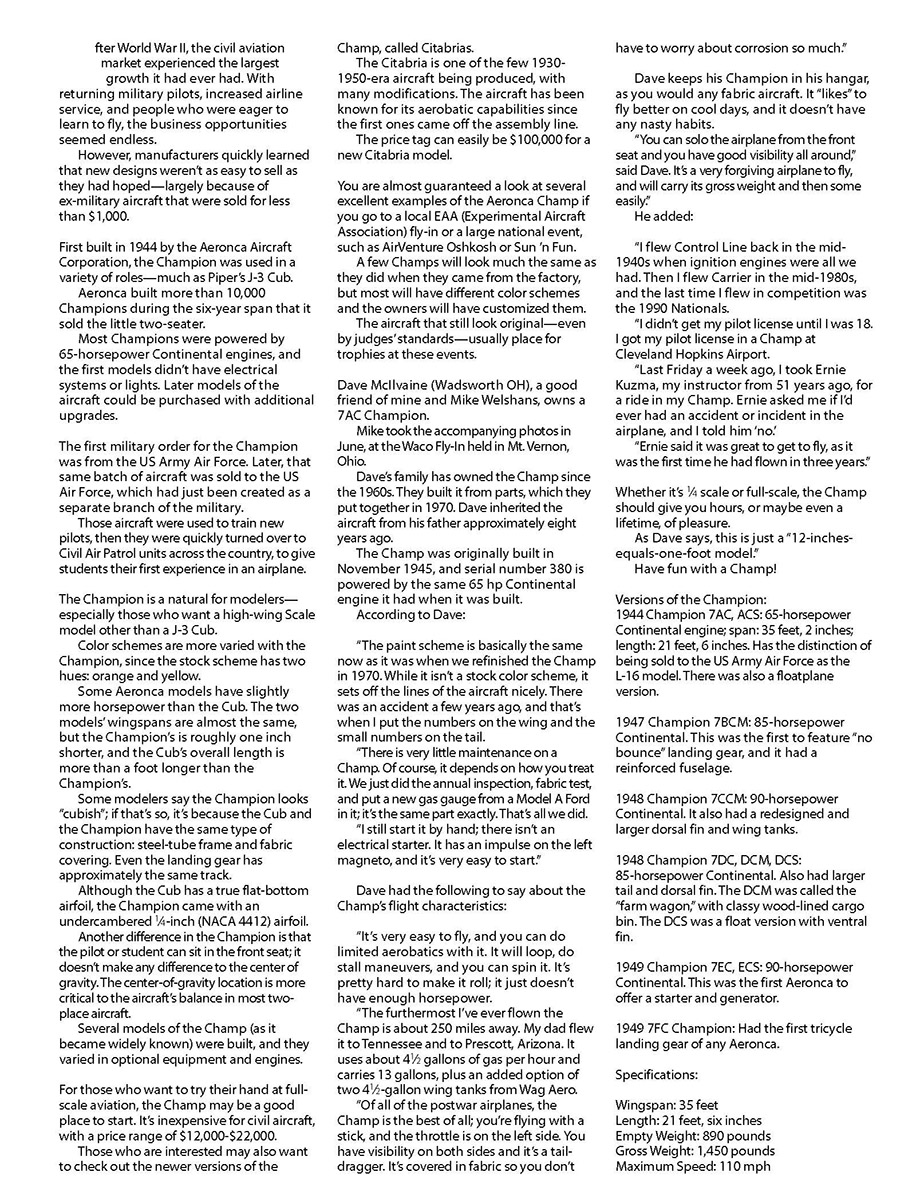
Dave McIlvaine (Wadsworth, OH), a friend of the author and Mike Welshans, owns a 7AC Champion. Mike took the accompanying photos in June at the Waco Fly-In in Mt. Vernon, Ohio. Dave's family has owned the Champ since the 1960s; they assembled it from parts in 1970. Dave inherited the aircraft from his father about eight years ago. The Champ was originally built in November 1945 (serial number 380) and is powered by the same 65 hp Continental engine it had when built.
From Dave:
- "The paint scheme is basically the same now as when we refinished the Champ in 1970. While it isn't a stock color scheme, it sets off the lines of the aircraft nicely. There was an accident a few years ago, and that's when I put the numbers on the wing and the small numbers on the tail.
- "There is very little maintenance on a Champ. Of course, it depends on how you treat it. We just did the annual inspection, fabric test, and put a new gas gauge from a Model A Ford in it; it's the same part exactly. That's all we did.
- "I still start it by hand; there isn't an electrical starter. It has an impulse on the left magneto, and it's very easy to start."
On flight characteristics, Dave said:
- "It's very easy to fly, and you can do limited aerobatics with it. It will loop, do stall maneuvers, and you can spin it. It's pretty hard to make it roll; it just doesn't have enough horsepower.
- "The farthest I've flown the Champ is about 250 miles away. My dad flew it to Tennessee and to Prescott, Arizona. It uses about 4½ gallons of gas per hour and carries 13 gallons, plus an option of two 4½-gallon wing tanks from Wag-Aero.
- "Of all the postwar airplanes, the Champ is the best of all; you're flying with a stick, and the throttle is on the left side. You have visibility on both sides and it's a taildragger. It's covered in fabric so you don't have to worry about corrosion so much."
Dave keeps his Champion in a hangar, as you would any fabric aircraft. It "likes" to fly better on cool days and doesn't have any nasty habits.
- "You can solo the airplane from the front seat and you have good visibility all around," Dave said. "It's a very forgiving airplane to fly, and will carry its gross weight and then some easily."
Dave added some personal background:
- "I flew control-line back in the mid-1940s when ignition engines were all we had. Then I flew carrier in the mid-1980s, and the last time I flew in competition was the 1990 Nationals.
- "I didn't get my pilot license until I was 18. I got my license in a Champ at Cleveland Hopkins Airport.
- "Last Friday a week ago, I took Ernie Kuzma, my instructor from 51 years ago, for a ride in my Champ. Ernie asked me if I'd ever had an accident or incident in the airplane, and I told him 'no.' Ernie said it was great to get to fly, as it was the first time he had flown in three years."
Whether it's 1/4 scale or full-scale, the Champ should give you hours, or even a lifetime, of pleasure. As Dave says, "It is just a '12-inches-equals-one-foot' model." Have fun with a Champ!
Fair skies and tail winds.
Stan Alexander 3709 Valley Ridge Dr. Nashville, IN 37211
Versions of the Champion
- 1944 Champion 7AC, ACS: 65-hp Continental; span 35 ft 2 in; length 21 ft 6 in. Sold to the US Army Air Forces as the L-16; floatplane version available.
- 1947 Champion 7BCM: 85-hp Continental. First to feature "no bounce" landing gear and a reinforced fuselage.
- 1948 Champion 7CCM: 90-hp Continental. Redesigned and larger dorsal fin and wing tanks.
- 1948 Champion 7DC, DCM, DCS: 85-hp Continental. Larger tail and dorsal fin. DCM was called the "farm wagon" with a wood-lined cargo bin; DCS was a float version with ventral fin.
- 1949 Champion 7EC, ECS: 90-hp Continental. First Aeronca to offer a starter and generator.
- 1949 7FC Champion: First Aeronca with tricycle landing gear.
Specifications
- Wingspan: 35 feet
- Length: 21 feet 6 inches
- Empty weight: 890 pounds
- Gross weight: 1,450 pounds
- Maximum speed: 110 mph
Transcribed from original scans by AI. Minor OCR errors may remain.

