
Why Not Model... Fairchild PT-19
by Stan Alexander
It seems as though we have more trainer-type aircraft than almost any other. In the 1930s, a variety of biplanes were used for training military and civil pilots. During the late 1930s, Fairchild Aircraft Division realized there was a need for a low-wing monoplane trainer.
At that time, biplanes such as the Stearman PT-13/PT-17 and the British de Havilland Tiger Moth were the standard. Trainers have evolved along with other aircraft during the last 65 years.
In the 1930s, the U.S. Army Air Forces (USAAF) had the primary trainer (PT)—the basic beginner’s aircraft. Then the student was transferred to the basic trainer (BT) series, which included aircraft such as the Vultee BT-13. The last series a student saw time in was the advanced trainer (AT) series, including the AT-6. The next stop was usually combat aircraft or further training for multiengine airplanes.
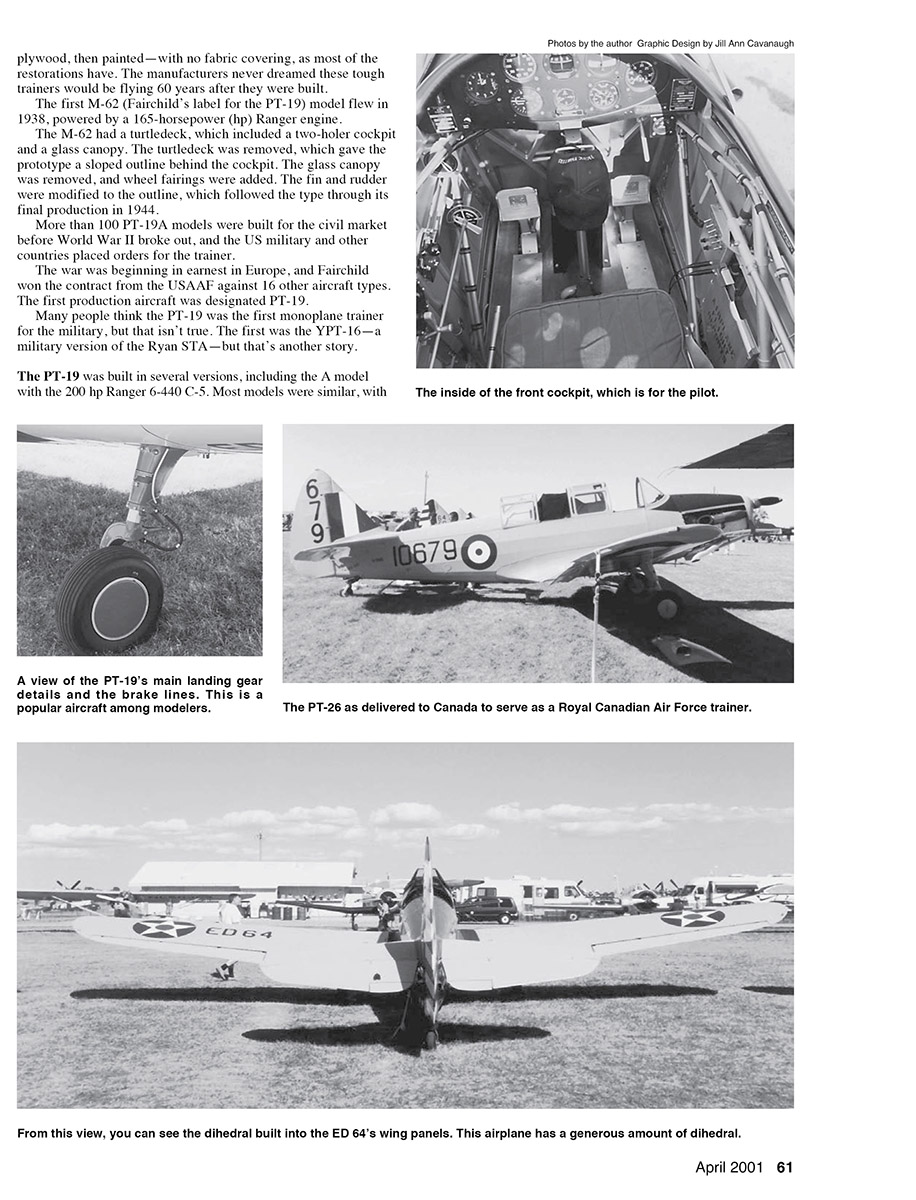
Our subject came into being in the late 1930s as a military and civil trainer. Originally designed for an inline engine, with wide-stance landing gear and generous dihedral built into the wing, the PT-19 was a significant departure from the normal biplane trainer types. The wide main landing gear made the PT-19 much easier to take off in and land—especially for inexperienced students.
Fairchild chief engineer Armand Thiebolt developed a design using conventional techniques and manufacturing processes. It allowed the company to build an inexpensive airframe that was easy and cheap to repair. The PT-19 has a steel-tube frame, wooden spars and ribs, and plywood covering. All the flying surfaces were covered with plywood and painted—there was no fabric covering.
The first M-62 (Fairchild’s label for the PT-19) prototype flew in 1938, powered by a 165-horsepower Ranger engine. The M-62 had a turtledeck, which included a two-place cockpit and a glass canopy. The turtledeck was removed, which gave the prototype a sloped outline behind the cockpit. The glass canopy was removed and wheel fairings were added. The fin and rudder were modified to a new outline, which remained through final production in 1944.
More than 100 PT-19A models were built for the civil market before World War II broke out, and the U.S. military and other countries placed orders for the trainer. The war was beginning in earnest in Europe, and Fairchild won the contract from the USAAF against 16 other aircraft types. The first production aircraft was designated PT-19. Many people think the PT-19 was the first monoplane trainer for the military, but that isn’t true—the first was the YPT-16 (a military version of the Ryan STA).
The PT-19 was built in several versions, the main differences being the engines. The A model used the 200 hp Ranger 6-440 C-5. The PT-19A was the second production model sold to the USAAF; more than 3,700 airframes were built by a variety of manufacturers. More PT-19As were built than any other variation.
The next model was the PT-23, produced because Ranger inline engines were in short supply. The PT-23 used a radial engine; Fairchild installed the 220 hp Continental R-670. The Royal Canadian Air Force needed trainers at the same time and required a closed canopy for operations in the far North. Fairchild responded with the PT-26, the same basic model as the A but fitted with a full greenhouse canopy.
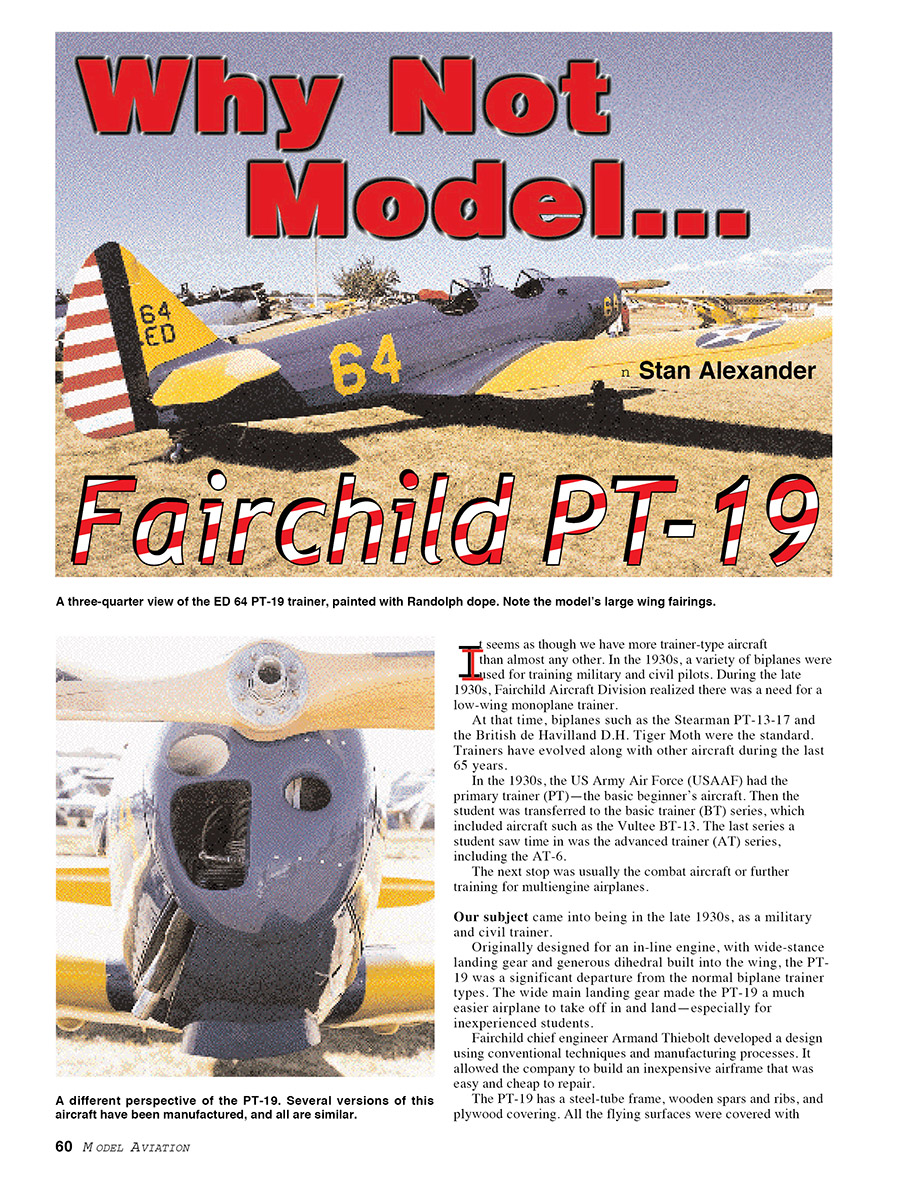
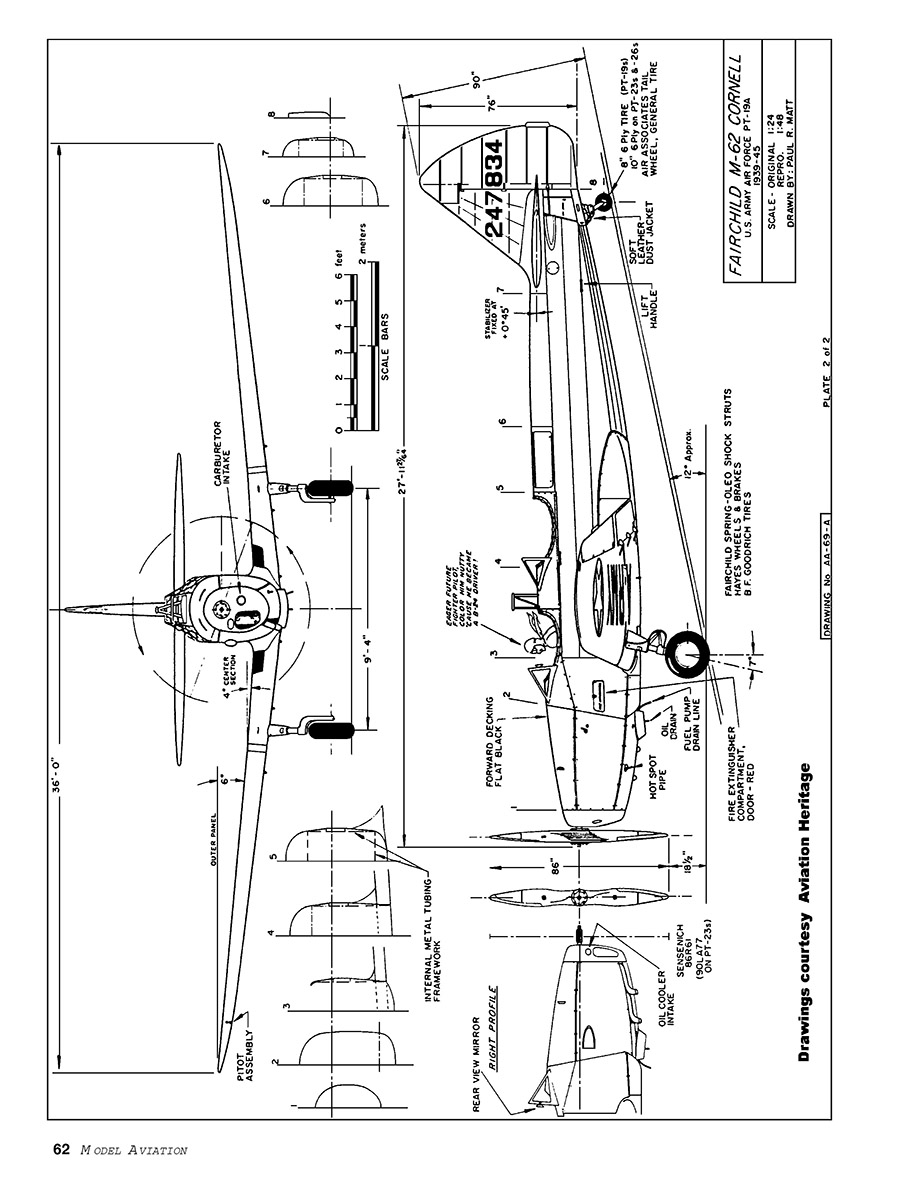
The aircraft shown in most of the photos is ED 64. I’ve photographed it several times at the Oshkosh (WI) fly-in. I’m sure it’s in better condition now than when it left the factory in 1942. This aircraft was delivered to the U.S. Army on January 24, 1942, at a cost of $9,823. After WWII ended, the trainers could be bought as military surplus for only about $750. Today the trainers go for approximately $60,000. I wish I could find one now for $750!
Many people don’t realize that civilians trained many pilots during WWII; this is one such story. World War II pilot and reserve Army officer Clarence Page had a farsighted vision: he thought he could best use his abilities to train pilots for the upcoming war. Clarence met with General H.H. “Hap” Arnold in Washington, D.C., and convinced the general that by training thousands of new pilots under contract to the Army he could make a greater contribution to the war effort than serving in a desk job.
The general agreed and told Page to locate a site. Cimarron Field came into focus as a training base; it was located just west of Oklahoma City on 240 acres of former wheat fields. Operated by the Oklahoma Air College under contract to the Army, it was one of many training bases across the country during this time. Cimarron Field received its first 50 PT-19s late in 1941, and another 50 in 1942—including the one photographed.
The aircraft at Cimarron Field carried the blue-and-yellow prewar training colors throughout their service at the school. The official USAAF training colors were changed to silver after May 30, 1942. The airplanes retained their prewar national markings, with the red circle in the star, throughout the life of the school. The aircraft carried the letters “ED” along with the line number (64) on the vertical fin and upper wing surfaces; “ED” denoted a civilian-operated flight school under contract with the Army.
ED 64 was later sold as surplus in Helena, Arkansas for $770.
The PT-19 has been a modelers’ favorite for decades. Can you remember one of your first control-line (CL) models? It was probably a Cox PT-19. Scale models? When you’re a kid, all that matters is that it flies well—thank goodness for all the rubber bands!
Almost all kit manufacturers have had a PT-19 design on their lists at one time or another. Why? Look at the wide-track main landing gear and nice, long moments. The wing has a great deal of dihedral and the aircraft is almost impossible to stall if a scale airfoil is used. Color schemes are numerous but usually simple for a scale model. There is more surface detail than meets the eye at first glance, and building a sport-scale or museum-scale model is possible without taking out a loan for as much as a new car.
This trainer series served as the cradle of pilots during WWII. So enjoy your slow-flying trainer that will do basic scale aerobatics as well as fly inverted!
Specifications
- Wingspan: 35 ft 11 in
- Length: 27 ft 8 in
- Height: 7 ft 9 in
- Weight: 2,450 lb
- Engine: Ranger L-440
Performance
- Maximum speed: 123 mph
- Cruising speed: 106 mph
- Range: 480 miles
- Ceiling: 16,000 ft
Sources
#### Drawings and research
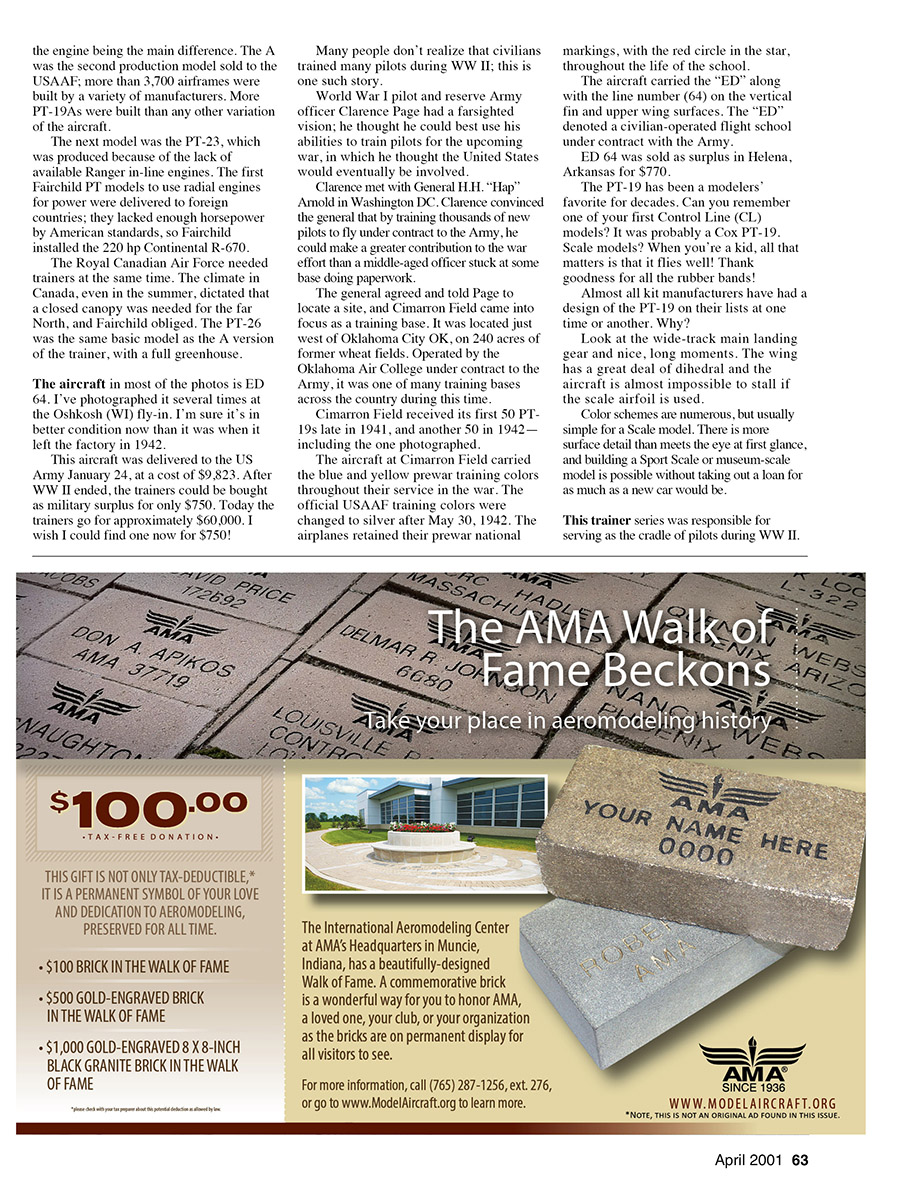
- Paul Matt scale airplane drawings courtesy of Aviation Heritage, Box 1445, Niceville FL 32588; Tel: (800) 999-0141; Fax: (850) 729-1111; E-mail: info@aviation-heritage.com; Web site: www.aviation-heritage.com. All Paul Matt three-views and research service are available from Aviation Heritage.
#### Books
- Fairchild Aircraft 1926–1987 by Kent A. Mitchell, published by Jonathan Thompson, 1997. Library of Congress 96-62018. ISBN 0-913322-04-0. A photo history of the manufacturer from the FC-1A to the T-46 jet trainer.
- Pilot Training Manual for the Army Models Fairchild PT-19, reprinted by Flying Books International, 1995. ISBN 0-911139-22-2. (Reprint of the original training manual.)
#### Magazines
- Air Progress, October/November 1963, p. 52: three-views plus details.
- Air Trails, Winter 1977, p. 67: color.
- Sport Aviation, February 1997, pp. 90–96: "A Passion For The PT" by Bud Davisson. Includes PT-19, PT-23, PT-26 with color photos.
- FlyPast, November 1998, pp. 40–42: "Out of the Barn." Color photos of PT-26 with canopy.
#### Photo documentation
- Scale Plans & Photo Service, 3209 Madison Ave., Greensboro NC 27403; Tel: (336) 292-5239. More than 15 photo packs available on the three types, three-views, 1/5-scale plans.
- Bob Banka's Aircraft Documentation, 3114 Yukon Ave., Costa Mesa CA 92626; Tel: (714) 979-8058; Fax: (714) 979-7279. More than 17 Foto Paaks for the PT-19, PT-23, and PT-26. Three-views available.
#### Plans
- Cleveland Model & Supply Company, Box 55962, Indianapolis IN 46205; Tel: (317) 257-7878; Fax: (317) 257-7877. Plans for the PT-19 and PT-26 in sizes from 1/2 to 1/4 scale (108-inch span).
- Scale Plans & Photo Service, 3209 Madison Ave., Greensboro NC 27403; Tel: (336) 292-5239. Plans for 1/6 scale (72.5-inch span) and 1/5 scale (87-inch span).
#### Kits
- Kyosho: .40-size ARF PT-19 with 61-inch wingspan.
- Dynaflite: PT-19 built-up kit with 89-inch wingspan, 11–13 lb, .20–.25 power.
- Horizon Hobbies (Hangar 9): ARF kit with 82-inch wingspan.
- House of Balsa: PT-19 kit for 50.5-inch span sport-scale model.
I'm sure this isn't all of them. MA
Stan Alexander 3709 Valley Ridge Dr. Nashville, TN 37211 onawang@mindspring.com
Transcribed from original scans by AI. Minor OCR errors may remain.

