
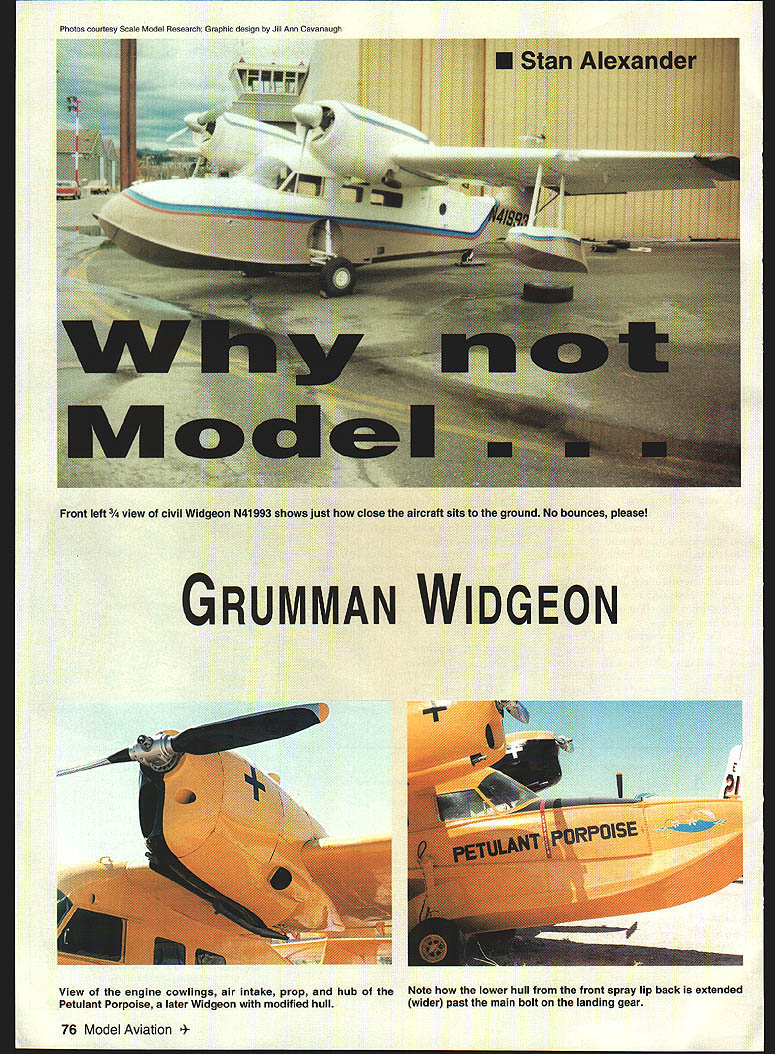
Why not Model: Grumman Widgeon
Stan Alexander
Introduction
Some aircraft company names immediately stand out, such as Boeing and North American in civil or military aviation. Other company names are identified with historical events, such as Supermarine with the Schneider Cup races or the Battle of Britain, or the Granville Brothers flying the Gee Bees in the National Air Races.
Our subject this month was built by Grumman Aircraft Engineering Company—a firm immediately identified with U.S. Naval Aviation.
Grumman background
Grumman started building floats for the Vought Corsair in 1930 after submitting a design proposal to the U.S. Navy. Grumman produced an incredible line of scouts, fighters, patrol aircraft, bombers, radar suppression aircraft, and a few models used as mail/supply aircraft for the fleet.
Many will remember the winning fighters in the Pacific battles of Midway, the Coral Sea, and the Marshall and Gilbert Islands. In many cases these tough aircraft flew through their own ships' flak to protect the fleet at all costs from kamikazes. The Wildcats and Hellcats racked up victories like few other aircraft ever did in battle, while safeguarding their pilots and bringing them back to the tiny bucking carrier decks in the vast Pacific.
Grumman amphibians — Goose and Widgeon
The Grumman Goose and the G-44 Widgeon are amphibians. According to Webster's, an amphibian is "an aircraft that can take off from or come down on either land or water" with the aid of retractable landing gear, usually mounted in the hull or attached to floats on the craft.
Grumman's first amphibian was a redesigned Loening XO2L in 1933. This XJF-1 was similar to the Loening aircraft but possessed superior performance and a Grumman trademark: folding landing gear into the main float. This type of retractable gear was used on many different Grumman aircraft.
The Widgeon was a smaller version of the Grumman JRF/Model G-21A Goose. The J4F Widgeon was originally designed to be a business commuter aircraft able to carry five passengers between Long Island and the business district of New York City. The larger Goose could only carry two more passengers than the Widgeon. Ten Widgeons were sold before the first one was produced.
Military service
After the United States was attacked by Japan, all of the production aircraft were requisitioned by the military. The Navy received most of them; other aircraft went to the Coast Guard, the Royal Navy, Canada, and Brazil.
- The Army Air Force received 21 OA-14s.
- The third production run of Widgeons went to the Coast Guard; one of these aircraft was credited with sinking U-166.
- In the Royal Navy Grumman's little Goose was known as the Gosling. These aircraft served throughout the entire war in antisubmarine coastal patrols.
After World War II most of the aircraft were reconverted to business and pleasure commuter use.
Design, engines, and variants
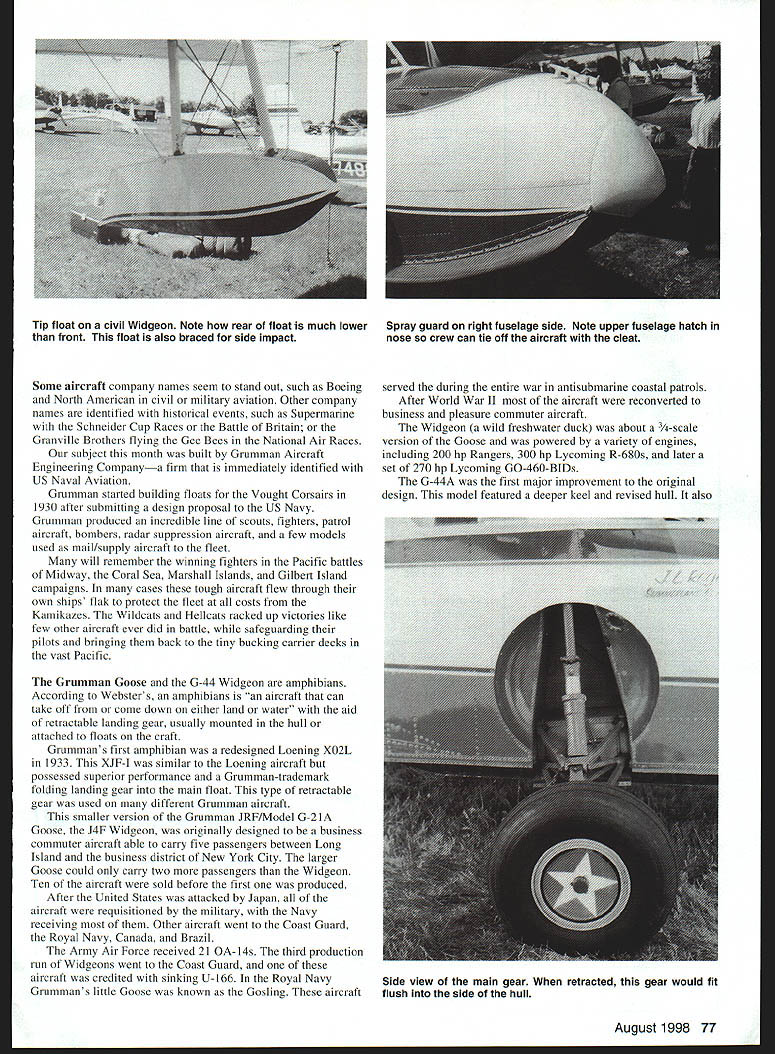
The Widgeon (a wild freshwater duck) was about a three-quarter-scale version of the Goose and was powered by a variety of engines, including 200 hp Rangers, 300 hp Lycoming R-680s, and later 270 hp Lycoming GO-460-BID engines. The G-44A was the first major improvement to the original design. This model featured a deeper keel and revised hull. It also received new power plants from Avco-Lycoming 90-435A engines; the last models of the type were called the Super Widgeon, powered by Avco-Lycoming 270 hp GO-460BiD engines. In this configuration the little amphibian could cruise at about 180 mph and had a range of 1,000 miles.
The cabin space, hull, and, very importantly, the fuel capacity were increased on later variants.
Main differences between the Goose and the Widgeon
- The Widgeon's wingspan was nine feet less than the Goose.
- The fuselage length was 7.5 feet less than the Goose.
- The Widgeon's wings have a comparatively more angular shape.
- The Widgeon was of all-metal construction; the ailerons were covered with fabric, and the hull was constructed with five watertight compartments.
- The Widgeon featured the "old style" (hand-crank) Grumman retractable landing gear for land operation.
With a production run totaling 317 aircraft, the Widgeon had the distinction of being the last nonmilitary aircraft produced by Grumman. This smaller version of the famous Grumman Goose served the country well during WWII before handing over many duties to the Goose and other types.
Modeling notes
If you are looking for a unique scale subject, the Widgeon offers options such as multiple engines mounted close to the wing root, flaps, retracts, and even the ability to depict bomb or depth-charge loads. For a water fly-in you would have a graceful, unique model to fly, as well as a good conversation piece among Grumman amphibian enthusiasts. If you like detailing a model you could add opening hatches and doors, dummy engines, cowl louvers, and much more.
G-44 Widgeon Specifications
- Wingspan: 40 feet
- Wing Area: 245 square feet
- Length: 31 feet 1 inch
- Height: 11 feet 5 inches
- Weight (Empty): 3,189 pounds
- Max. Weight: 4,500 pounds
- Maximum Speed: 153 mph
- Cruising Speed: 138 mph
- Ceiling: 14,600 feet
- Range: 920 miles
Photo documentation sources
- Bob Banska's Scale Model Research
3114 Yukon Ave., Costa Mesa, CA 92626 Tel.: (714) 979-8058, Fax: (714) 979-7279 Seven Foto-Paaks and three-views are available.
- Scale Plans and Photo Service
3209 Madison Ave., Greensboro, NC 27403 Tel./Fax: (910) 292-5239 Anne Pepino offers two photo paks on the Widgeon, both in civil color schemes, and three-views are available.
Other documentation sources
- Sport Aviation, November 1980, p. 66 (color photo).
- Wingspan #20, p. 2 (article, photos).
- American Aviation Historical Society Journal, Vol. 13, #2, p. 113.
- Ironworks—Grumman's Fighting Aeroplanes by Terry Treadwell. Motorbooks International. Library of Congress ISBN 0879384883.
Plans
- Sea-Clusion Aeronautics, Gene Falado
22W 070 Byron Ave., Addison, IL 60101 Quarter-scale, 120-inch wingspan (includes duplicate sheet for ribs and formers), $45; $42 plus $5 for shipping to the U.S. Write to Gene and include a large SASE for a complete list of scale floats, flying boats, amphibians, and other large aircraft.
Transcribed from original scans by AI. Minor OCR errors may remain.

