
Why Not Model... P-47
Stan Alexander
At a fly-in or scale meet, you usually see at least one P-47. Why?
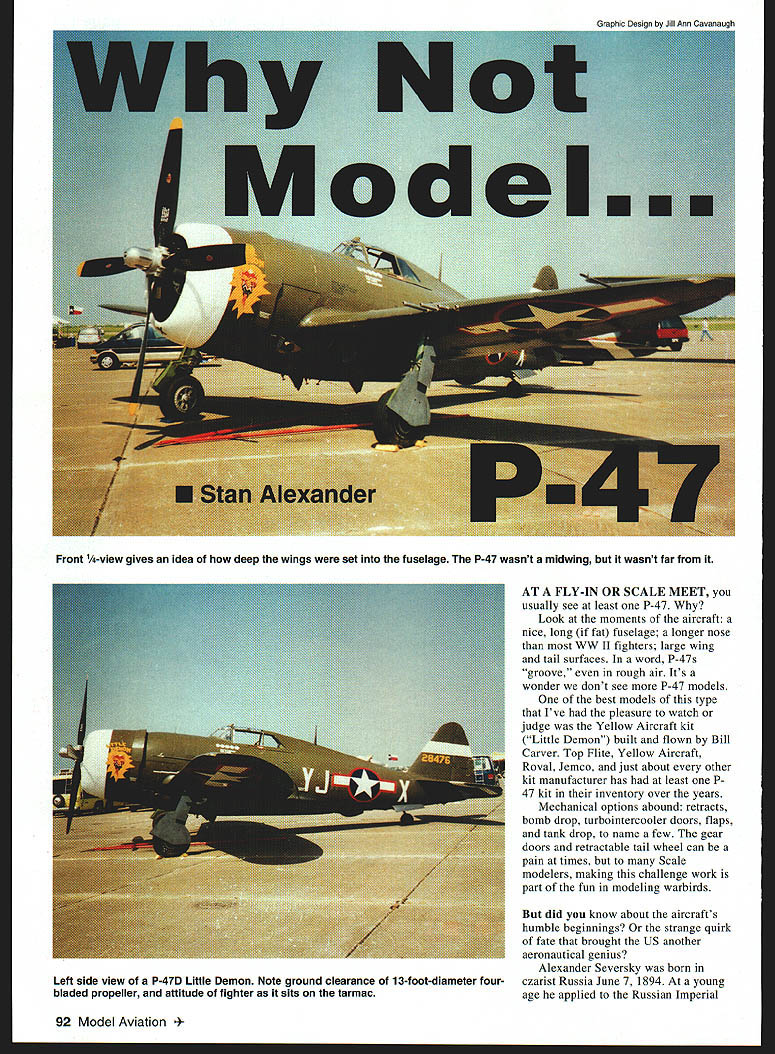
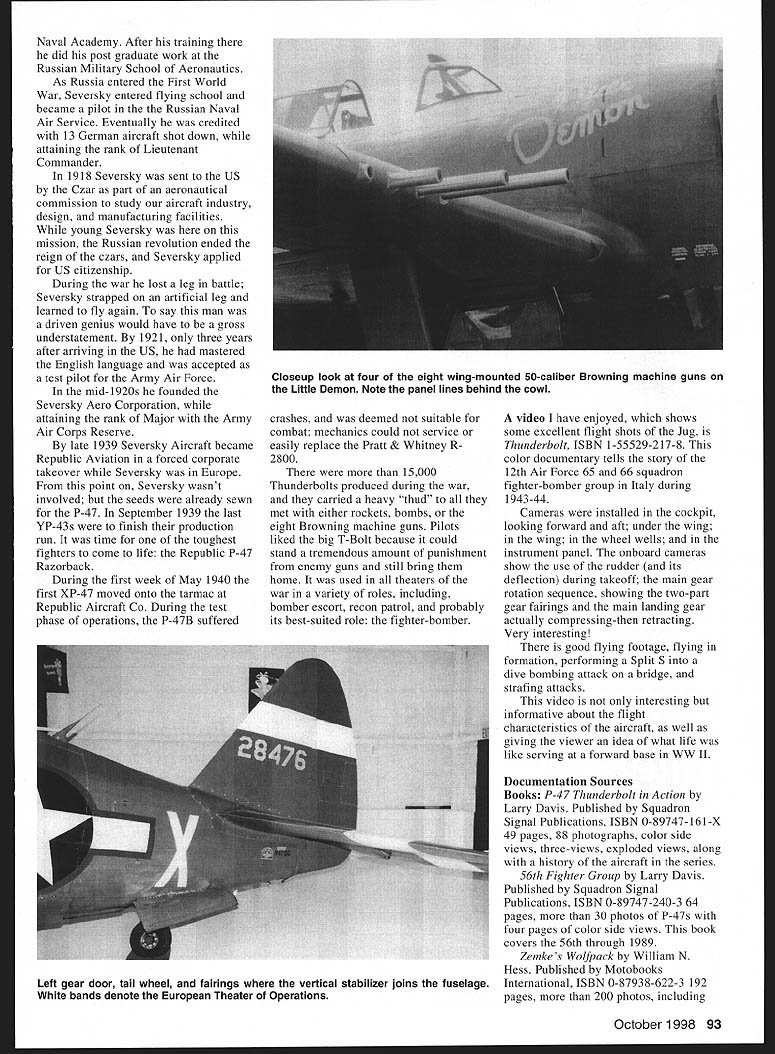
Look at the moments of the aircraft: a nice, long (if fat) fuselage; a longer nose than most WWII fighters; large wing and tail surfaces. In a word, P-47s "groove," even in rough air. It's a wonder we don't see more P-47 models.
One of the best models of this type that I've had the pleasure to watch or judge was the Yellow Aircraft kit ("Little Demon") built and flown by Bill Carver. Top Flite, Yellow Aircraft, Royal, Jemco, and just about every other kit manufacturer has had at least one P-47 kit in their inventory over the years.
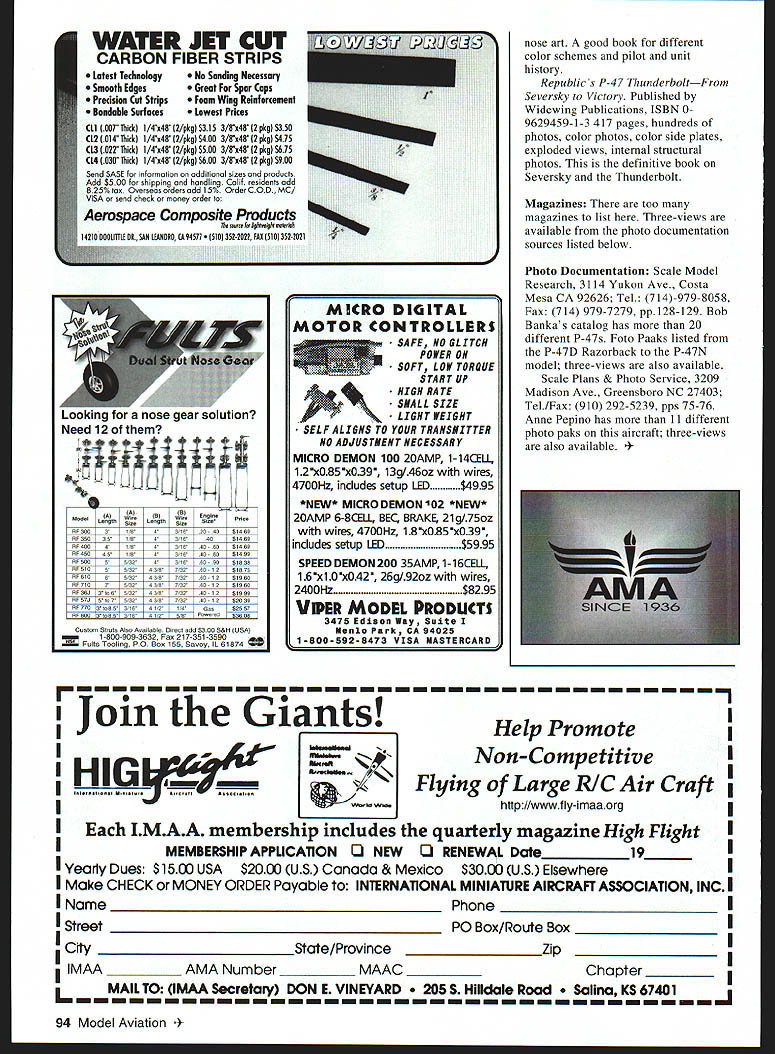
Mechanical options abound: retracts, bomb drop, turbo-intercooler doors, flaps, and tank drop, to name a few. The gear doors and retractable tail wheel can be a pain at times, but to many scale modelers, making these challenges work is part of the fun in modeling warbirds.
But did you know about the aircraft's humble beginnings? Or the strange quirk of fate that brought the U.S. another aeronautical genius?
Alexander Seversky was born in czarist Russia on June 7, 1894. At a young age he applied to the Russian Imperial Naval Academy and did postgraduate work at the Russian Military School of Aeronautics. As Russia entered the First World War, Seversky entered flying school and became a pilot in the Russian Naval Air Service. He was eventually credited with 13 German aircraft shot down and attained the rank of lieutenant commander.
In 1918 Seversky was sent to the U.S. as part of an aeronautical commission to study aircraft industry design and manufacturing facilities. While he was here the Russian Revolution ended the reign of the czars, and Seversky applied for U.S. citizenship. During the war he lost a leg in battle; he strapped on an artificial leg and learned to fly again. To say he was a driven genius would be a gross understatement.
By 1921, three years after arriving in the U.S., he had mastered English and accepted a test pilot post with the Army Air Service. In the mid-1920s he founded Seversky Aero Corporation and attained the rank of major in the Army Air Corps Reserve. In late 1939 Seversky Aircraft became Republic Aviation after a forced corporate takeover while Seversky was in Europe. From that point on Seversky wasn't involved, but the seeds were already sown for the P-47.
September 1939 saw the last YP-43s finish their production run. It was time for one of the toughest fighters to come to life: the Republic P-47 Razorback. During the first week of May 1940 the first XP-47 moved onto the tarmac at Republic Aircraft Co. During test-phase operations the P-47B suffered crashes and at one time was deemed unsuitable for combat because mechanics could not easily service or replace the Pratt & Whitney R-2800.
Ultimately, some 15,000 Thunderbolts were produced during the war. They carried heavy loads — rockets, bombs — and mounted eight Browning machine guns. Pilots liked the big T-Bolt because it could stand a tremendous amount of punishment and still bring you home. Used in theaters of war in a variety of roles — including bomber escort, reconnaissance patrol, and ground attack — it was probably best suited to the fighter-bomber role.
I've enjoyed some excellent flight shots of the Jug. Jug Thunderbolt (ISBN 1-55529-217-8), a color documentary, tells the story of the 12th Air Force's 65th and 66th Squadron fighter-bomber group in Italy during 1943–44. Cameras installed in the cockpit looking forward and aft, under the wing, in the wheel wells, and on the instrument panel show use of the rudder and its deflection during takeoff, the main-gear rotation sequence showing two-part gear fairings, and the main landing gear actually compressing then retracting. There is good flying footage of formation flying, performing Split-S dives, dive-bombing attacks, bridge strafing attacks, and more. The video is interesting and informative about the flight characteristics of the aircraft while giving the viewer an idea what life was like serving at a forward base in World War II.
Documentation Sources
Books
- P-47 Thunderbolt Action — Larry Davis. Squadron/Signal Publications. ISBN 0-89747-161-X. 49 pages, 88 photographs, color side views, three-views, exploded views, plus history of the aircraft.
- 56th Fighter Group — Larry Davis. Squadron/Signal Publications. ISBN 0-89747-240-3. 64 pages, 30 photos. Includes P-47 coverage with color side views.
- Zemke's Wolfpack — William N. Hess. Motorbooks International. ISBN 0-87938-622-3. 192 pages, 200 photos.
- Republic's P-47 Thunderbolt — From Seversky to Victory. Widewing Publications. ISBN 0-9629459-1-3. 417 pages, hundreds of photos, color side plates, exploded views, internal structural photos. Considered a definitive book on Seversky and the Thunderbolt.
Magazines: Too many to list here. Three-views are available from the photo documentation sources listed below.
Photo Documentation
- Scale Model Research, 3114 Yukon Ave., Costa Mesa, CA 92626. Tel: (714) 979-8058. Fax: (714) 979-7279. Bob Banka's catalog has more than 20 different P-47 photo paks, from the P-47D Razorback to the P-47N; three-views are also available.
- Scale Plans & Photo Service, 3209 Madison Ave., Greensboro, NC 27403. Tel/Fax: (910) 292-5239. Anne Pepino has more than 11 different photo paks on this aircraft; three-views are also available.
Transcribed from original scans by AI. Minor OCR errors may remain.

