
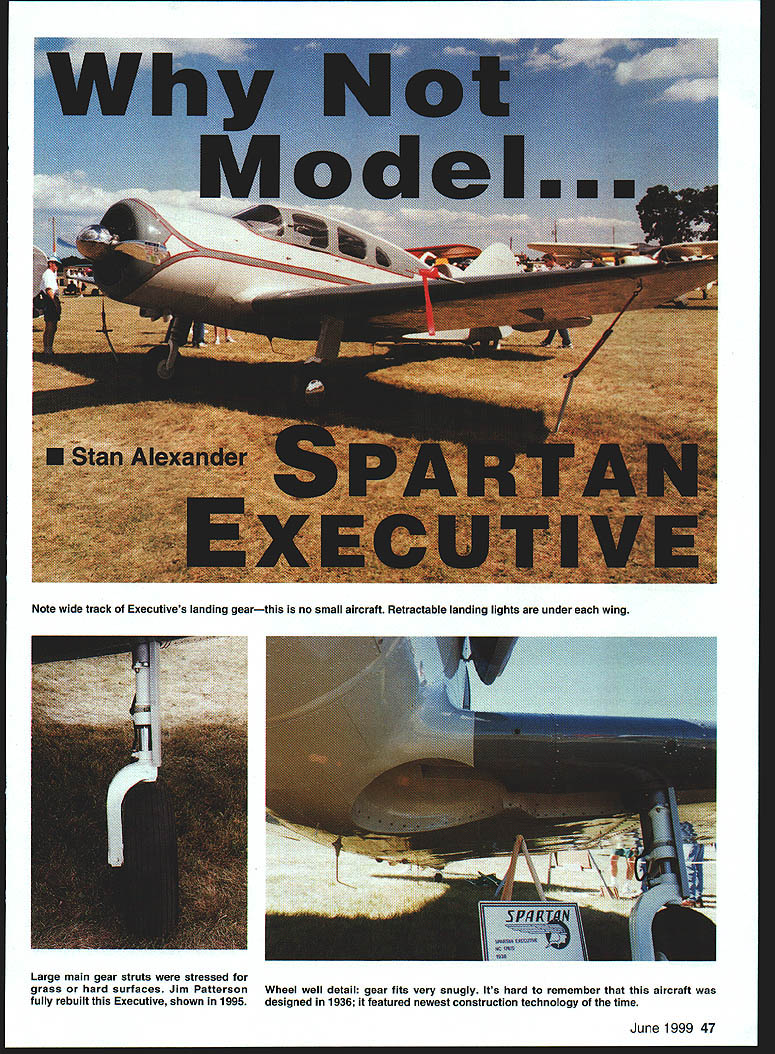
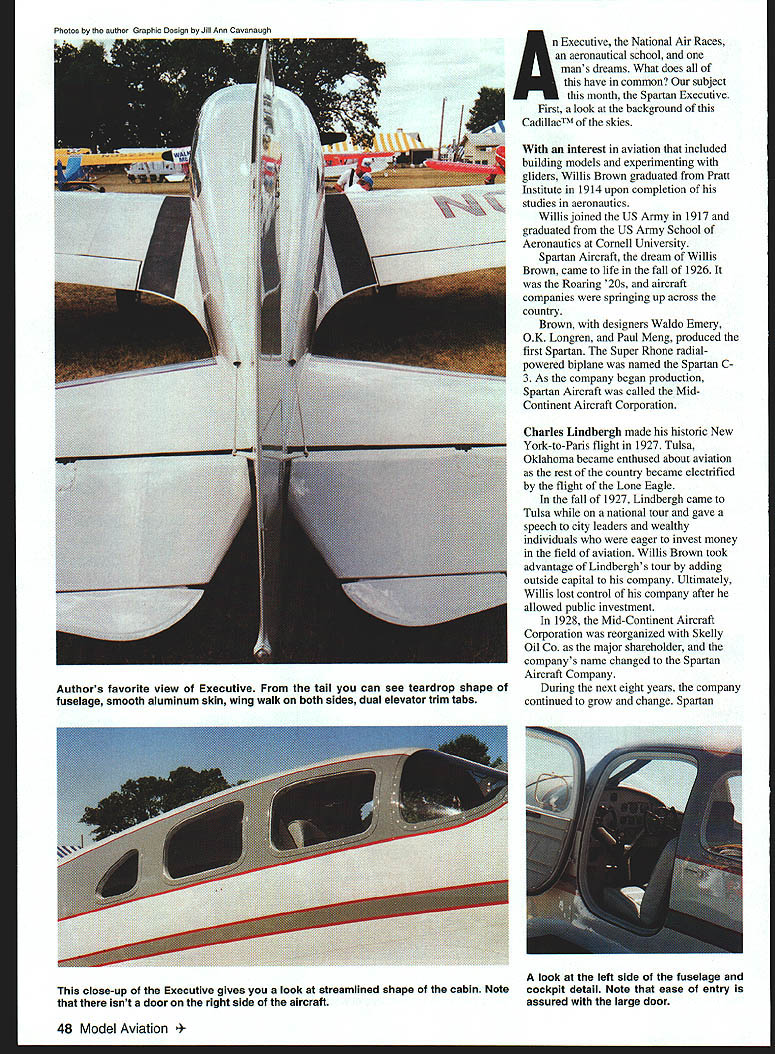
Why Not Model... Spartan Executive
Stan Alexander
An Executive — national air races, aeronautical schools and a man's dreams do have a common subject this month: the Spartan Executive.
An Executive, the National Air Races, an aeronautical school, and one man's dreams. What does all of this have in common? Our subject this month, the Spartan Executive — the Cadillac of the skies.
Background
With an interest in aviation that included building models and experimenting with gliders, Willis Brown graduated from Pratt Institute in 1914 after completing his studies in aeronautics. He joined the U.S. Army in 1917 and graduated from the U.S. Army School of Aeronautics at Cornell University.
Spartan Aircraft, the dream of Willis Brown, came to life in the fall of 1926. It was the Roaring '20s, and aircraft companies were springing up across the country. Brown, with designers Waldo Emery, O.K. Longren and Paul Meng, produced the first Spartan — the Super, a Rhone radial–powered biplane named the Spartan C-3. As the company began production, Spartan Aircraft was called Mid-Continent Aircraft Corporation.
Charles Lindbergh made his historic New York-to-Paris flight in 1927. Tulsa, Oklahoma became enthused about aviation as the rest of the country was electrified by the flight of the Lone Eagle. In the fall of 1927 Lindbergh visited Tulsa on a national tour and spoke to city leaders and wealthy individuals who were eager to invest in aviation. Willis Brown took advantage of the tour by adding outside capital to his company; ultimately, however, he lost control of the company after allowing public investment.
In 1928 Mid-Continent Aircraft Corporation was reorganized; Skelly Oil Co. became a major shareholder and the company's name was changed to Spartan Aircraft Company. During the next eight years the company continued to grow and change. The Spartan School of Aeronautics was started and is still in operation today, having trained thousands of pilots and mechanics. Aircraft built by Spartan were flown at the school, and new models were designed and built for that purpose.
The Leap to the Executive
The Spartan Executive was different from anything the company had produced previously. Earlier Spartans used steel-tube frames, fabric covering and mostly wooden wing spars. The Executive, by contrast, used all-metal construction and the latest technology to offer speed, luxury and safety.
Ed Hudlow dreamed of building an airplane that would appeal to oil-company executives and other wealthy individuals. Spartan president Bill Skelly hired designer James B. Ford to develop a uniquely futuristic airplane. At a glance the first Standard Seven looked like a rocket ship straight out of a Flash Gordon movie.
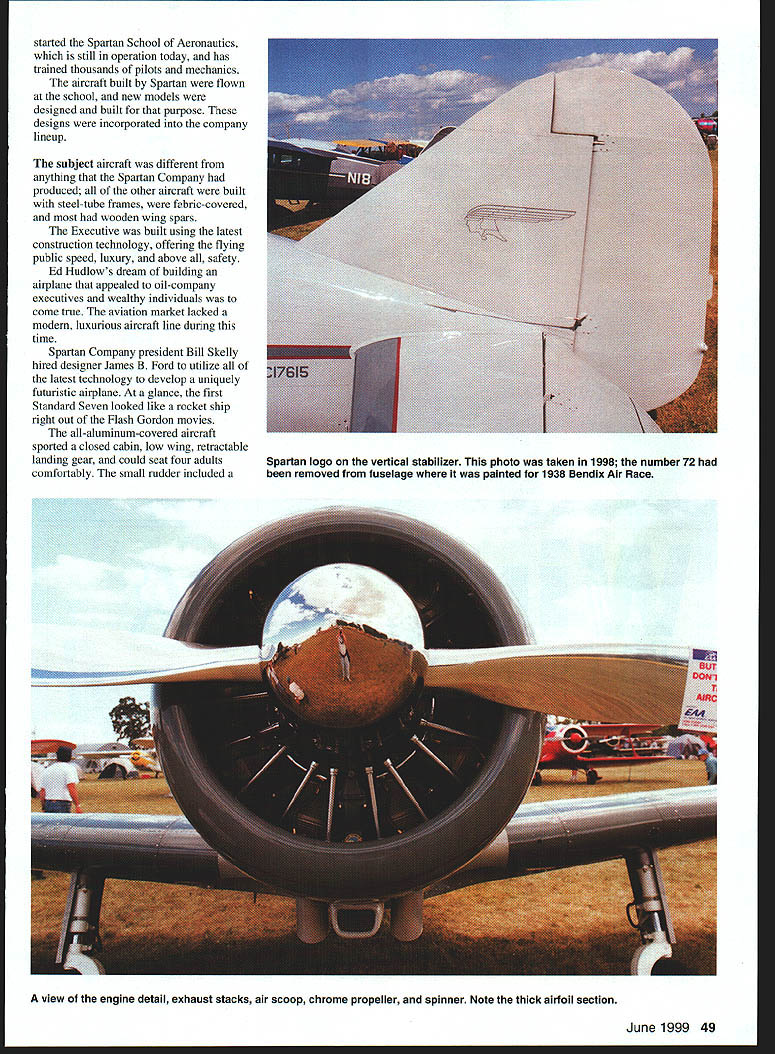
The all-aluminum-covered aircraft had a closed cabin, low wing and retractable landing gear, and could seat four adults comfortably. Early versions featured a small rudder with a dorsal fin that extended from the vertical stabilizer to the rear of the cabin — remember, this was 1937! After testing, a new tail assembly with a more conventional appearance was fitted and used throughout production. The original cowling, which resembled the bottom of a two-liter cola bottle, was replaced by a NACA-streamlined cowling.
Compared with rival cabin models of the era — several of which were still biplanes, fabric-covered or cramped — the Executive was a leap ahead. The Beechcraft Model 17 Staggerwing was one notable rival; most other contemporary cabin aircraft were slower and less refined.
Design and Features
- Standard production model: Spartan 7W Executive (Standard Seven)
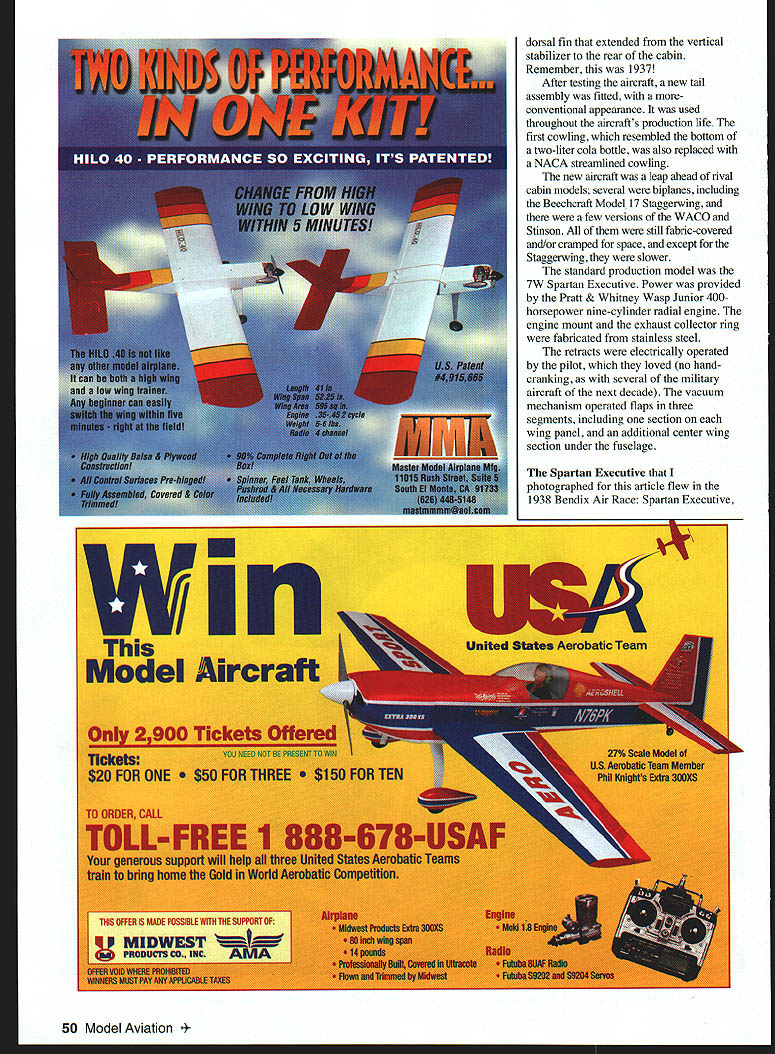
- Engine: Pratt & Whitney Wasp Junior SB, 400 horsepower, nine-cylinder radial
- Engine mount and exhaust collector ring: fabricated from stainless steel
- Landing gear: electrically retractable (pilots appreciated no hand-cranking)
- Flaps: vacuum-operated in three segments — one on each wing panel and a center section under the fuselage
- Construction: all-aluminum skin over modern internal structure
- Cabin: comfortable seating for four adults; high level of finish and luxury for the era
The Bendix Racer — NC17615 (Serial 7W14)
The Spartan Executive photographed for this article flew in the 1938 Bendix Air Race as NC17615, serial number 7W14. It carried race number 72 painted on the fuselage just forward of the stabilizer. Ten aircraft entered the Bendix that year; only three were purpose-built race airplanes. A Seversky won the race at 249.774 mph; the Spartan Executive finished sixth, with several competitors dropping out.
Jim Patterson bought this particular Executive in 1973. During a phone call from another aviation enthusiast he learned he had a Bendix racer on his hands and that the aircraft had been used in a John Wayne movie. During a five-year rebuild Jim completely disassembled the airplane down to the steel-tube frame, added modern avionics and repainted it before leaving for Oshkosh.
At the 1995 Oshkosh gathering of Golden Age air racers, Jim’s Executive fit right in among antique racers flown in the National Air Races prior to WWII.
Rarity and Preservation
The Executive was ahead of its time in many respects, but because it was sold during the late 1930s only 34 were built. Of those 34 airframes, 20 survive today. There is usually at least one Executive at the large fly-ins around the country, but it is rare to see more than one at a time.
Why Build a Model?
Why build a model of this aircraft? Simple — it’s different. It looks a bit like a fighter in sheep’s clothing. This all-metal, low-wing, radial-powered design is not your usual scale model. It offers scale options such as flaps and retractable gear, and its wide main gear gives good ground-handling stability — something a Spitfire or Messerschmitt lacks. The nose is not overly short, and the lines are pleasing. It’s a modeler’s 1930s classic.
Aircraft Specifications: 7W Executive
- Wingspan: 39 feet
- Airfoil — center section (108-inch chord): NACA 2418
- Airfoil — tips (54-inch chord): NACA 2406
- Wing area: 250 sq ft
- Overall height: 8 feet
- Overall length: 26 feet 10 inches
- Engine: Pratt & Whitney Wasp Jr. SB, 400 hp
- Wing loading: 17.6 lb/sq ft
Documentation Sources
Photos and Three-Views
- Scale Model Research, 3114 Yukon Ave., Costa Mesa, CA 92626; Tel.: (714) 979-8058. Bob Banka has five different foto packs on the Executive and three-views.
- Scale Plans & Photo Service, 3209 Madison Ave., Greensboro, NC 27403; Tel.: (910) 292-5239. Anne Pepino has four different photo packs on the Executive, three-views, and an article.
- Aviation Heritage Books, Box 665, Destin, FL 32540; Tel.: (800) 999-0141. Has three-views and several photos of the Executive 7W.
- National Association of Scale Aeromodelers, Ed Clayman — three-views. c/o Barcode Resources, Inc., 3050 Post Oak Blvd., Ste. 400, Houston, TX 77056. Send #10 SASE for three-views.
Books
- The Spartan Story by Chet Peek with George Goodhead. Aviation Heritage Books. ISBN 0-943691-16-8. Published 1994. 150 pages. Available from Aviation Heritage Books.
- The Golden Age of Air Racing by S.H. Schmid and Truman C. Weaver. EAA Aviation Foundation, Inc. Refer to page 487 for a photo. One of the best sources on Golden Age racing.
Magazines
- Air Progress, March 1967, pp. 40–43: article, three-view, specifications.
- Sport Aviation, March 1975, pp. 50–53: article, color photo, history.
- Sport Aviation, January 1996, pp. 56–58: article, color photo.
- Sport Aviation, November 1996, p. 26: color photo.
- Sport Aviation, January 1997, p. 72: photo (Model 12) — the only one produced with a trike gear.
Plan Sources
- Lewis Pancoast Plans, 7878 N. Wilding Dr. #7, Spokane, WA 99208-5586; Tel.: (509) 483-6513. Radio-control plans in 1/4 scale with a 117-inch wingspan.
Stan Alexander 3709 Valley Ridge Dr. Nashville, TN 37211-3831 Onawing@mindspring.com
Transcribed from original scans by AI. Minor OCR errors may remain.

