
Why Not Model... Velie Monocoupe
Stan Alexander
IN THE 1920s the aviation industry was growing at a rapid pace. Almost anything seemed possible—especially after Charles Lindbergh flew across the Atlantic Ocean in 1927. After that, only the imagination of designers limited their leaps in technology and the future of aviation.
The word "Monocoupe" is synonymous with the dawn of civil aviation. Individuals flew Monocoupes as company aircraft; they were raced and worked the air show circuits. Stock and modified models took 11 of 49 first-place finishes at the 1930 National Air Races. Pilots Johnny Livingston, Phoebe Omlie, Wesley Smith, Bart Stevenson, and Vera Roberts were among those who flew Monocoupes to victory that year. Models such as the 110 Special could be equipped with shortened wings specifically for racing.
Back in the 1920s, the beginning of the magical era of aviation, most aircraft were still biplanes and that type dominated production lines. WACOs were arguably the Cadillacs of the era, but they were biplanes with steel-tube frames and wooden formers and stringers. The Travel Air, Alexander Eaglerock, Challenger, Pitcairn, and Douglas aircraft were some of the others produced in the 1920s and early 1930s.
Central States Aero Company and the Monocoupe
Don Luscombe and Clayton Folkerts founded Central States Aero Company. The men complemented each other — Don providing promotional expertise and Clayton providing the majority of the technical skill. They constructed their first airframe with an engineering motto that many modelers still use: That Looks About Right (TLAR). A plaque with that saying is hanging in my shop!
Luscombe and Folkerts' first airplane was test-flown in 1927 — model 1025, serial number 1. Clayton learned to weld before he could construct the fuselage; most of his experience had been in wooden structures. The wing used traditional built-up construction with wooden spars and ribs. The wing, fuselage, and tail surfaces were covered with fabric and doped.
The Monocoupe had a high-wing configuration with a one-piece wing. Two people could sit side-by-side in the aircraft, but it was a very tight fit. As the company grew, the first Monocoupe plans were literally drawn on the wall of the construction facility — there were no formal plans at first. After press releases and public appearances, orders started coming in.
Along with an acute shortage of reliable engines and other threats to the young manufacturer, biplane producers felt threatened by the little aircraft and tried unsuccessfully to squash the company. The Model 70 went into production.
Phoebe F. Omlie and Jack Atkinson entered two Monocoupes in the 1928 National Air Tour. Ms. Omlie, of Memphis, Tennessee, was the first woman to obtain a Transport Pilot License in the U.S. The two finished 24th and 19th in the grueling Air Tour. Phoebe continued to fly Monocoupes, and Central States Aero Company enjoyed the novelty of the first female Transport Pilot using its aircraft.
About the Velie connection with Monocoupe
Willard L. Velie Sr. was the third son of Stephen Velie Sr. and Emma Deere (daughter of John Deere). Willard graduated from Yale in 1888 and later married Anne Flowerree. He started in the family business as secretary of Deere & Co. and a member of the board of directors. Because of his ambition to build his own company, he resigned as secretary but retained a position on the board.
Willard founded Velie Carriage Co., which made horse-drawn buggies and wagons. In 1908 the company produced an early automobile, the Velie 30. By 1927 Willard Velie Sr. owned and operated the Velie Automobile Company. Willard Velie Jr. was interested in aviation; the Velie family was known for building transportation products and for putting quality first.
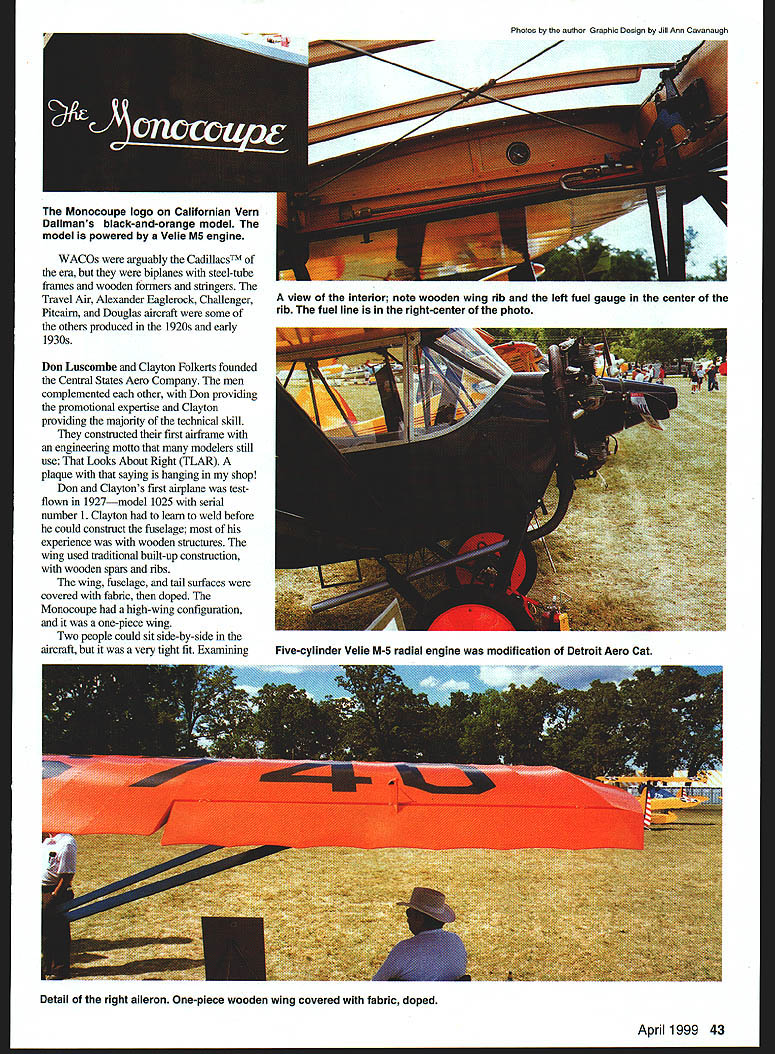
The Detroit Air Cat engine used in many Monocoupes was hard to come by and had reliability problems. With the Velie corporation guiding the engine-building program, their engineers made necessary modifications, resulting in an immediate improvement in dependability. The Velie-built modified engine was produced as the Velie M-5 (M5). The Velie M-5 five-cylinder radial engine was used on a majority of Monocoupes.
In 1928 Charles Lindbergh flew a Monocoupe, as did many other famous pilots of the time. There were several Monocoupe models beyond the famous 110 Special and the Velie Monocoupe Model 70: the Model 113, the Monosport, Monoprep, and the Monocoach 201, among others.
With the death of Willard Velie Sr. in October 1928, the automobile assembly line was shut down and sold a month later. Tragedy struck again in 1929 when Willard Velie Jr. passed away; shortly thereafter the Velie Monocoupe company was sold to a St. Louis firm.
A Monocoupe Model 60 could be bought for less than $2,000 in 1930, while the Monocoupe Model 90 sold for about $3,375.
After Don Luscombe's exit from the Velie corporation, he went on to greater success with his own company, Luscombe Aircraft Co. If you examine the Luscombe Phantom, there is a marked resemblance to the Monocoupe, though the construction is totally different.
The featured aircraft and flight characteristics
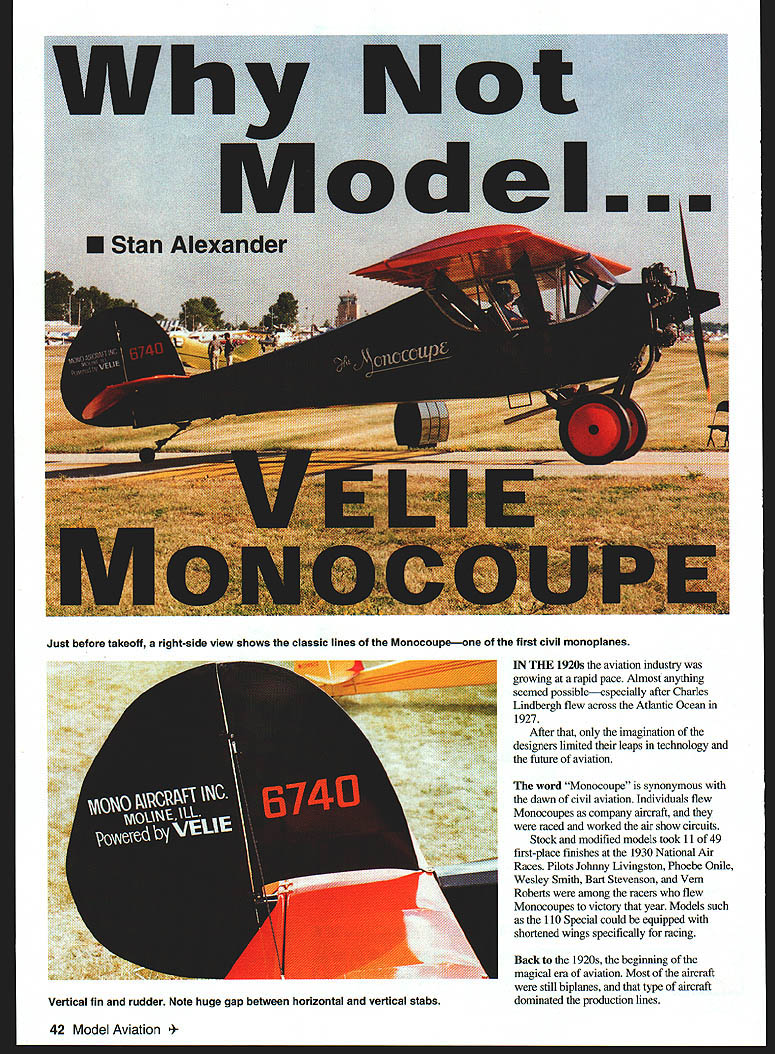
This month's photo subject is a Velie Monocoupe featuring the Velie M5 engine. Vern Dallman of California owns the beautiful orange-and-black two-place aircraft. Admiring the 1928-like new "Coupe," you notice the attention to detail that the owner lavished on this Golden Age classic.
This Monocoupe flies similarly to a J-3 Cub—very docile in the air. Some other Monocoupes, such as the 110 Special, are viable aerobatic types. If you have been looking for a subject to putter around the field with, without having to stay far ahead of the model as it flies, try an early Monocoupe. The conversations at the field about this elegant-but-simple classic will test many of your friends' knowledge of early civil aviation. Try a Golden Age of Flight Velie Monocoupe!
Aircraft Specifications: 1928 Velie Monocoupe Model 70
- Wingspan: 32 feet
- Chord: 60 inches
- Length: 19 feet 9 inches
- Wing Area: 143 square feet
- Airfoil: Clark Y
- Weight Empty: 795 pounds
The only difference between the Model 70 and the Model 113 (plans available) is the landing gear struts and empty weight. The Model 113 weighs 53 pounds more and has a slightly smaller payload.
Notable Monocoupe models
- Model 60
- Model 70 (Velie Monocoupe subject of this article)
- Model 90
- Model 110 Special (racing-capable)
- Model 113
- Monosport
- Monoprep
- Monocoach 201
Documentation Sources
Books
- Of Monocoupes and Men by John Underwood (out of print).
- Visions of Luscombe "The Early Years" by James B. Zazas, published by Sunshine House, Inc., ISBN 0-943691-09-5. Photos, three-views, and history of Monocoupe, Phantom, and Luscombe aircraft available from Aviation Heritage, Inc., Box 665, Destin FL 32540; Tel.: (800) 999-0141 for $26.95 plus $4.50 shipping (free catalog available).
- U.S. Civil Aircraft Series, Volume I (ATC 1–ATC 100) by Joseph P. Juptner, pages 178–179. Published by Tab Aero, $29.95; available from Zenith Aviation or Historic Aviation. Library of Congress Card #62-15967.
- The Golden Age of Air Racing in 1940 by S.H. Schmid and Truman C. Weaver. Printed by the Times Printing Co.; considered the "Bible of Golden Age Racing," available from Zenith Aviation or Historic Aviation.
Magazines
- RC Modeler, January 1973 — article and plans by John A. de Vries. Available for the Model 113; can be modified to the earlier Model 70. Wingspan: 66 inches.
- In Model Aviation issue October 1998 (pages 92–93), photo credit should be given to Scale Model Research.
Other Scale Sources
- Scale Model Research, 3114 Yukon Ave., Costa Mesa, CA 92626; Tel.: (714) 979-8058. Foto Paks with 31 photos, black-and-orange scheme, three-views available.
- Scale Plans & Photo Service, 3209 Madison Ave., Greensboro, NC 27403; Tel.: (910) 292-5239. Model 113 photo pak, 15 photos—yellow-and-black scheme, three-views available.
Stan Alexander 3709 Valley Ridge Dr. Nashville, TN 37211-3831 Onawing@mindspring.com
Transcribed from original scans by AI. Minor OCR errors may remain.

