
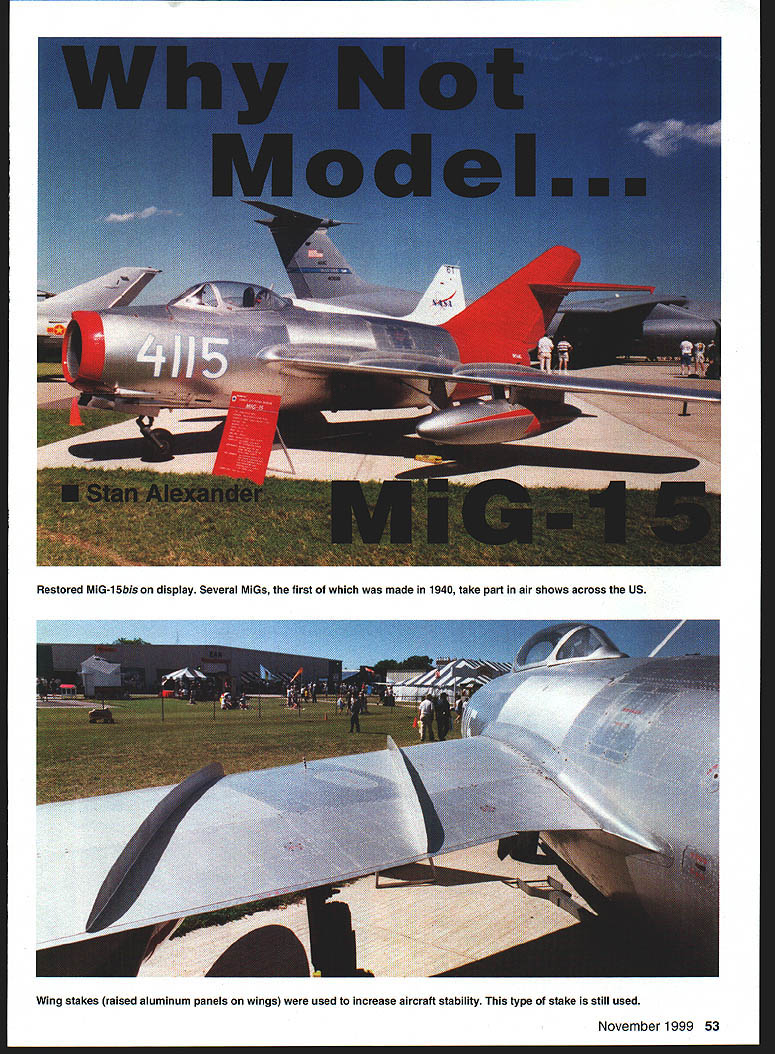
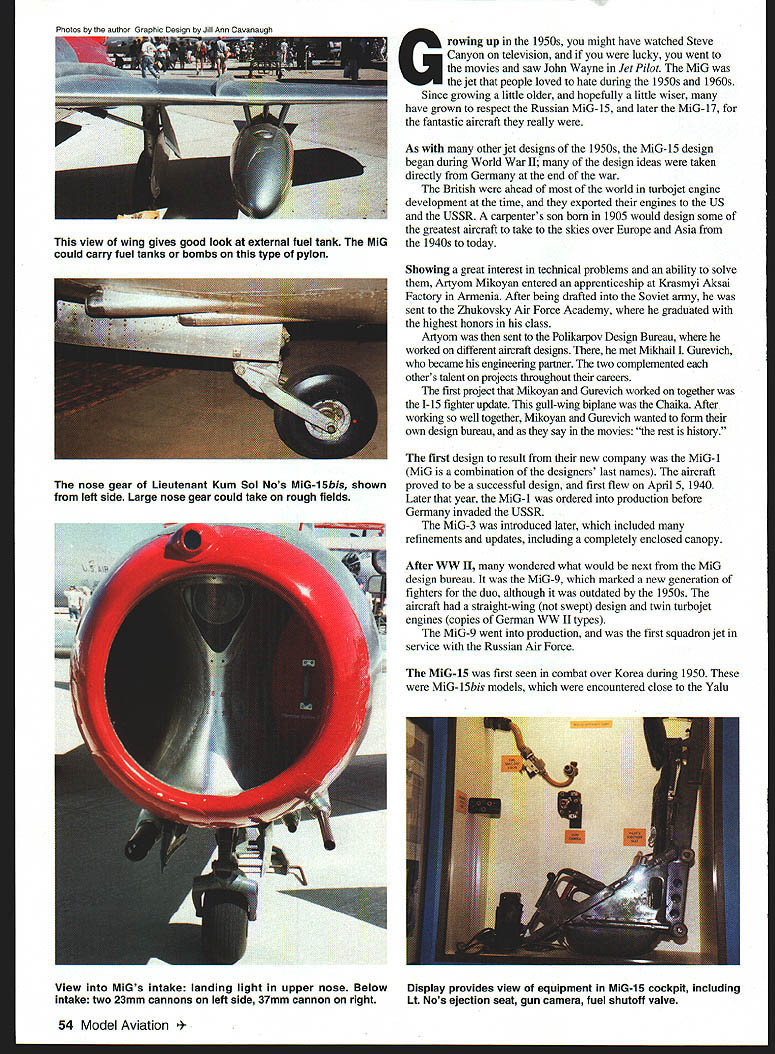
Why Not Model... MiG-15
Stan Alexander
Growing up in the 1950s, you might have watched Steve Canyon on television, and if you were lucky you went to the movies and saw John Wayne in Jet Pilot. The MiG was the jet that people loved to hate during the 1950s and 1960s. Since growing a little older, and hopefully a little wiser, many have grown to respect the Russian MiG-15, and later the MiG-17, for the fantastic aircraft they really were.
As with many other jet designs of the 1950s, the MiG-15 design began during World War II; many of the design ideas were taken from Germany at the end of the war. The British were ahead of most of the world in turbojet engine development at the time, and they exported their engines to the US and the USSR. A carpenter’s son born in 1905 would design some of the greatest aircraft to take to the skies over Europe and Asia from the 1940s to today.
Showing a great interest in technical problems and an ability to solve them, Artyom Mikoyan entered an apprenticeship at Krasnyi Aksai Factory in Armenia. After being drafted into the Soviet army, he was sent to the Zhukovsky Air Force Academy, where he graduated with the highest honors in his class.
Artyom was then sent to the Polikarpov Design Bureau, where he worked on different aircraft designs. There, he met Mikhail I. Gurevich, who became his engineering partner. The two complemented each other’s talents on projects throughout their careers.
The first project that Mikoyan and Gurevich worked on together was the I-15 fighter update. This gull-wing biplane was the Chaika. After working so well together, Mikoyan and Gurevich wanted to form their own design bureau, and as they say in the movies: “the rest is history.”
The first design to result from their new company was the MiG-1 (MiG is a combination of the designers’ last names). The aircraft proved to be a successful design and first flew on April 5, 1940. Later that year the MiG-1 was ordered into production before Germany invaded the USSR.
The MiG-3 was introduced later, which included many refinements and updates, including a completely enclosed canopy.
After WWII many wondered what would be next from the MiG design bureau. It was the MiG-9, which marked a new generation of fighters for the duo, although it was outdated by the 1950s. The aircraft had a straight-wing (not swept) design and twin turbojet engines (copies of German WWII types). The MiG-9 went into production and was the first squadron jet in service with the Russian Air Force.
Combat in Korea
The MiG-15 was first seen in combat over Korea in 1950. These were MiG-15bis models, which were encountered close to the Yalu River.
On November 8, 1950, the first-ever jet-to-jet combat took place between MiG-15s and US Air Force F-80s (Shooting Stars). MiG-15s shot down F-80s that day. The MiG scored its first victory two days later, shooting down a B-29. In response, the US Air Force sent the F-86A Sabre jet to the Korean theater of operations.
The MiG-15 surprised United Nations forces because in some ways its performance was better than the early F-86 Sabre. The MiG had a higher rate of climb — 10,100 feet per minute; the F-86A, 7,250 feet per minute. Its weight was 11,070 pounds, considerably less than the F-86’s 19,346 pounds. Its service ceiling was about 7,000 feet higher than the F-86 (figures for the F-86E model). Later F-86 models improved in these respects; some updates resulted from studying downed MiG-15s.
The US Air Force Museum in Dayton, Ohio, has on display the first complete MiG-15bis from the Korean conflict — an aircraft flown from Kimpo Air Base below the 38th parallel. Lieutenant Kum Sol No was the first pilot to land his MiG in the south and surrender to the US Air Force. His mother had escaped South Korea early in the war; the opportunity to reunite came almost two months after the Korean truce, on September 21, 1953. Having no other family north, Lt. No did not have to worry about reprisals.
After landing downwind at Kimpo, the MiG was stripped of its markings and transferred to an air base in Okinawa, Japan, where it was test-flown by US Air Force pilots including Captain H.E. Tom Collins and Major Chuck Yeager. Lt. Kum Sol No collected a $100,000 reward for turning the intact MiG-15 over to the US Air Force. After tests finished in Okinawa, the MiG was transferred to Wright-Patterson AFB in Dayton, Ohio, where more tests were conducted. The MiG-15bis now rests in the US Air Force Museum’s Korean War display, along with an F-86A marked in the colors of Lieutenant Colonel Bruce Hinton — the first pilot to shoot down a MiG.
According to some volunteers at the Air Force Museum, for many years Lt. No came to visit his old “friend” that took him to a new country and a new life. He graduated from the University of Delaware with a degree in engineering.
Employing the F-86, the US Air Force enjoyed about a 10:1 kill ratio over Communist MiG pilots. The main reasons for this ratio were training, education, professionalism, and the skill level of US pilots and ground crews.
For Modelers
For modelers, the MiG-15 has a larger wing than the MiG-17. There are several MiG-15s in the US, flown at air shows every year. A squat, beefy wide-track landing gear makes ground-handling a breeze.
With a generous wing area and a huge inlet for a turbine or ducted fan, the MiG begs to be modeled. Documentation, plans, and kits are available. Retracts, flaps, wing tanks, and bombs are some of the options for a scale model. Enjoy a trip back to the 1950s with the elegant-but-dreaded MiG-15.
MiG Models
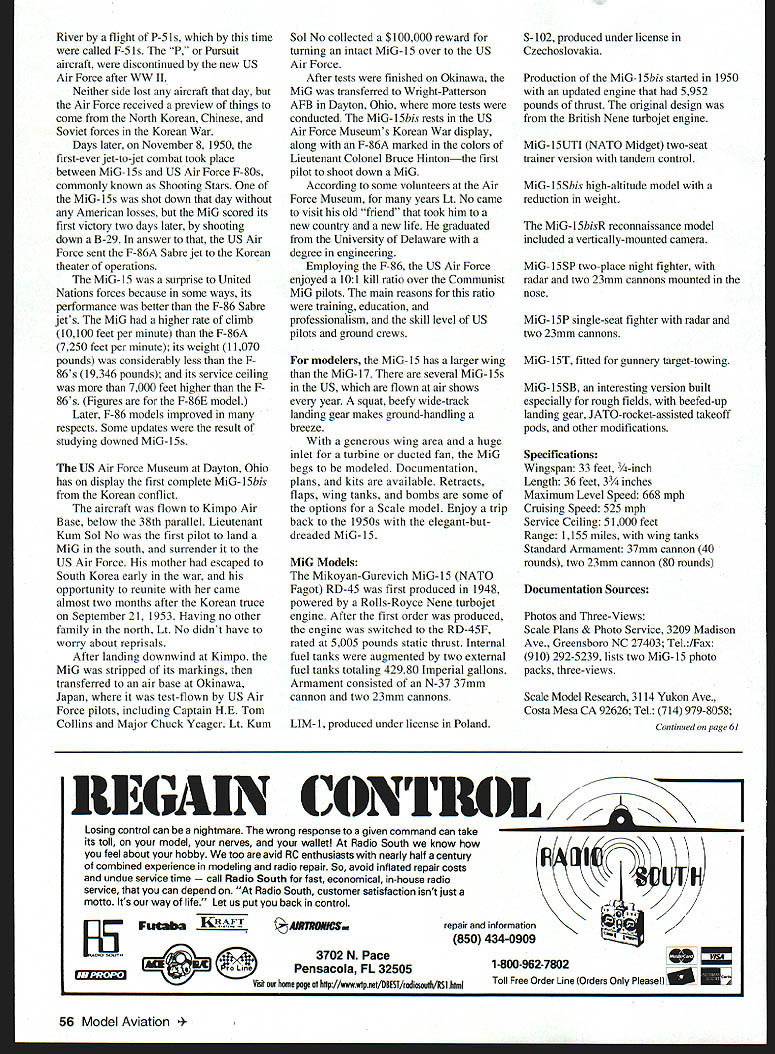
- Mikoyan-Gurevich MiG-15 (NATO: Fagot) RD-45 — first produced in 1948, powered by a Rolls-Royce Nene turbojet (Soviet RD-45). After the first production order the engine was switched to the RD-45F, rated at 5,005 lb static thrust. Internal fuel tanks were augmented by two external fuel tanks totaling 429.80 Imperial gallons. Armament: one N-37 37mm cannon and two 23mm cannons.
- LIM-1 — produced under license in Poland.
- S-102 — produced under license in Czechoslovakia.
- MiG-15bis — production started in 1950 with an updated engine rated at approximately 5,952 lb thrust. The original design used the British Nene turbojet.
- MiG-15UTI (NATO: Midget) — two-seat trainer version with tandem controls.
- MiG-15Sh — high-altitude model with weight reductions.
- MiG-15bisR — reconnaissance model with a vertically mounted camera.
- MiG-15SP — two-place night fighter with radar and two 23mm cannons mounted in the nose.
- MiG-15P — single-seat fighter with radar and two 23mm cannons.
- MiG-15T — fitted for gunnery target-towing.
- MiG-15SB — version built especially for rough fields, with beefed-up landing gear, JATO rocket-assisted takeoff pods, and other modifications.
Specifications
- Wingspan: 33 ft 5-3/4 in
- Length: 36 ft 3/4 in
- Maximum level speed: 668 mph
- Cruising speed: 525 mph
- Service ceiling: 51,000 ft
- Range: 1,155 miles (with wing tanks)
- Standard armament: one 37mm cannon (40 rounds) and two 23mm cannons (80 rounds)
Documentation Sources
Photos and Three-Views
- Scale Plans & Photo Service, 3209 Madison Ave., Greensboro, NC 27405; Tel./Fax: (910) 292-5239. Lists two MiG-15 photo packs and three-views.
- Scale Model Research, 3114 Yukon Ave., Costa Mesa, CA 92626; Tel: (714) 979-8058; Fax: (714) 979-7279. Lists seven color schemes (Foto Paak), three-views, and an article.
- US Air Force Museum, 1100 Spaatz St., Wright-Patterson AFB, Dayton, OH 45433-7102; Tel.: (937) 255-3286; Web: www.wpafb.af.mil/museum/. This museum has the first complete MiG-15 captured in South Korea. Information is available through its research library — call for an appointment or spend a day there. Best photo time is Monday–Thursday; Friday is school field-trip day and the museum is busier on weekends.
- NASA (National Association of Scale Aeromodelers) has MiG three-views. Send an SASE (legal size) to NASA three-views, Ed Clayman c/o Barcode Resources, Inc., 3050 Post Oak Blvd., Ste. 400, Houston, TX 77056; NASA web: www.scaleaero.com/amascale.htm.
Books
- Russian MiG-15 — Planes of Fame Publications. ISBN 0-915454-02-1. Available from Zenith Aviation (Tel.: 1-800-862-6600) or Historic Aviation Books (Tel.: 1-800-225-5575).
- Historic Warplanes by Steve MacDonald, Quintet Publishing Ltd., 1995. ISBN 0-7858-0337-8. Color photos on page 32.
- Vietnam — The War in the Air by René J. Francillon, Aerospace Publishing Ltd., 1987. ISBN 0-517-62976-3. Photo on page 198, three-view and data on page 241.
Magazines
- Air Progress, April/May 1963 — cockpit detail photos on page 71.
- Air International, Vol. 28, No. 6, June 1985 — “The Fighter” MiG-15 cutaway and F-86 cutaway; comparison article on pages 315–319.
- Airpower, May 1986 — “MiG Killers” article on pages 46–53; photo on page 53.
- Air Classics, May 1989 — MiG-15bis photo on page 52.
- Aviation, January 1993 — MiG-15bis photo on page 44, article “Defining The Jet.”
- Air Classics, February 1997 — photo of MiG-15 on page 67.
Plans and Kits Available
- Plans: Bob Holman Plans, Box 741, San Bernardino, CA 92402; Tel.: (909) 885-3959. Catalog: R/C Model World Plans Guide. MiG-15 plan by Pavel Bosak: 60-inch span for an .81 ducted fan.
- Plan: MiG-15 by Marcus Norman — 46-inch span, uses a takeoff dolly with a .40–.45 ducted fan.
- Kit: Bob Violett Models, 170 State Rd. 419, Winter Springs, FL 32708; Tel.: (407) 327-6333; Web: bvmjets.com. MiG-15: 68-inch length, 68-inch span, 16 lb; options for ducted fan or 20 lb turbine.
- Kit: Century Jet Models Inc., 11216 Bluegrass Pkwy., Louisville, KY 40299; Tel.: (502) 266-0234; Web: www.centuryjet.com. Fan or turbine options; 74-inch wingspan, 74-inch length, 16–18 lb.
Stan Alexander 3709 Valley Ridge Dr. Nashville, TN 37211-3831 onawing@mindspring.com
Transcribed from original scans by AI. Minor OCR errors may remain.

