
Why Scale?
Bill Hannan
The quest for realism has always been a phenomena, for scale is a wheel within wheels world, here reviewed in depth for the first time. The first of two articles.
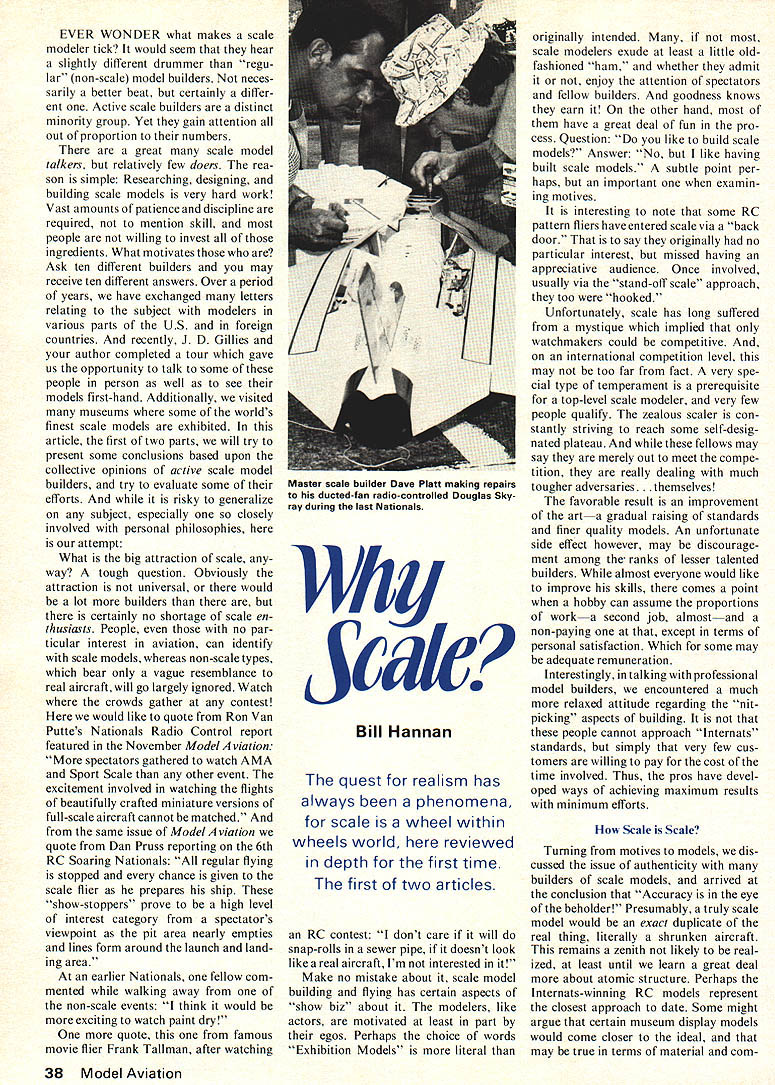
EVER WONDER what makes a scale modeler tick? It would seem that they hear a slightly different drummer than "regular" (non-scale) model builders. Not necessarily a better beat, but certainly a different one. Active scale builders are a distinct minority group. Yet they gain attention all out of proportion to their numbers.
There are a great many scale model talkers, but relatively few doers. The reason is simple: Researching, designing, and building scale models is very hard work! Vast amounts of patience and discipline are required, not to mention skill, and most people are not willing to invest all of those ingredients. What motivates those who are? Ask ten different builders and you may receive ten different answers. Over a period of years, we have exchanged many letters relating to the subject with modelers in various parts of the U.S. and in foreign countries. And recently, J. D. Gillies and your author completed a tour which gave us the opportunity to talk to some of these people in person as well as to see their models first-hand. Additionally, we visited many museums where some of the world's finest scale models are exhibited. In this article, the first of two parts, we will try to present some conclusions based upon the collective opinions of active scale model builders, and try to evaluate some of their efforts. And while it is risky to generalize on any subject, especially one so closely involved with personal philosophies, here is our attempt:
What is the big attraction of scale, anyway? A tough question. Obviously the attraction is not universal, or there would be a lot more builders than there are, but there is certainly no shortage of scale enthusiasts. People, even those with no particular interest in aviation, can identify with scale models, whereas non-scale types, which bear only a vague resemblance to real aircraft, will go largely ignored. Watch where the crowds gather at any contest! Here we would like to quote from Ron Van Putte's Nationals Radio Control report featured in the November Model Aviation: "More spectators gathered to watch AMA and Sport Scale than any other event. The excitement involved in watching the flights of beautifully crafted miniature versions of full-scale aircraft cannot be matched." And from the same issue of Model Aviation we quote from Dan Pruss reporting on the 6th RC Soaring Nationals: "All regular flying is stopped and every chance is given to the scale flier as he prepares his ship. These 'show-stoppers' prove to be a high level of interest category from a spectator's viewpoint as the pit area nearly empties and lines form around the launch and landing area."
At an earlier Nationals, one fellow commented while walking away from one of the non-scale events: "I think it would be more exciting to watch paint dry!"
Many, if not most, scale modelers exude at least a little old-fashioned "ham," and whether they admit it or not, enjoy the attention of spectators and fellow builders. And goodness knows they earn it! On the other hand, most of them have a great deal of fun in the process. Question: "Do you like to build scale models?" Answer: "No, but I like having built scale models." A subtle point perhaps, but an important one when examining motives.
It is interesting to note that some RC pattern fliers have entered scale via a "back door." That is to say they originally had no particular interest, but missed having an appreciative audience. Once involved, usually via the "stand-off scale" approach, they too were "hooked."
Unfortunately, scale has long suffered from a mystique which implied that only watchmakers could be competitive. And, on an international competition level, this may be too far from fact. A very special type of temperament is a prerequisite for a top-level scale modeler, and very few people qualify. The zealous scaler is constantly striving to reach some self-designated plateau. And while these fellows may say they are merely out to meet the competition, they are really dealing with much tougher adversaries... themselves!
The favorable result is an improvement of the art—a gradual raising of standards and finer quality models. An unfortunate side effect however, may be discouragement among the ranks of lesser talented builders. While almost everyone would like to improve his skills, there comes a point when a hobby can assume the proportions of work—a second job, almost—and a non-paying one at that, except in terms of personal satisfaction. Which for some may be adequate remuneration.
Interestingly, in talking with professional model builders, we encountered a much more relaxed attitude regarding the "nit-picking" aspects of building. It is not that these people cannot approach Internats standards, but simply that very few customers are willing to pay for the cost of the time involved. Thus, the pros have developed ways of achieving maximum results with minimum efforts.
How Scale is Scale?
Turning from motives to models, we discussed the issue of authenticity with many builders of scale models, and arrived at the conclusion that "Accuracy is in the eye of the beholder!" Presumably, a truly scale model would be an exact duplicate of the real thing—literally a shrunken aircraft. This remains a goal and not likely to be realized in most cases, for it involves an enormous amount of time and effort. Better to approach the subject realistically and attempt to obtain the closest approach to date. Some might argue that certain museum display models would come closer to the ideal, and that may be true in terms of material and com- ponent duplication. But one might counter with the question: "How authentic is a model of an aircraft if it cannot fly?"
Authenticity vs. Craftsmanship
In evaluating any model, it is difficult to separate accuracy from craftsmanship, since there is a great deal of overlap involved. That is to say that one's craftsmanship naturally affects accuracy. Conversely, dazzling craftsmanship can occasionally mesmerize onlookers (and judges!) into overlooking dimensional inaccuracies. The distinction is particularly important when competition is involved, and the philosophy of the modeler can drastically affect the outcome.
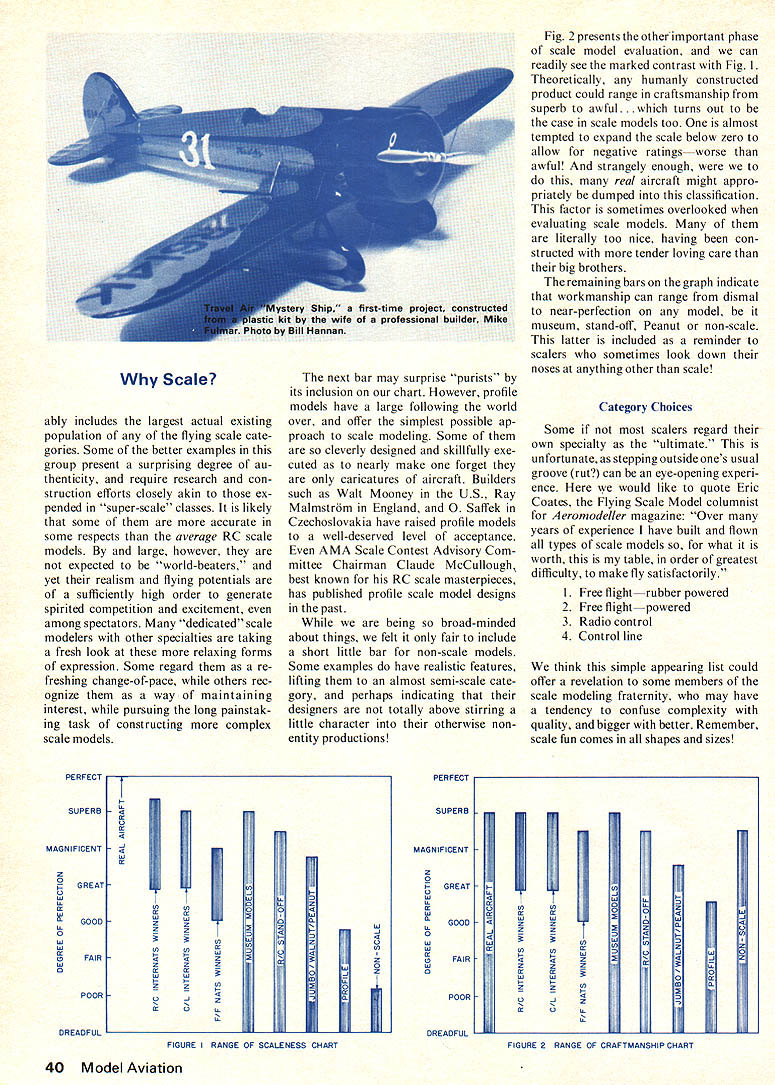
Fig. 1 is a "Range of Authenticity" chart. Since it is based upon unmeasurable quantities, it must be regarded only as a yardstick for comparison and visualization purposes. Assuming a real aircraft as perfect, we move from left to right and encounter the bar labeled RC Internats, intended as a guesstimate of the better models' authenticity range. The upper limit assumes that no model is perfect, and the lower limit is an arbitrary cut-off below which an entry could probably not remain competitive. This class of model would seem to represent the epitome of "scaleness" at present, and the total world's supply of them probably amounts to fewer than 25. Reports occasionally filter through the modeling press of better models, featuring such niceties as functional scale engines, but somehow these craft seldom appear in public.
The Internats-quality control-line model may be next in order of scaleness achievement. We have placed their bar upper limit below that of RC because the inherent spatial limitations of the control system preclude the flight duplication possibilities permitted by RC. However, if this factor was excluded, some of these models might surpass the standards of the RC models.
Again, so few models of top caliber exist that not all of us may ever have a chance to see one.
Since there is no international contest for free-flight scale models at present (a pity!), we must look to the outstanding national contest winners of various countries to evaluate the scope of possibilities in this class. Although the first free-flight bar on the chart is labeled "gas," it might encompass CO2 and electric power as well. Presumably, if an international challenge were extended, the standards could be higher, as a great many facets of free-flight scale remain largely unexplored. Pre-programmed flight is one example.
One quickly ventures into the deep water of personal opinion when trying to apply the apples-and-oranges comparisons of free flight vs. control-line and RC, but it can be a stimulating mental exercise!
The bar labeled Museum Models may puzzle some with its long range. Although some such models are incredibly authentic, others are downright wretched. While most museums are constantly trying to upgrade their standards, most suffer from shortages of staff, money and space. Thus, given the choice between displaying sub-standard models or no models, the decision is understandable. Then, too, some examples, primitive by today's standards, deserve a place in museum collections by virtue of their age or historical importance. Nonetheless, use of the term "museum quality" should be regarded with caution.
The Stand-off or Sport Scale bar also encompasses a broad range, since some of the top examples are right up there with "true" scale models (some are entered in both types of events), while others are so far to the other extreme as to scarcely qualify as any sort of scale model. One must feel sympathy for the hapless contest director and judges of these events! Now there is a real study in psychology.
The bar labeled Jumbo, Walnut, Peanut is another of considerable span and probably reflects the gamut from the crudest homebuilt to the highly refined contest-standard designs. In general, the smaller classes tend to have close ties with the peanut and "jumbolino" contests rather than with true scale. Some of these small models, however, are indeed accurate and well-built, and are for that reason popular display items in museums and private collections.
Why Scale?
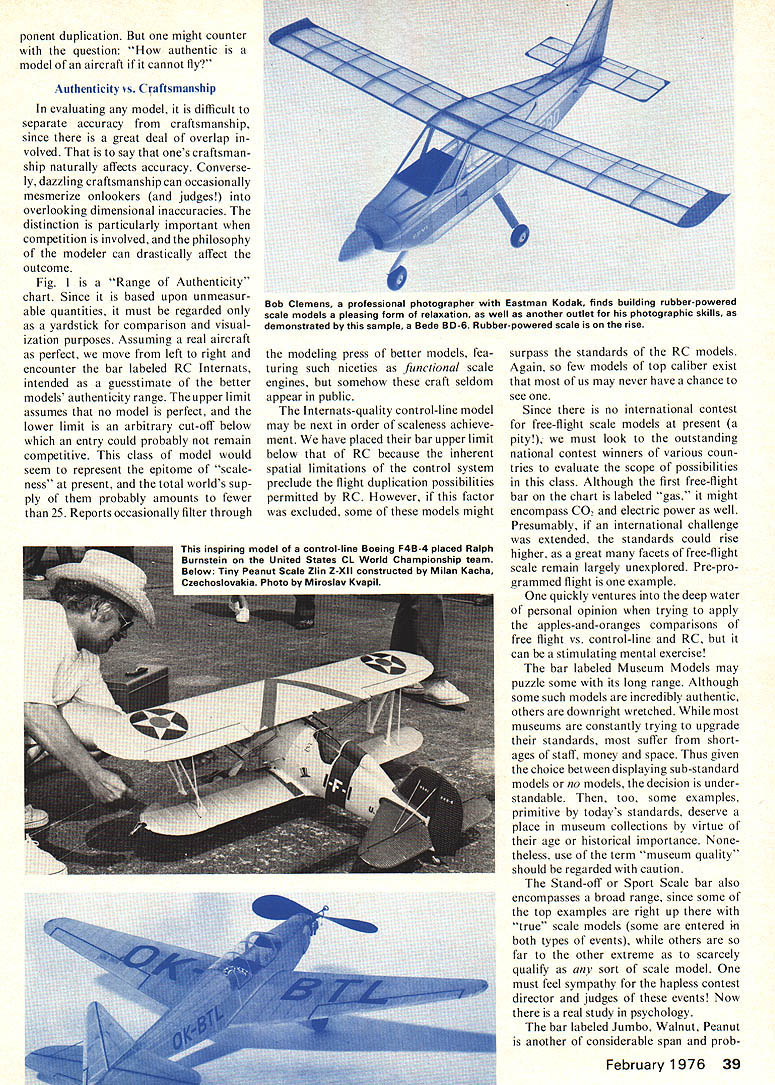
ably includes the largest actual existing population of any of the flying scale categories. Some of the better examples in this group present a surprising degree of authenticity, and require research and construction efforts closely akin to those expected in "super-scale" classes. It is likely that some of them are more accurate in some respects than the average RC scale models. By and large, however, they are not expected to be "world-beaters," and yet their realism and flying potentials are of a sufficiently high order to generate spirited competition and excitement, even among spectators. Many "dedicated" scale modelers with other specialties are taking a fresh look at these more relaxing forms of expression. Some regard them as a refreshing change-of-pace, while others recognize them as a way of maintaining interest, while pursuing the long painstaking task of constructing more complex scale models.
The next bar may surprise "purists" by its inclusion on our chart. However, profile models have a large following the world over, and offer the simplest possible approach to scale modeling. Some of them are so cleverly designed and skillfully executed as to nearly make one forget they are only caricatures of aircraft. Builders such as Walt Mooney in the U.S., Ray Malmström in England, and O. Safek in Czechoslovakia have raised profile models to a well-deserved level of acceptance. Even AMA Scale Contest Advisory Committee Chairman Claude McCullough, best known for his RC scale masterpieces, has published profile scale model designs in the past.
While we are being so broad-minded about this, we felt it only fair to include a short little bar for non-scale models. Some examples do have realistic features, drifting them to an almost semi-scale category, and perhaps indicating that their designers are not totally above stirring a little character into their otherwise nonentity productions!
Fig. 2 presents the other important phase of scale model evaluation, and we can readily see the marked contrast with Fig. 1. Theoretically, any humanly constructed product could range in craftsmanship from superb to awful... which turns out to be the case in scale models too. One is almost tempted to expand the scale below zero to allow for negative ratings—worse than awful! And strangely enough, were we to do this, many real aircraft might appropriately be dumped into this classification. This factor is sometimes overlooked when evaluating scale models. Many of them are literally too nice, having been constructed with more tender loving care than their big brothers.
The remaining bars on the graph indicate that workmanship can range from dismal to near-perfection on any model, be it museum, stand-off, Peanut or non-scale. This latter is included as a reminder to scalers who sometimes look down their noses at anything other than scale!
Category Choices
Some if not most scalers regard their own specialty as the "ultimate." This is unfortunate, as stepping outside one's usual groove (rut?) can be an eye-opening experience. Here we would like to quote Eric Coates, the Flying Scale Model columnist for Aeromodeller magazine: "Over many years of experience I have built and flown all types of scale models so, for what it is worth, this is my table, in order of greatest difficulty to make fully satisfactorily."
- Free flight—rubber powered
- Free flight—powered
- Radio control
- Control line
We think this simple appearing list could offer a revelation to some members of the scale modeling fraternity, who may have a tendency to confuse complexity with quality, and bigger with better. Remember, scale fun comes in all shapes and sizes!
Static Scale
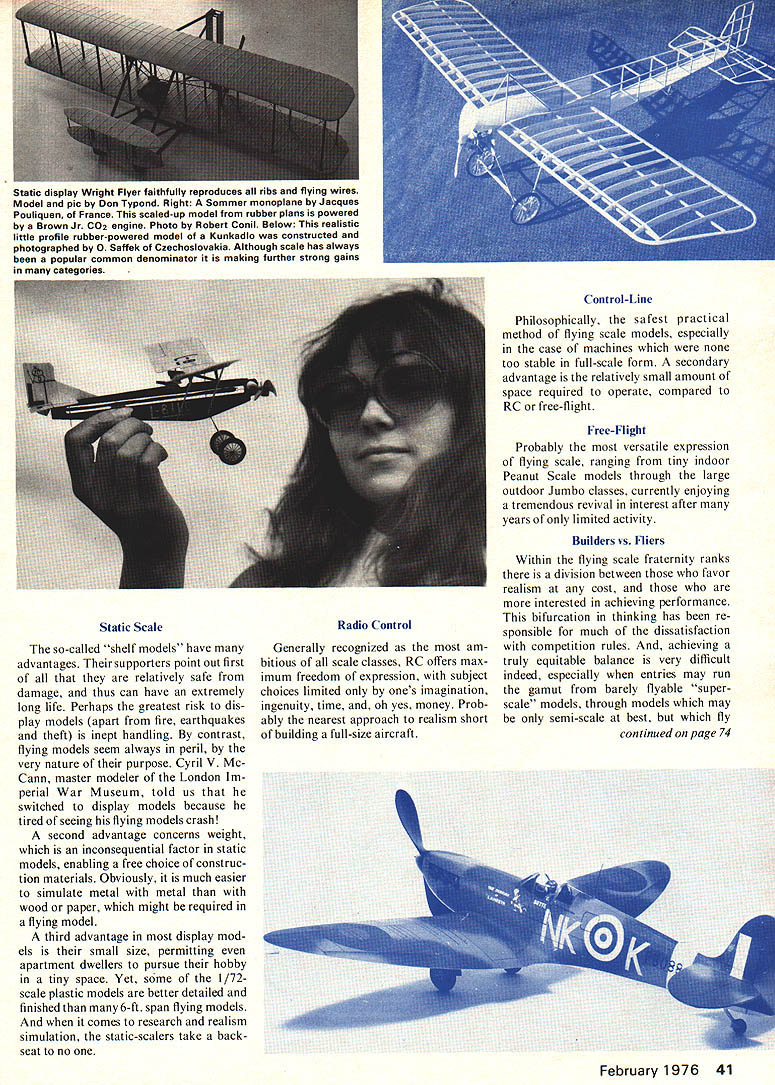
The so-called "shelf models" have many advantages. Their supporters point out first of all that they are relatively safe from damage, and thus can have an extremely long life. Perhaps the greatest risk to display models (apart from fire, earthquakes and theft) is inept handling. By contrast, flying models seem always in peril, by the very nature of their purpose. Cyril V. McCann, master modeler of the London Imperial War Museum, told us that he switched to display models because he tired of seeing his flying models crash!
A second advantage concerns weight, which is an inconsequential factor in static models, enabling a free choice of construction materials. Obviously, it is much easier to simulate metal with metal than with wood or paper, which might be required in a flying model.
A third advantage in most display models is their small size, permitting even apartment dwellers to pursue their hobby in a tiny space. Yet, some of the 1/72-scale plastic models are better detailed and finished than many 6-ft. span flying models. And when it comes to research and realism simulation, the static-scalers take a backseat to no one.
Radio Control
Generally recognized as the most ambitious of all scale classes, RC offers maximum freedom of expression, with subject choices limited only by one's imagination, ingenuity, time, and, oh yes, money. Probably the nearest approach to realism short of building a full-size aircraft.
Control-Line
Philosophically, the safest practical method of flying scale models, especially in the case of machines which were none too stable in full-scale form. A secondary advantage is the relatively small amount of space required to operate, compared to RC or free-flight.
Free-Flight
Probably the most versatile expression of flying scale, ranging from tiny indoor Peanut Scale models through the large outdoor Jumbo classes, currently enjoying a tremendous revival in interest after many years of only limited activity.
Builders vs. Fliers
Within the flying scale fraternity ranks there is a division between those who favor realism at any cost, and those who are more interested in achieving performance. This bifurcation in thinking has been responsible for much of the dissatisfaction with competition rules. And, achieving a truly equitable balance is very difficult indeed, especially when entries may run the gamut from barely flyable "super-scale" models, through models which may be only semi-scale at best, but which fly well.
EVER WONDER what makes the scale modeler tick? You would seem to hear a slightly different drummer. Regular non-scale model builders necessarily beat a better beat; certainly different. Active scale builders are a distinct minority group. Yet they gain attention out of proportion to their numbers. There are great scale model talkers and relatively few doers. The reason is simple. Researching, designing and building scale models is very hard work. Vast amounts of patience and discipline are required, not to mention skill. People willing to invest these ingredients — what motivates them?
Ask ten different builders and you may receive ten different answers. Over a period of years I have exchanged letters relating to the subject with modelers in various parts of the U.S. and foreign countries. Recently J. D. Gillies, author, completed a tour and gave us an opportunity to talk with some people in person and to see models first-hand. Additionally I visited museums where some of the world's finest scale models are exhibited. In the first two parts of this article I will try to present some conclusions based upon the collective opinions of active scale-model builders and try to evaluate some efforts. It is risky to generalize on the subject, especially when one is closely involved with personal philosophies one attempts to espouse.
What is the big attraction of scale? A tough question. Obviously the attraction is universal — were it otherwise there would not be so many scale enthusiasts. People with no particular interest in aviation can identify scale models, whereas non-scale types, which bear only a vague resemblance to real aircraft, will go largely ignored. Watch crowds gather at a contest and you will see it. To quote Ron Van Putte's Nationals Radio Control report featured in the November Model Aviation: spectators gathered to watch AMA Sport Scale. The excitement involved in watching flights of beautifully crafted miniature versions of full-scale aircraft cannot be matched. In the same issue of Model Aviation, Dan Pruss reporting the 6th RC Soaring Nationals noted that regular flying stopped when the chance was given for a scale flier to prepare his ship; show-stoppers prove a high level of interest in the category. From a spectator's viewpoint the pit area nearly empties and lines form around the launch/landing area. At earlier Nationals a fellow commented that walking away from non-scale events was like watching paint dry — a quote attributed to famous movie flier Frank Tallman after watching Wily Bill Hannan.
The quest for realism has always been a phenomenon within the world of scale — wheels within wheels. In the first two articles I reviewed the depths of this. Some RC contest fliers don't care — they will snap-roll a sewer pipe that doesn't look like a real aircraft. "I'm interested" is the attitude of the scale enthusiast. Make no mistake about it: scale model building and flying has certain aspects of show business about it. Modelers, like actors, are motivated at least in part by egos. Perhaps "exhibition models" — originally intended as scale models — exude at least a little old-fashioned ham, whether admitted or not. Many enjoy the attention of spectators and fellow builders; goodness knows it is earned. On the other hand many have a great deal of fun in the process.
Ask the question "Why build scale models?" and another answer is "Because I like having built scale models." That subtle point perhaps is the most important when examining motives. An interesting note: some RC pattern fliers have entered scale via the back door, saying that originally they had no particular interest but missed having an appreciative audience. Once involved, usually via a stand-off scale approach, they got hooked.
Unfortunately, scale has long suffered a mystique implying that only watchmakers could be competitive at the international level. That may be too far from the fact. Very special temperament may be a prerequisite for the top-level scale modeler, and very few people qualify as zealous scalers constantly striving to reach some self-designated plateau. Some fellows may say they merely enter to meet competition; really they are dealing with much tougher adversaries — themselves — and favorable results reflect improvement in art and a gradual raising of standards and finer quality models. An unfortunate side effect, however, may be discouragement among the ranks of lesser talented builders. Almost everyone would like to improve skills, but there comes a point when the hobby can assume the proportions of a second job — almost — and non-paying except in terms of personal satisfaction, which some may consider adequate remuneration.
Interestingly, in talking with professional model builders I encountered a much more relaxed attitude regarding nit-picking aspects of building. People cannot approach Internationals standards simply because very few customers are willing to pay the cost in time involved. Thus pros have developed ways or the Pitts Special. Only time will tell.
But either way, the frontiers will have been pushed forward by those who were not satisfied with the way things were. By men convinced that there must be a better way.
Transcribed from original scans by AI. Minor OCR errors may remain.

