
Why Scale?
Concluding a two-part series the author discusses better models through research.
Bill Hannan
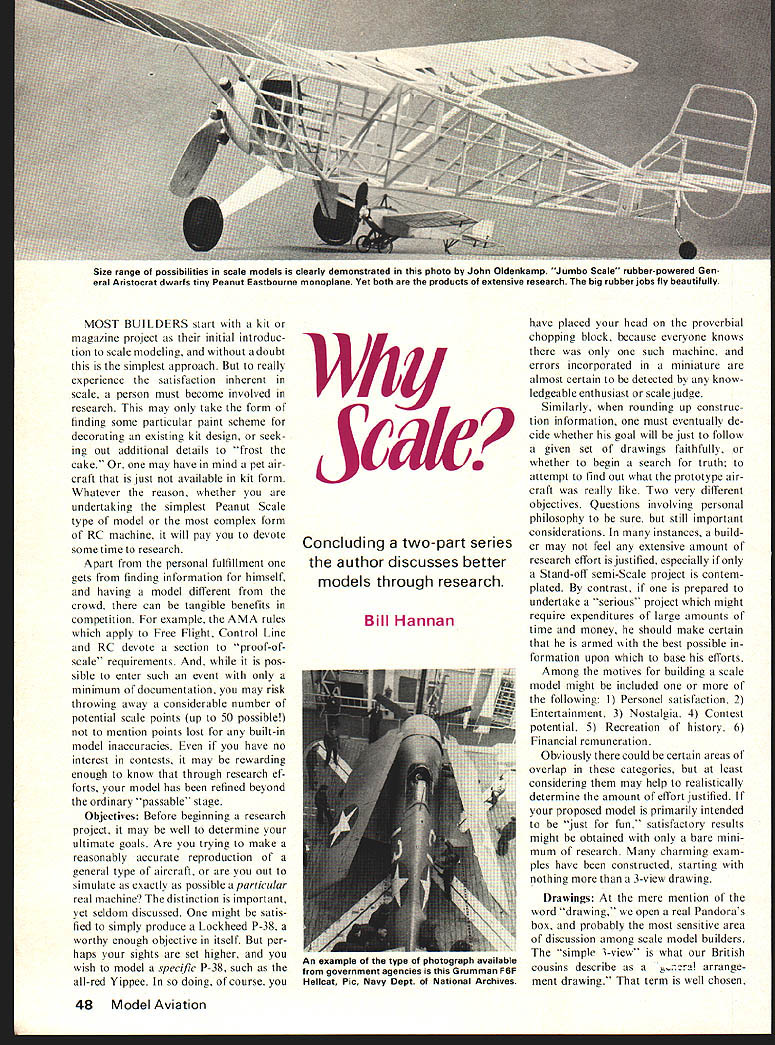
MOST BUILDERS start with a kit or magazine project as their initial introduction to scale modeling, and without a doubt this is the simplest approach. But to really experience the satisfaction inherent in scale, a person must become involved in research. This may only take the form of finding some particular paint scheme for decorating an existing kit design, or seeking out additional details to "frost the cake." Or one may have in mind a pet aircraft that is just not available in kit form.
Whatever the reason, whether you are undertaking the simplest Peanut Scale type of model or the most complex form of RC machine, it will pay you to devote some time to research.
Apart from the personal fulfillment one gets from finding information for himself, and having a model different from the crowd, there can be tangible benefits in competition. For example, the AMA rules which apply to Free Flight, Control Line and RC devote a section to "proof-of-scale" requirements. And, while it is possible to enter such an event with only a minimum of documentation, you may risk throwing away a considerable number of potential scale points (up to 50 possible!) not to mention points lost for any built-in model inaccuracies. Even if you have no interest in contests, it may be rewarding enough to know that through research efforts, your model has been refined beyond the ordinary "passable" stage.
Objectives: Before beginning a research project, it may be well to determine your ultimate goals. Are you trying to make a reasonably accurate reproduction of a general type of aircraft, or are you out to simulate as exactly as possible a particular real machine? The distinction is important, yet seldom discussed. One might be satisfied to simply produce a Lockheed P-38, a worthy enough objective in itself. But perhaps your sights are set higher, and you wish to model a specific P-38, such as the all-red Yippee. In so doing, of course, you have placed your head on the proverbial chopping block, because everyone knows there was only one such machine, and errors incorporated in a miniature are almost certain to be detected by any knowledgeable enthusiast or scale judge.
Similarly, when rounding up construction information, one must eventually decide whether his goal will be just to follow a given set of drawings faithfully, or whether to begin a search for truth; to attempt to find out what the prototype aircraft was really like. Two very different objectives. Questions involving personal philosophy to be sure, but still important considerations. In many instances, a builder may not feel any extensive amount of research effort is justified, especially if only a Stand-off semi-Scale project is contemplated. By contrast, if one is prepared to undertake a "serious" project which might require expenditures of large amounts of time and money, he should make certain that he is armed with the best possible information upon which to base his efforts.
Among the motives for building a scale model might be included one or more of the following: 1) Personal satisfaction, 2) Entertainment, 3) Nostalgia, 4) Contest potential, 5) Recreation, 6) History, 7) Financial remuneration.
Obviously there could be certain areas of overlap in these categories, but at least considering them may help to realistically determine the amount of effort justified. If your proposed model is primarily intended to be "just for fun," satisfactory results might be obtained with only a bare minimum of research. Many charming examples have been constructed, starting with nothing more than a 3-view drawing.
Drawings: At the mere mention of the word "drawings," we open a real Pandora's box and probably the most sensitive area of discussion among scale model builders. The "simple 3-view" is what our British cousins describe as a "plan-arrangement" drawing. That term is well chosen, because such drawings often present just a limited amount of information. As such, they might be suitable for a basic rubber-driven free flight or minimum RC Stand-off Scale model, but surely much better source information must be obtained. Ah, but what of the "super-detailed" scale drawings? Surely they are a much better source of information! To that assumption, we must give a qualified "maybe." Even the most detailed of drawings are still only someone's representation of an aircraft's configuration. Regardless of complexity, any given drawing should be regarded with extreme caution. The danger is to confuse quantity of information with quality of information. After all, such drawings are not the product of divine revelation, but rather the product of human effort. A great deal of it, perhaps, but still quite subject to human error. One might even say that the more details that are included, the more chances exist for inaccuracies to creep in! Even assuming accuracy in drawing, reproduction processes can almost be depended upon to introduce certain distortions, owing to such variables as shrinkage and stretching of paper and film, lens aberrations, effects of chemicals and climate, improper exposure, and such-like. Although it may seem cruel, the safest approach in evaluating line drawings is to consider them suspect until proven correct.
Color drawings or paintings reveal yet another important facet of an aircraft's character. Unfortunately, they are only the result of some artist's impression of the subject, and are subject to even more translation between the originator and the final printed reproduction, owing to the nature of the color process involved. Examination of, for example, magazine covers several thousand issues apart in the print run will reveal astonishing differences in color rendition. Thus, all color drawings must also be taken with a grain-of-salt, and more likely, a shaker full! Drawings should be regarded as useful tools, but not the final word. It is best to assume that at least minor errors exist, and in fact, if they are only minor, consider yourself lucky. If at all possible, try to obtain two or three different drawings to your proposed subject. Even seemingly "bad" drawings can sometimes offer clues as to the character of the aircraft, if only to point out where it doesn't look quite right! Of course in the case of some obscure birds, finding even one drawing can be something of a challenge.
The foregoing sounds as if it is a blanket condemnation of all aircraft drawings. Not so. Rather, the intention is merely to warn scale builders to be on their guard against possible "sources" of misinformation. The perfect scale drawing has yet to be produced, but then neither has the perfect scale model! As you develop your own working drawings, you will gain a fresh respect for the difficulties involved, and any cynicism toward scale draftsmen may mellow somewhat.
Dimensions and Specifications:
When conducting research, keep on the alert for any written descriptive information relating to your subject. Often useful data can be found, which will enable cross-checking of drawings. Dimensions such as wing span and chord are usually given along with the overall length, etc. Also, apparent discrepancies in drawings can sometimes be resolved by careful reading of the descriptive material, which may explain that the craft has been subject to modification or different variations. Color schemes are less frequently presented, but so are surface treatment and finish. Also, interior features, such as instrumentation may be described, which, though not as useful as drawings or photos, may be better than nothing.
Why Scale?
note of caution, however: The printed word is also open to question. As in the case of drawings, one should consider the possibility of typographical errors or just plain mistakes. Well-known historian Pete Bowers did an article on the Fokker Triplane, for the Cross & Cockade society during 1964, in which he pointed out the surprising amount of discrepancies in published dimensions, which varied from source to source by as much as one foot in the case of the horizontal tail span! He explained that such errors can be attributed to hurriedly-made measurements in the field, and poor arithmetic in conversion of metric measurements to English units.
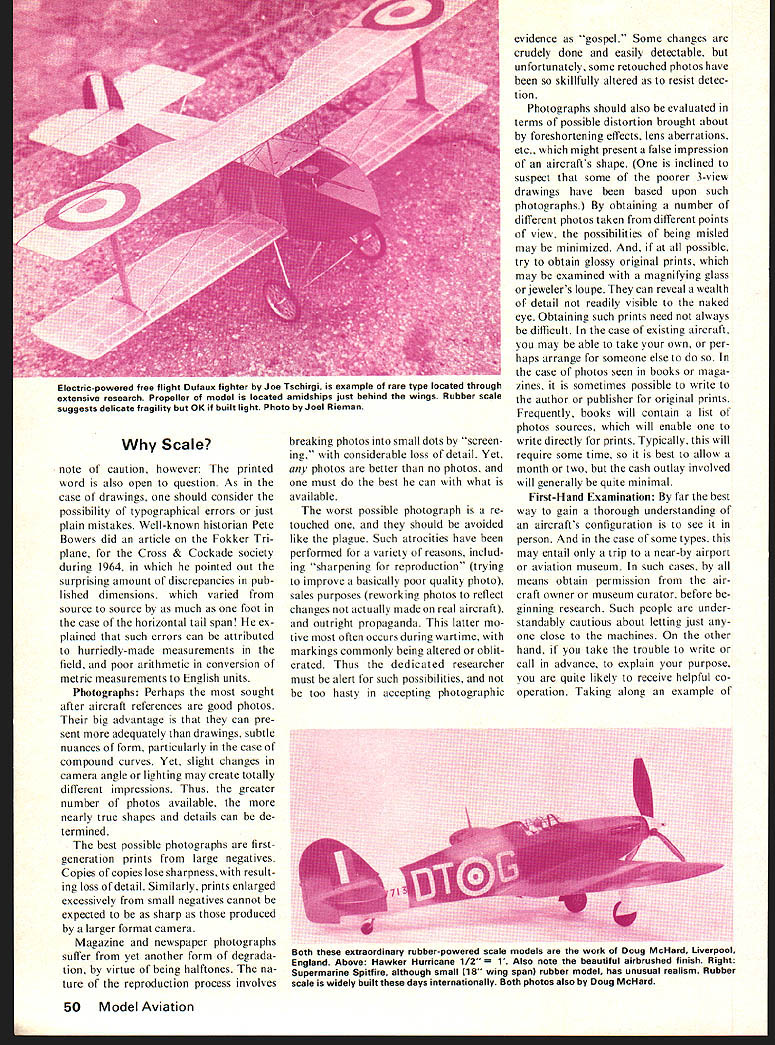
Photographs: Perhaps the most sought after aircraft references are good photos. Their big advantage is that they can present more adequately than drawings, subtle nuances of form, particularly in the case of compound curves. Yet, slight changes in camera angle or lighting may create totally different impressions. Thus, the greater number of photos available, the more nearly true shapes and details can be determined.
The best possible photographs are first-generation prints from large negatives. Copies of copies lose sharpness, with resulting loss of detail. Similarly, prints enlarged excessively from small negatives cannot be expected to be as sharp as those produced by a larger format camera.
Magazine and newspaper photographs suffer from yet another form of degradation, by virtue of being halftones. The nature of the reproduction process involves breaking photos into small dots by "screening," with considerable loss of detail. Yet, any photos are better than no photos, and one must do the best he can with what is available.
The worst possible photograph is a retouched one, and they should be avoided like the plague. Such atrocities have been performed for a variety of reasons, including "sharpening for reproduction" (trying to improve a basically poor quality photo), sales purposes (reworking photos to reflect changes not actually made on real aircraft), and outright propaganda. This latter motive most often occurs during wartime, with markings commonly being altered or obliterated. Thus the dedicated researcher must be alert for such possibilities, and not be too hasty in accepting photographic evidence as "gospel." Some changes are crudely done and easily detectable, but unfortunately, some retouched photos have been so skillfully altered as to resist detection.
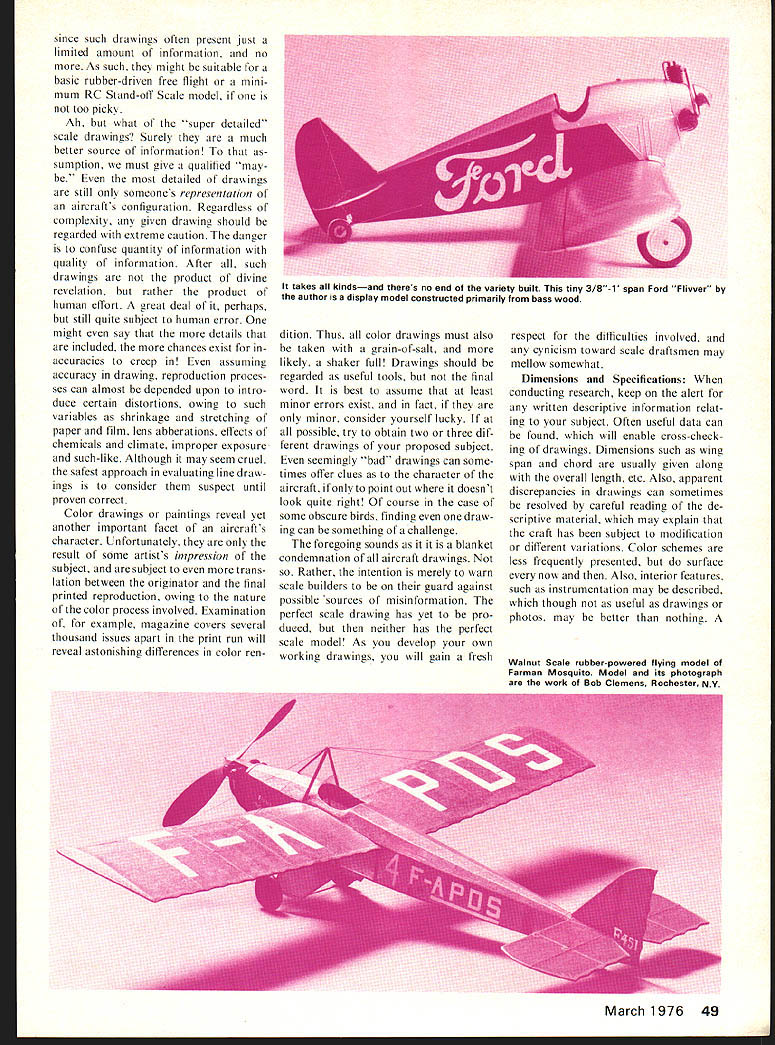
Photographs should also be evaluated in terms of possible distortion brought about by foreshortening effects, lens aberrations, etc., which might present a false impression of an aircraft's shape. (One is inclined to suspect that some of the poorer 3-view drawings have been based upon such photographs.) By obtaining a number of different photos taken from different points of view, the possibilities of being misled may be minimized. And, if at all possible, try to obtain glossy original prints, which may be examined with a magnifying glass or jeweler's loupe. They can reveal a wealth of detail not readily visible to the naked eye. Obtaining such prints need not always be difficult. In the case of existing aircraft, you may be able to take your own, or perhaps arrange for someone else to do so. In the case of photos seen in books or magazines, it is sometimes possible to write to the author or publisher for original prints. Frequently, books will contain a list of photo sources, which will enable one to write directly for prints. Typically, this will require some time, so it is best to allow a month or two, but the cash outlay involved will generally be quite minimal.
First-Hand Examination
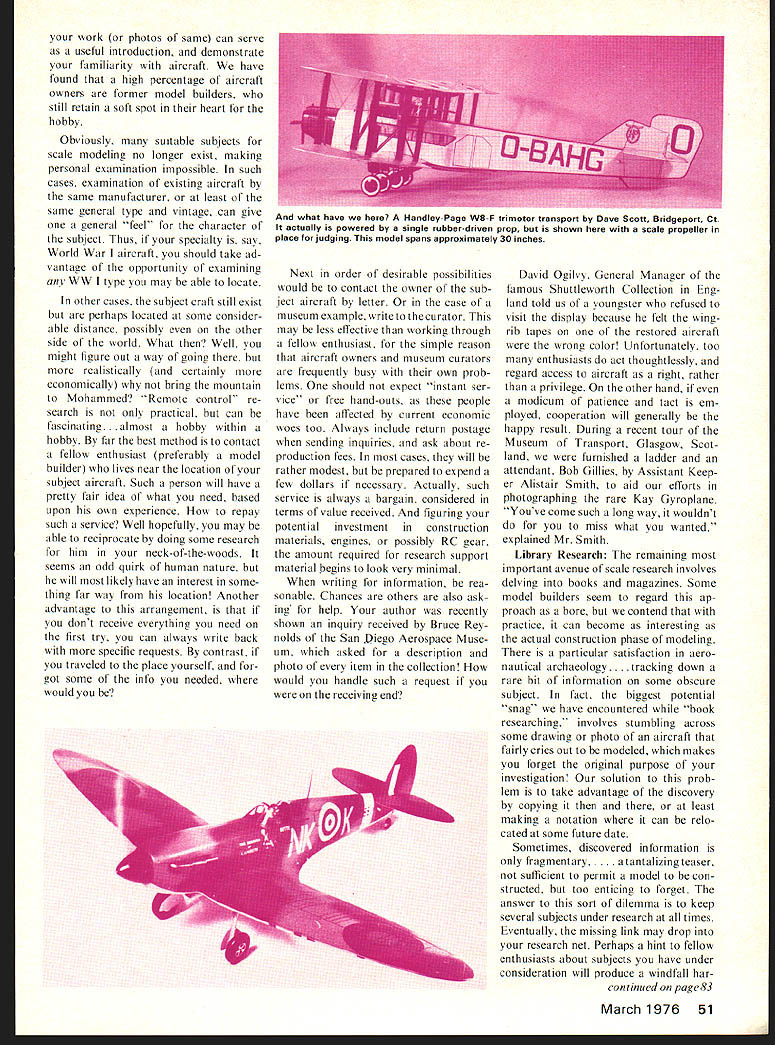
By far the best way to gain a thorough understanding of an aircraft's configuration is to see it in person. And in the case of some types, this may entail only a trip to a near-by airport or aviation museum. In such cases, by all means obtain permission from the aircraft owner or museum curator before beginning research. Such people are understandably cautious about letting just anyone close to the machines. On the other hand, if you take the trouble to write or call in advance, to explain your purpose, you are quite likely to receive helpful cooperation. Taking along an example of your work (or photos of same) can serve as a useful introduction, and demonstrate your familiarity with aircraft. We have found that a high percentage of aircraft owners are former model builders, who still retain a soft spot in their heart for the hobby.
Obviously, many suitable subjects for scale modeling no longer exist, making personal examination impossible. In such cases, examination of existing aircraft by the same manufacturer, or at least of the same general type and vintage, can give one a general "feel" for the character of the subject. Thus, if your specialty is, say, World War I aircraft, you should take advantage of the opportunity of examining any WW I type aircraft you may be able to locate.
In other cases, the subject craft still exist but are perhaps located at some considerable distance, possibly even on the other side of the world. What then? Well, you might figure out a way of going there, but more realistically (and certainly more economically) why not bring the mountain to Mohammed? "Remote control" research is not only practical, but can be fascinating... almost a hobby within a hobby. By far the best method is to contact a fellow enthusiast (preferably a model builder) who lives near the location of your subject aircraft. Such a person will have a pretty fair idea of what you need, based upon his own experience. How to repay such a service? Well, hopefully, you may be able to reciprocate by doing some research for him in your neck-of-the-woods. It seems an odd quirk of human nature, but he will most likely have an interest in something far away from his location! Another advantage to this arrangement, is that if you don't receive everything you need on the first try, you can always write back with more specific requests. By contrast, if you traveled to the place yourself, and forgot some of the info you needed, where would you be?
Next in order of desirable possibilities would be to contact the owner of the subject aircraft by letter. Or in the case of a museum, example, write to the curator. This may be less effective than working through a fellow enthusiast, for the simple reason that aircraft owners and museum curators are frequently busy with their own problems. One should not expect "instant service" or free hand-outs, as these people have been affected by current economic woes too. Always include return postage when sending inquiries, and ask about reproduction fees. In most cases, they will be rather modest, but be prepared to expend a few dollars if necessary. Actually, such service is always a bargain, considered in terms of value received. And figuring your potential investment in construction materials, engines, or possibly RC gear, the amount required for research support material begins to look very minimal.
When writing for information, be reasonable. Chances are others are also asking for help. As your author was recently shown, an inquiry received by Bruce Reynolds of the San Diego Aerospace Museum asked for a description and photo of every item in the collection! How would you handle such a request if you were on the receiving end?
David Ogilvy, General Manager of the famous Shuttleworth Collection in England, told us of a youngster who refused to visit the display because he felt the wing-rib tapes on one of the restored aircraft were the wrong color! Unfortunately, too many enthusiasts do act thoughtlessly, and regard access to aircraft as a right, rather than a privilege. On the other hand, if even a modicum of patience and tact is employed, cooperation will generally be the happy result. During a recent tour of the Museum of Transport, Glasgow, Scotland, we were furnished a ladder and an attendant. Bob Gillies, by Assistant Keeper Alistair Smith, to aid our efforts in photographing the rare Kay Gyroplane. "You've come such a long way, it wouldn't do for you to miss what you wanted," explained Mr. Smith.
Library Research:
The remaining most important avenue of scale research involves delving into books and magazines. Some doubtful users seem to regard this approach as a bore, but we contend that with practice, it can become as interesting as the actual construction phase of modeling. There is a particular satisfaction in aeronautical archaeology... tracking down a rare bit of information on some obscure subject. In fact, the biggest potential "snag" we have encountered while "book researching," involves stumbling across some drawing or photo of an aircraft that fairly cries out to be modeled, which makes you forget your original purpose of your investigation! Our solution to this problem is to take advantage of the discovery by copying it then and there, or at least making a notation where it can be relocated at some future date.
Sometimes, discovered information is only fragmentary... a tantalizing teaser, not sufficient to permit a model to be constructed, but too enticing to forego. The answer to this sort of dilemma is to keep several subjects under research at all times. Eventually, the missing link may drop into your research net. Perhaps a hint to fellow enthusiasts about subjects you have under consideration will produce a windfall harvest. of material, especially if their interests are similar to your own. Locally, the Flightmasters all-scale club sponsor various differing types of scale contests, including rise-off-water events, Indoor Scale, Peanut Scale, Jumbo Scale, Rubber Scale Speed, as well as the more traditional categories. By keeping a file of widely varied subjects under active research, chances are one will prove appropriate for at least one event! The big trick, of course, is to discover a subject that will qualify for several events.
Proof-of-Scale:
Returning to the AMA competition rules, mentioned at the beginning of this article, it is well to consider putting together the required scale judging information in advance of constructing your model. Altogether too many builders neglect their proof-of-scale presentation until the last minute. By organizing it prior to starting the model, it will, in effect, give you a preview of what the judges will see first. By browsing through it at odd moments, you may be better able to discern the real essence of your subject... mentally boiling it down into the most important features... the "character" of the craft. After the model has been completed, you may decide to rearrange or revise your scale presentation, but the vital part will have been accomplished, without being under contest deadline pressures.
Another aspect of proof-of-scale presentation not frequently mentioned involves gamesmanship. We referred earlier to the varying complexity of scale drawings. In cases where several drawings have been located, make your selection carefully. If you only contemplate building a fairly basic Peanut or Walnut Scale model, you may be giving yourself a needless handicap by presenting a super-detailed scale drawing to the judges! Perhaps a plain generalized arrangement drawing would have a psychological advantage, since by comparison, your model would appear much more complex and detailed! Similarly, if through lack of time or by choice you have omitted a few details, why present the judges with photos which accent those areas? Rather, select photos which flatter areas where you have devoted special efforts in finishing.
Make Your Own Scale Drawings:
Finally, if you would like to discuss a most logical, yet seldom pursued solution to the inaccurate or non-existent scale drawing dilemma, we refer to item b, section 40, Unified Scale Judging (RC, CL and Outdoor FF) of the official AMA model aircraft regulations. In this paragraph, provision is clearly set forth for the possibility of producing one's own proof-of-scale drawings. To date, surprisingly few modelers seem to have taken advantage of this clause. Briefly, scale drawings by the model builder, supported by photos, historical background and data, may be submitted to the AMA Technical Director (Frank Ehling), a scale contest board member, the aircraft manufacturer or other competent authority for approval. Here is a good opportunity to introduce some "fresh" subjects into scale competition. This same provision also allows scope for making corrections to some of the existing 3-view drawings, which are sadly in need of revision.
Nationals winner Tom Stark is one of the few who has followed this procedure to the benefit of us all. Rather than gripe about obvious discrepancies in published scale drawings, why not produce your own, and have them approved? Additionally, you may find that your finished drawing is suitable for publication. This can offer a two-fold bonus: First, the results of your research may be printed, providing credit to you, and second, your drawing may solve the problem for others. The process of producing accurate drawings will also teach you much about the subject, and it will be easier to spot errors in the published material.
Of course, there are practical considerations — time involved, available reference, drawing equipment, etc. But anyone with some patience and basic drafting skills can produce a drawing good enough to be used as proof-of-scale. A simple method is to measure a surviving example, or to use photographs taken from several stations and apply perspective corrections. If the prototype is not available, try to find detailed photographs, factory plans, or even parts that can be measured and scaled up or down. Reduce all measurements to a single scale and lay out the three views carefully.
Make judicious choices in selecting photos for the scale documentation. Photographs that show the overall shape and distinguishing features without emphasizing minor inaccuracies will work best. When presenting the material to the approving authority, include a brief cover letter explaining the sources used and any assumptions made.
Whatever route you follow, keep accurate records of sources and measurements. Build models in stages, comparing periodically with drawings and photos. Don't be afraid to correct or modify a model as new information becomes available. In the end, the satisfaction of having a model that truly represents its prototype is worth the extra effort.
Why Scale (continued)
dedicated efforts can be shared with other modelers, and second, financial remuneration which can be applied toward funding your future projects. Remember, however, that if your drawings are published, you may be on the receiving end of the criticism for producing imperfect results!
Summary: In researching material for scale model use, try to keep the following points in mind:
1) Regard all drawings with caution, regardless of source (even your own!), but obtain as many as possible for comparison purposes before starting model construction.
2) Collect as many photos of your subject as feasible. Allow for possible distortions, odd lighting and particularly retouching.
3) View the subject in person if possible. Alternatively, try to obtain the cooperation of an enthusiast who may be able to examine the aircraft first-hand.
4) Enlist the aid of subject owners or museum curators if items 3 or 4 are out of the question.
5) Always include return postage and inquire about reproduction fees when seeking information by mail.
6) Expect to produce your own drawings, or at least make additions and/or corrections to existing plans.
7) If competition is one of your objectives, think in terms of proof-of-scale documentation presentation from the outset of your research project.
8) Share the results of your efforts and enthusiasm with fellow scale modelers. They constitute a special minority group with a common bond, international in scope, which deserves preservation and careful nurturing.
9) Check, check and check again. We may never reach the "zero-defect" stage, but we can have fun trying!
The author is indebted to many individuals who helped "show the way" over the years. To thank a few is to risk overlooking the many, but special recognition is due: J. D. Gillies, Ced Galloway, Ken Sykora, Bill Warner, Bill Kreeck, Granger Williams, John Underwood, Russ Barrera, plus all the Flightmasters.
Useful Publications for Scale Model Researchers
While a list of potential helpful book titles could fill a book themselves, and every serious scale modeler should cultivate a library devoted to his specialties, we have selected a few which may help out with the preliminary "spadework" of research. Although some may be out of print, they should be accessible in large libraries and aviation museums.
Flying Scale Models, by R. G. Moulton, published by the Model and Allied Publications Ltd., England. (Probably the single most comprehensive book available on the subject.)
Veteran and Vintage Aircraft. Compiled by Leslie Hunt, published by the Garnstone Press Limited, England, 1974. (The world's preserved aircraft; where they are; what they look like; who owns them.)
Museum and Display Aircraft of the World. Compiled by Stephen Munson, published by the American Aviation Historical Society, circa 1968. (Museum aircraft and their locations.)
The Vintage and Veteran Aircraft Guide. Compiled by John Underwood, published by Heritage Press, 1968. (Photos, facts and specific histories.)
The Aircraft of the World. William Green and Gerald Pollinger, published by Doubleday and Company, Inc., 1965 (other editions were also published). (Photos, specifications, and silhouette drawings.)
Jane's All the World's Aircraft. A series of books published in England covering the period 1909 through the present. (Photos, specifications, and some 3-view drawings.)
The Aircraft Year Book. Compiled by the Aeronautical Chamber of Commerce of America, Inc. (various publishers). A series of books covering American aircraft and engines, published for many years. (Photos, specifications, and 3-view drawings.)
Transcribed from original scans by AI. Minor OCR errors may remain.

