
Why We Have Showteams
Show teams play an important role in promoting model aviation. They act as ambassadors to the sport by attracting public attention and creating enthusiastic interest through exhibition flying.
Duke Iden
Definition and purpose
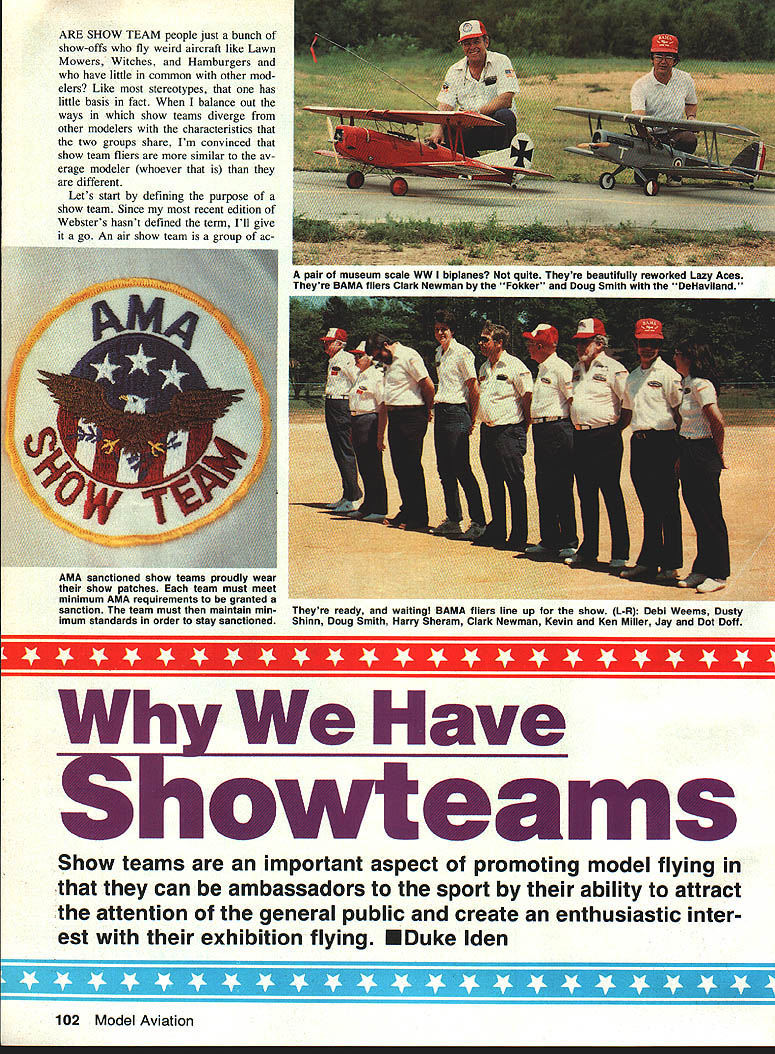
An air show team is a group of active model airplane hobbyists who want to share the fun with the general public, thereby exposing people to what the hobby is about and helping promote the sport. Rather than being merely show-offs who fly oddball aircraft, show-team members are often very similar to the average modeler: people who enjoy building, flying, and displaying a wide variety of models and want others to appreciate the hobby.
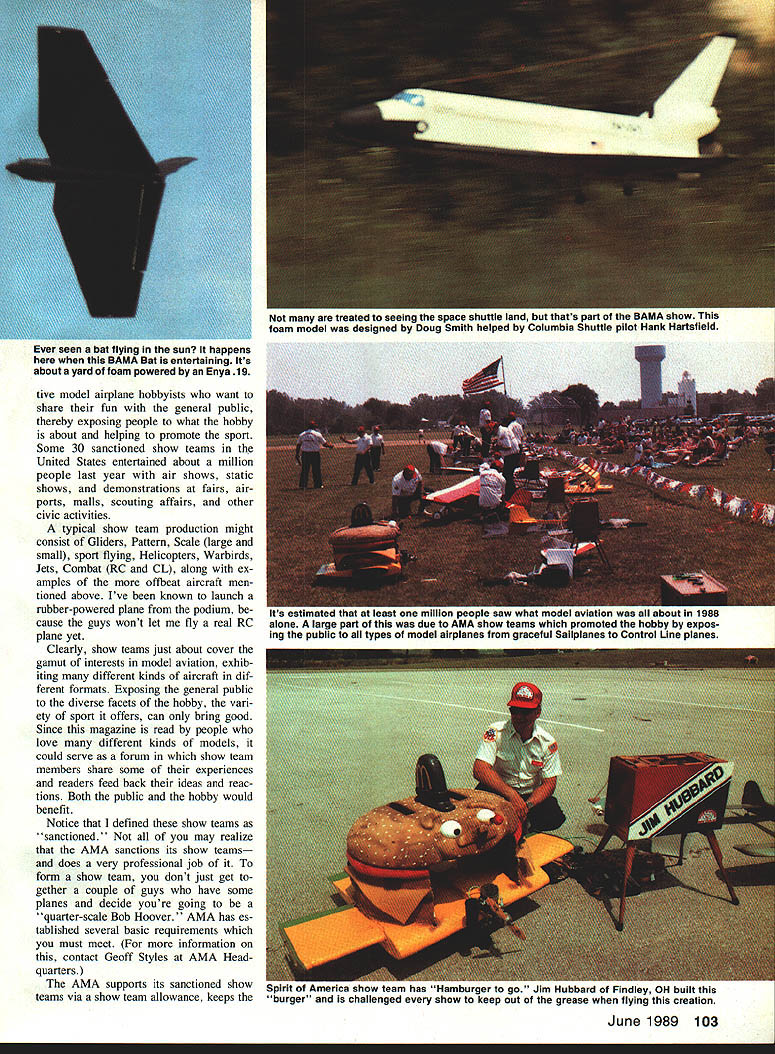
Some 30 sanctioned show teams in the United States entertain about a million people each year at air shows, static displays, demonstrations, fairs, airport events, mall events, scouting affairs, and other civic activities.
What show teams do
A typical show-team production can include many facets of model aviation, for example:
- Gliders and sailplanes
- Pattern and precision aerobatics
- Scale models (large and small)
- Sport flying
- Helicopters and jets
- Warbirds
- Combat (RC and control-line)
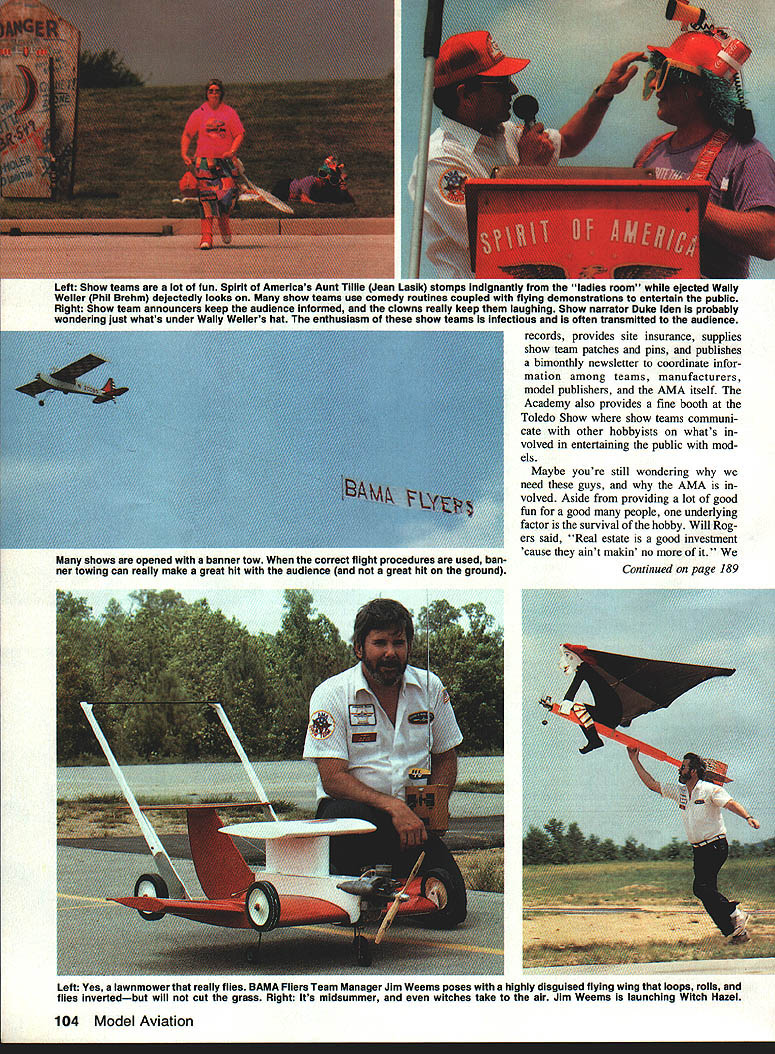
- Offbeat or novelty aircraft (e.g., themed or humorous models)
- Static displays and educational demonstrations
Show teams demonstrate the diversity of the hobby and expose the public to the range of aircraft and flying formats available.
AMA involvement and support
The Academy of Model Aeronautics (AMA) sanctions many show teams and provides professional support. AMA’s role includes:
- Establishing basic requirements for sanctioned teams (do not form a team by simply getting a few planes together and calling yourselves a professional act).
- Maintaining records and coordinating teams.
- Providing site insurance.
- Supplying show-team patches and pins.
- Offering a show-team allowance.
- Publishing a bimonthly newsletter to coordinate information among teams, manufacturers, model publishers, and AMA staff.
- Staffing an informational booth (for example, at the Toledo Show) where show teams can communicate with other hobbyists and the public.
For information on AMA show-team requirements and support, contact Geoff Styles at AMA Headquarters.
Public impact and advocacy
Model air shows create opportunities to change public perception. Reactions from first-time viewers often progress from wonder at the craftsmanship (“I never saw one of these up close — they’re beautiful”) to admiration of skill (“It looks just like the real thing up there”) to curiosity about how to get involved (“How do you get started?”).
The people who watch these shows may include state senators, zoning commissioners, park board members, or other local decision-makers. A well-run show and courteous, knowledgeable show-team members can turn spectators into friends or allies — people more likely to support a club’s need for flying sites and less likely to oppose them. Exposure and good public relations are vital to the survival and growth of the hobby. As Will Rogers said, “Real estate is a good investment because they aren’t making any more of it.”
Resources and contacts
- For AMA show-team information and requirements: contact Geoff Styles, AMA Headquarters.
- For Old-Timer (OT) Stunt plans and nostalgia stunt information: John Miske, Jr. has extensive information and plans.
- Plans for OT, Nostalgia, and modern Stunters are also available from Tom Dixon.
- For information on Vintage Stunt or to inquire about joining the Precision Aerobatics Model Pilots Association (PAMPA), write to the author or to JoAnn at:
6618 Dashwood St., Lakewood, CA 90713
Closing
Show teams are simply groups of hobbyists who come together to have a good time and to demonstrate how others can enjoy model aircraft. They help promote the sport, educate the public, and build community support that protects flying sites and grows the hobby.
Transcribed from original scans by AI. Minor OCR errors may remain.

