
The Winged World of Ned Kragness
As told to Col. Hurst Bowers (Ret.)
Ned Kragness is a scientist for the Department of Defense. He has been an engineering test pilot, barnstormer, and bush pilot. First and foremost, however, he is a modeler.
Although few of today's hobbyists were among the young students who flocked to aircraft modeling during the post-Lindbergh era of the 1930s, those who were there then are now retiring and returning to the fold in large numbers. Many are coming off colorful aviation careers — capable chaps with a pent-up drive to build extraordinary models long dreamed about. Their skills, insights, and stories about planes both big and little are mind-blowing. You sometimes meet them now at club meetings or in bull sessions with others who are so addicted to the hobby. Ned Kragness is one of them.
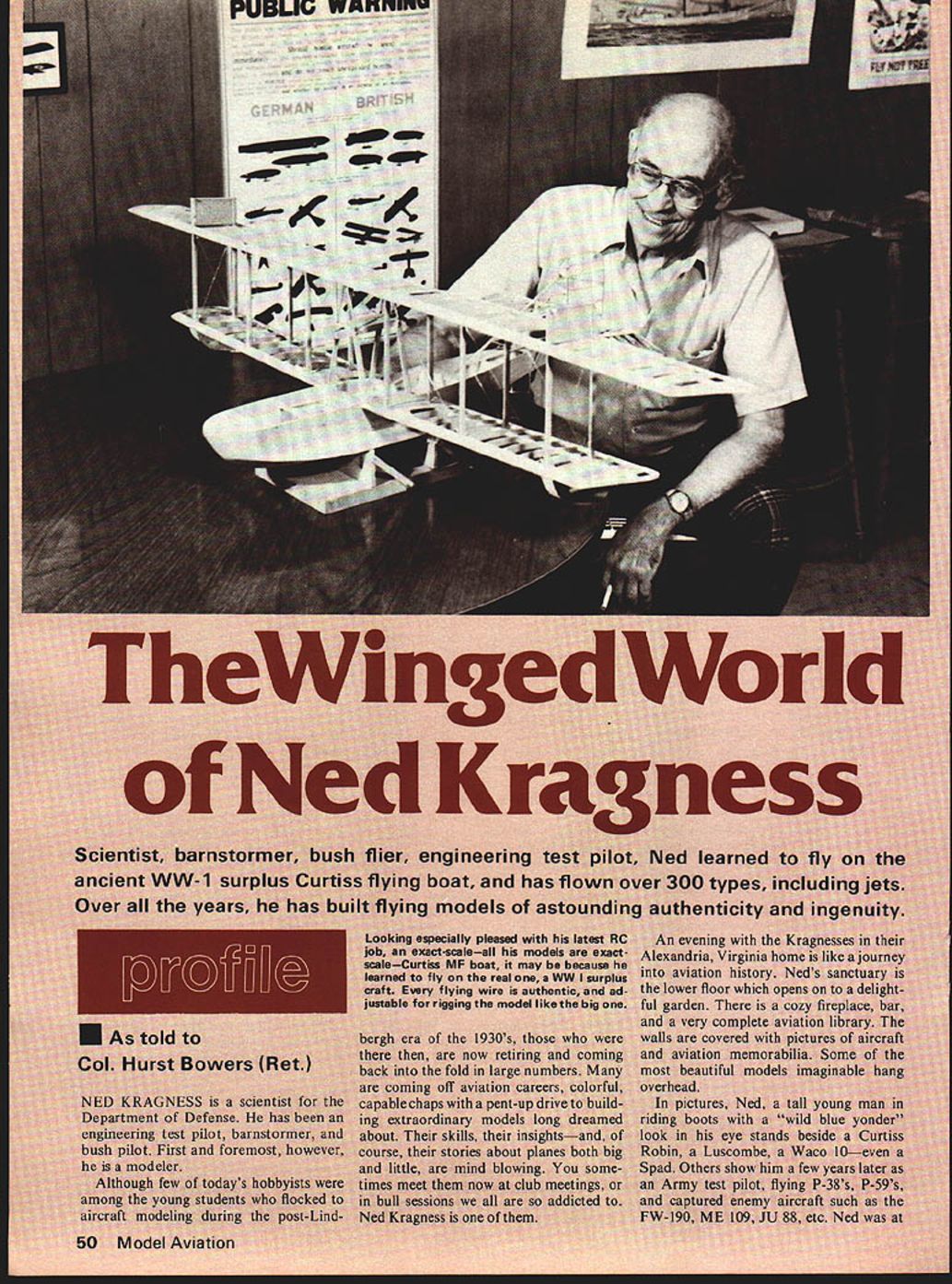
Looking especially pleased with his latest radio-control job, an exact-scale — as all his models are — Curtiss MF flying boat, he may well be because he learned to fly on the real one, a World War I surplus craft. Every flying wire is authentic and adjustable for rigging the model like the big one.
An evening with the Kragnesses in their Alexandria, Virginia home is like a journey into aviation history. Ned's sanctuary is the lower floor, which opens onto a delightful garden. There is a cozy fireplace, a bar, and a very complete aviation library. The walls are covered with pictures of aircraft and aviation memorabilia. Some of the most beautiful models imaginable hang overhead.
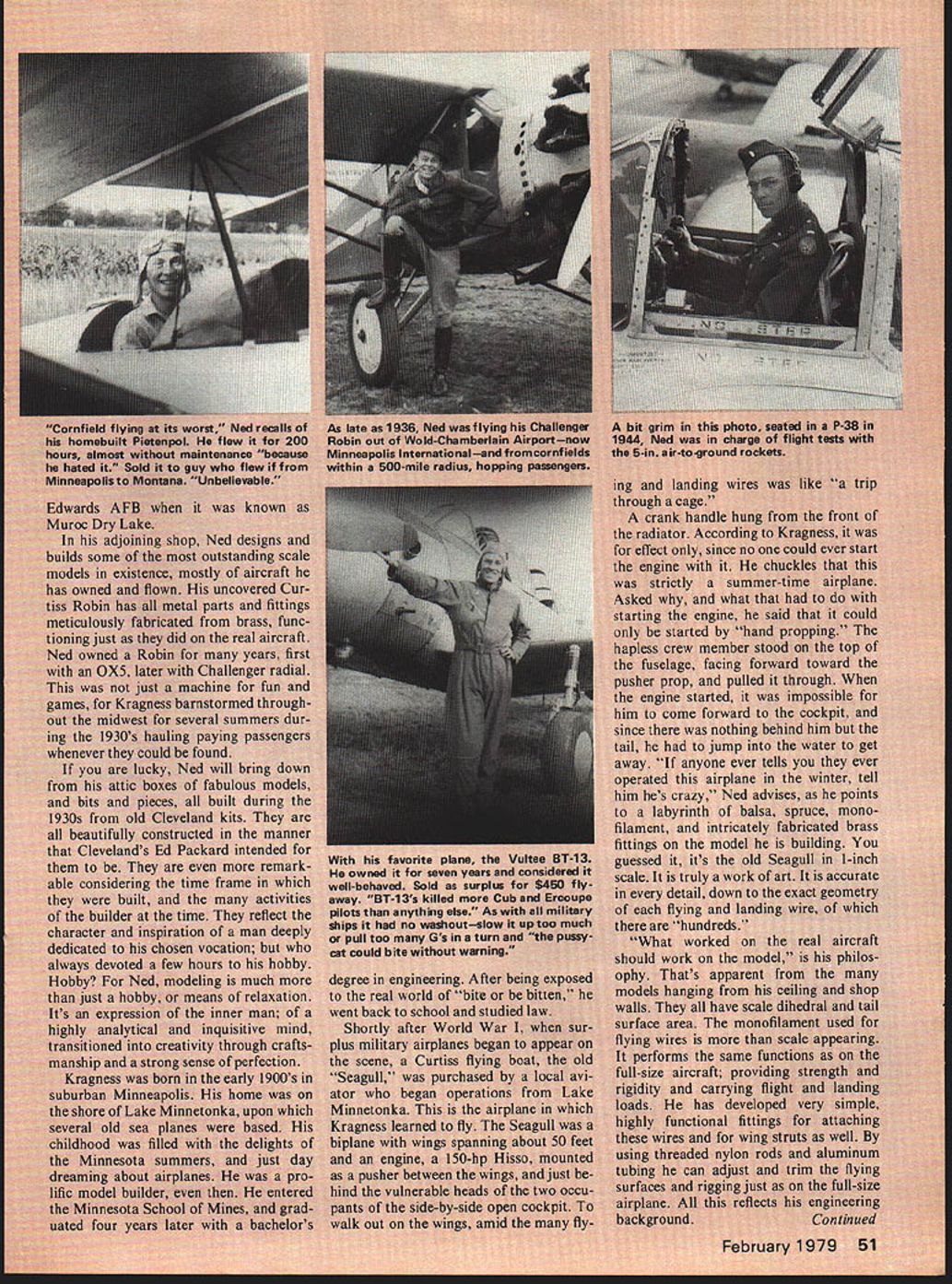
In pictures, Ned — a tall man in riding boots with a "wild blue yonder" look in his eye — stands beside a Curtiss Robin, a Luscombe, a Waco 10, even a Spad. Others show him a few years later as an Army test pilot flying P-38s, P-59s, and captured enemy aircraft such as the Fw 190, Me 109, Ju 88, etc. Ned was at Edwards AFB when it was known as Muroc Dry Lake.
In his adjoining shop, Ned designs and builds some of the most outstanding scale models in existence, mostly of aircraft he has owned and flown. His uncovered Curtiss Robin has all metal parts and fittings meticulously fabricated from brass, functioning just as they did on the real aircraft. Ned owned a Robin for many years, first with an OX-5, later with a Challenger radial. This was not just a machine for fun and games: Kragness barnstormed throughout the Midwest for several summers during the 1930s, hauling paying passengers whenever they could be found.
If you are lucky, Ned will bring down from his attic boxes of fabulous models and bits and pieces, all built during the 1930s from old Cleveland kits. They are all beautifully constructed in the manner that Cleveland's Ed Packard intended. They are even more remarkable considering the time frame in which they were built and the many activities of the builder at the time. They reflect the character and inspiration of a man deeply dedicated to his chosen vocation who always devoted a few hours to his hobby.
Hobby? For Ned, modeling is much more than just a hobby or means of relaxation. It's an expression of the inner man: a highly analytical and inquisitive mind transitioning into creativity through craftsmanship and a strong sense of perfection.
Early life and training
Kragness was born in the early 1900s in suburban Minneapolis. His home was on the shore of Lake Minnetonka, upon which several old seaplanes were based. His childhood was filled with the delights of Minnesota summers and daydreaming about airplanes. He was a prolific model builder even then.
He entered the Minnesota School of Mines and graduated four years later with a bachelor's degree in engineering. After exposure to the real world of "bite or be bitten," he went back to school and studied law.
Shortly after World War I, when surplus military airplanes began to appear, a Curtiss flying boat — the old "Seagull" — was purchased by a local aviator who began operations from Lake Minnetonka. This is the airplane in which Kragness learned to fly. The Seagull was a biplane with wings spanning about 50 feet and a 150-hp Hisso engine mounted as a pusher between the wings, just behind the vulnerable heads of the two occupants in the side-by-side open cockpit. To walk out on the wings amid the many flying and landing wires was like "a trip through a cage."
A crank handle hung from the front of the radiator. According to Kragness, it was for effect only, since no one could ever start the engine with it. He chuckles that this was strictly a summertime airplane. Asked why, and what that had to do with starting the engine, he said it could only be started by hand propping. The hapless crew member stood on the top of the fuselage facing forward toward the pusher prop and pulled it through. When the engine started, it was impossible for him to come forward to the cockpit; since there was nothing behind him but the tail, he had to jump into the water to get away. "If anyone ever tells you they operated this airplane in the winter, tell him he's crazy," Ned advises, as he points to a labyrinth of balsa, spruce, monofilament, and intricately fabricated brass fittings on the model he is building. You guessed it: it's the old Seagull in 1-inch scale. It is truly a work of art, accurate in every detail down to the exact geometry of each flying and landing wire — of which there are hundreds.
Modeling: philosophy and techniques
"'What worked on the real aircraft should work on the model' is his philosophy." That's apparent from the many models hanging from his ceiling and shop walls. They all have scale dihedral and tail surface area. The monofilament used for flying wires is more than merely for scale appearance; it performs the same functions as on the full-size aircraft: providing strength and rigidity and carrying flight and landing loads. He has developed very simple, highly functional fittings for attaching these wires and for wing struts. By using threaded nylon rods and aluminum tubing he can adjust and trim the flying surfaces and rigging just as on the full-size airplane. All this reflects his engineering background.
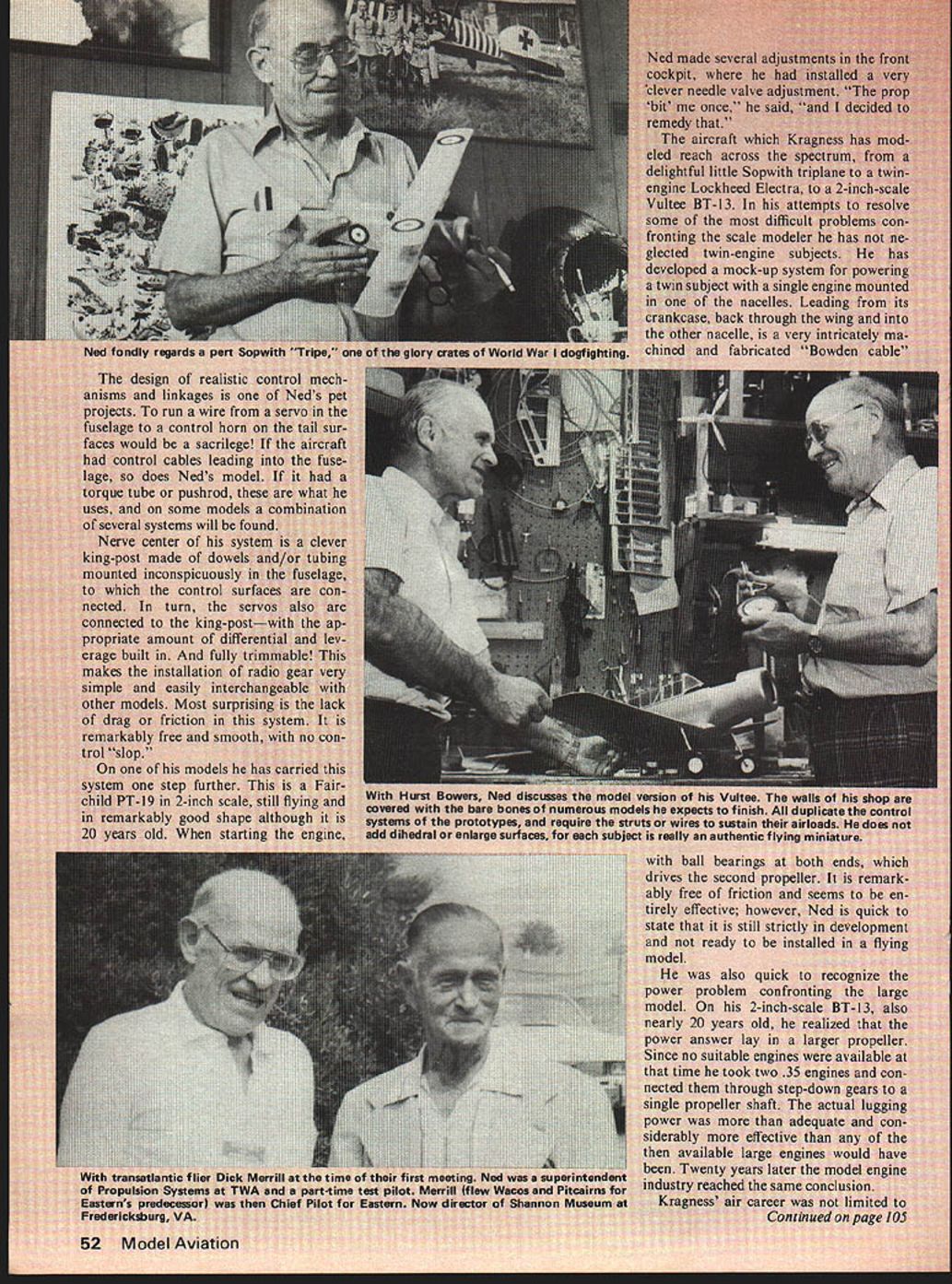
The design of realistic control mechanisms and linkages is one of Ned's pet projects. Running a single wire from a servo in the fuselage to a control horn on the tail surfaces would be a sacrilege. If the full-scale aircraft had control cables leading into the fuselage, so does Ned's model. If it had a torque tube or pushrod, these are what he uses. On some models a combination of several systems will be found.
The nerve center of his system is a clever king-post made of dowels and/or tubing mounted inconspicuously in the fuselage, to which the control surfaces are connected. In turn, the servos are also connected to the king-post — with the appropriate amount of differential and leverage built in. And fully trimmable! This makes the installation of radio gear very simple and easily interchangeable with other models. Most surprising is the lack of drag or friction in this system. It is remarkably free and smooth, with no control "slop."
On one model he has carried this system one step further. This is a Fairchild PT-19 in 2-inch scale, still flying and in remarkably good shape although it is 20 years old. When starting the engine, Ned made several adjustments in the front cockpit, where he had installed a very clever needle-valve adjustment. "The prop 'bit' me once," he said, "and I decided to remedy that."
Notable models and inventions
The aircraft Kragness has modeled reach across the spectrum, from a delightful little Sopwith triplane to a twin-engine Lockheed Electra to a 2-inch-scale Vultee BT-13. In his attempts to resolve some of the most difficult problems confronting the scale modeler he has not neglected twin-engine subjects. He has developed a mock-up system for powering a twin subject with a single engine mounted in one nacelle. Leading from its crankcase, back through the wing and into the other nacelle, is a very intricately machined and fabricated Bowden-cable with ball bearings at both ends, which drives the second propeller. It is remarkably free of friction and seems entirely effective; however, Ned is quick to state that it is still strictly in development and not ready to be installed in a flying model.
He was also quick to recognize the power problem confronting the larger model. On his 2-inch-scale BT-13, also nearly 20 years old, he realized the power answer lay in a larger propeller. Since no suitable engines were available at that time he took two .35 engines and connected them through step-down gears to a single propeller shaft. The actual lugging power was more than adequate and considerably more effective than any of the then-available large engines would have been. Twenty years later the model engine industry reached the same conclusion.
Kragness has developed remarkable techniques for constructing monocoque fuselages and has applied them to the BT-13. He has also developed another clever control system for this model, completely enclosed in the tail cone. These models have flown free flight (FF) and radio control (RC) with considerable success, and the techniques are being applied to other subjects. Several of these techniques have been the subject of magazine articles.
Aircraft and models (selected)
- Models: Curtiss MF flying boat (Seagull), Curtiss Robin, Sopwith triplane, Fairchild PT-19 (2-inch scale), Lockheed Electra, Vultee BT-13 (2-inch scale), Waco 10, Spad.
- Full-size aircraft flown: Curtiss flying boat and other WWI types, Curtiss Robin, Howard racers, Lockheed Vegas, P-38s, P-59s, P-40s, B-24s, Constellations, Ju 52s, Fw 190s, Me 109s, Ju 88s, and modern jets.
Flying career
Kragness' air career was not limited to barnstorming. During the "golden age" years he flew in air races (the Howard Pete), built home-built aircraft, and rebuilt "bought airplanes," such as his Waco 10. During these operations he meticulously photographed, plumbed, measured, and recorded all structural details and now maintains this data in his reference files. He flew for the old Northwest Airways, using Laird Speedwings, and was a friend of "Speed" Holman. In Canada he bush-flew Bellancas into the most remote areas of the Northwest Territories.
On one such trip Ned tells of picking up a load of mining tools, several dogs, and a pregnant Eskimo woman. Enroute he encountered moderate turbulence when suddenly his attention was grabbed by a loud crack followed by a ripping noise. "You never felt so much cold air." The dogs started barking, the expectant mother began to have pains, and amid all the excitement Ned's assessment determined that the Bellanca's fuselage fabric had torn away from just behind the wing almost back to the fin and was "flapping in the breeze." He was able to maintain flight to the next mining station where he landed for relief and repairs.
Kragness continued to work for the airlines, including Transcontinental and Western (later TWA), leaving them for a special assignment which took him into pre-war Nazi Germany and throughout South America. During this period he was able to fly many foreign aircraft whose names were soon to become household words.
Just prior to World War II he was called to active duty with the Army Air Corps (he held a reserve commission in the Coast Artillery), and his first military flying began when the operations officer, after looking at his logbook, pointed to a North American O-47 on the field and told him to go out and brush up a bit on it.
From then on, his military flying took him to Panama where he flew all the "oddballs," combat tours in P-40s and B-24s in the Pacific, and later to Muroc Dry Lake into test flying and engineering. Just before the war ended, many captured enemy aircraft were brought to Wright Field for flight evaluation and engineering studies in which Kragness was deeply involved. He laughs when he recalls an incident on the ramp at Wright Field when a captured Ju 88 was flown in from Africa. All the brass came out to inspect the new prize and were milling around under the wings, kicking the tires, and doing what pilots do when they see a new machine. One major got into the cockpit and began examining the switches on the armament panel.
"I guess he couldn't read German," Ned recalls, "for soon there was a loud bang and all hell broke loose." The major had thrown a switch which detonated explosive bolts under the wing that were part of an emergency system used to jettison certain external armament loads. Bits and pieces of shrapnel peppered all the brass under the wing. All the injured were awarded the Purple Heart.
Postwar career and later life
After the war Kragness left the service and joined the CAA (later the FAA), where he held many positions of responsibility in engineering and research and in aviation law. But the lure of the cockpit became too strong. He returned to industry and more active flying as an engineering test pilot with Hayes Aircraft and later with Lockheed.
During these years Kragness owned several airplanes; his all-time favorite was an old surplus Vultee "Vibrator" (BT-13), which he flew for fun for seven years. This is a remarkable choice for a pilot who has flown several hundred types.
Kragness went back to government service in 1959. Although his day-to-day responsibilities do not include active flying, he manages to remain proficient in two or three different aircraft types. He is flying a Beech Sierra and most of the Cessna models. But Kragness still manages to spend many hours in his shop and is producing beautiful models, the quality of which seems to improve with each one he builds.
We often think of the active modeler as an individual who spends every spare moment at the flying field amid much ballyhoo. The quality of his model, and whether or not he built it himself, may be of no real concern to him or his admirers. Significant only is how many rolls he can get on a fast flypast with a super "Macho X." But there are many highly active modelers whose needs for expression are satisfied through creativity, such as producing a replica of an aircraft with special aesthetic or nostalgic appeal. Kragness is one of them.
In recognition of Kragness' many varied activities he has received frequent requests for his services as a consultant. From time to time he has represented the Department of Justice, insurance firms, and several large legal firms in litigation regarding aircraft accidents.
Retirement and plans
For Kragness, retirement has no allure. It will be a progression into another career. What are his plans for the future?
"Well," Ned says with a big grin, "I think I'll just do what my neighbor's neutered tomcat, Sam, does: continue consulting."
"There are also many other things that I want to do," he goes on, "such as writing about aviation and model planes, and instructing in Beechs and Cessnas at the local airport." He plans to pursue his other hobbies of photography, music, and the use of his wonderful collection of machine tools.
"Will this provide satisfaction after so many active years in aviation?" I asked him.
"No," he replied, "but there sure are a hell of a lot of models I want to build."
Transcribed from original scans by AI. Minor OCR errors may remain.

