
THE WINNING OF THE 1935 WAKEFIELD TROPHY
A refreshing account that guarantees reading enjoyment for all modelers. It's not a construction project but the plans will please any red-blooded old-timer.
Gordon S. Light
THE FIRST semi-serious go at the Wakefield Trophy was in 1931 at Dayton, OH, at the Fourth National Contest of the Airplane Model League of America, June 29 and 30, 1931. Flying was done at Wright Field and the events were sponsored by the Materiel Division of the U.S. Army Air Corps. Joseph Ehrhardt of St. Louis defended the Wakefield which he had won the year before in England. He won $25 for his troubles. The flight was 264.8 seconds. Lt. Colonel H.H. (the "HAP") Arnold was the executive officer of the Materiel Division and he signed the letter to me in response to my "thank you" note after the contest. This was the first big contest for me. I did 95 seconds and was awarded a Certificate of Distinction, i.e., Honorable Mention—801 place, I think!
The next year I had another whack at it. Atlantic City, Bamberger Aero Club—Charles Grant, the editor of MAN, was the timer for the elimination flights and, together in a motorcycle sidecar, we watched the crate go out over the water, lose altitude, drift back over land, back out, etc., etc. This went on for ten miles and 25 minutes and 53 seconds. Got the crate back in great shape and was ready for the finals—having survived the eliminations. Max Bassett also survived and he was ready, too.
In the finals the crate disappeared after 7 minutes and 57 seconds—the timers didn't chase after them. It landed five miles from the AC Airport—but I didn't know that until Miss Loraine Reynolds found it in her backyard Sunday morning—she fired me a letter. She had read about the contest in the Sunday paper. Name and address was on the side of the fuselage, of course. I got that crate back—pretty much the worse for wear since the trip from Pleasantville, NJ to Lebanon, PA wasn't the best—packing model airplanes is different from most things.
Max had us all worried with the gas machine—he was really cooking but the best (with unlimited gas supply) was 2:55.
After much backing and filling it was finally decided that the contest was not legal and therefore the results kaput. Reason was that the English models were in their crates too long, having been shipped over for an earlier date which was postponed until September 10. No trophy. Have you ever gotten nationwide publicity as a winner—Lindy from Lebanon and all that—and then no trophy? How do you explain this to the hometown crowd? No way. Oh well, back into the basement and the old sticks and glue. Us aeronauts don't have brains enuf to take a hint.
So in 1933 it was a mail deal. I sent the crate over to England and J.E. Pelly-Fry flew it. That was a break—he was so much better at it than I was. He coaxed 2 minutes 23.2 seconds out of it. That was 1/10 second behind second place. The third place medal was very nice, though. J.W. Kenworthy won the event with an O.O.S. flight of 5:21.
Nor was 1934 a banner year for the Wakefield Grail campaign. Again the mail routine "crashed"; entry made in the list of contest results. Something like a 14 second flight; 7 up, 7 down. Anything less than 20 was not recorded.
But 1935 was a diversion and "Congratulations you win" was the complete message in the cablegram which I received August 6, 1935—the contest had been the previous day. T.H. Ives was the proxy flier who handled things nicely. The first flight was 7:20 and the model was out of sight. It took off from Fairey's Aerodrome and landed at Hanworth Aerodrome after a two-hour flight. The crate was flown back to Fairey's in a Puss Moth in great shape and would have been ready for another flight—but it wasn't necessary.
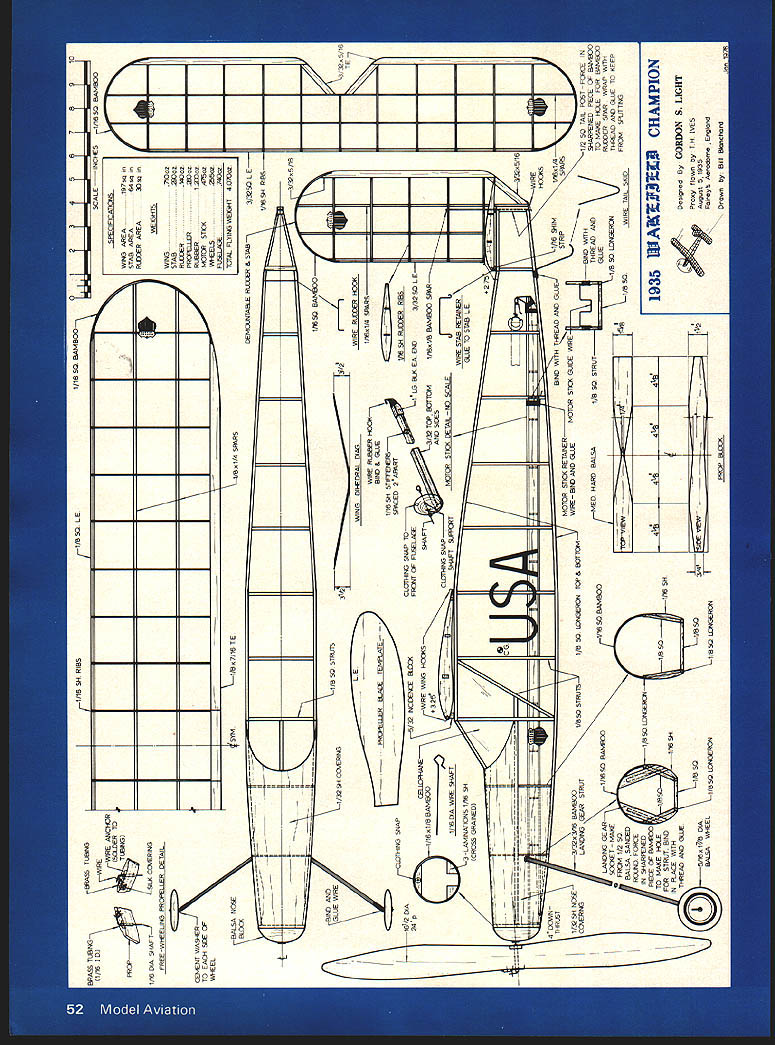
1935 WAKEFIELD CHAMPION
Designed by Gordon S. Light
Drawn by Bill Redwood
(Note: this page contains the full-size plan/diagram for the 1935 Wakefield Champion. There is no further running article text continuing from the previous page.)
1935 Wakefield Trophy
26.6 seconds average was enough to do it.
This time I did get the trophy to flash around and also to pay the insurance on, plus the shipping charges. Joe E. had warned me that it was expensive (more so than getting married) to have custody of the mug. Someone (who knows?) had dropped the thing and the world was a little flat in the vicinity of Alaska. Might still be as far as I know. (I personally think Joe dropped it.)
Obviously, for a proxy model the most important thing, other than a good proxy flier, is a good packing crate. First it must pass the parcel post regulations for length, girth, etc., otherwise the Post Office won't take it and that means shipping by express and during the depression no one could afford that.
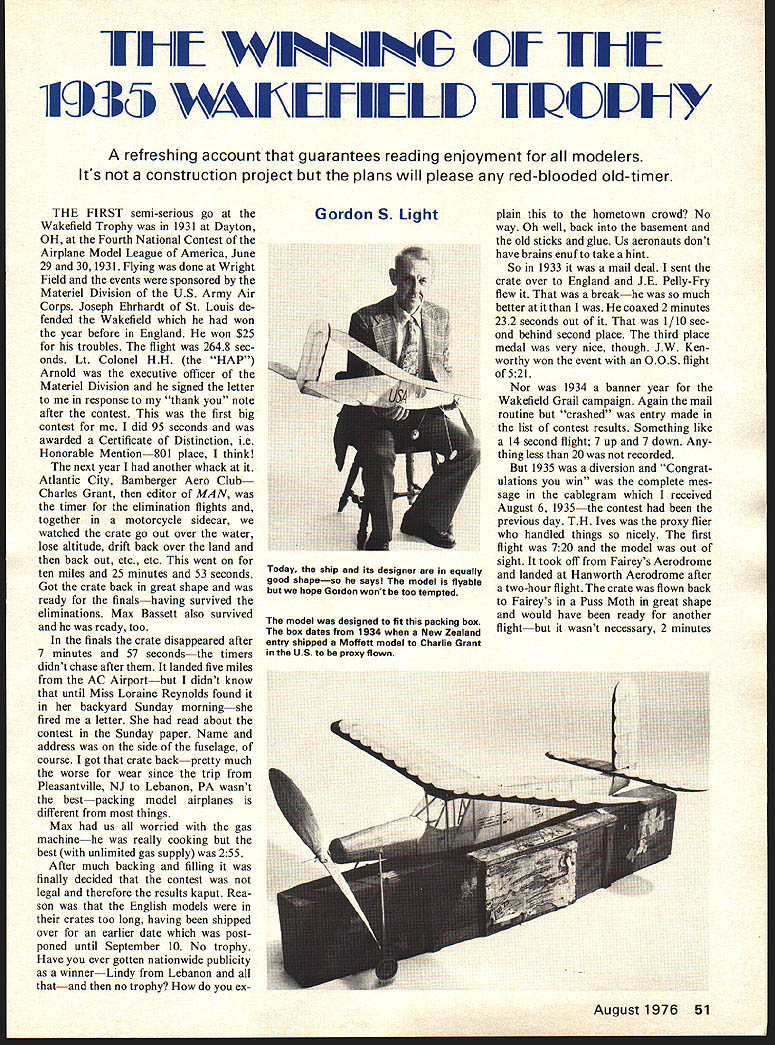
So, obviously, if you have a good box you are well advised to build the model to fit — so much easier and more sound technically than the other way around. It turns out that there was a Moffett Trophy contest. Remember? Charles Grant was a proxy flier for a New Zealand entry which was flown out of sight and he took the empty box to his camp in Peru, Vt. I was there in the summer of 1934 and used the box to ship some models home in. Obviously I had 1935 very much in mind. I could struggle through the model building part of the job but the shipping crate took talent way beyond me.
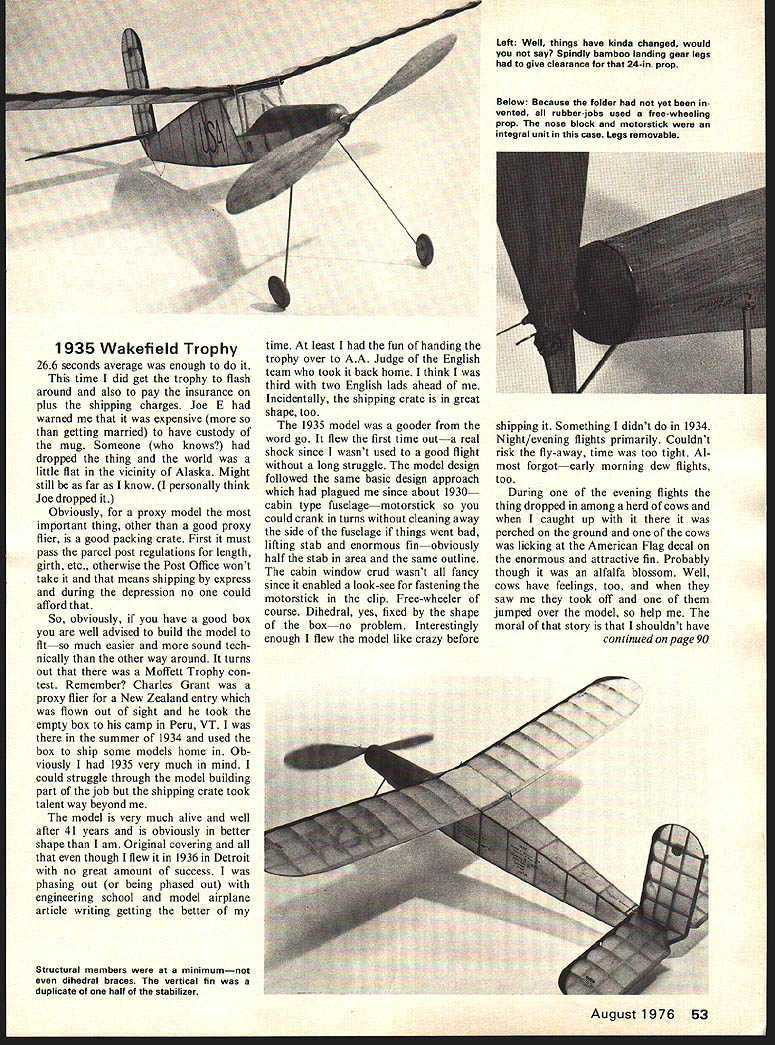
The model is very much alive and well after 41 years and is obviously in better shape than I am. Original covering and all that even though I flew it in 1936 in Detroit with no great amount of success. I was phasing out (or being phased out) with engineering school and model airplane article writing getting the better of my time. At least I had the fun of handing the trophy over to A. A. Judge of the English team who took it back home. I think I was third with two English lads ahead of me. Incidentally, the shipping crate is in great shape, too.
The 1935 model was a gooder from the word go. It flew the first time out — a real shock since I wasn't used to a good flight without a long struggle. The model design followed the same basic design approach which had plagued me since about 1930 — cabin type fuselage — motorstick so you could crank in turns without cleaning away the side of the fuselage if things went bad, lifting stab and enormous fin — obviously half the stab in area and the same on outline. The cabin window crud wasn't all fancy since it enabled a look-see for fastening the motorstick in the clip. Free-wheeler of course. Dihedral, yes, fixed by the shape of the box — no problem. Interestingly enough I flew the model like crazy before shipping it. Something I didn't do in 1934. Night/evening flights primarily. Couldn't risk the fly-away, time was too tight. Almost forgot — early morning dew flights, too.
During one of the evening flights the thing dropped in a herd of cows and when I caught up with it there it was perched on the ground and one of the cows was licking at the American Flag decal on the enormous and attractive fin. Probably thought it was an alfalfa blossom. Well, cows have feelings, too, and when they saw me they took off and one of them jumped over the model, so help me. The moral of that story is that I shouldn't have flown it without its shipping container. There were no other events during the test flying—nothing dramatic or profound. No repairs really before incarceration and turning it over to the P. O. Department. Of course, I had about a zillion small patches on the bottom of the fuselage from the landings in cut, stubbly grass, etc. I'm tempted to try to fly the crate again sometime but that would be foolish. I wouldn't mind having Ives do it. He could cope with it.
Lots of Wakefield contests have been held since 1935 and the performance is, of course, unbelievable. I don't know if proxy flying is done any more. It was a poor substitute for the real thing but so were many things during the depression. Old-timers will recall with me that in 1927 and the following years before the depression there were significant prizes for model contests. Joe E. won the trophy in England sponsored by the AMLA and the American Boy magazine. I arrived too late for any of that—1931 was the last cash prize year and they never returned during my tour of duty.
However, I assume that it is required of any old-timer to mumble that it was better that way and wouldn't trade for anything. Be it so mumbled.
Transcribed from original scans by AI. Minor OCR errors may remain.

