
WINTERHAWK
Bill Evans
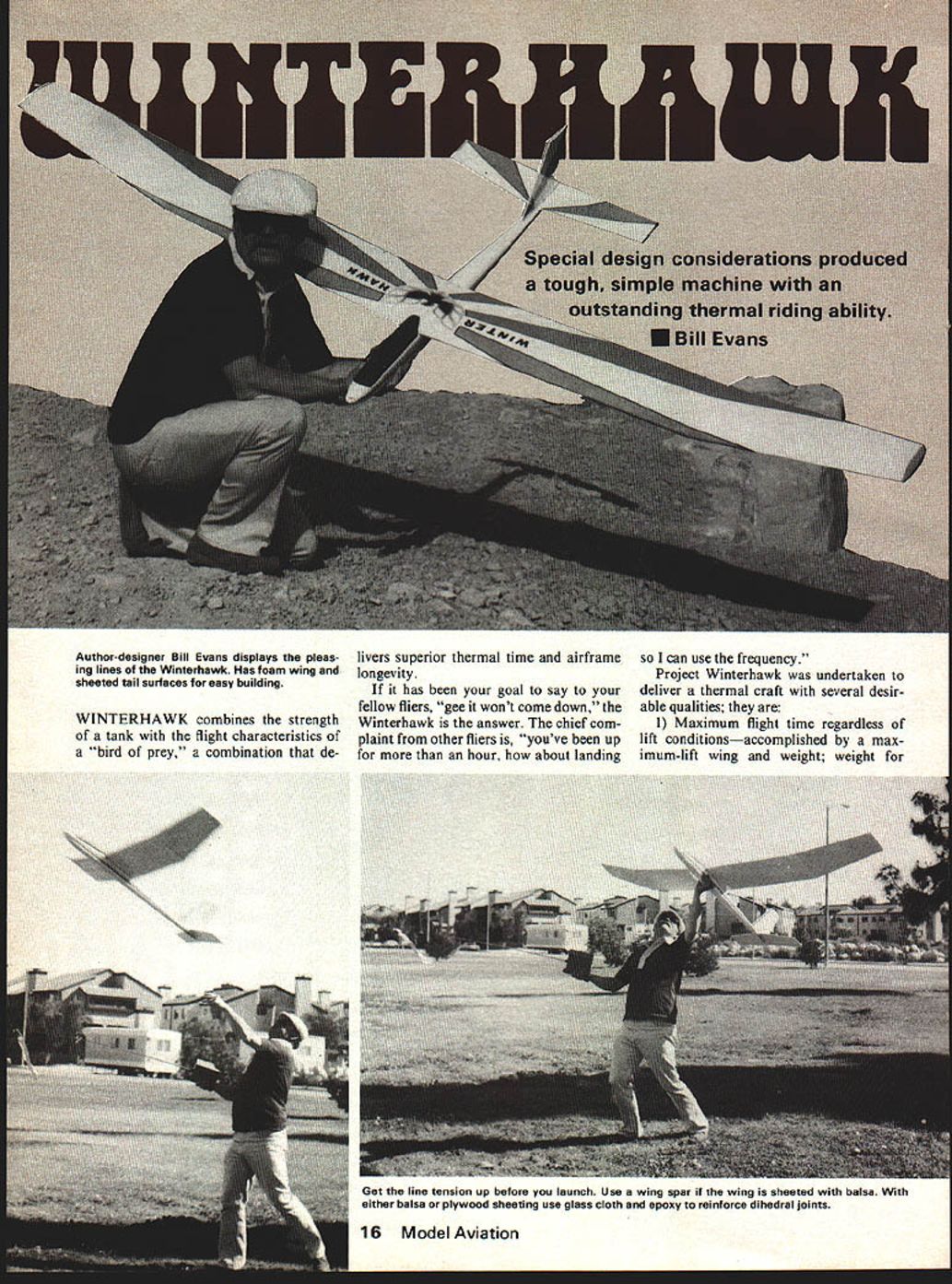
WINTERHAWK combines the strength of a tank with the flight characteristics of a "bird of prey," a combination that delivers superior thermal time and airframe longevity.
If it has been your goal to say to your fellow fliers, "gee it won't come down," the Winterhawk is the answer. The chief complaint from other fliers is, "you've been up for more than an hour, how about landing so I can use the frequency."
Project Winterhawk was undertaken to deliver a thermal craft with several desirable qualities; they are:
- Maximum flight time regardless of lift conditions — accomplished by a maximum-lift wing and weight; weight-for-minimum-speed produces optimum lift.
- Airframe longevity — since the wing takes punishment in high-impact landings, an almost indestructible fully-sheeted foam wing provided the answer.
- Span to exceed 100 inches (actually 98 inches).
- Hands-off performance, yet responsive — tested by setting up a climbing turn and switching off the transmitter.
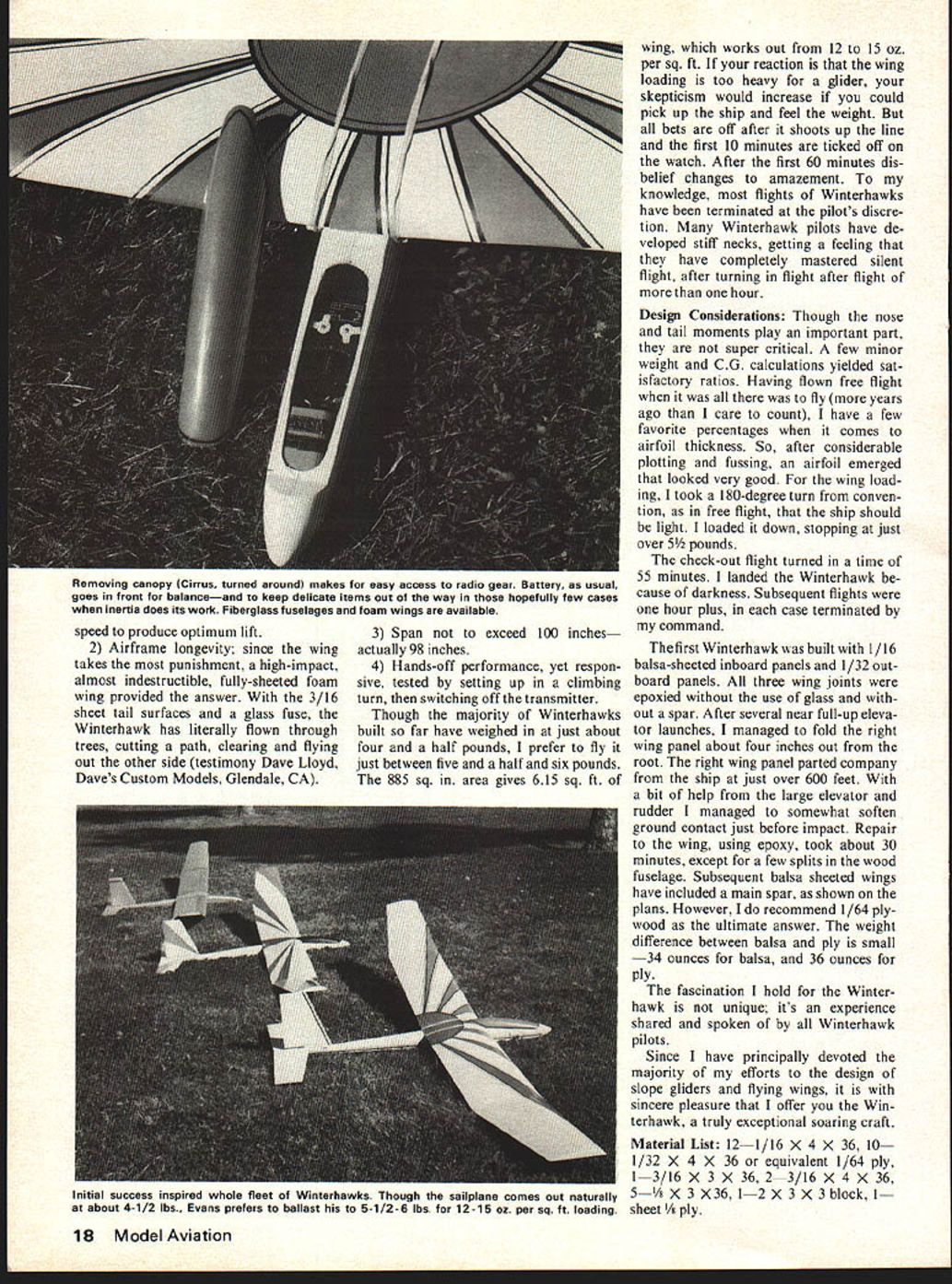
Though the majority of Winterhawks built so far have weighed just about four and a half pounds, I prefer to fly just between five and a half and six pounds. The 88.5 sq. in. area gives .615 sq. ft. wing area; this works out to about 12–15 oz. per sq. ft. If wing loading is too heavy, glider performance and the ability to exploit weak lift will suffer. You can pick up the ship and feel the weight, but after it shoots up the line the first ten minutes, even a skeptical watcher will be convinced. After the first 60 minutes, disbelief changes to amazement. Many Winterhawk flights have been terminated only at the pilot's discretion. Winterhawk pilots have developed stiff necks from watching and turning flight after flight.
Design Considerations
Though nose and tail moments play an important part, they are not super-critical. A few minor weight and CG calculations yielded satisfactory ratios. Having flown free-flight ships years ago, I have a few favorite percentages when it comes to airfoil thickness. After considerable plotting and fussing an airfoil emerged that looked very good, and wing-loading considerations took a 180-degree turn from conventional free-flight thinking.
The first Winterhawk was built with 1/16" balsa-sheeted inboard panels and 1/32" outboard panels, with three wing joints epoxied and a glassed outer spar. After several near full-up elevator launches, one right wing panel folded about four inches out from the root; the right wing panel then parted company and the ship impacted after a flight of just over 600 feet. With a large elevator and rudder I managed to somewhat soften the ground contact just before impact. Repairing the wing using epoxy took about 30 minutes, except for a few splits in the wood fuselage. Subsequent balsa-sheeted wings have included a main spar and other refinements.
WINTERHAWK
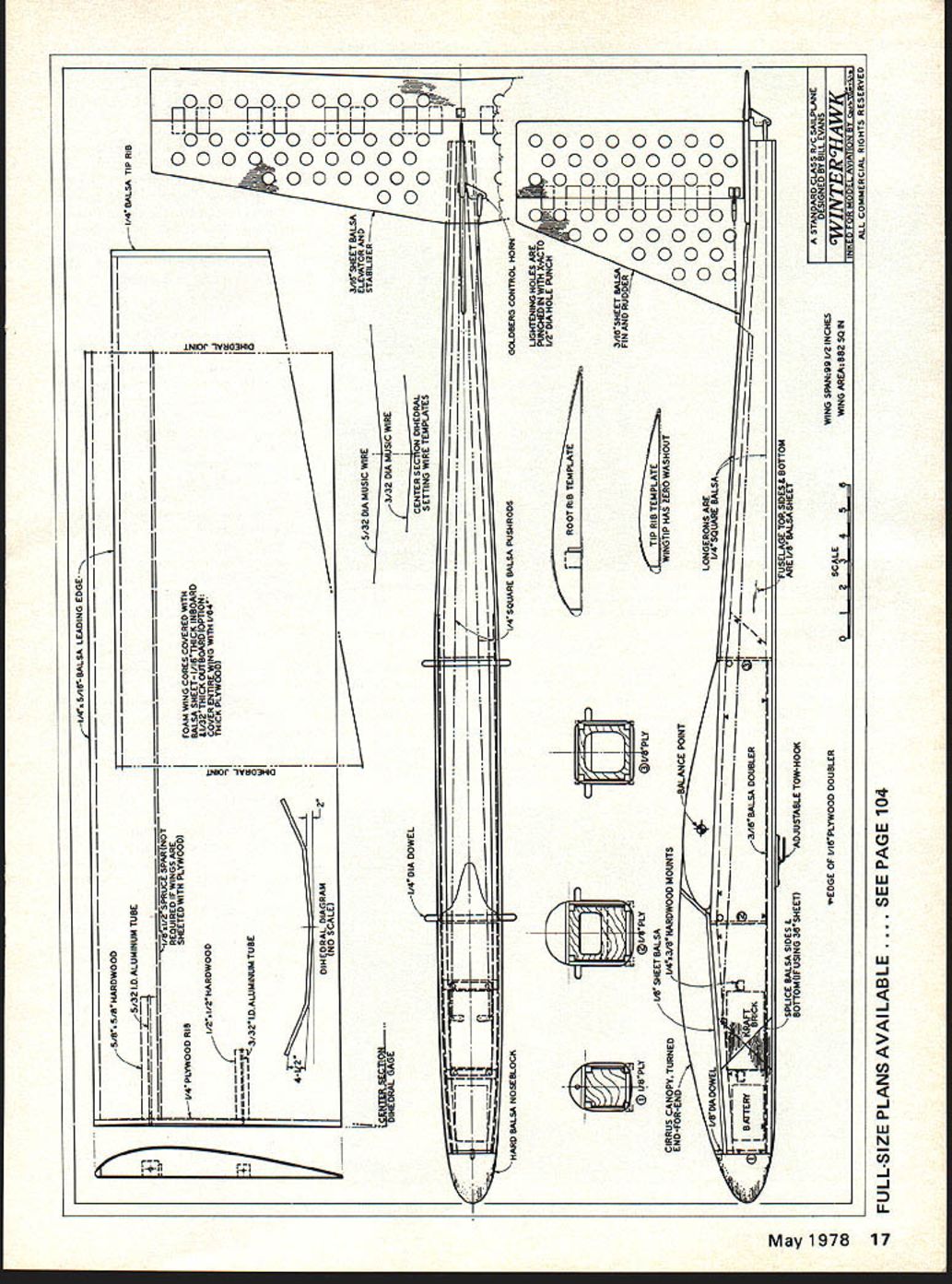
WING SPAN 99 1/2 INCHES WING AREA 882.50 SQ IN
STANDARD CLASS (N/C) SAILPLANE DESIGNED BY BILL EVANS WINTERHAWK — ALL RIGHTS RESERVED
FULL-SIZE PLANS AVAILABLE ... SEE PAGE 104 The 885 sq. in. area gives 6.15 sq. ft. of wing, which works out from 12 to 15 oz. per sq. ft. If your reaction is that the wing loading is too heavy for a glider, your skepticism would increase if you could pick up the ship and feel the weight. But all bets are off after it shoots up the line and the first 10 minutes are ticked off on the watch. After the first 60 minutes disbelief changes to amazement. To my knowledge, most flights of Winterhawks have been terminated at the pilot's discretion. Many Winterhawk pilots have developed stiff necks, getting a feeling that they have completely mastered silent flight, after turning in flight after flight of more than one hour.
Design Considerations: Though the nose and tail moments play an important part, they are not super critical. A few minor weight and C.G. calculations yielded satisfactory ratios. Having flown free flight when it was all there was to fly (more years ago than I care to count), I have a few favorite percentages when it comes to airfoil thickness. So, after considerable plotting and fussing, an airfoil emerged that looked very good. For the wing loading, I took a 180-degree turn from convention, as in free flight, that the ship should be light. I loaded it down, stopping at just over 5½ pounds.
The check-out flight turned in a time of 55 minutes. I landed the Winterhawk because of darkness. Subsequent flights were one hour plus, in each case terminated by my command.
The first Winterhawk was built with 1/16" balsa-sheeted inboard panels and 1/32" outboard panels. All three wing joints were epoxied without the use of glass and without a spar. After several near full-up elevator launches, I managed to fold the right wing panel about four inches out from the root. The right wing panel parted company from the ship at just over 600 feet. With a bit of help from the large elevator and rudder I managed to somewhat soften ground contact just before impact. Repair to the wing, using epoxy, took about 30 minutes, except for a few splits in the wood fuselage. Subsequent balsa-sheeted wings have included a main spar, as shown on the plans. However, I do recommend 1/64" plywood as the ultimate answer. The weight difference between balsa and ply is small — .34 ounces for balsa, and .36 ounces for ply.
The fascination I hold for the Winterhawk is not unique; it's an experience shared and spoken of by all Winterhawk pilots.
Since I have principally devoted the majority of my efforts to the design of slope gliders and flying wings, it is with sincere pleasure that I offer you the Winterhawk, a truly exceptional soaring craft.
Material List:
- 12 — 1/16" x 4" x 36"
- 10 — 1/32" x 4" x 36" or equivalent 1/64" ply
- 3 — 1/16" x 3" x 36"
- 2 — 3/16" x 4" x 36"
- 5 — 1/8" x 3" x 36"
- 1 — 2" x 3" x 3" block
- 1 — sheet 1/8" ply
Winterhawk foam cores are available for $10.00 including shipping (CA residents add 6%) from Soaring Research, 19216 Calvert St., Reseda, CA 91335, who also can supply 1/64" plywood Winterhawk wing sheeting for $10.00, and an epoxy-fiberglass fuselage for $30.00.
Construction: As you can see from the plans the KISS (keep it simple stupid) construction principle is used. The following construction sequence will be helpful as a building time-saver.
Cut, then white-glue the balsa leading edges to the wing cores, and set aside to dry. Cut out the fuselage parts (sides, bottom, top, doublers, formers, and nose block). White-glue the fuselage doublers to the fuse sides, making sure to make a right and a left side, and to raise the doubler at the bottom edge of the fuse side, to allow the fuse bottom to fit between the balsa sides and below the doubler. Let dry.
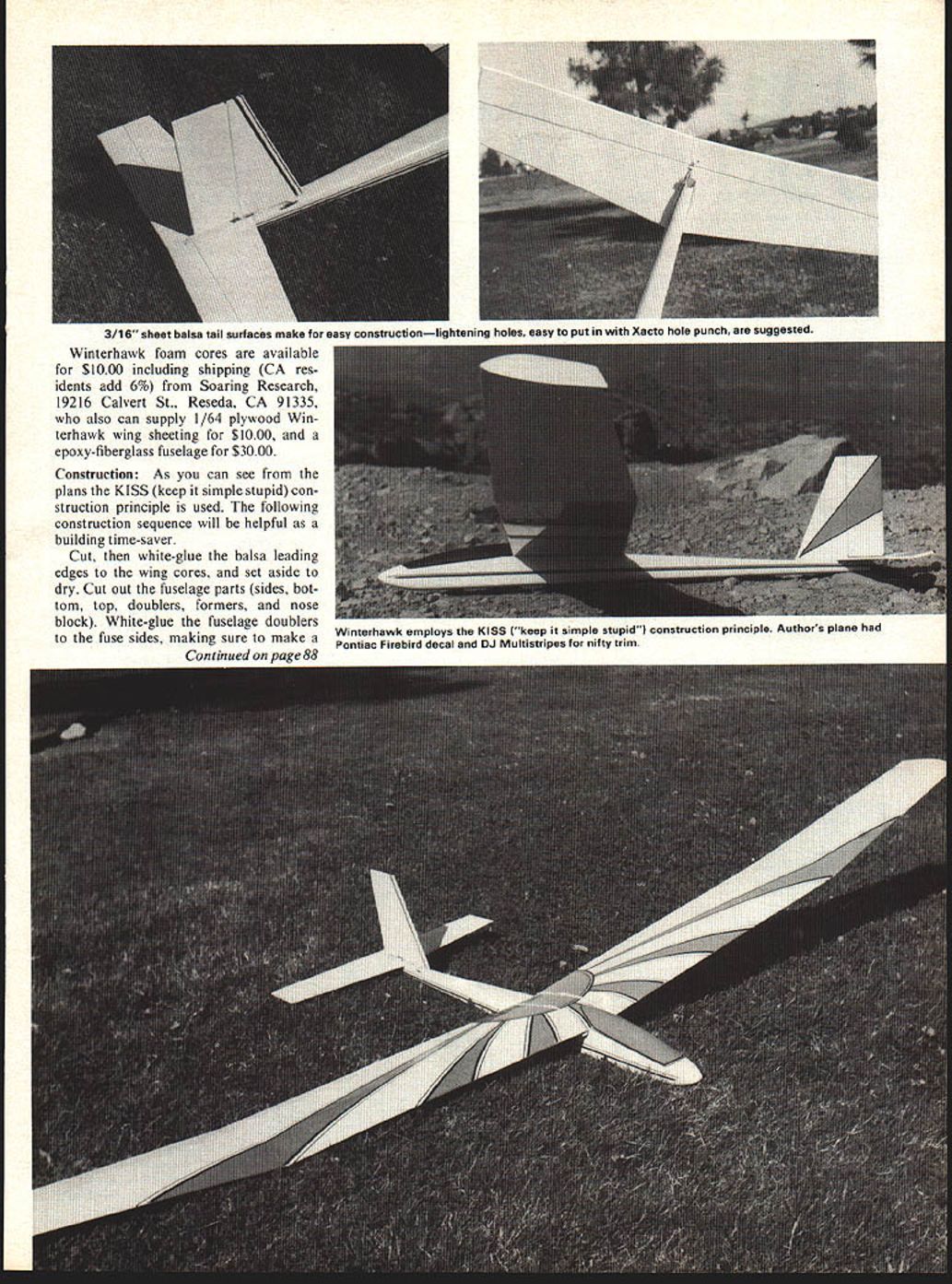
Cut out, trim, and sand the 3/16" tail surfaces, being sure to cut lightening holes in these surfaces as per plan. X-Acto makes a 1/2" hole punch which can be used in a drill. It is ideal for this purpose.
Glue fuse parts together by first pinning the fuse bottom down on a flat surface, then glue and pin on the sides, corner squares, formers at rear top, and nose block. Let dry.
Trim and sand the leading edges of the wing panels so the sheeting will fit neatly on them. Cut wing sheeting to size and contact-cement sheeting to cores, using any good waterbase contact cement. Epoxy wing panels together, using 5-minute epoxy. Set the dihedral as per plans. You may elect to join wing halves using tubing and wire; if so, you should do it at this point. I generally make a one-piece wing.
The canopy is made from a large Cirrus canopy turned end for end. Use Zap and Zap filler to secure the canopy to the base.
After sanding the fuselage and other parts, use your favorite covering material, and install the radio and linkage. The trim on the original included a small Pontiac Firebird decal (from local Pontiac dealer parts), epoxy paint, and DJ Multistripes. Get line tension up before launch. Use a wing spar with the wing sheeted in balsa; either balsa or plywood sheeting may be used. Use glass cloth and epoxy to reinforce dihedral joints.
WINTERHAWK combines strength and the flight characteristics of a bird of prey. The combination delivers superior thermal time and airframe longevity. The goal, say fellow fliers, is "gee, won't come down." Winterhawk answers the chief complaint other fliers have after you've been up an hour about landing so you can use the frequency. Project Winterhawk was undertaken to deliver a thermal craft with several desirable qualities:
- Maximum flight time regardless of lift conditions — accomplished with a maximum-lift wing.
- Airframe longevity since the wing takes punishment. A high-impact, almost indestructible fully-sheeted foam wing provided the answer.
- Span to exceed 100 inches — actually 98 inches.
- Hands-off performance yet responsive — tested setting up, climbing, turning, and switching off the transmitter.
Though the majority of Winterhawks built so far have weighed just about four and a half pounds, I prefer to fly just between five and a half and six pounds. The 885 sq. in. area gives 6.15 sq. ft. wing area, which works out to about 12–15 oz. per sq. ft. If the wing loading is too heavy, the glider will have trouble picking up in light lift; skepticism would increase. You can get the feel for the ship after it shoots up the line in the first 10 minutes. After the first 60 minutes, disbelief changes to amazement. Flights have been terminated at the pilots' discretion. Winterhawk pilots have developed stiff necks getting the feeling they have completely mastered silent flight after turning flight after flight for an hour.
Design Considerations
Though nose and tail moments play an important part, they are not super-critical. A few minor weight and CG calculations yielded satisfactory ratios. Having flown free-flight ships years ago, I have a few favorite percentages that come with airfoil thickness. After considerable plotting and fussing, an airfoil emerged that looked very good. The wing-loading philosophy took a 180-degree turn from conventional free-flight thinking; the ship should be lightly loaded, stopping just over 5 pounds.
The checkout flight turned into 55 minutes; I landed the Winterhawk because of darkness. Subsequent flights of an hour plus were terminated by command. The first Winterhawk was built with 1/16" balsa-sheathed inboard panels and 1/32" outboard panels; three wing joints were epoxied and a glassed spar was used. After several near full-up elevator launches I managed to fold the right wing panel about four inches out at the root; the right wing panel parted company. The ship traveled just over 600 feet; with the help of large elevator and rudder I managed to somewhat soften ground contact just before impact. Repairing the wing using epoxy took about 30 minutes except for a few splits in the wood fuselage. Subsequent balsa-sheeted wings have included the main spar shown.
Transcribed from original scans by AI. Minor OCR errors may remain.

