
The Wit and Wisdom of Alexander Lippisch
Paul McIlrath
Imagine yourself building research models for one of the most creative aerodynamic designers the world has ever produced. This account gives some insight as to what the man and the experience was like.
Lippisch's contributions
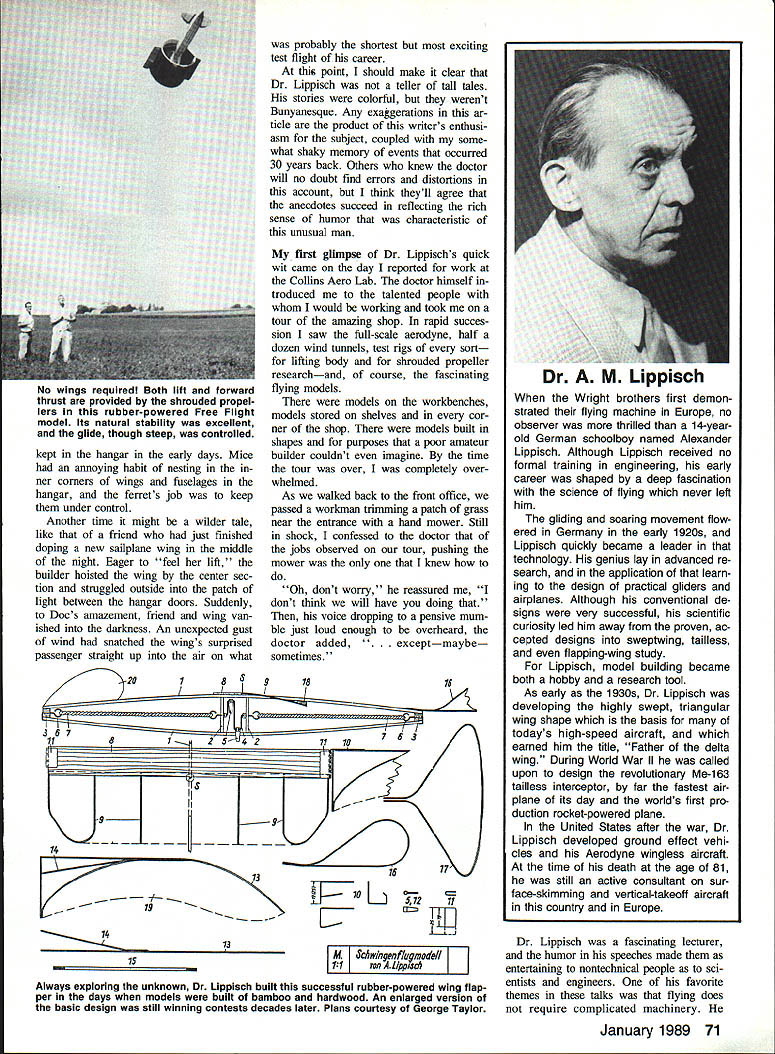
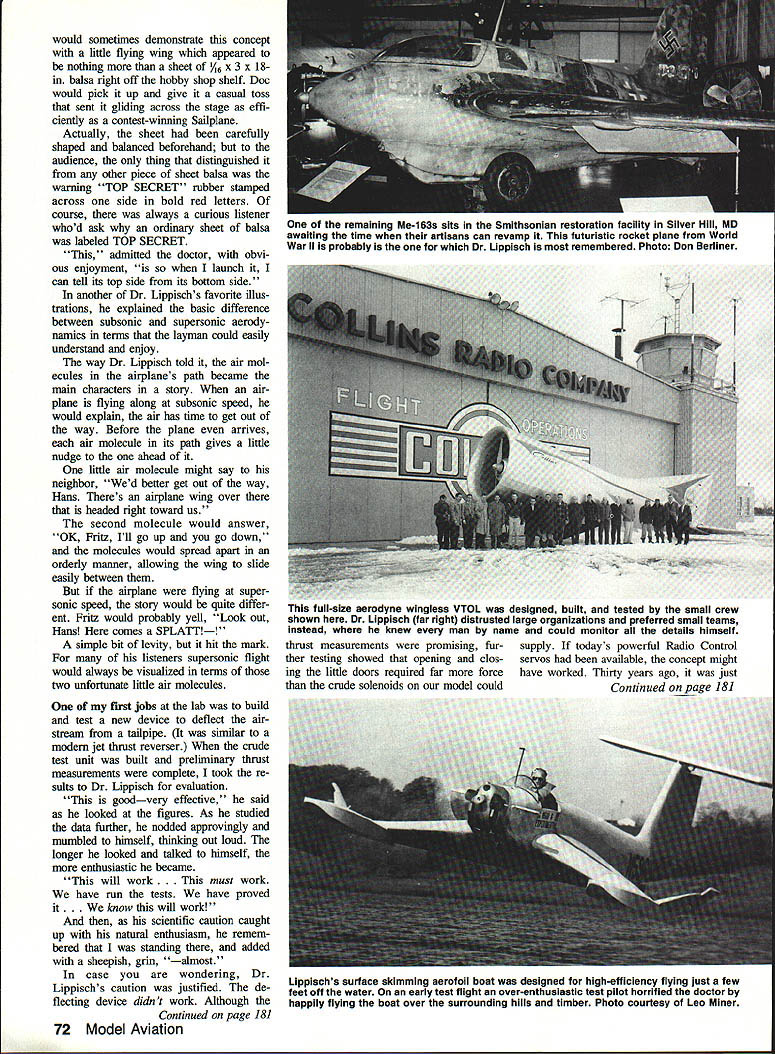
Dr. Alexander Lippisch is recognized as the designer of the world's first operational rocket-powered airplane and the father of the delta wing concept. He also did important pioneering work in:
- Gliding and soaring
- Tailless aircraft
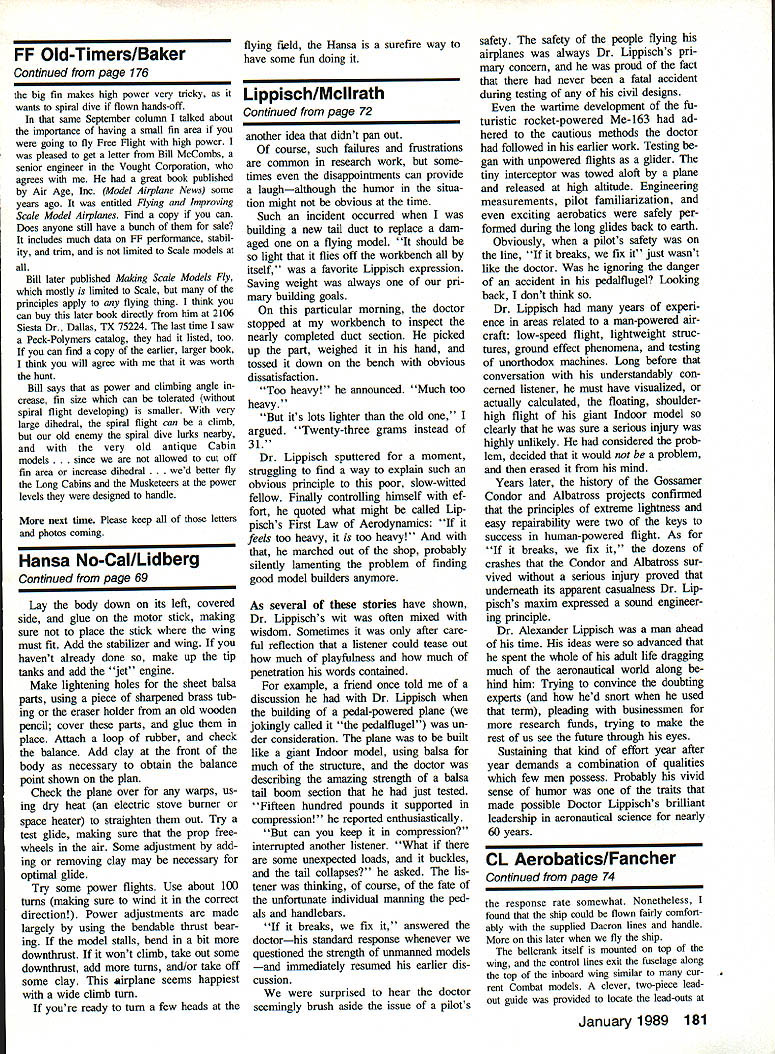
- Ground-effect vehicles
- Ducted fans
- Wind-tunnel design
We modelers remember him as a fellow builder, designer, writer, and researcher who continued to recognize the value of model building in research when others were abandoning scaled-down aircraft for reels of computer tape.
Memories at the Collins Aeronautical Research Laboratory
Curiously, when those modelers who worked for the doctor at the Collins Aeronautical Research Laboratory get together and reminisce, we seldom discuss the purely technical side of the job. We're more likely to recall personal things that don't interest historians—especially the laughs and humorous moments we shared. A lot of funny things did happen when you worked for Dr. Lippisch, and the group's recollections often take the form of humorous anecdotes.
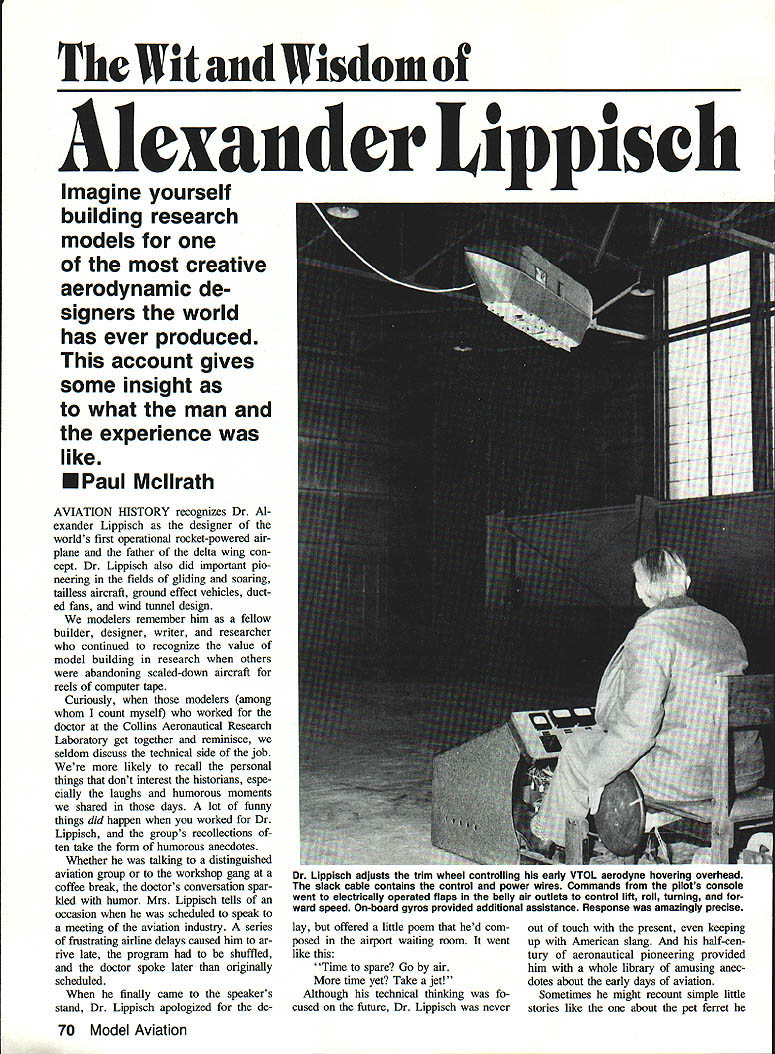
My first glimpse of Dr. Lippisch's quick wit came the day I reported to work at Collins Aero Lab. The doctor introduced the talented people who would be working there and took us on a tour of the amazing shop. In rapid succession we saw a full-scale aerodyne, half a dozen wind tunnels and test rigs, a sort of lifting body and shrouded-propeller research, and of course fascinating flying models—models on workbenches and models stored on shelves and in corners of the shop, built in shapes and for purposes the poor amateur builder couldn't imagine. By the time the tour was over I was completely overwhelmed.
As we walked back past the front office we passed a workman trimming a patch of grass near the entrance with a hand mower. Still in shock, I confessed to the doctor that the most remarkable thing I'd observed on the tour was the man pushing the mower; I knew then that Dr. Lippisch kept the hangar in the early days.
"Oh, don't worry," he reassured me, "I don't think we will have you doing that." Then, his voice dropping to a pensive mumble just loud enough to be overheard, the doctor added, ". . . except—maybe—sometimes."
Workshop anecdotes
Dr. Lippisch kept the hangar well supplied with stories. Once he told of a pet ferret he kept in the hangar to rid it of mice. Mice had an annoying habit of nesting in the inner corners of wings and fuselages, and the ferret's job was to keep them under control.
Another tale told of a friend who had just finished doping a new sailplane wing in the middle of the night. Eager to "feel her lift," the builder hoisted the wing by the center section and struggled outside into the patch of light between the hangar doors. Suddenly, to Doc's amazement, friend and wing vanished into the darkness. An unexpected gust of wind had snatched the wing's surprised passenger straight up into the air on what was probably the shortest but most exciting test flight of his career.
Dr. Lippisch would sometimes demonstrate wing concept with what appeared to be nothing more than a sheet of 1/16 x 3 x 18-in. balsa right off the hobby-shop shelf. He would pick it up and give it a casual toss that sent it gliding across the stage as efficiently as a contest-winning sailplane. Actually, the sheet had been carefully shaped and balanced beforehand; but to the audience, the only thing that distinguished it from any other piece of sheet balsa was the warning "TOP SECRET" rubber stamped across one side in bold red letters. When a curious listener asked why an ordinary sheet of balsa was labeled TOP SECRET, Doc would grin and say, "This is so when I launch it, I can tell its top side from its bottom side."
Humor and teaching
Whether he was talking to a distinguished aviation group or to the workshop gang at a coffee break, the doctor's conversation sparkled with humor. Mrs. Lippisch tells of an occasion when he was scheduled to speak to a meeting of the aviation industry. A series of frustrating airline delays caused him to arrive late; the program had to be shuffled, and the doctor spoke later than originally scheduled. When he finally came to the speaker's stand, Dr. Lippisch apologized for the delay and offered a little poem he'd composed in the airport waiting room:
"Time to spare? Go by air. More time yet? Take a jet!"
In another favorite illustration he explained the basic difference between subsonic and supersonic aerodynamics in terms the layman could easily understand. He personified air molecules. At subsonic speed each molecule had time to nudge the one ahead: "We'd better get out of the way, Hans. There's an airplane wing over there that is headed right toward us." "OK, Fritz, I'll go up and you go down," the neighbor answers, and the molecules spread apart in an orderly manner.
But at supersonic speed, Fritz would probably yell, "Look out, Hans! Here comes a SPLATT!" For many of his listeners, supersonic flight would always be visualized in terms of those two unfortunate little air molecules.
Experiments, failures, and Lippisch's laws
One of my first jobs at the lab was to build and test a new device to deflect the airstream from a tailpipe (similar to a modern jet thrust reverser). When the crude test unit was built and preliminary measurements were complete, I took the results to Dr. Lippisch. "This is good—very effective," he said as he looked at the figures. As he studied the data further, he nodded approvingly and mumbled to himself, thinking out loud. The longer he looked and talked, the more enthusiastic he became.
"This will work . . . This must work. We have run the tests. We have proved it . . . We know this will work!"
Then, as his scientific caution caught up with his natural enthusiasm, he remembered I was standing there and added with a sheepish grin, "—almost."
In case you are wondering, his caution was justified. The deflecting device didn't work. Although the thrust measurements were promising, further tests showed that opening and closing the little doors required far more force than the crude solenoids on our model could supply. If today's powerful radio-control servos had been available, the concept might have worked. Thirty years ago, it was just another idea that didn't pan out.
Such disappointments sometimes provided a laugh—though the humor might not have been obvious at the time. Once I was building a new tail duct to replace a damaged one on a flying model. "It should be so light that it flies off the workbench and by itself," was a favorite Lippisch expression. Saving weight was always one of our primary building goals.
The doctor stopped at my workbench to inspect the nearly completed duct section. He picked up the part, weighed it in his hand, and tossed it down on the bench with obvious dissatisfaction. "Too heavy!" he announced. "Much too heavy."
"But it's lots lighter than the old one," I argued. "Twenty-three grams instead of 31."
Dr. Lippisch sputtered, struggling to find a way to explain such an obvious principle to this poor, slow-witted fellow. Finally controlling himself, he quoted what might be called Lippisch's First Law of Aerodynamics: "If it feels too heavy, it is too heavy!" And with that he marched out of the shop, probably silently lamenting the problem of finding good model builders anymore.
Safety, repairability, and human-powered flight
Sometimes his wit was mixed with deep engineering wisdom. A friend once told of a discussion with Dr. Lippisch when the building of a pedal-powered plane (jokingly called "the pedalglider") was under consideration. The doctor described the amazing strength of a balsa tail boom he had just tested: "Fifteen hundred pounds it supported in compression!" he reported enthusiastically.
"But can you keep it in compression?" another listener asked. "What if there are unexpected loads, and it buckles, and the tail collapses?" He was thinking, of course, of the fate of the unfortunate individual manning the pedals.
"If it breaks, we fix it," answered the doctor—his standard response whenever we questioned the strength of untried models—and immediately resumed his earlier discussion.
We were surprised to hear him seemingly brush aside the issue of a pilot's safety. In fact, the safety of people flying his airplanes was always Dr. Lippisch's primary concern, and he was proud that there had never been a fatal accident during testing of any of his civil designs. Even the wartime development of the futuristic rocket-powered Me-163 adhered to the cautious methods he had followed earlier: testing small unpowered flights as gliders, towing pilots aloft and releasing them at high altitude so engineering measurements, pilot familiarization, and aerobatics could be performed safely during long glides back to earth.
When a pilot's safety was on the line, "If it breaks, we fix it" was not a careless motto. Dr. Lippisch had many years of experience in areas related to man-powered aircraft—low-speed flight, lightweight structures, ground-effect phenomena, and testing unorthodox machines. He had considered problems carefully, decided they would not be serious, and then erased them from his mind. Years later, the successes of the Gossamer Condor and Albatross confirmed that extreme lightness and easy repairability were keys to success in human-powered flight. The dozens of crashes those machines survived without serious injury showed that beneath its apparent casualness, Lippisch's maxim expressed a sound engineering principle.
Legacy
Dr. Alexander Lippisch was a man ahead of his time. His ideas were so advanced that he spent his adult life dragging much of the aeronautical world along behind him—trying to convince doubting experts (and how he'd snort when he used that term), pleading with businessmen for more research funds, and trying to make the rest of us see the future through his eyes.
Sustaining that effort year after year demands a combination of qualities few men possess. Probably his vivid sense of humor was one of the traits that made possible Dr. Lippisch's brilliant leadership in aeronautical science for nearly 60 years.
Note on accuracy: the stories here are meant to reflect the rich sense of humor characteristic of this unusual man. Any small errors or distortions are the product of the writer's enthusiasm and imperfect memory of events that occurred thirty years ago.
Transcribed from original scans by AI. Minor OCR errors may remain.

