
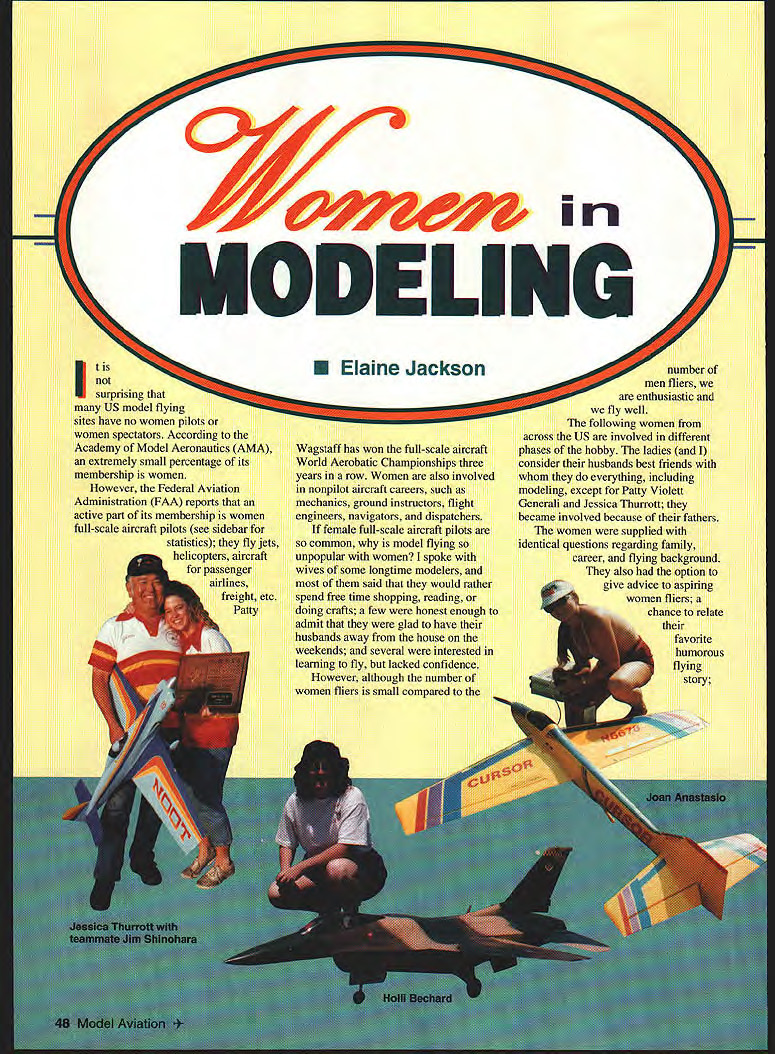
Women in Modeling
Elaine Jackson
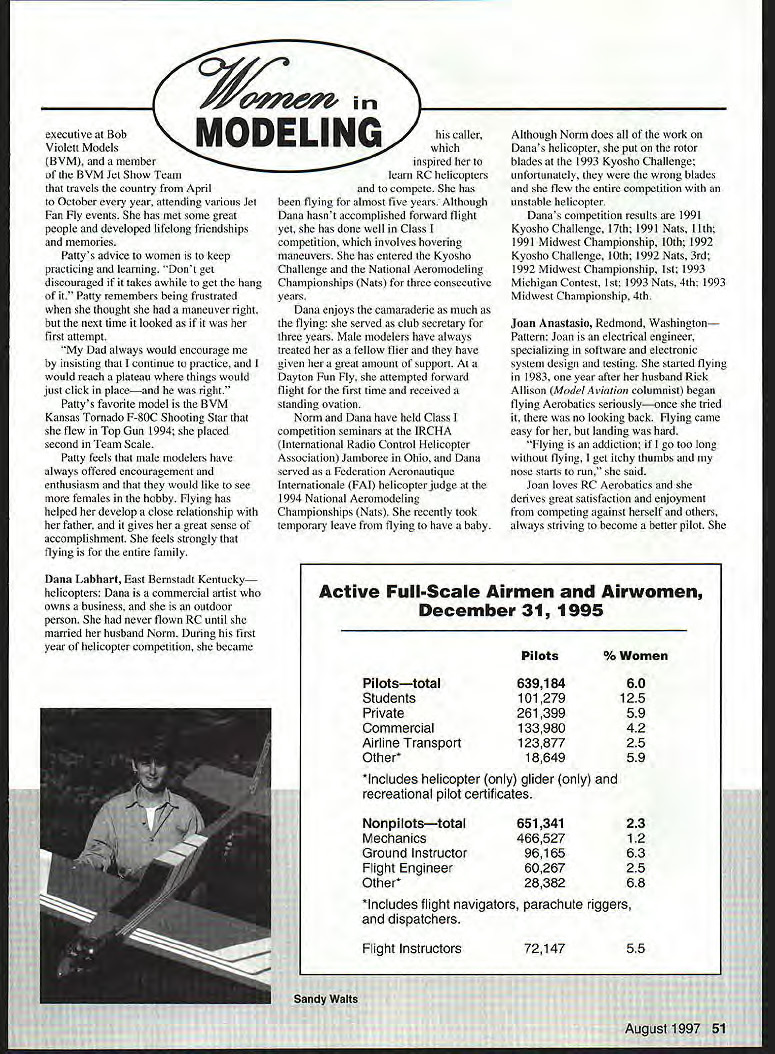
It is not surprising that many U.S. model-flying sites have few or no women pilots or women spectators. According to the Academy of Model Aeronautics (AMA), an extremely small percentage of its membership is women. However, the Federal Aviation Administration (FAA) reports that a notable portion of its full-scale aircraft pilots are women (see sidebar for statistics). Women fly jets, helicopters, and airliners; they have won world aerobatic championships, and they work in nonpilot aircraft careers such as mechanics, ground instructors, flight engineers, navigators, and dispatchers.
If female full-scale aircraft pilots are relatively common, why is model flying so unpopular with women? I spoke with wives of some longtime modelers. Most said they would rather spend free time shopping, reading, or doing crafts; a few admitted they were glad to have their husbands away from the house on weekends; and several were interested in learning to fly but lacked confidence.
Although the number of women fliers is small compared to men, the women who do fly are enthusiastic and skilled. The following profiles highlight women from across the U.S. who are involved in different phases of the hobby. They answered identical questions about family, career, and flying background, and many offered advice to aspiring women fliers and a favorite humorous flying story.
Elaine Jackson
I learned to fly helicopters with a .60-size Schluter Champion that my husband Les helped me build. Flying helicopters can be rewarding, sometimes frustrating, but always challenging. Les and I are best flying buddies; we spend three days each week at our flying site.
Flying has become a way of life for me. I had a column in the international RC helicopter magazine Heliscene, and now I'm a freelance writer with articles published in RC Modeler, Model Airplane News, Rotary Modeler, and the German magazine Rotor. I also run a small hobby business on the Central Coast of California.
My advice to women is to learn on your own model—sitting across the dinner table after crashing your mate's favorite model is not a confidence-booster. My favorite early story: after two weeks of flying I could hover steadily with my training gear removed. Near the end of a flight, my husband said it was time to learn to walk the helicopter back to the pits. I could hover but could not move my legs. Les reached down and pulled at my pant legs one at a time, as if I were a puppet, until I got the helicopter back to the pits. It took several tries before my walking gait stopped resembling Frankenstein's daughter. Whenever I hear my husband tell new students it's time to learn to walk with their helicopters, I snicker.
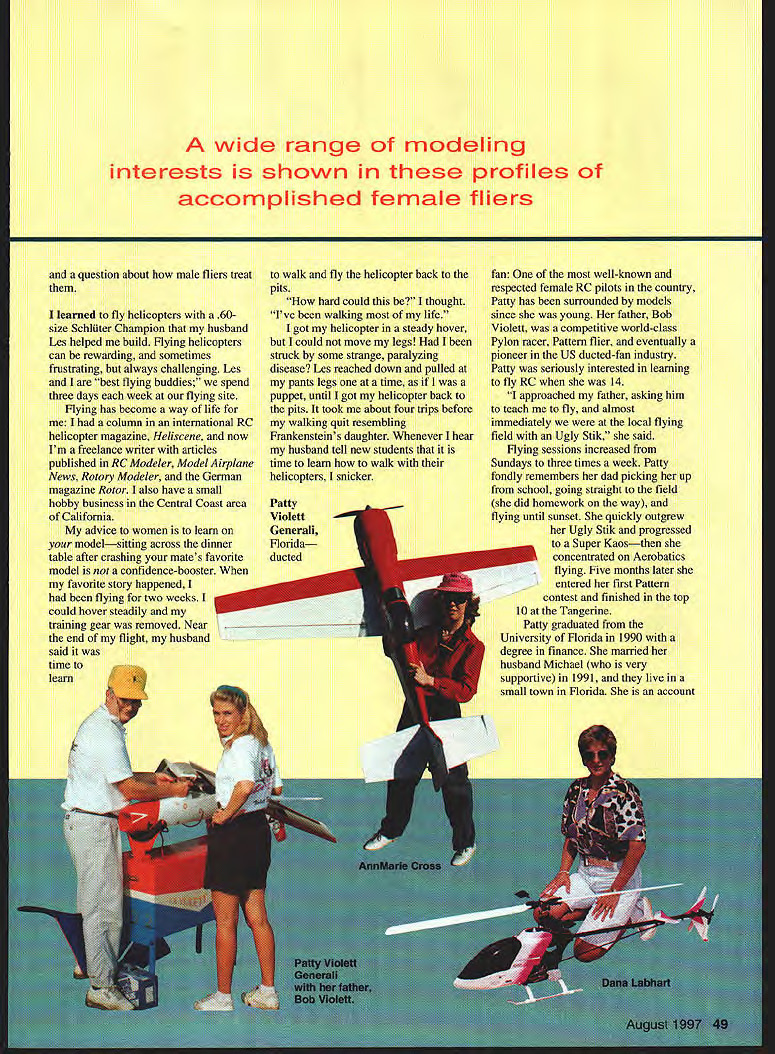
Patty Violett Generali
One of the most well-known and respected female RC pilots in the country, Patty was surrounded by models from a young age. Her father, Bob Violett, was a competitive world-class pylon racer and pattern flier and later a pioneer in the U.S. ducted-fan industry. Patty became seriously interested in RC flying at 14 and asked her father to teach her. They flew at the local field multiple times a week; she did homework in the car on the way to the field and flew until sunset.
Patty progressed quickly from an Ugly Stik to a Super Kaos and concentrated on aerobatics. Five months after starting she entered her first Pattern contest and finished in the top 10 at the Tangerine. She graduated from the University of Florida in 1990 with a degree in finance and married her husband Michael in 1991. She is an account executive at Bob Violett Models (BVM) and a member of the BVM Jet Show Team that travels the country attending Jet Fan Fly events.
Patty's advice to women is to keep practicing and learning. "Don't get discouraged if it takes awhile to get the hang of it," she says. Her father encouraged persistence—after plateaus, things suddenly click. Her favorite model is the BVM Kansas Tornado F-80C Shooting Star, which she flew at Top Gun '94 and placed second in Team Scale. Patty feels male modelers have offered encouragement and enthusiasm and would like to see more females in the hobby. Flying has helped her develop a close relationship with her father and gives her a great sense of accomplishment.
Dana Labhart — East Bernstadt, Kentucky (Helicopters)
Dana is a commercial artist who owns a business and enjoys the outdoors. She had never flown RC until she married Norm. During his first year of helicopter competition she became his caller, which inspired her to learn RC helicopters and to compete. She has been flying for almost five years. Although Dana hasn't mastered forward flight yet, she has done well in Class I competition (hovering maneuvers). She has entered the Kyosho Challenge and the National Aeromodeling Championships (Nats) for three consecutive years.
Dana enjoys the camaraderie as much as the flying; she served as club secretary for three years. Male modelers have treated her as a fellow flier and given strong support. At a Dayton Fun Fly, she attempted forward flight for the first time and received a standing ovation. Norm and Dana have held Class I seminars at the IRCHA Jamboree in Ohio, and Dana served as an FAI helicopter judge at the 1994 Nats. She recently took temporary leave from flying to have a baby.
Although Norm does most of the work on Dana's helicopter, she once fitted rotor blades at the 1993 Kyosho Challenge—but they were the wrong blades, and she flew the entire competition with an unstable ship.
Dana's competition results:
- 1991 Kyosho Challenge, 17th
- 1991 Nats, 11th
- 1991 Midwest Championship, 10th
- 1992 Kyosho Challenge, 10th
- 1992 Nats, 3rd
- 1992 Midwest Championship, 1st
- 1993 Michigan Contest, 1st
- 1993 Nats, 4th
- 1993 Midwest Championship, 4th
Joan Anastasio — Redmond, Washington (Pattern)
Joan is an electrical engineer specializing in software and electronic system design and testing. She started flying in 1983, one year after her husband Rick Allison (Model Aviation columnist) began flying aerobatics seriously. Once she tried it, there was no looking back. Flying came easily to her, though landing was initially difficult.
"Flying is an addiction; if I go too long without flying, I get itchy thumbs and my nose starts to run," she says.
Joan loves RC aerobatics and derives great satisfaction from competing against herself and others. She and Rick support each other through triumphs and setbacks. Joan was president of the Marymoor RC Club for two years and served on the Snohomish Radio Control Club executive board for four years, including 2½ years as president. She is an AMA Contest Director and has run numerous Pattern contests. She has judged events and served two terms as chairperson on the NSRCA rules committee. Joan was associate vice president of NSRCA District 8 for 1993–1994 and vice president in 1995. She also wrote the "K Factor" column in the NSRCA newsletter.
She started competing in Pattern events in 1986 and has attended at least one national contest every year since 1989 (except 1991). Joan's national Pattern competition results:
- 1989 Nats, 7th in Sportsman
- 1990 Nats, 22nd in Expert Turnaround
- 1992 NSRCA Pan American Championships, 8th in Advanced
- 1993 Nats, 12th in Advanced
- 1994 NSRCA Pan American Championships, 15th in Masters
- 1995 Nats, 24th in Masters
Joan also won the 1988 NSRCA District 8 Novice Championship, the 1989 Sportsman Championship, and was 1994 Reserve Masters Champion. She is sponsored by Japan Radio (JR). Her advice to women is to get involved only if they are genuinely interested—not just to please a husband or boyfriend. Flying is fun but not easy at first; women can do it as well as men. She thinks the majority of male modelers have accepted her as one of the gang.
AnnMarie Cross — Huntington Beach, California (IMAC / Pattern)
AnnMarie and her husband Michael have always done everything together, and she missed being part of his favorite hobby. Shortly after her second baby she tried Michael's Goldberg Extra 300 and was hooked. The Extra quickly became hers. Her first contest was three months later; she placed third in Novice IMAC and third in Team Scale. The next weekend she moved into Sportsman class and placed third.
When I met AnnMarie in November 1994 at the Goldberg Classic, she placed fourth in Sportsman—impressive for less than a year of flying. Although Michael was still landing for her at that time, she has progressed and now lands her Bücker and Extra confidently.
AnnMarie competes regularly and has earned various place finishes in Pattern events, including second place in the 1995 Goldberg Classic. She especially enjoys participating in DARE programs and Toys for Tots benefits; they draw outsiders into the hobby and support important causes. She writes a column in The R/C Trainer Guide and does reviews for Radio Control Modeler and Scale R/C Modeler.
AnnMarie has a bachelor's degree in animal science from Cornell University and has completed half of a master's degree to teach high-school biology and chemistry. She is operations manager at a mainframe computer reseller and assists her husband with their RC aircraft construction business. Michael and AnnMarie's two daughters share their passion for airplanes—the 10-year-old flies and the three-year-old spends considerable time on the simulator.
Her recommendation for a wife who wants to learn to fly: get an airplane and an instructor that both partners agree on.
Holli Bechard — Upland, California (Ducted Fan)
Holli has loved flying since she was young, and that dream became reality when she met her husband Ron. They initially learned helicopters, but after three months Holli decided she wanted to fly airplanes. Her first airplane was a basic high-wing trainer; she learned quickly because of her helicopter experience and was landing after the first week.
She then flew a P-40 Warhawk (which crashed after she discovered stalls and landing), a P-51, Pattern airplanes, and some speed models before getting involved with ducted-fan jets. Her first ducted-fan was a Bob Parkinson Cheetah, which was a durable trainer. Later she flew a Bob Violett Aggressor and an F-16.
One of her biggest accomplishments was helping Ron build the F-16; she built about 75% of the model. She entered the Scale Masters qualifier, finished sixth, and didn't qualify—but intends to try again. Holli has won trophies for Best of Scale, People's Choice (Scale Masters), and various speed awards with her F-16. She plans to build a BVM Viper to attempt the speed record (249 mph).
She was the first woman to participate in the Madera Air Races (with an AT-6) and was six months pregnant at the time. Holli donates much time to the DARE program, finding it rewarding to show kids alternatives to drugs and violence.
Holli is 27 and has six years of flying experience. The hardest thing has been gaining the respect of other pilots. "Don't get me wrong, the people I fly with are nice, but there was always that question: 'Can she really fly?'" She credits her achievements to Ron's support and hopes to fly at Madera again, fly with the Violettes, and become the first woman to compete in the Scale Masters.
Jessica Thurrott — East Hartford, Connecticut (Pylon Racing)
Jessica went to Pattern contests with her father when she was very young but found them uninteresting until he started flying Quickee 500 (Q-500). At 12 the excitement appealed to her and she flew her first Quickee race at 14. The next year she worked at the Nats in Westover, Massachusetts, and while timing a Samurai Racing Team member she met Dave Shadel, Jim Shinohara, and others from the team.
Four months later Jim Shinohara called and asked what color Formula 1 plane she wanted. Jessica raced as a Samurai Team member with a pink Formula 1 at the Lake Charles Nats and the team built planes for her at contests in Lincoln, Norfolk, Westover, and in California, as well as for two NMPRA Championships.
She has placed in the top 10 at every Nats she has attended, placed third in the 1987 NMPRA Championships, and second in Q-500 at the 1992 Nats in Westover. Jessica learned a great deal from racing with the Samurai Team and enjoys sport flying and local racing as a way to spend time with her dad.
Jessica lived in Japan from 1988 to 1990 and flew with teams from O.S., JR, and EZ Models. Japanese fliers welcomed her, toured factories with her, loaned equipment, and drove her to contests. She earned a B.A. from Duke University in 1990 and a master's in education in the spring following. She is a Japanese teacher in Connecticut and served as president of the Northern Connecticut Radio Control Club from 1992–1994; she is currently the club's vice president.
These women are very competitive, and there are many more women across the country involved in the hobby. For example, Sandy Watts, mother of three teenage boys, started flying when her husband won a trainer in a raffle. Sandy enjoys flying and sharing a hobby with her family and recently bought Gulfstream Direct, a company that sells videos for the RC enthusiast.
If you have an interest in flying, or would like to share a wonderful hobby with your husband or boyfriend, go for it!
Elaine Jackson 14310 San Miguel Rd. Atascadero, CA 93422
Active Full-Scale Airmen and Airwomen, December 31, 1995
- Pilots — total 639,184 6.0%
- Students 101,279 12.5%
- Private 261,399 5.9%
- Commercial 133,980 4.2%
- Airline Transport 123,877 2.5%
- Other* 18,649 5.9%
- *Includes helicopter (only), glider (only), and recreational pilot certificates.
- Nonpilots — total 651,341 2.3%
- Mechanics 466,527 1.2%
- Ground Instructor 96,165 6.3%
- Flight Engineer 60,267 2.5%
- Other* 28,382 6.8%
- *Includes flight navigators, parachute riggers, and dispatchers.
- Flight Instructors 72,147 5.5%
Transcribed from original scans by AI. Minor OCR errors may remain.

