
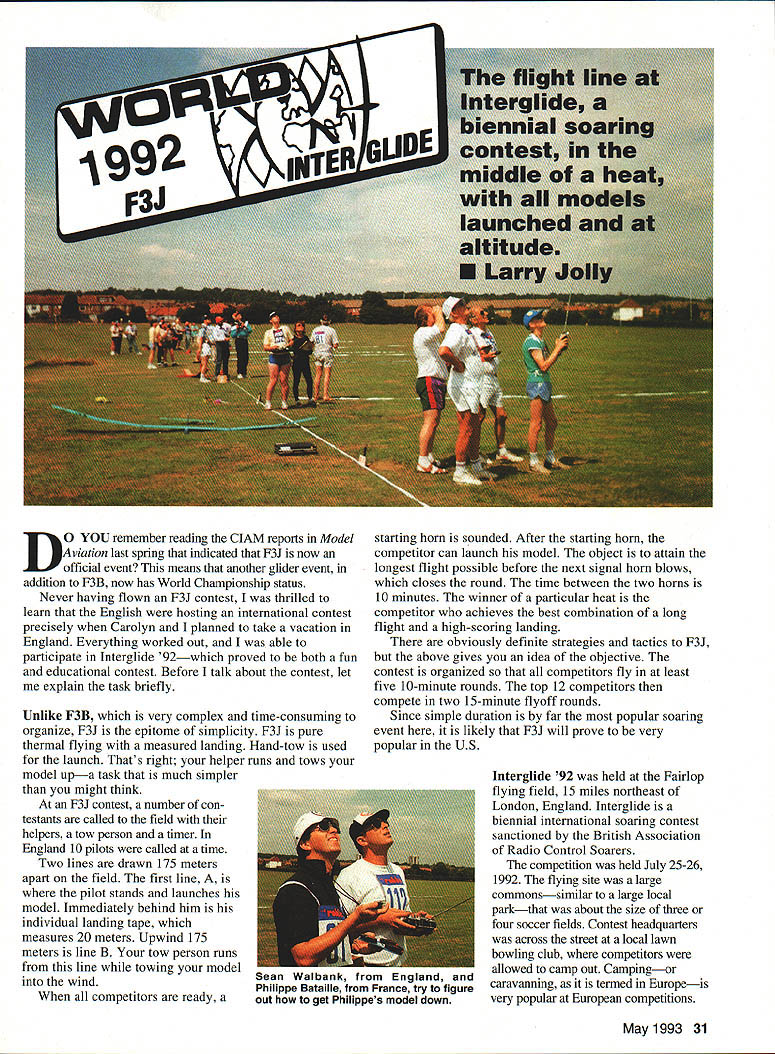
World 1992 F3J Inter Glide
Introduction
Do you remember reading the CIAM reports in Model Aviation last spring that indicated F3J is now an official event? This means that another glider event, in addition to F3B, now has World Championship status.
Never having flown an F3J contest, I was thrilled to learn that the English were hosting an international contest precisely when Carolyn and I planned to take a vacation in England. Everything worked out, and I was able to participate in Interglide ’92 — which proved to be both a fun and educational contest.
What is F3J?
Unlike F3B, which is very complex and time-consuming to organize, F3J is the epitome of simplicity. F3J is pure thermal flying with a measured landing. Hand-tow is used for the launch — your helper runs and tows your model up, a task that is simpler than it might sound.
The Task and Scoring
- Two lines are drawn 175 meters apart on the field.
- Line A: where the pilot stands and launches his model. Immediately behind the pilot is an individual 20-meter landing tape.
- Line B: upwind, 175 meters from line A; the tow person runs from this line while towing the model into the wind.
- A starting horn signals the beginning of the round; the closing horn sounds 10 minutes later. The object is to attain the longest flight possible and a high-scoring landing within that interval.
- Competitors fly at least five 10-minute rounds. The top 12 then compete in two 15-minute flyoff rounds.
- In England, groups of 10 pilots were called to the field at a time.
There are definite strategies and tactics to F3J, but the above gives the basic objective. Since simple duration is a very popular soaring event, F3J is likely to become popular in the U.S.
Interglide ’92 — Contest Details
- Date: July 25–26, 1992
- Location: Fairlop flying field, about 15 miles northeast of London, England
- Event: Interglide, a biennial international soaring contest sanctioned by the British Association of Radio Control Soarers
- Contest headquarters: local lawn bowling club across the street (camping/caravanning was allowed and popular)
Contest Director Les Sparkes presided over the briefing. Competitors were present from:
- England
- Scotland
- France
- Holland
- Belgium
- Germany
- Czechoslovakia
- U.S.A.
The contest was well organized. Three rounds were easily completed on Saturday; Sunday dawned cloudy and breezy, a sharp contrast to Saturday’s balmy weather.
Results and Highlights
- Saturday: I was fortunate to record the top score — a perfect 3,000.
- Sunday: Windy conditions caused problems. Round four saw line breaks that reduced scores and kept some experienced pilots, including myself, out of the finals.
- A large field of pilots participated (the briefing included 130 pilots).
Models and Equipment
Most models flown were English Open-class ships:
- Typical wingspan: about four meters
- Airfoil sections commonly used: Eppler 193, Eppler 205, SD 3021
- Construction: foam-and-veneer wings with fiberglass or plywood fuselages
- Geometry: high-aspect-ratio polyhedral wings with rudder and elevator; spoilers or air brakes
- Typical weight: five to seven pounds
These models showed excellent thermal performance. Predictably, however, smaller models often had advantages: they towed faster, were easier to land, and were more consistent in the long run.
Hand-Tow Equipment and Technique
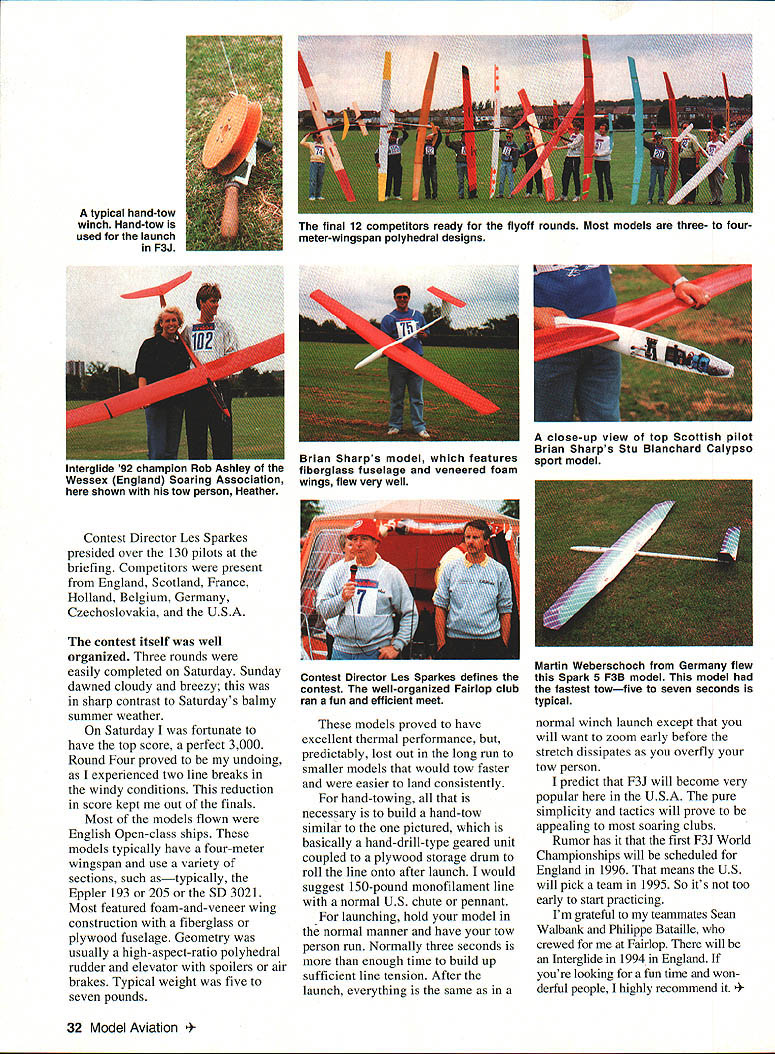
Since hand-towing is necessary, build a hand-tow similar to the one described here:
- Basic design: a hand-drill-type geared unit coupled to a plywood storage drum that rolls the line onto the drum after launch.
- Line: I suggest 150-pound monofilament.
- Tow pennant: a normal U.S. chute pennant works well.
- Launch technique: hold the model in the normal manner and have the tow person run. About three seconds is usually enough to build sufficient line tension. After launch, zoom early before the stretch dissipates and overfly the tow person; otherwise the launch is similar to a normal winch launch.
Looking Ahead
I predict F3J will become very popular in the USA because of its pure simplicity and appealing tactics for soaring clubs. Rumor has it the first F3J World Championships will be scheduled in England in 1996, which means the U.S. will pick a team in 1995 — so it’s not too early to start practicing.
Acknowledgements
I’m grateful to teammates Sean Walbank, Philippe Bataille, and the crew at Fairlop who helped me at Interglide ’92. If you’re looking for a fun time and wonderful people, I highly recommend Interglide.
Transcribed from original scans by AI. Minor OCR errors may remain.

