


World Championships
By Ron Chidgey
Location and overview
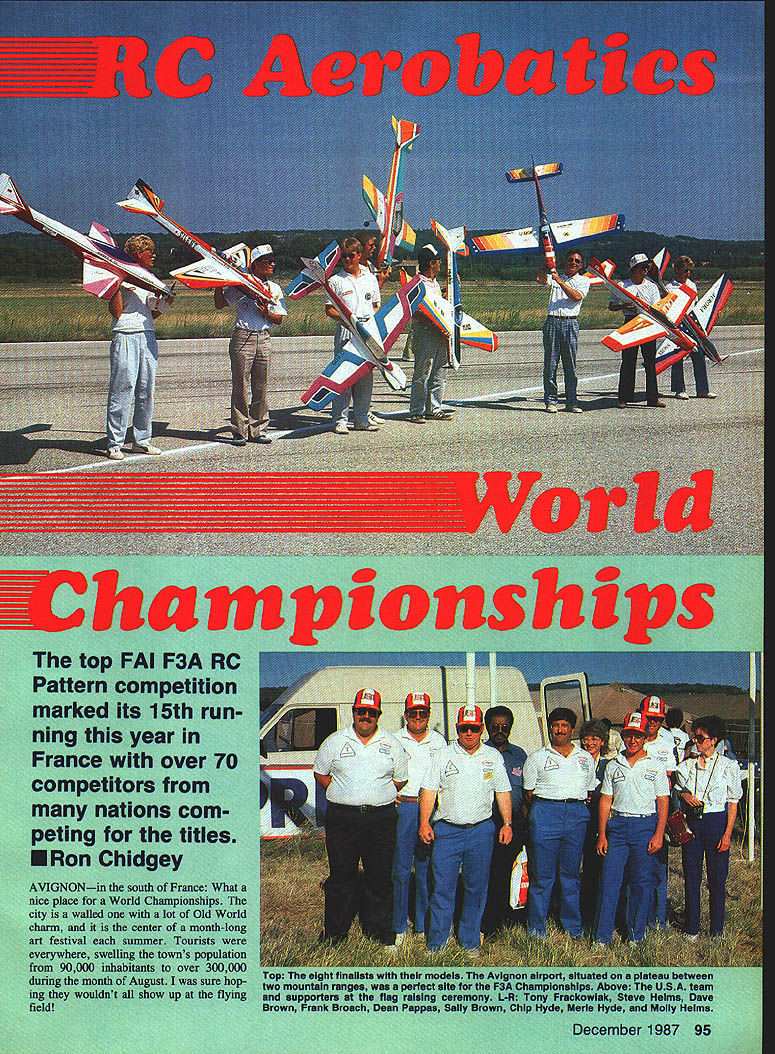
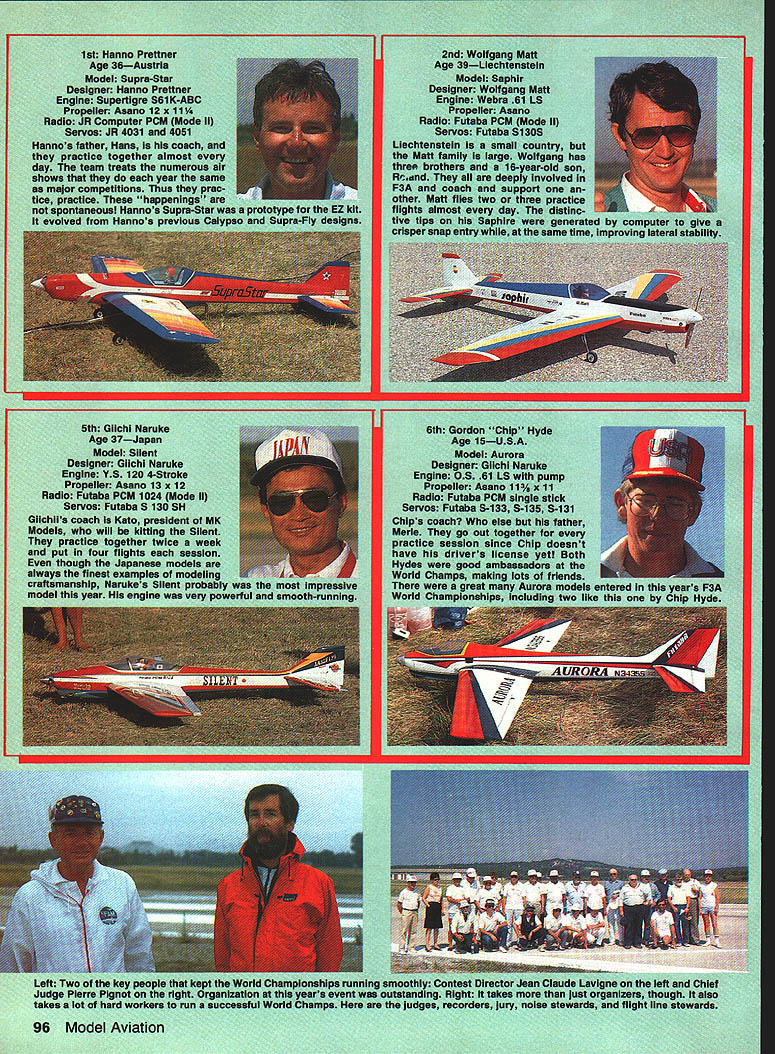
Avignon, in the south of France, was the site of the 15th FAI F3A RC Pattern World Championships. The walled city, hosting a month-long summer art festival, swelled with tourists in August. The flying site was the Avignon Municipal Airport, with a 100 × 4,000 ft runway. Over 70 competitors from many nations vied for titles in what proved to be a memorable contest.
The Mistral (the wind)
Locals warned of the Mistral—a strong, persistent wind in the Rhone Valley. Typical patterns are stretches of steady 20–30 knot winds for three, six, or nine days, then an abrupt stop. The Mistral eased somewhat for official practice day (Tuesday), returned in force for Wednesday’s official flying (near the FAI limit of 12 m/s), then stopped Wednesday night and produced nearly perfect conditions for the remainder of the contest.
Site layout and organization
- Two flight lines were laid out, separated by 200 meters, with starting boxes adjacent to the runway.
- Organizers used a back-to-back arrangement rather than the usual side-by-side layout: one line for morning flights (group A judges) and the other for afternoon flights (group B judges). This allowed all spectators and contestants to see every flight since only one model flew at a time.
- The long noon break accommodated full-scale airport traffic. Flights often started as early as 6:30 a.m. and could run until nearly 8:00 p.m.
- Contest Director Jean-Claude Lavigne and Chief Judge Pierre Pignot led an exceptionally well-run event; many volunteers (judges, recorders, jury, noise stewards, flight line stewards) supported smooth operations.
Practice day incidents
- Early in practice, a large flat-bed truck used to transport teams hit a rough spot. The tailgate bounced up, striking a crewman in the face and breaking his jaw; he was hospitalized and later flown to Marseille for surgery.
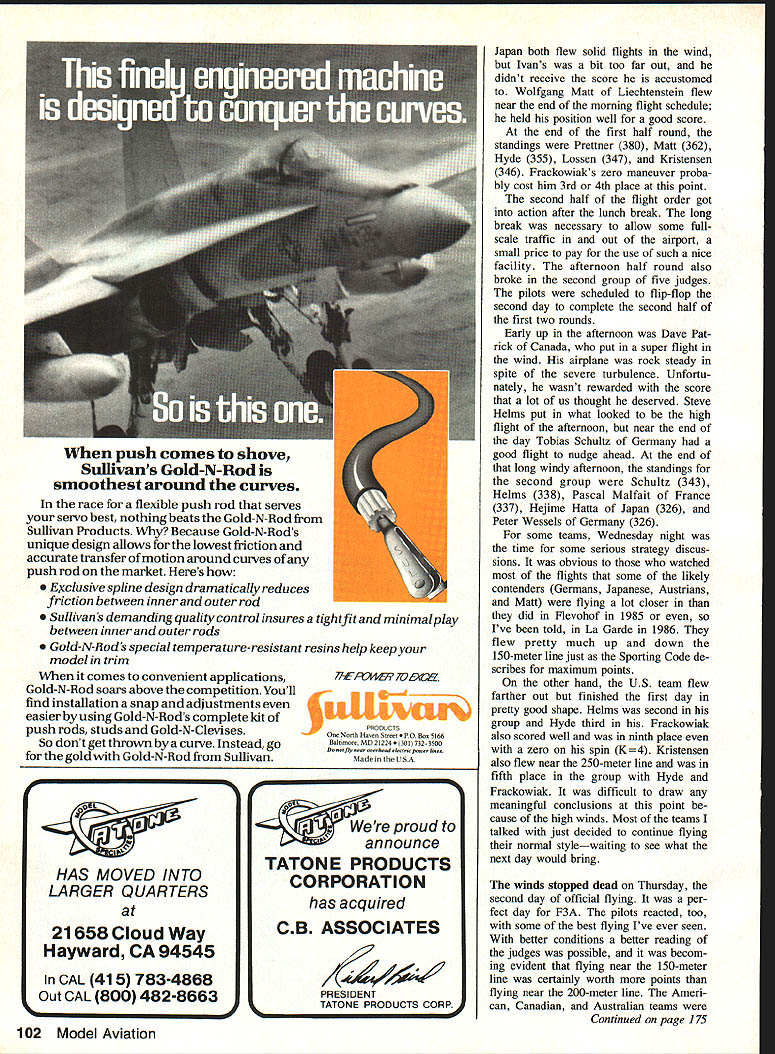
- The same truck’s sudden braking caused people to tumble and two No. 1 models—Tsugutaka Yoshioka’s and Hajime Hatta’s—were severely damaged. Both pilots used backup models and still performed strongly.
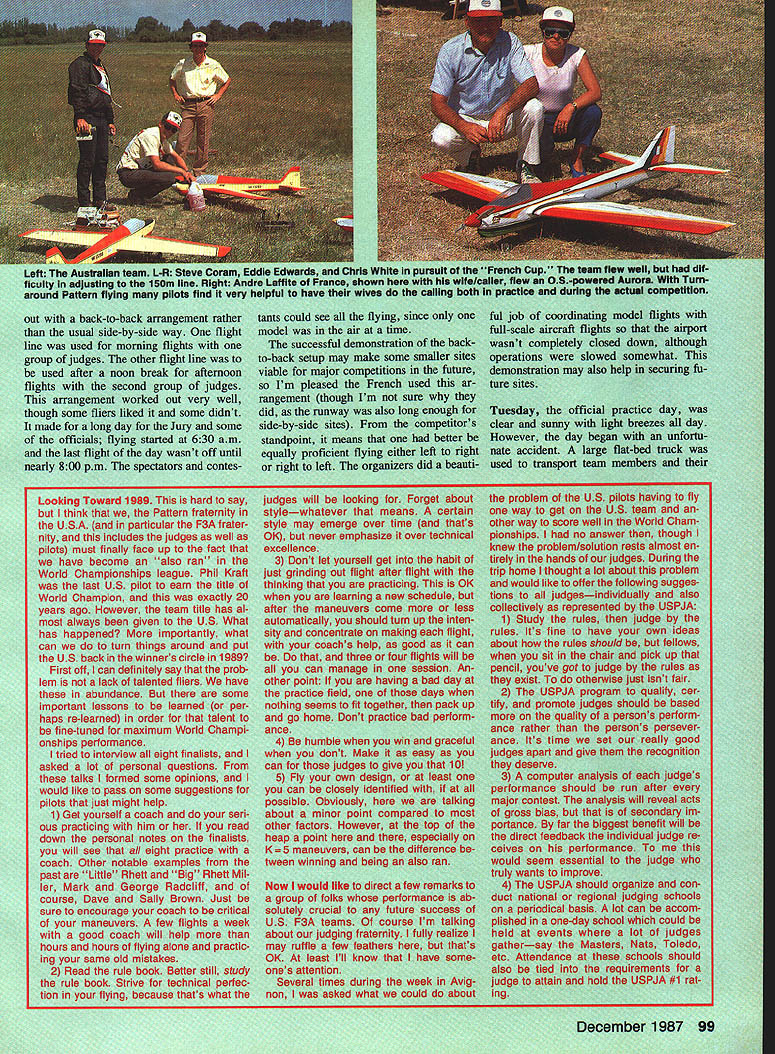
- Mid-morning radio interference caused a crash by Australian Chris White on 72.240 MHz—the same frequency used by the U.S. team. Spectrum analyzer recordings showed a spike at that frequency (possibly a long-skip broadcast signal). A late practice slot was granted so affected teams could change frequencies and continue.
Preliminaries (first two days)
- Day 1 (Wednesday) featured strong, gusty winds. Pilots flew in two groups (odd-numbered pilots in the morning, even in the afternoon). The morning was particularly testing; several pilots struggled to hold position.
- Morning top scorers included Prettner 380, Matt 362, Hyde 355, Lossen 347, Kristensen 346. A zero on a maneuver hurt Tony Frackowiak’s placing.
- Afternoon group top scorers included Tobias Schultz 343, Steve Helms 338, Pascal Malfait 337, Hajime Hatta 326, Peter Wessels 326.
- Day 2 (Thursday) saw the winds die down. Conditions were nearly perfect, and the flying quality improved dramatically. Judges and pilots began to favor flying near the 150-meter line for maximum points, rather than the farther 200–250 meter lines some teams had used.
- Rounds three and four (Friday and Saturday) continued with very light winds and warm temperatures. Consistency became crucial. Prettner and Matt flew very steadily; other pilots had individual outstanding flights but needed consistent excellence to win.
Finalists (after prelims)
- Eight finalists (top 10%) and their preliminary standings:
- Hanno Prettner, Austria — 3000
- Wolfgang Matt, Liechtenstein — 2934
- Bertram Lossen, F.R. Germany — 2898
- Hajime Hatta, Japan — 2862
- Giichi Naruke, Japan — 2827
- Chip Hyde, U.S.A. — 2805
- Tobias Schultz, F.R. Germany — 2791
- Peter Wessels, F.R. Germany — 2785
Finals and final results
- Finals are mandatory in F3A World Championships and count for 40% of the total score. With near-perfect weather for finals, all eight finalists flew extremely well. Two final-round flights (mid-morning and early afternoon) left standings unchanged from prelims.
- Top 8 final standings (total points shown as final score):
- H. Prettner, Austria — 5000
- W. Matt, Liechtenstein — 4893
- B. Lossen, Germany — 4869
- H. Hatta, Japan — 4794
- G. Naruke, Japan — 4780
- C. Hyde, U.S.A. — 4745
- T. Schultz, Germany — 4693
- P. Wessels, Germany — 4673
- Final team standings (teams count prelims only; finals don’t affect team result):
- F.R. Germany — 8474 points
- Japan — 8462 points
- Austria — 8331 points
- U.S.A. — 8082 points
- China — 7950 points
- Top 20 individual standings (prelim + final totals through 20th place where applicable):
- H. Prettner, Austria — 5000
- W. Matt, Liechtenstein — 4893
- B. Lossen, Germany — 4869
- H. Hatta, Japan — 4794
- G. Naruke, Japan — 4780
- C. Hyde, U.S.A. — 4745
- T. Schulz, Germany — 4693
- P. Wessels, Germany — 4673
- J. Yoshioka, Japan — 2772
- H. Kronlachner, Austria — 2775
- Y. Tan, China — 2751
- I. Kristensen, Canada — 2743
- M. Di Biagio, Italy — 2709
- D. Patrick, Canada — 2703
- K. Binks, U.K. — 2662
- S. Helms, U.S.A. — 2656
- W. Fan, China — 2644
- P. Malfait, France — 2636
- R. Bossum, Norway — 2622
- A. Frackowiak, U.S.A. — 2621
Pilot profiles (top finishers)
#### 1st: Hanno Prettner
- Age: 36 — Austria
- Model: Supra-Star (designer: Hanno Prettner)
- Engine: Super Tigre S61K-ABC
- Propeller: Asano 12 × 11 1/4
- Radio: JR Computer PCM (Mode II)
- Servos: JR 4031 and 4051
- Notes: Coached by his father Hans. They practice together almost every day and treat air shows like major competitions. Hanno’s Supra-Star evolved from his Calypso and Supra-Fly designs; his World Championship airplane was a prototype for the EZ kit.
#### 2nd: Wolfgang Matt
- Age: 39 — Liechtenstein
- Model: Saphir (designer: Wolfgang Matt)
- Engine: Webra .61 LS
- Propeller: Asano
- Radio: Futaba PCM (Mode II)
- Servos: Futaba S130S
- Notes: Supported by a large, modelling-focused family. Wolfgang practices two or three flights almost daily. The Saphir’s distinctive tips were computer-designed for crisper snap entries and improved lateral stability.
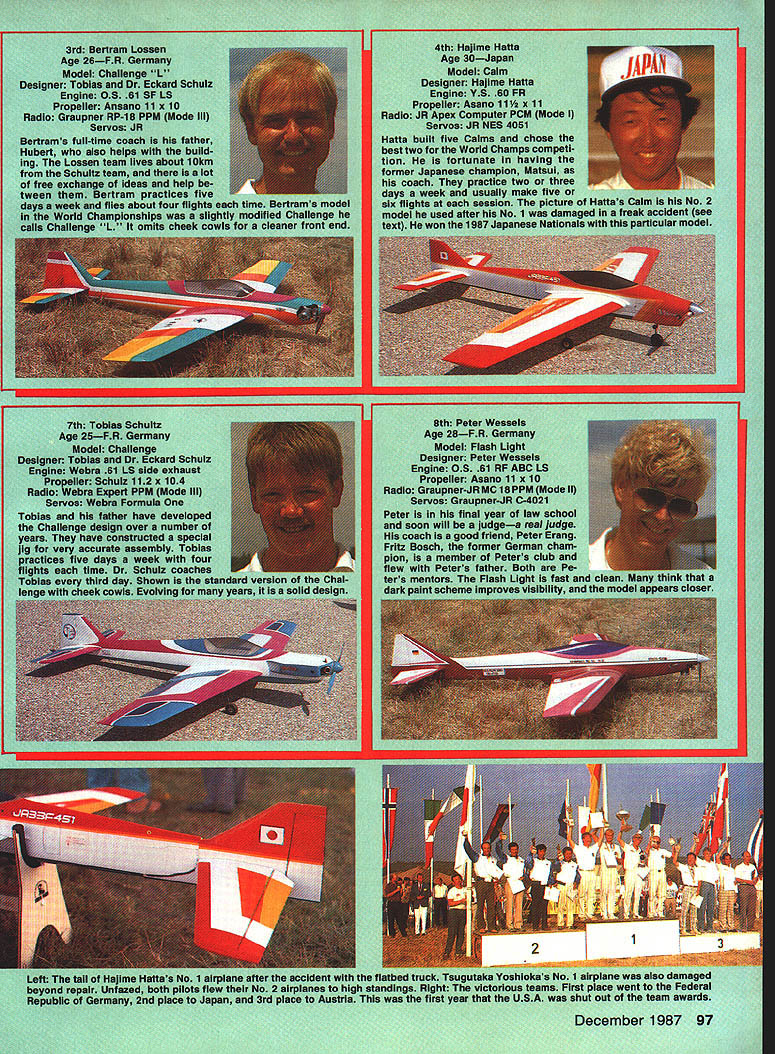
#### 3rd: Bertram Lossen
- Age: 26 — F.R. Germany
- Model: Challenge "L" (designers: Tobias & Dr. Eckard Schulz)
- Engine: O.S. .61 SF LS
- Propeller: Asano 11 × 10
- Radio: Graupner RP-18 PPM (Mode III)
- Servos: JR
- Notes: Coached full-time by his father, Hubert. Practices five days a week with multiple flights per session. His World model is a slightly modified Challenge without cheek cowls for a cleaner front end.
#### 4th: Hajime Hatta
- Age: 30 — Japan
- Model: Calm (designer: Hajime Hatta)
- Engine: YS .60 FR
- Propeller: Asano 11½ × 11
- Radio: JR Apex Computer PCM (Mode 1)
- Servos: JR NES 4051
- Notes: Built five Calms and chose the best two for the contest. Coached by former Japanese champion Matsui. His No. 2 model was used after his No. 1 was damaged in practice; that model won the 1987 Japanese Nationals.
#### 5th: Giichi Naruke
- Age: 37 — Japan
- Model: Silent (designer: Giichi Naruke)
- Engine: Y.S. 120 4-stroke
- Propeller: Asano 13 × 12
- Radio: Futaba PCM 1024 (Mode II)
- Servos: Futaba PCM single stick
- Notes: Coached by Kato, president of MK Models, who will kit the Silent. Practices twice weekly, four flights per session. Naruke’s model was noted as one of the most impressive and finely crafted.
#### 6th: Gordon "Chip" Hyde
- Age: 15 — U.S.A.
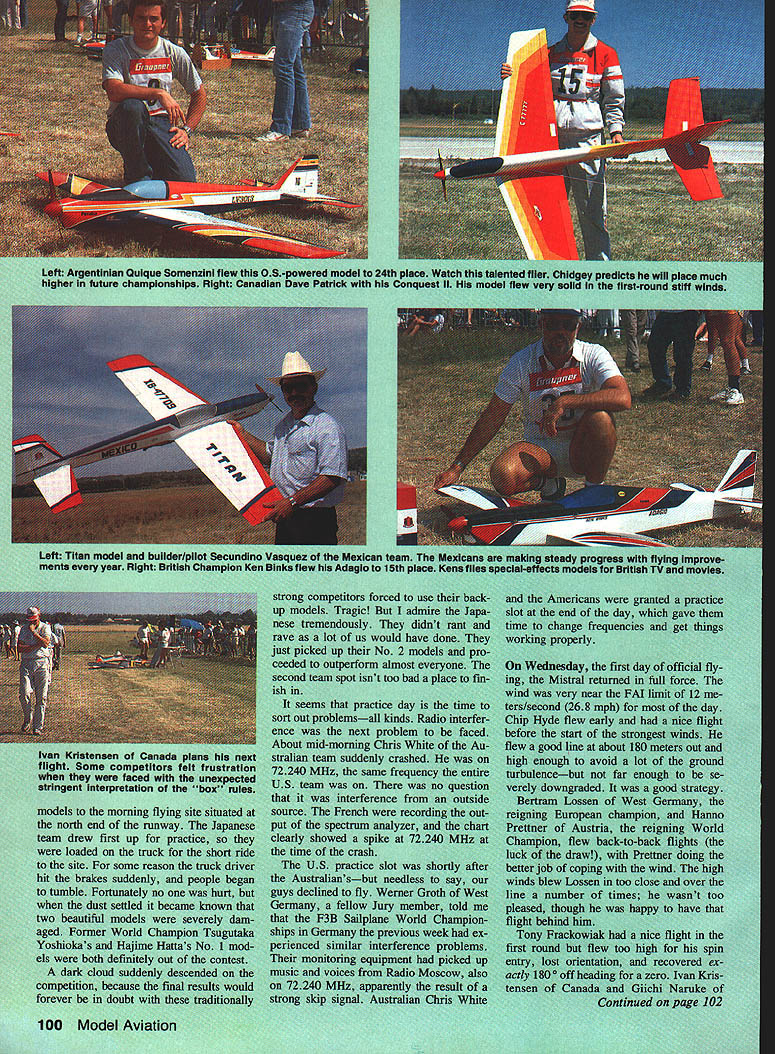
- Model: Aurora (designer: Giichi Naruke)
- Engine: OS .61 LS with pump
- Propeller: Asano 11½ × 11
- Radio: Futaba PCM single stick
- Servos: Futaba S-133, S-135, S-131
- Notes: Coached by his father, Merle Hyde; they practice together since Chip does not yet drive. Chip was a friendly and popular representative of the U.S. team.
#### 7th: Tobias Schultz
- Age: 25 — F.R. Germany
- Model: Challenge (designers: Tobias & Dr. Eckard Schulz)
- Engine: Webra .61 LS side exhaust
- Propeller: Schultz 11.2 × 10.4
- Radio: Webra Expert PPM (Mode III)
- Servos: Webra Formula One
- Notes: Tobias and his father have refined the Challenge over years, using a special assembly jig for accuracy. Practices five days a week; Dr. Schulz coaches every third day.
#### 8th: Peter Wessels
- Age: 28 — F.R. Germany
- Model: Flash Light (designer: Peter Wessels)
- Engine: O.S. .61 FR ABC LS
- Propeller: Asano 11 × 10
- Radio: Graupner-JR MC 18 PPM (Mode II)
- Servos: Graupner-JR C-4021
- Notes: In his final year of law school and soon to be a judge. Coached by friend Peter Erang, mentored by Fritz Bosch and Peter’s father. Flash Light is fast and clean; darker paint schemes improve visibility.
Observations from the contest
- Wind conditions dramatically affected strategy: in high winds, many fliers flew farther out; in calm conditions, judges favored flights nearer the 150-meter line for higher scores.
- Consistency across all rounds proved decisive. Many pilots had single outstanding flights, but winners were those technically correct and disciplined every flight.
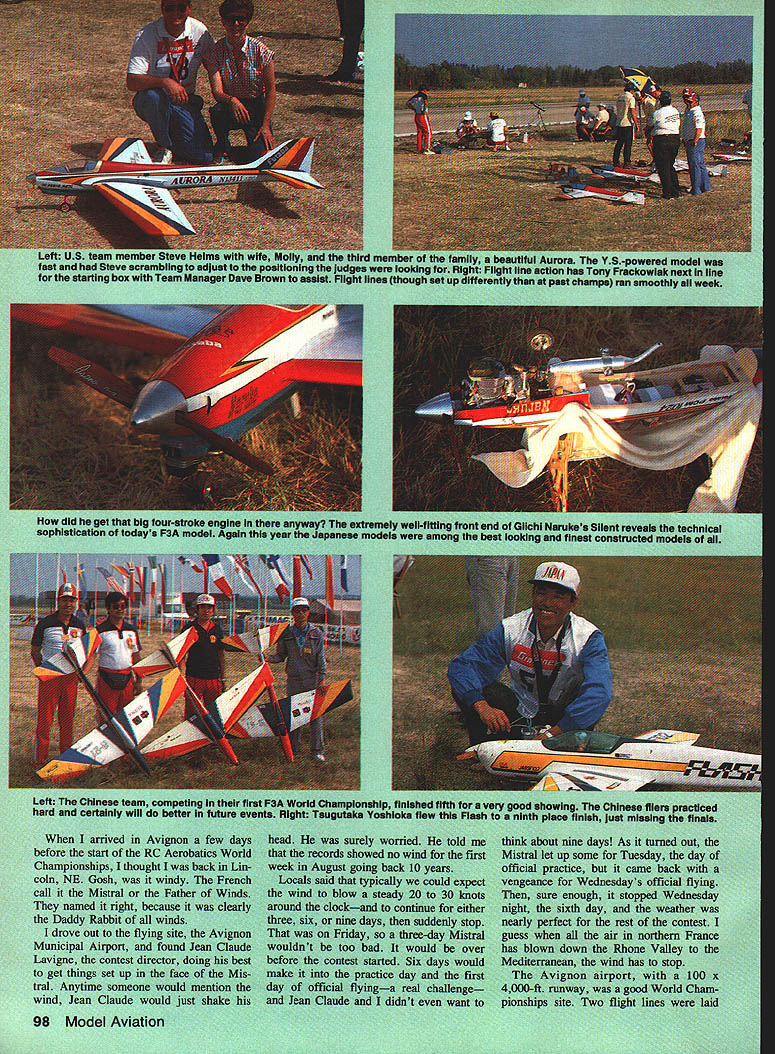
- Some pilots (e.g., Steve Helms) made excellent adjustment and throttle work to match judge expectations but may have lost points early by not "priming" judges with a consistent presentation.
Looking Toward 1989 — advice for pilots
- Get a coach and do serious practice with them. All eight finalists practiced with coaches; critical coaching yields more improvement than solo repetition.
- Study the rule book thoroughly. Judges look for technical perfection; emphasize technical correctness over subjective "style."
- Practice with intensity. After maneuvers are learned, concentrate on making each flight as good as possible—three or four high-quality flights per session are better than many sloppy ones. If a practice day is bad, pack up and go home.
- Be humble in victory and graceful in defeat. Make it easy for judges to award you high marks.
- Fly your own design or a model you are closely identified with. At elite levels, small points on maneuvers (e.g., K-5) can decide outcomes.
Looking Toward 1989 — suggestions for judges and judging organization
- Study the rules and judge by them. Personal preferences are fine, but scoring must follow the official rules.
- Judge qualification and promotion should emphasize quality of performance, not just persistence. Recognize and promote truly excellent judges.
- Implement computer analysis of each judge’s performance after major contests. Feedback will reveal patterns and help judges improve.
- The USPJA should run national or regional judging schools periodically—one-day schools at major events would help. Attendance should be factored into requirements for attaining and holding USPJA F1 ratings.
Closing and acknowledgments
- The awards ceremony honored each of the 76 competitors with a presentation—a thoughtful gesture—followed by a wine and cheese buffet on the field. The closing banquet featured warm and friendly farewells.
- Thanks to Jean-Claude Lavigne and the FFAM for outstanding organization and hospitality.
- To the U.S. team: you flew well—better than the scores indicate. With a new maneuver schedule coming next year, it’s time to reset and prepare for the 1989 World Championships (to be hosted in the U.S., including F3A, F3B, F3C, and F3D).
Transcribed from original scans by AI. Minor OCR errors may remain.

