
World Soaring Jamboree
Fellowship, competition, and fun at first-ever event
Wil Byers
The 1994 World Soaring Jamboree (WSJ) was a big event: 208 model-soaring enthusiasts from 21 states and four countries gathered in the Washington State Tri-Cities for nine days of flying, fellowship, and competition. The AMA‑sanctioned jamboree offered 21 events that encompassed the many formats of the RC soaring movement.
RC soaring formats
RC soaring has changed greatly over the last decade. It is no longer just a few contest formats for Thermal Duration models (not hardly!). The WSJ showcased many formats, including:
- F3B, F3F, F3H, F3J, F3E
- Handlaunch
- Power Slope Scale, Slope Scale, Scale Cross Country
- Thermal Scale, Thermal Duration (Open, Standard, Two‑Meter)
- Slope Racing (60‑inch and Unlimited)
- Fun‑fly models
- Scale models
The WSJ emphasized diversification: it was not just a contest or a who‑is‑best pilot event, but a week focused on people, models, learning, and fun. Organizers aimed to include average RC soarers along with outstanding pilots, builders, and competitors so everyone could participate in a world‑class event.
Events and activities
The jamboree included:
- A banquet and social
- A vendor forum and raffle
- Guest speakers and technical presentations
- Multiple flying sites and 14–21 competitive and fun events across slope and thermal venues
Special guest speakers and the learning program were major incentives to attend.
Guest speakers and technical sessions
Dr. Michael Selig (University of Illinois) and Professor Richard Eppler (Stuttgart University) were keynote presenters who generously gave their time.
Dr. Michael Selig
- Kicked off the learning program with a review of his accomplishments and planned projects in airfoil design.
- Described a new research program (with graduate students) to develop improved airfoil sections, with a bias toward glider sections if funding is available.
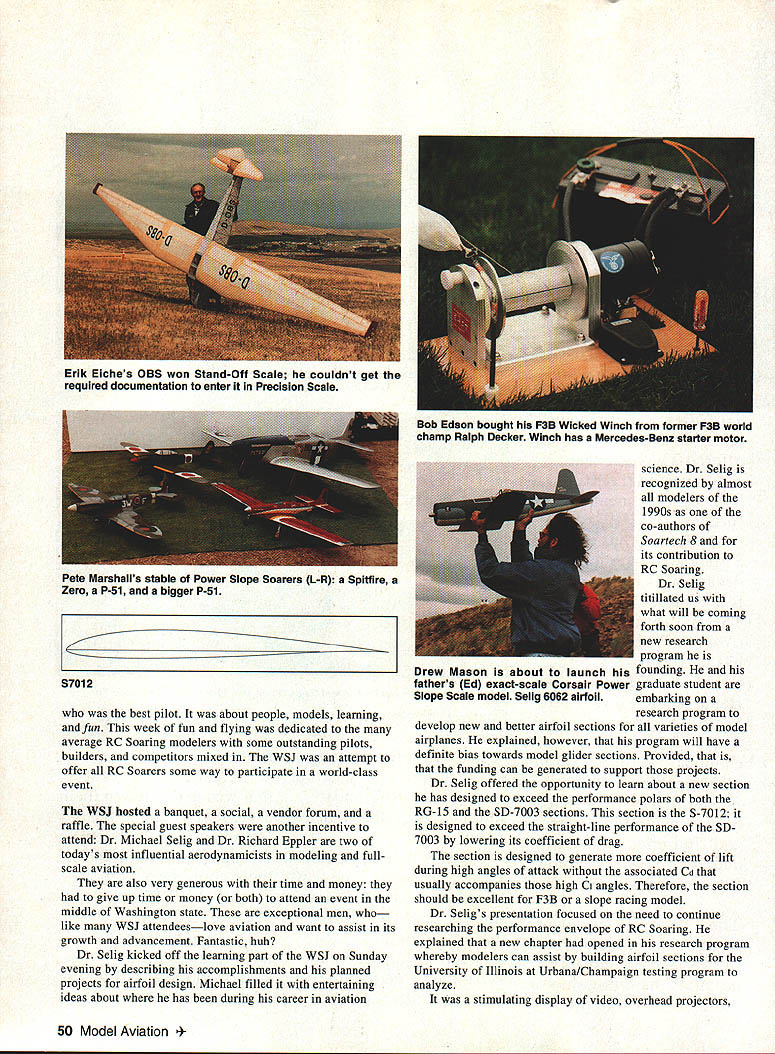
- Introduced the S‑7012 section, designed to improve straight‑line performance over the SD‑7003 by lowering coefficient of drag, and to produce higher coefficient of lift at high angles of attack without the usual penalty in Cd — features that should benefit F3B and slope‑racing models.
- Invited modelers to assist by building airfoil sections for testing at the University of Illinois Urbana–Champaign facilities.
- Used video and overhead projections for a stimulating presentation; banquet attendees were the first to receive coordinates for the S‑7012.
Professor Richard (Dick) Eppler
- Pioneer of the Inverse Method (published 1957), a mathematical/computer approach that changed airfoil design and prediction at a given Reynolds number.
- Spent the entire WSJ accessible to attendees: watching, talking, flying, and signing autographs.
- Gave two talks: one on longitudinal stability (demonstrated with model aircraft) and another on a new twist in classical aerodynamic theory related to wingtip geometry and induced effects — an approach he termed “induced lift.”
- Challenged existing paradigms about optimized wing planforms and proposed that turning up wing tips at specified angles could enhance performance. He suggested that the optimized wing shape may not yet have been found and invited modelers to participate.
- Announced plans to design new application‑specific airfoils for model gliders; noted that Eppler code improvements (with Dr. Dan Somers) are addressing phenomena such as “bubble drag.”
- Indicated he would offer new airfoil sections (possibly published in Model Aviation or similar venues) and was enthusiastic about contributing to the hobby.
Models and craftsmanship
With 208 modelers attending, there were well over 600 models of every type on display. The workmanship and engineering variety were striking. Notable highlights:
- Ray Olson: an all‑molded wing with computer‑machined molds and molded internal components — exceptional airfoil accuracy.
- The Diamont (from The Zaks, via Chip Bullen, Carl Bice, John Weyl): an all‑molded, near‑flawless 100‑inch model using an Eppler 193 airfoil — very clean detailing and ARF potential.
- Erik Eiche’s OBS: a 1/4‑scale replica of a 1931 Lippisch meteorological research glider — museum quality, 6.6 m (21 ft 8 in) span, 26 lb, built in over 2,000 hours using Eppler 68 airfoil; flew beautifully.
- Tony Elliot’s ASH‑25: 20 ft 5 in span, fuselage from Gevalt (Germany), wings by Tony, aspect ratio ~37; used Eppler 66, 67, and 68 sections and demonstrated the easiest way to gain performance is to increase span.
- Imported F3B models (e.g., by Phil Renaud) and scale oddities, including a B‑29 with a releasable X‑1 and Canada’s Fred China with a de Havilland Sparrow.
- Gary Brokaw’s built‑up ASK‑13.
- Numerous Thermal Duration models (Super V, Spectrum, Eagle, Shadow, etc.).
Competition highlights
Thermal events
- Thermal soaring competitions were held on a 450‑acre sod farm (with a 125‑acre center pivot dedicated to flying), hosting Unlimited, Standard, Two‑Meter, F3J, F3B, Cross Country, and Thermal Scale events.
- A standout performance: Bob McGowan’s Two‑Meter Precision Duration flight. Six minutes into a seven‑minute flight he rolled his Falcon 600 continuously, stopped inverted, dove five feet above ground for an inverted flyby, pushed out to upright, and landed — a perfect score and a crowd‑pleasing demonstration.
F3J
- F3J emerged as a major challenge and crowd favorite. Jack Sile (CIAM Vice Chairman for the FAI) CD’d the event to promote it as world‑class competition.
- Format: model‑to‑model thermal duration flying with normalized scoring and graduated landing circles for bonus points — simple, fair, and exciting.
- Launch method: 150 m towline with a hand‑held launcher and runner tower (usually monofilament). A runner pulls the line and the model is flung into the air, reducing dependence on hand‑tow strength and standardizing launches — spectacular to watch and accessible to many pilots.
Handlaunch and Thermal Novice
- Hosted at separate sites; handlaunch encountered challenging wind conditions so few max flights were recorded. Notable competition between Mike Lachowski and Paul Naton showed exceptional pilot‑air sensitivity and earned maxes.
Slope soaring and slope racing
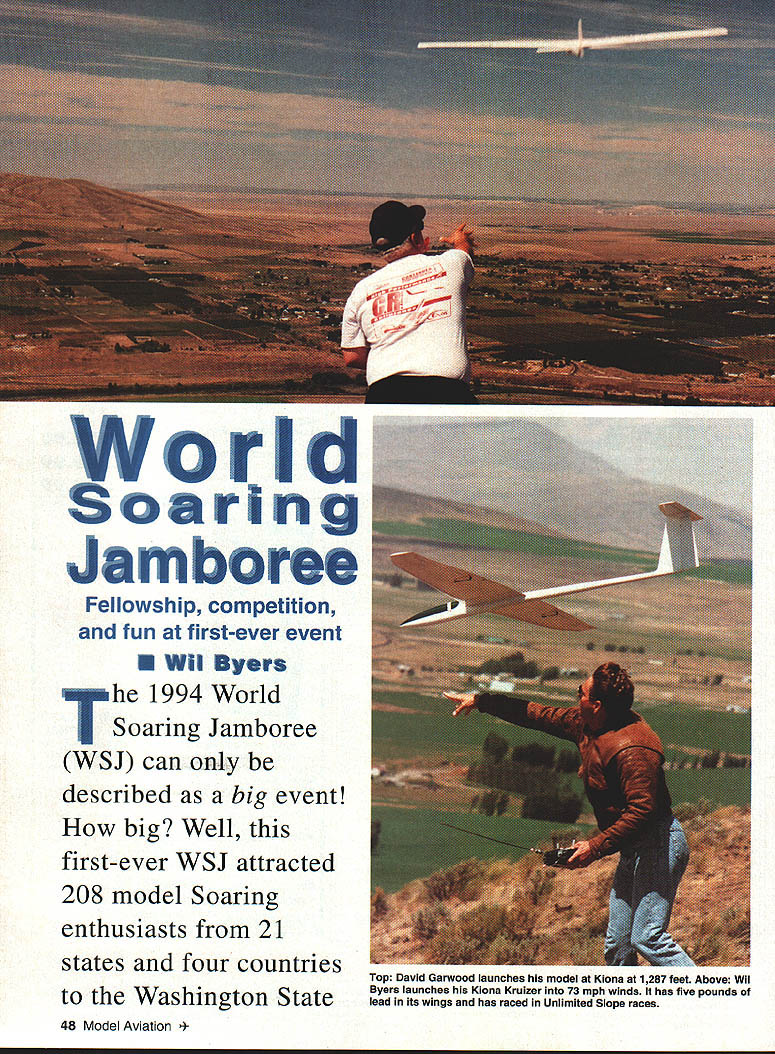
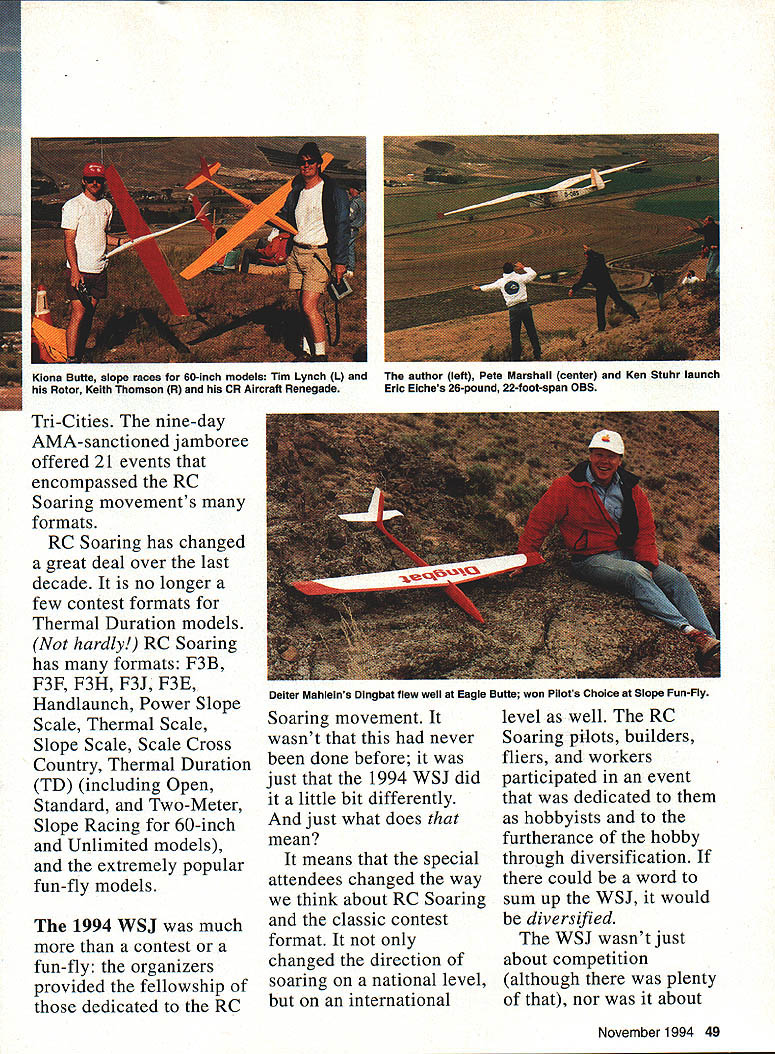
- Eagle Butte and Kiona Butte hosted slope events. On one day winds reached extreme levels (a digital anemometer recorded a steady 73 mph at one point) and brave pilots launched into a desert windstorm for dramatic flying.
- Pilots (Charlie Richardson, Paul Naton, Steve Neu, Eric Larson, Dieter Mehler, etc.) added ballast for penetration; models became “ridge rockets” performing climbing rolls, snap rolls, Cuban eights, inverted flying, and four‑point rolls.
- Slope racing (figure‑eight format) pitted models and pilots in head‑to‑head racing with speeds exceeding 150 mph in aircraft staged off competitors’ wingtips. The final heats between Paul Naton and Charlie Richardson in Raider Unlimited‑class racers (ballasted to the 5 kg limit) were thrilling — model‑to‑model racing at its gladiatorial best.
Organization, volunteers, and support
The WSJ was a community effort involving clubs, individuals, sponsors, and landowners. Key contributors included:
Clubs and organizers
- Seattle Area Soaring Society
- Portland Area Soaring Society
- Inland Empire Soaring Society
- Moses Lake Modelers
- Okalla Hawks
- North American Scale Soaring Association
- Mid‑Columbia Soarers
Contest directors and organizers
- Gary Anderson, Gene Cope, Mike Mellor, Frank Wheeler, Joseph Conrad, Erwin Ledet, Mike Bamberg, Jack Sile, Chuck Warren, Phil Renaud, Robin Robinson, and Wil Byers — all invested time and money to make the event happen.
Volunteers and helpers
- Charlie and Dorothy Harris (hotel registration and pilot services)
- Judy Slates (editor of RC Soaring Digest) — major help organizing and compiling the event program
Sponsors and manufacturers
- JR Radio, Siegers International, RC Soaring Digest, Futaba Corp., Ace R/C, BAT Winches, Viking Models, Aerospace Composites, Windspiel Models, Sig Manufacturing, and others provided manufacturer support.
Land and facilities
- Greg Higgs donated the 450‑acre sod farm and improved access roads.
- Badger Mountain Irrigation District (BMID) and Brad Anderson provided the Eagle Butte site.
- The Bureau of Land Management and Gary Yeager granted a permit to fly at Kiona Butte and agreed to work toward making it a permanent RC soaring park.
Closing
The WSJ was not the work of one person but of many who wanted to be part of a movement — to promote comradeship, learning, flying, and competition. There is another WSJ scheduled for 1998 to continue and expand that concept. The World Soaring Jamboree was, and is, dedicated to you and to the furtherance of this great hobby. See you in 1998!
Transcribed from original scans by AI. Minor OCR errors may remain.

