

World's First RC Sailplane?
Walt Good and Hans Justus Meier
In days when worldwide communications were very poor, more than once an inventor came up with the same idea at about the same time as another distantly removed and with neither having knowledge of the other. This is the reason for placing the question mark in the title.
THIS STORY relates the results of chasing down one of the early hobby RC flights which was well documented and appears to predate any similar event in the U.S.A. This may be a candidate for the first RC model flight in the world. There may be earlier flights of which I'm not aware, but if there are, perhaps this story will help pull them out into the open.
My RC History series in Model Aviation was deliberately confined to the U.S.A. because I was personally involved and had gathered a wealth of historical material over those early years. Thus the review of RC activities in other countries was delayed until now.
It is well known that inventions spring into existence all over the world almost simultaneously when the necessary ingredients are available. In this case the inventions were the radio and model techniques. The enormity of researching each country's RC history is a formidable task. In spite of these potential difficulties, I thought the quest would be an interesting one. Then several years ago I happened to be glancing through a 1938 Model Airplane News and read a report by Frank Zaic about his visit to Europe in 1937. That got me started on this story.
His report was "An American View of German Model Aviation," which described his impressions of a German national meet (Reichswettbewerb) in Borkenbergen, Westfalen in August 1937. He was invited as a guest after attending the Wakefield event in Europe earlier that year.
Although most of his report covered the rubber- and gas-powered Free Flight events, there was one sentence that caught my attention: "Special events brought out a gas autogyro, which failed to fly, and a steam-turbine-powered model with radio control which also failed to fly."
This meet was only a month after the 1937 AMA Nats which had six RC entries in the U.S.A., so I wondered if there had been any earlier RC events in Germany which might have been successful. Then I turned to a book which I had received from Werner Groth of the German Aero Club while on a visit to Germany in 1982. It was a history of German model flying for the 25-year period from 1951 to 1975. It covered their Nats and many model events of that quarter-century period, plus other entries from as early as 1904!
Sure enough, the 1937 meet which Zaic had attended was covered — but still another one caught my eye. It was about RC gliders in mid-1936, a year earlier than the first U.S. RC Nats.
Right away, I queried my longtime friend in Bremen, Hans Justus Meier, whom I had met at my first CIAM meeting in Europe in 1958. The CIAM is the FAI's Committee for International Aero Modeling. We had become well acquainted during many years on the CIAM and he maintained contact over the years. He was an active leader in German model activities and, in the early postwar years, he was one of the founding members of the Modellflugkommission (model plane committee) of the German Aero Club as were, among others, Richard Eppler, Berthold Petersen, and the late Werner Thies. Meier was vice-president of the CIAM from 1955 to 1960 and president in 1960–61. He received the coveted Tissandier Diploma in 1964 for valuable contributions to international modeling over many years.
He responded, assisted by Petersen, with copies of Modellflug magazine which described the 1936 RC Glider contest. Further, Meier translated the articles into English and provided photos and background comments for which I'm very grateful.
Next, we will recount the story of the first German RC Glider meet as based on this material—after a bit of background of this pre-World War II period in German history.
Background: The 1930s in Germany
After Hitler's rise to power in 1933, a number of dramatic changes took place. Not only were all political parties outlawed, except Hitler's own National Socialist Party, but individual liberties were also curtailed. For example, the 140,000 amateur wireless operators who were busy designing, building, and operating their home-built radio sets at the time and had set up a national ham radio organization, called the "Funktechnische Verband" (a radio technical group similar to the U.S. Amateur Radio Relay League), also fell prey to the new restrictive regulations. Thus the operation of wireless sets by amateurs was ruled illegal, and the Funktechnische Verband was forced to disband.
This decision was meant to protect Hitler's newly established government by preventing clandestine communications, but it proved to be a fatal mistake for Germany in the forthcoming radar war. In contrast, the British were able to enlist the help of a large number of skilled and experienced operators, chosen from a great reservoir of radio hams, to man their radar stations, thereby helping England to win the Battle of Britain. The Germans had spoiled their own chance of developing a source of radio experts by their hasty and fatal silencing of hams in 1933.
It was three years later before the Reichsminister for Luftfahrt (aviation), Hermann Goering, decided to permit experiments with wireless-controlled model aircraft. Thus in 1936 a small number of licenses for the operation of RC sets was allotted to each of the 18 Regional Airsport Groups. Nonmembers of the National Socialist Flyingkorps (NSFK), and even some individual members of the NSFK, were not eligible to apply for a license, which was issued only through the official regional groups.
In this manner, only "reliable" persons could obtain a license legally. The regional groups passed the licenses only to persons who had been carefully screened by the officials concerned.
Two frequencies were made available to licensed operators: 3.16 and 24.55 MHz. Transmitter output was limited to five watts. Use of the transmitters was restricted to the control of model aircraft. Their use for transmitting signals for communication purposes was not only expressly excluded, but positively prohibited. Illegal use was severely punished. This was the situation in 1936 when the NSFK issued a set of rules for RC model aircraft competition in Germany.
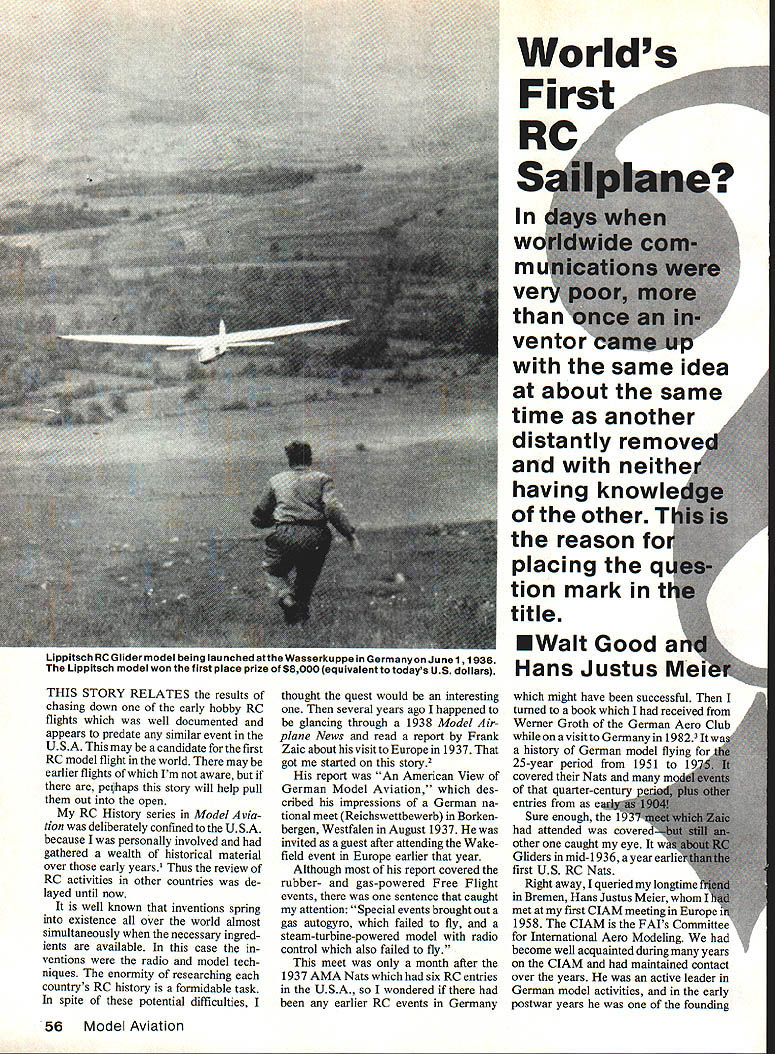
Then in the spring of 1936, it was announced, for the first time ever, that a national meet for RC Gliders would be held on the Wasserkuppe slope site near Fulda, just east of Frankfurt. This is close to the present border with East Germany. I have visited this famous site several times since 1965 and found it very active for both full-scale and RC gliders.
As an aside, I can recommend a visit to the Wasserkuppe for any RC glider flier. It will be the high point of your European vacation trip. You can even stay on the site overnight in a cozy hotel called Peterchens Mondfahrt (literally, "Little Peter's Moon Ship"), which has an excellent restaurant. Also, rides in two-place powered gliders are available, affording an overview of the beautiful Rhön Valley and the glider slopes which have faces for every wind direction.
Now, back to 1936. Especially attractive to the competitors in this event was the unusually large cash prize of 1500 marks, which was almost five months' salary for a young graduate engineer! Today, the equivalent dollars to the old 1500M would be over $10,000—not bad!
The contest entries
When Sunday, May 31, 1936 finally arrived, there were three entries in the RC Glider competition: all were "rudder only" designs. More entries had been anticipated, but in view of the licensing difficulty, perhaps this small number should have been expected. We understand that at least one person did not enter because his license application was turned down.
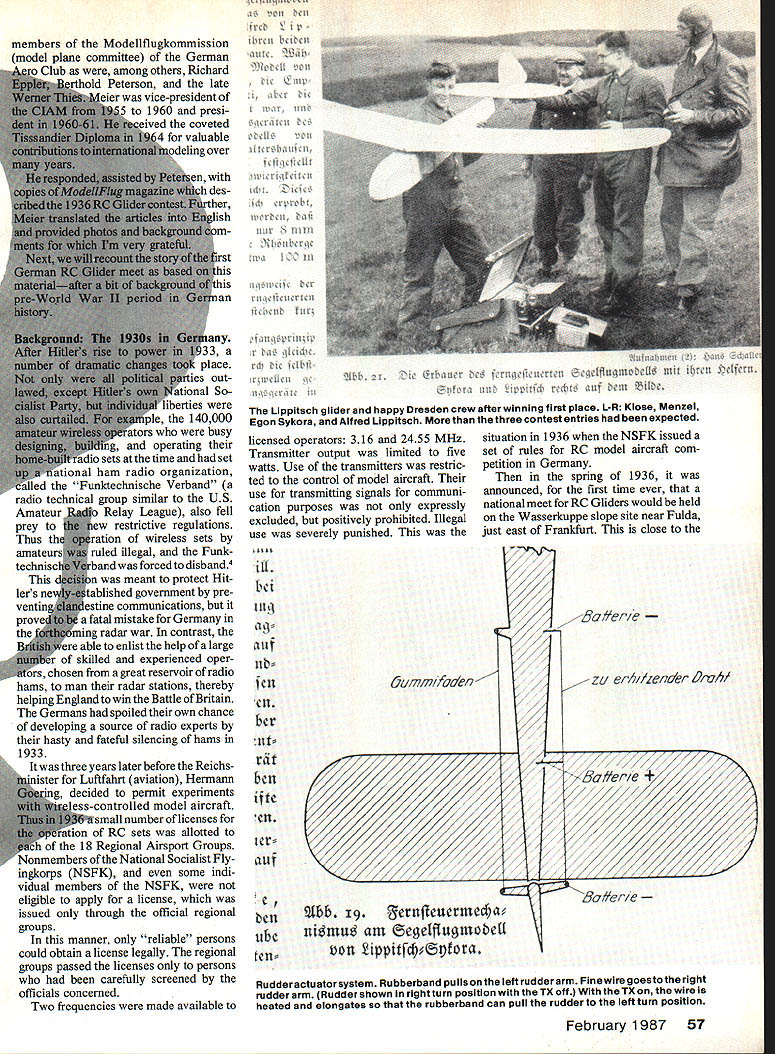
- Alfred Lippitsch, a well-known modeler from Dresden, and his three-man team (Egon Sykora, an electrical engineering student, and two helpers—Klose and Menzel, also well-known model fliers)
- Helmut Sinn from Göppingen
- Merkner-Rieger from Waltershausen
The following descriptions are taken from 1936 issues of Modellflug magazine with permission from the German publishers. It should be mentioned that none of these models had been flown prior to the meet!
Helmut Sinn's model had the rudder set for a left turn when the transmitter was "off"—then with it "on," a small electric actuator would move the rudder to the right. Unfortunately, although the receiver and actuator worked properly, no official flights were made by Sinn's model because the transmitter failed to function.
The Merkner-Rieger model used an electric motor which moved the rudder in a sequence of L–N–R–N–L, etc., similar to a four-spoke escapement. Difficulties in both the receiver and transmitter resulted in no official flights for him.
That left only the Lippitsch/Sykora entry.
Lippitsch/Sykora
The rugged Lippitsch model employed a clever and lightweight rudder actuator based on the physical property that a fine wire, when heated by an electrical current passing through it, will stretch and become longer. The wire was attached to the right rudder horn and a rubber band to the left horn.
When the wire was cold, it was short and held the rudder in a right turn. When heated, the wire lengthened, and the rubber band pulled the rudder into a left turn. The movement of the rudder trailing edge was 8 mm (5/16 in.), which later demonstrated a turning radius of 300 ft. in flight.
Before proceeding to a description of the electronics, a word about the radio license. Egon Sykora was an electrical engineering student when Alfred Lippitsch, the modeler, sought his assistance in 1935 for his RC team. They applied for the special RC license on November 5, 1935 and received it on February 1, 1936, at which time Sykora started serious construction of transmitters and receivers. In the next three months, he built two transmitters and three receivers before he was satisfied. He conducted their first successful radio ground test on May 1, 1936.
Receiver
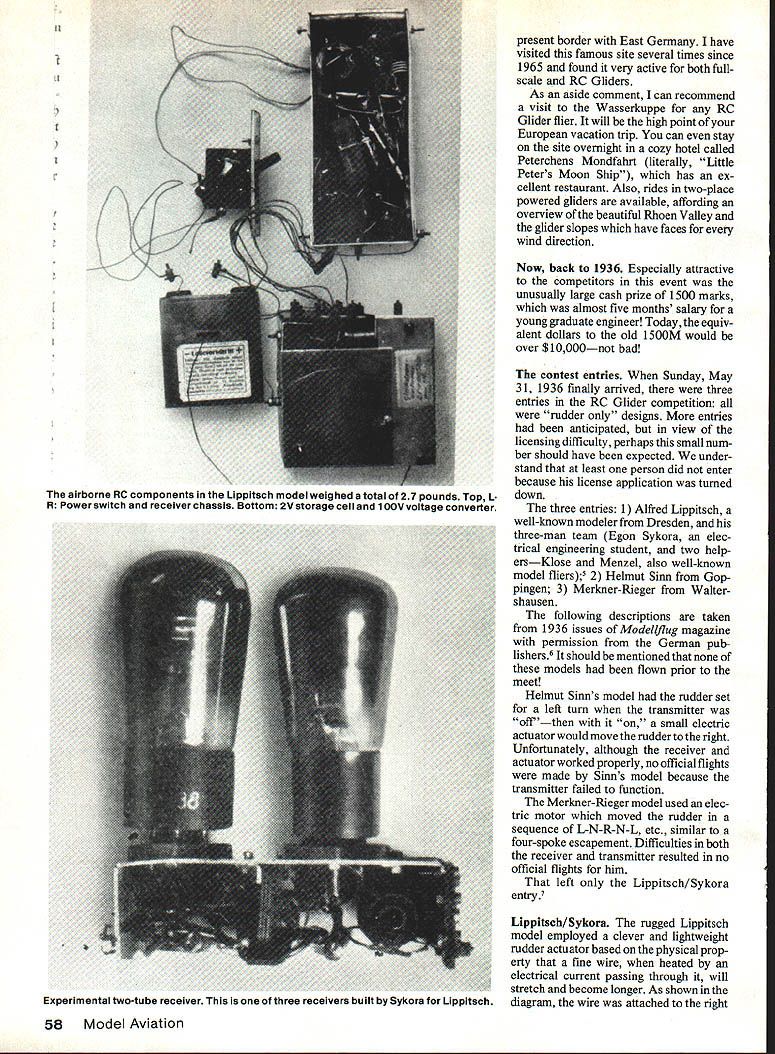
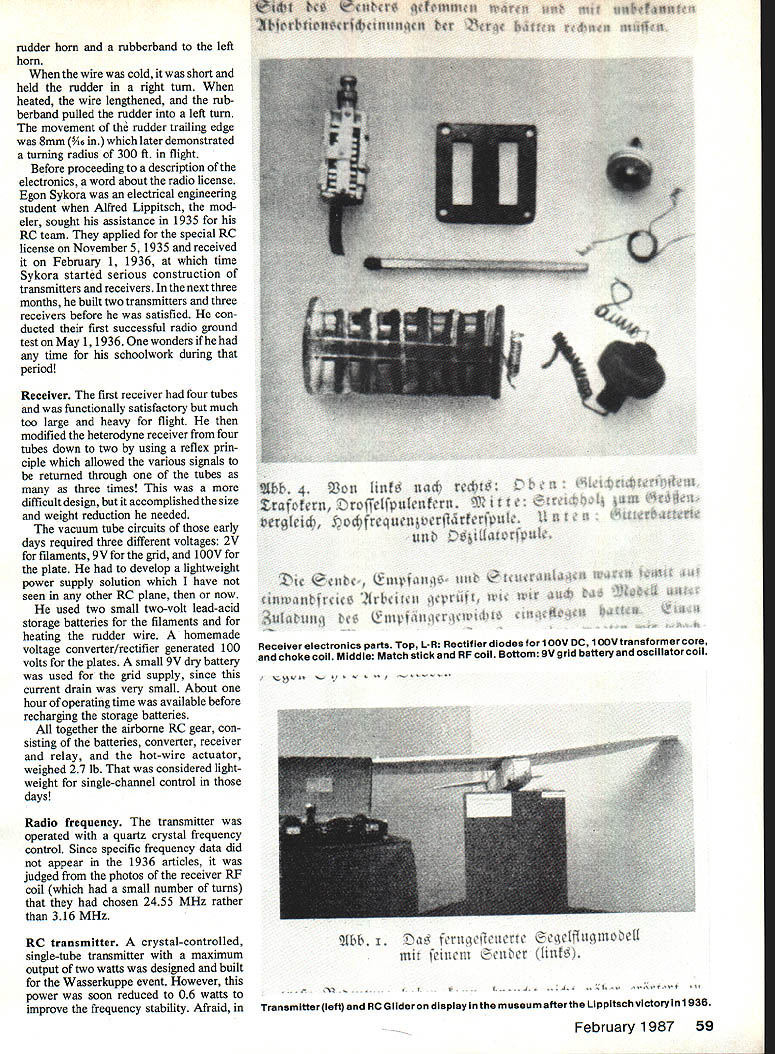
The first receiver had four tubes and was functionally satisfactory but much too large and heavy for flight. He then modified the heterodyne receiver from four tubes down to two by using a reflex principle which allowed the various signals to be returned through one of the tubes as many as three times. This was a more difficult design, but it accomplished the size and weight reduction he needed.
The vacuum tube circuits of those early days required three different voltages: 2 V for filaments, 9 V for the grid, and 100 V for the plate. He had to develop a lightweight power supply solution which I have not seen in any other RC plane, then or now.
He used two small two-volt lead-acid storage batteries for the filaments and for heating the rudder wire. A homemade voltage converter/rectifier generated 100 volts for the plates. A small 9 V dry battery was used for the grid supply, since this current drain was very small. About one hour of operating time was available before recharging the storage batteries.
All together the airborne RC gear, consisting of the batteries, converter, receiver and relay, and the hot-wire actuator, weighed 2.7 lb. That was considered lightweight for single-channel control in those days!
Radio frequency
The transmitter was operated with a quartz crystal frequency control. Since specific frequency data did not appear in the 1936 articles, it was judged from the photos of the receiver RF coil (which had a small number of turns) that they had chosen 24.55 MHz rather than 3.16 MHz.
RC transmitter
A crystal-controlled, single-tube transmitter with a maximum output of two watts was designed and built for the Wasserkuppe event. However, this power was soon reduced to 0.6 watts to improve the frequency stability. Afraid, in view of this low output, that the range might prove inadequate (unjustified, as was found out later), Sykora built a second transmitter equipped with three tubes and more complex circuitry; it had a weight only slightly greater than that of the first unit.
During pre-contest ground tests at the Rhön, the whole system worked well over a range of 4,000 ft. with a transmitter output of 0.4 watt. At this range the trials were stopped because the distance was greater than was expected to be in any flight test. The model, minus RC gear but loaded to full weight with ballast, was thoroughly test-glided and trimmed as a free-flight model.
The RC flights
The Dresden crew did not dare to fly their complete model prior to the day of the contest for fear that a hard landing might damage the valuable tubes. None of the four men had enough money to buy a new set of tubes, which at today's cost would be $130!
On the contest day at noon, June 1, 1936, the moment of truth had arrived. The slightly damp weather did not favor the electrical gear. Furthermore, the wind conditions could have been better, too. The first trial launch was a failure, the speed of the model being too slow. The second attempt did not fare much better, the model being unable to catch the slope lift.
On the third launch the model flew straight off the slope, then turned to the left and finally to the right, following the signals of the pilot. As the model tended to drop its right wing, it was brought down after a flight lasting 45 seconds; it landed about 90 feet from the transmitter. Here was the first indication of possible radio control even though the wing appeared warped. After the wing had been de-warped, a fourth attempt followed, again unsuccessful.
The fifth launch provided a flight that lasted 104 seconds. In the course of the flight, reliable operation of the system was convincingly demonstrated: first a turn to the left followed by one to the right, then by two complete right circles with several small left turn movements in between. These small left turns were performed to show whether the model was still within range for proper control operation. At this moment the distance between the transmitter and model was over 2,000 ft, when the model flew into a region of downdraft. It was quickly steered toward home, flying a straight course, and landed some 20 yards from the transmitter!
This was the first officially recognized demonstration of an RC model sailplane in Germany—and perhaps, in the world! Although the model made several hard landings in the course of these five flights, no parts of model or RC gear were damaged. The receiver did not even require returning!
The hefty cash prizes were awarded in the following way:
- Lippitsch — $8,000 (in equivalent 1986 U.S. dollars)
- Sinn — $1,300
- Merkner-Rieger — $700
The competitors won valuable experience during these first successful flights at the Rhön. They expressed their sincere hope that within a reasonably short time they would be able to demonstrate improvements, both as regards variety of control functions and flight endurance.
We must comment that we rate the Lippitsch team very high for their joint abilities in devising the model and the radio control gear—testing them separately, then joining the plane and radio. Then, with only five attempts, they demonstrated radio control clearly with right and left turns for nearly two minutes and landed the model near the starting point. They were, indeed, true pioneers.
Recent efforts to trace the whereabouts of these pioneers have not been successful. It was interesting to find out that Helmut Sinn continued in RC and automatic flight controls. In 1938 at the Wasserkuppe, he demonstrated a glider with gyro directional steering and a servomotor pitch control. Further, in July 1939, he entered a contest for automatically steered powered models requiring the plane to fly to a goal and return. This contest was held in secrecy, and no visitors were admitted. Apparently the government sponsors were looking for a low-cost tactical mini-reconnaissance vehicle! Unfortunately, Sinn's model crashed on takeoff, and Herbert Scholl's steam-turbine-powered plane burned up shortly after the burner was lighted. Scholl had been developing model RC gear and miniature steam turbines since 1935.
Powered RC models
In Germany, several modelers were experimenting in the late 1930s with powered RC models, but a report of a contest held in Westfalen in 1937 stated, "there were no successful flights." A similar contest in Leipzig in July 1939 produced the same result.
It was generally considered in those early days that a successful powered RC flight was more difficult than RC gliders, primarily due to the engine vibration and electrical interference from the spark-ignition system as compared to the more gentle flight environment of the gliders.
At this writing, it appears that Germany demonstrated the world's first successful RC sailplane in a national competition in 1936. I assume there may be other countries which might challenge this statement. In the case of powered RC models, it appears that the U.S.A. may have been the world's first, at the AMA National Meet in Detroit in 1937.
Criteria for "firsts" in RC
In order to judge a "first" in hobby RC planes, I have listed below some of the criteria which I believe are reasonable. Not all of these will apply to every RC "first," but some set of criteria is needed to establish the authenticity of the event.
- The model was demonstrated in public, preferably in a recognized national competition with specific regulations.
- The results were documented in writing and photos by two or more reliable reporters and appeared in national publications.
- The flights were recognized by the country's national aeronautics organization.
- The RC model demonstrated maneuvers on command, climbed to altitudes above the launch height, and then returned and landed near the transmitter.
Related non-hobby RC in Germany
In a historical sequence similar to that in the United States, the Germans initiated several types of non-hobby RC starting in the late 1800s. Of course, they had some advantage of early information due to the discoveries, in 1887, by the famous Heinrich Hertz who proved that electrical waves did exist and could be measured, transmitted, and received.
In 1899, Mr. A. Vogler from Kamenz, Germany, and Prof. Fitzgerald in Dublin, Ireland, simultaneously filed patents for the remote control of a vehicle by radio. Here it is remembered that Tesla's vehicle demonstrations in the U.S.A. were dated 1898, and his other demonstrations of RC boats in Madison Square Garden were in that same year. Again, this is an example of simultaneous developments in different locations.
Later, in 1911, a student and aviator named Wirth from Nuremberg put Vogler's ideas into practice with an RC boat called the Prinz Ludwig. It was demonstrated in Nuremberg and also in Berlin on the Wannsee. The boat had steering and engine controls, as well as a small gun that was fired remotely.
In 1913 Anton Flettner, who is remembered for his inventions of the rudder servo tab and the Flettner rotor, proposed a remotely controlled tank which was to be steered toward enemy positions where it would cut barbed wire barriers before returning to its starting place. The tank was built and tested successfully in 1915, but the military lost interest when it was discovered that stray radio signals from the Eiffel Tower in Paris interfered with the tank's guidance system.
In the 1920s, the German Navy converted a former battleship, Zähringen, to a radio-controlled target ship for training gun crews. It was even fitted with cork to prevent sinking from the bombardment practice.
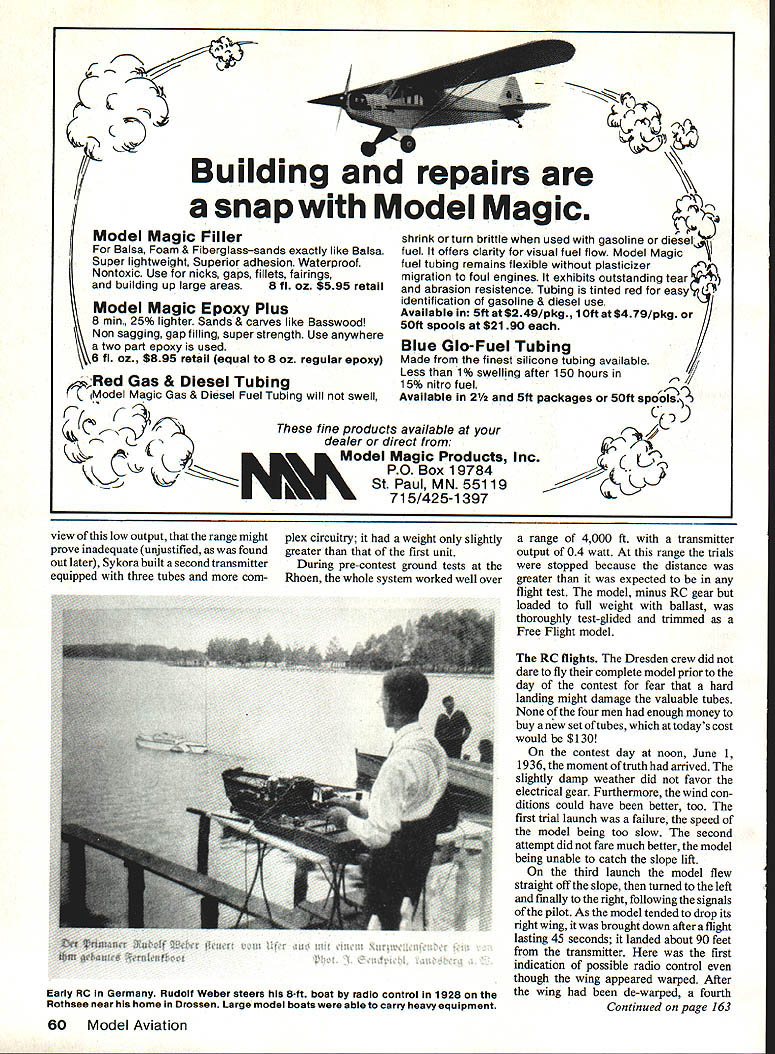
Rudolf Weber, from Drossen near Frankfurt/Oder, began experiments with RC boats while still a student in 1928. One boat was almost 8 ft. long and had "proportional" steering on the rudder, which was new at that time, and several on-off controls for the engine and other functions. He demonstrated it on the Rothsee near his home during the late 1920s. This included the firing of four bullets from a gun on the deck, so we placed this project in the non-hobby category.
Weber used the term "Radio Dynamics" to describe the emerging radio-control technology. That term was also the title of a radio control book by B. F. Miessner in the U.S.A. in 1916! The term is no longer used today, but it is conjectured that Weber may have borrowed the words from Miessner. We wonder if anyone used that term before Miessner?
Acknowledgements
Many thanks to Hans Justus Meier in Bremen for his research, translations, and advice—to my wife Joyce for her typing and patience—to brother Bill and my son Terry for their proofreading and critiques—and to Tom Perzentka for the Flettner reference.
References
- Good, Walt, "History of RC Flying," Model Aviation, March, April, and May, 1986.
- Zaic, Frank, "An American View of Model Aviation," Model Airplane News, April, 1938.
- Petersen, Berthold and others, "25 Years Modellflug im Deutscher Aero Club," 1975.
- Eichhorn, M., "Neue Bestimmungen über die Fernsteuerung von Flugmodellen," Modellflug, Vol. 2 (1937), No. 5, p. 150.
- Alexander, Franz, Modellflug magazine, Vol. 1 (1936), No. 2.
- Note: Official permission from Modellflug magazine in Germany was obtained from Verlag E.S. Mittler & Sohn in Munich (letter of December 3, 1985).
- Lippitsch, Alfred, Modellflug, Vol. 1 (1936), No. 3.
- Lubke, A., Technik und Mensch im Jahre 2000, Albrecht & Co., Munich, 1927.
- Flettner, Anton, "The Story of the Rotor," pub. F.W. Woolworth, New York, N.Y.; original 1926; then Weg zum Rotor, pub. Koehler, 1926; and Almaslal, Leipzig, 1926.
- Weber, Rudolf, "Strahlen lenken ein Boot," Das Neue Universum, Vol. 53, 1933.
Transcribed from original scans by AI. Minor OCR errors may remain.

