
Airportraits
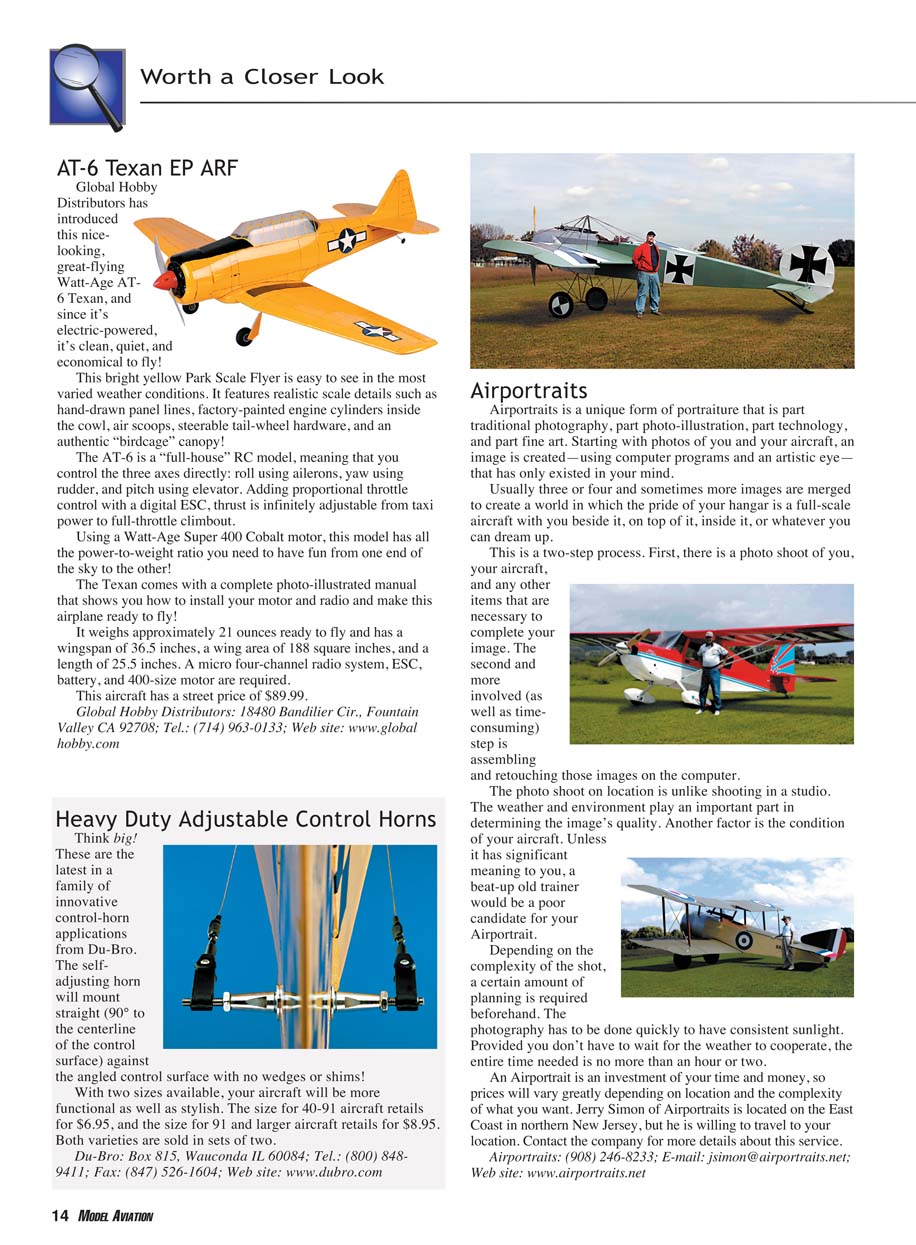
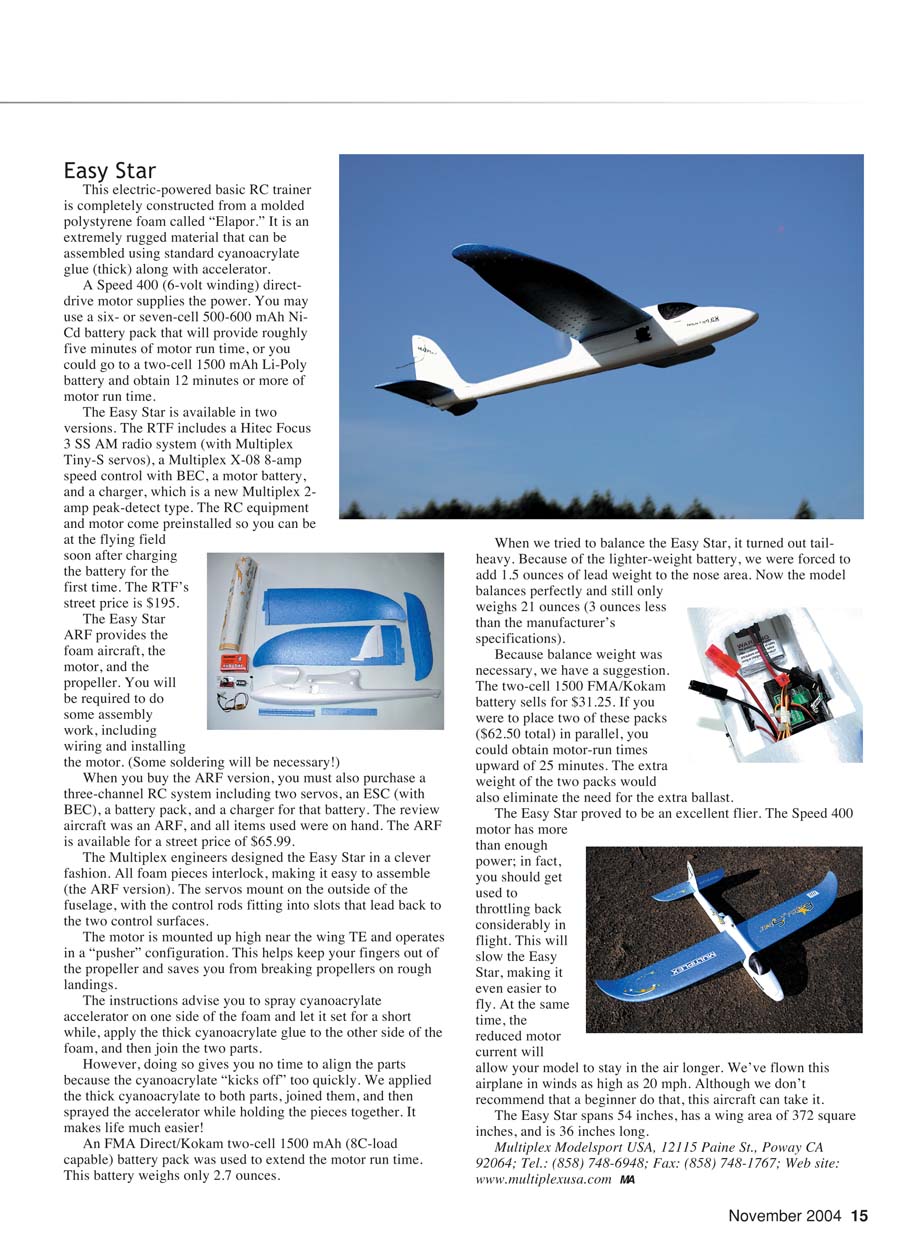
Airportraits is a unique form of portraiture that is part traditional photography, part photo-illustration, part technology, and part fine art. Starting with photos of you and your aircraft, an image is created—using computer programs and an artistic eye—that has only existed in your mind.
Usually three or four, and sometimes more, images are merged to create a world in which the pride of your hangar is a full-scale aircraft with you beside it, on top of it, inside it, or whatever you can dream up.
This is a two-step process. First, there is a photo shoot of you, your aircraft, and any other items that are necessary to complete your image. The second—and more involved (as well as time-consuming)—step is assembling and retouching those images on the computer.
The photo shoot on location is unlike shooting in a studio. The weather and environment play an important part in determining the image’s quality. Another factor is the condition of your aircraft. Unless it has significant meaning to you, a beat-up old trainer would be a poor candidate for your Airportrait.
Depending on the complexity of the shot, a certain amount of planning is required beforehand. The photography has to be done quickly to have consistent sunlight. Provided you don’t have to wait for the weather to cooperate, the entire time needed is no more than an hour or two.
An Airportrait is an investment of your time and money, so prices will vary greatly depending on location and the complexity of what you want. Jerry Simon of Airportraits is located on the East Coast in northern New Jersey, but he is willing to travel to your location. Contact the company for more details about this service.
- Phone: (908) 246-8233
- E-mail: jsimon@airportraits.net
- Web site: www.airportraits.net
Worth a Closer Look - 2004/11
Easy Star
This electric-powered basic RC trainer is completely constructed from a molded polystyrene foam called "Elapor." It is an extremely rugged material that can be assembled using standard cyanoacrylate glue (thick) along with accelerator.
A Speed 400 (6-volt winding) direct-drive motor supplies the power. You may use a six- or seven-cell 500–600 mAh Ni-Cd battery pack that will provide roughly five minutes of motor run time, or you could go to a two-cell 1500 mAh Li-Poly battery and obtain 12 minutes or more of motor run time.
The Easy Star is available in two versions:
- RTF (Ready to Fly): Includes a Hitec Focus 3 SS AM radio system (with Multiplex Tiny-S servos), a Multiplex X-08 8-amp speed control with BEC, a motor battery, and a charger (a Multiplex 2-amp peak-detect type). The RC equipment and motor come preinstalled so you can be at the flying field soon after charging the battery for the first time. The RTF’s street price is $195.
- ARF (Almost Ready to Fly): Provides the foam aircraft, the motor, and the propeller. You will be required to do some assembly work, including wiring and installing the motor (some soldering will be necessary). When you buy the ARF version, you must also purchase a three-channel RC system including two servos, an ESC (with BEC), a battery pack, and a charger for that battery. The ARF is available for a street price of $65.99.
The Multiplex engineers designed the Easy Star in a clever fashion. All foam pieces interlock, making it easy to assemble (the ARF version). The servos mount on the outside of the fuselage, with the control rods fitting into slots that lead back to the two control surfaces.
The motor is mounted up high near the wing trailing edge and operates in a pusher configuration. This helps keep your fingers out of the propeller and saves you from breaking propellers on rough landings.
The instructions advise you to spray cyanoacrylate accelerator on one side of the foam and let it set for a short while, apply the thick cyanoacrylate glue to the other side of the foam, and then join the two parts. However, doing so gives you no time to align the parts because the cyanoacrylate "kicks off" too quickly. We applied the thick cyanoacrylate to both parts, joined them, and then sprayed the accelerator while holding the pieces together. It makes life much easier!
An FMA Direct/Kokam two-cell 1500 mAh (8C-load capable) battery pack was used to extend the motor run time. This battery weighs only 2.7 ounces.
When we tried to balance the Easy Star, it turned out tail-heavy. Because of the lighter-weight battery, we were forced to add 1.5 ounces of lead weight to the nose area. Now the model balances perfectly and still only weighs 21 ounces (3 ounces less than the manufacturer's specifications).
Because balance weight was necessary, we have a suggestion. The two-cell 1500 mAh FMA/Kokam battery sells for $31.25. If you were to place two of these packs ($62.50 total) in parallel, you could obtain motor-run times upward of 25 minutes. The extra weight of the two packs would also eliminate the need for the additional ballast.
The Easy Star proved to be an excellent flier. The Speed 400 motor has more than enough power; in fact, you should get used to throttling back considerably in flight. This will slow the Easy Star, making it even easier to fly. At the same time, the reduced motor current will allow your model to stay in the air longer. We've flown this airplane in winds as high as 20 mph. Although we don't recommend that a beginner do that, this aircraft can take it.
Specifications:
- Wingspan: 54 inches
- Wing area: 372 square inches
- Length: 36 inches
Multiplex Modelsport USA, 12115 Paine St., Poway, CA 92064 Tel.: (858) 748-6948; Fax: (858) 748-1767 Web site: www.multiplexusa.com
Transcribed from original scans by AI. Minor OCR errors may remain.

