
WRAM SHOW 1985: New Beginnings
George M. Myers
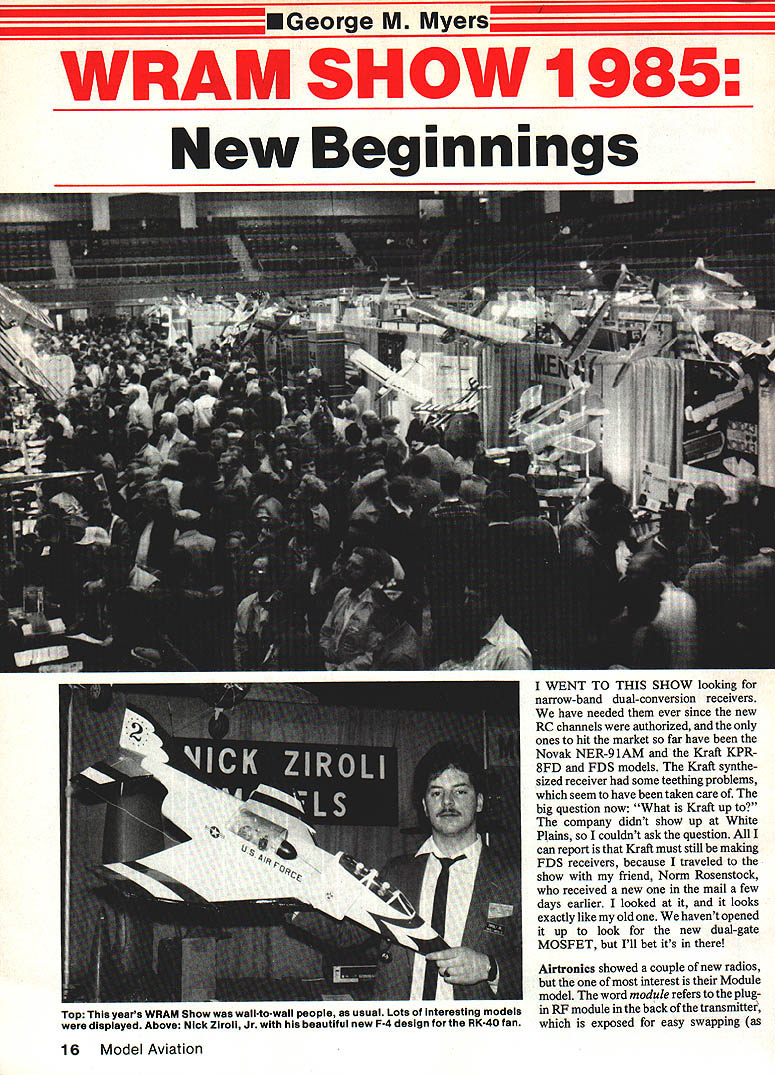
I went to this show looking for narrow-band, dual-conversion receivers. We have needed them ever since the new RC channels were authorized. The ones that have hit the market so far include the Novak NER-9 (AM) and the Kraft KPR-8FD and FDS models. Kraft's synthesized receiver had some teething problems; those seem to have been taken care of. The big question now: what happened to Kraft? The company didn't show up in White Plains, so I couldn't ask. I can report Kraft must still be making FDS receivers because my friend Norm Rosenstock received a new mail-order unit a few days earlier. It looks exactly like the old one; I haven't opened it up to check for the new dual-gate MOSFET, but I'll bet it's in there.
Airtronics
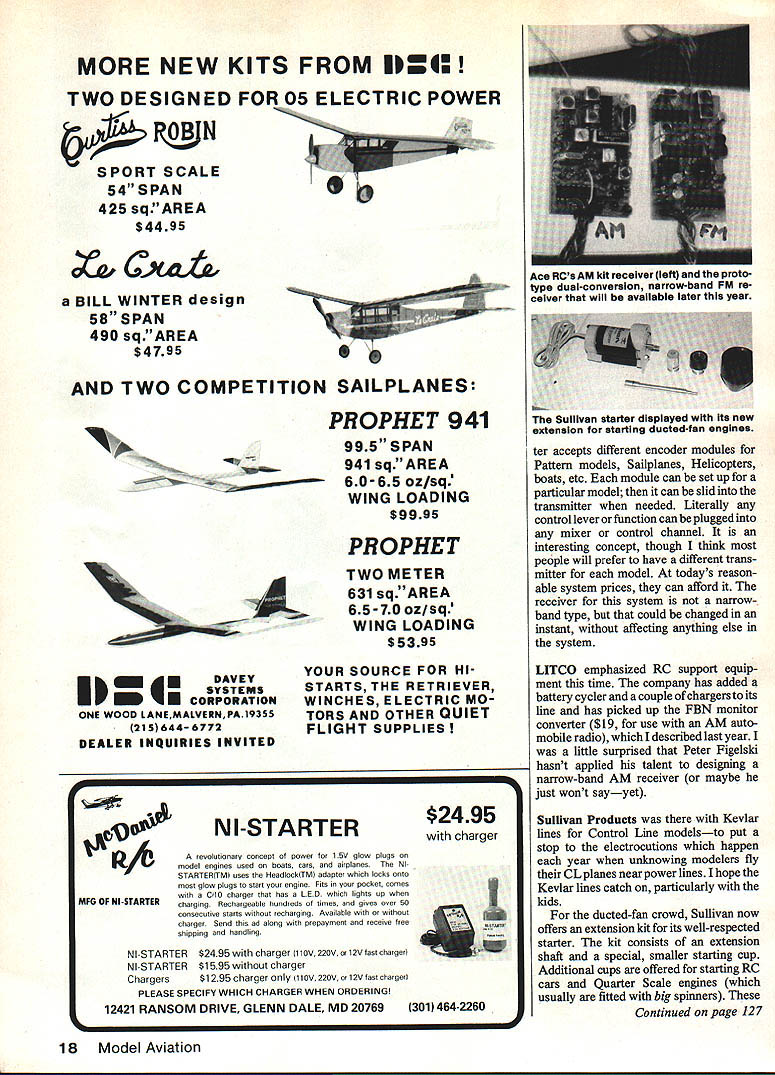
Airtronics showed a couple of new radios, the most interesting being the "Module" model. The word module refers to a plug-in RF module in the back of the transmitter, exposed for easy swapping (as opposed to the previous Championship series, which required removing the back and the crystal to access its bare-board module).
Key points:
- The Module package includes a dual-conversion receiver and is advertised as a narrow-band FM design.
- Bob Aberle has already tested one; its performance seems comparable to the Kraft unit.
- The receiver is tiny and priced at roughly two-thirds of the Kraft, which may attract buyers willing to give up a synthesizer for lower price and reduced bulk.
- Helicopter and fixed-wing transmitter configurations are offered.
- Mixing, servo reversing, and span-setting controls are hidden under a hinged front cover to prevent losing small sliders and knobs.
Ace R/C
Ace R/C displayed prototypes of both AM and FM dual-conversion, narrow-band receivers intended for the Silver Seven transmitter:
- A dual-conversion narrow-band AM receiver kit (prototype shown). May 1985 deliveries were anticipated.
- A dual-conversion narrow-band FM receiver and an FM module for the Silver Seven transmitter to be made available later in the year.
I like building electronics kits and look forward to building these.
Futaba
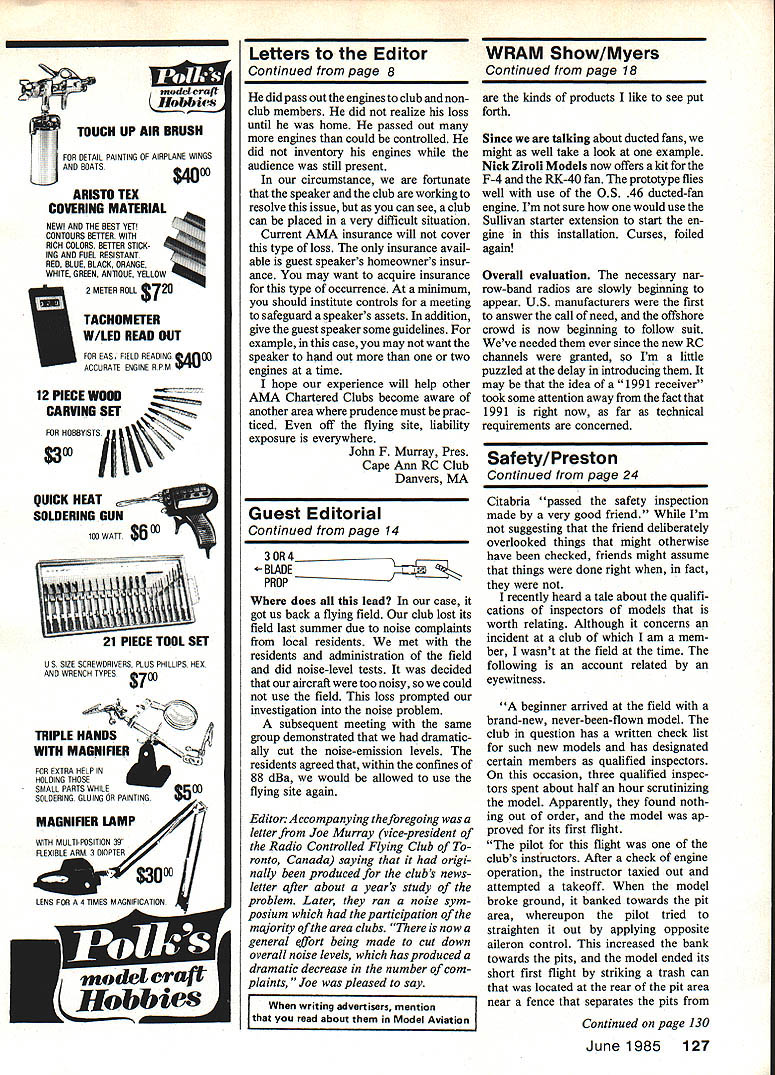
Futaba is staying with the PCM system for the time being. It uses a single-conversion FM receiver, but the onboard computer makes it behave like a narrow-band system. In my experience, Futaba's PCM works better in the presence of interference than any other system I've seen.
Futaba also showed a prototype single-stick transmitter. Advantages:
- The left hand can operate special knobs and switches without removing the right hand from primary flight controls.
- Scale fliers should appreciate the arrangement.
- A steering knob on top of the stick makes ground-handling maneuvers easy and natural—useful for maneuvers with high K-factors.
Novak Electronics
Novak continues to offer its dual-conversion narrow-band AM receiver (NER-9/AM). Price range this year is about $99 to $110, depending on the type of servo plugs fitted. Novak's big news is a line of electric motor speed controls: tiny, lightweight units that operate on four to ten cells and include a built-in regulator to power a receiver and one servo.
Altech Marketing / Simprop PCM-20
Altech Marketing offers the Simprop PCM-20 radio discussed last year. Its notable feature is the transmitter's acceptance of different encoder modules for Pattern models, sailplanes, helicopters, boats, etc. Each module can be set up for a particular model and slid into the transmitter when needed. Any control lever or function can be assigned to any mixer or control channel. The receiver supplied for this system is not narrow-band, but that could be changed without affecting the rest of the system.
LITCO
LITCO emphasized RC support equipment, adding a battery cycler and a couple of chargers to its line. It also picked up the FBN monitor converter ($19, for use with an AM automobile radio), which I described last year. I was a little surprised that Peter Figelski hasn't applied his talent to designing a narrow-band AM receiver—perhaps he simply won't say yet.
Sullivan Products
Sullivan Products exhibited Kevlar lines for Control Line models to reduce electrocutions that happen when CL planes are flown near power lines. I hope Kevlar lines catch on, particularly with younger modelers.
For the ducted-fan crowd, Sullivan now offers an extension kit for its well-respected starter. The kit consists of an extension shaft and a special, smaller starting cup. Additional cups are offered for starting RC cars and quarter-scale engines (often fitted with large spinners). These are the kinds of products I like to see put forth.
Nick Ziroli Models / Ducted Fans
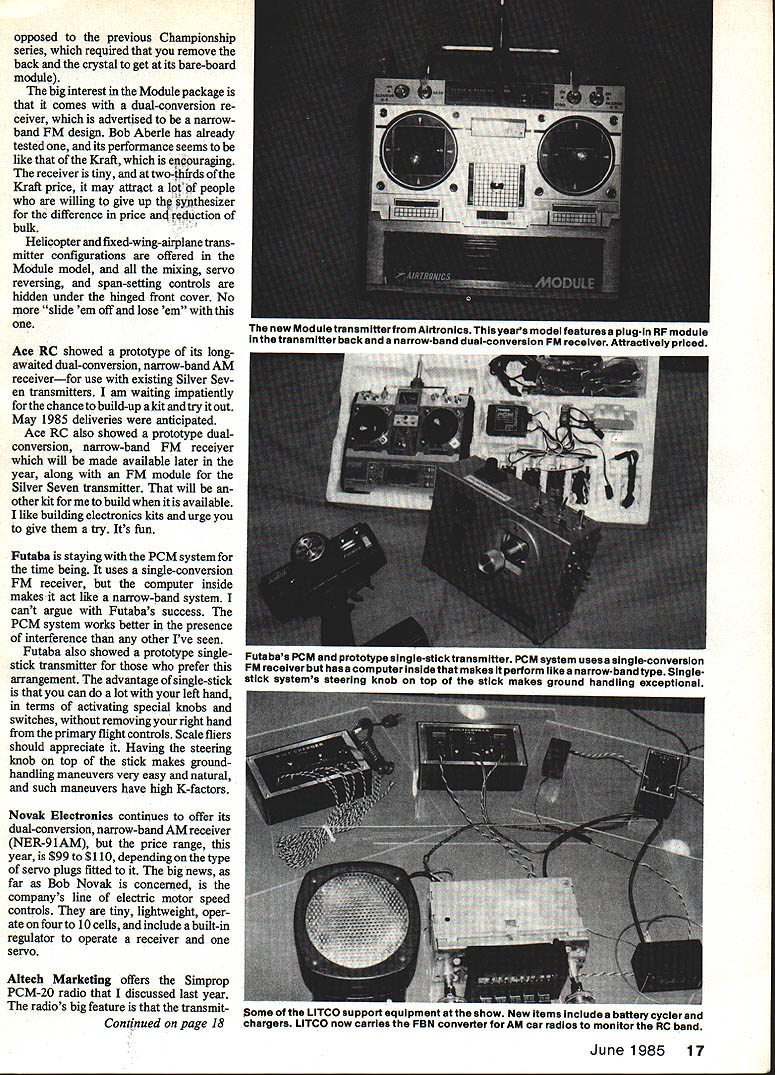
Nick Ziroli Models now offers a kit for the F-4 and the RK-40 fan. The prototype flies well using an O.S. .46 ducted-fan engine. I'm not sure how one would use the Sullivan starter extension in this installation—curses, foiled again!
Overall Evaluation
The necessary narrow-band radios are slowly beginning to appear. U.S. manufacturers were first to answer the need, and the offshore crowd is now beginning to follow suit. We've needed these receivers ever since the new RC channels were granted, so the delay in introducing them is puzzling. Perhaps attention was diverted by the idea of a "1991 receiver," but 1991 is effectively here now in terms of technical requirements.
Transcribed from original scans by AI. Minor OCR errors may remain.

