
WRAM Show 1988
By George M. Myers
Radios were the highlight of this year's WRAM Show, and results from transmitter testing indicate that most recent transmitters operate within AMA narrow‑band guidelines. Based on tests at WRAM and two January shows (Pasadena, CA and Puyallup, WA), the industry appears well along in meeting the new requirements for channels RC12 through RC34.
Transmitter testing and stickers
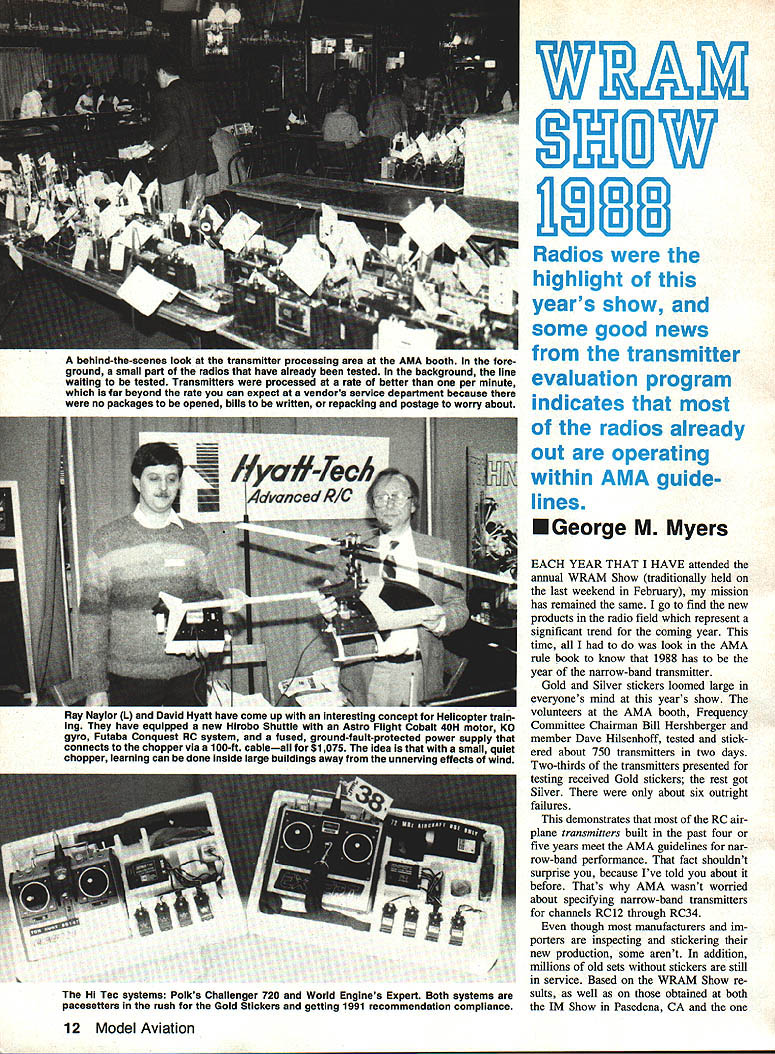
Volunteers at the AMA booth—Frequency Committee chairman Bill Hershberger and member Dave Hilsenhoff—tested and stickered about 750 transmitters in two days. Two‑thirds received Gold stickers; most of the rest received Silver; only about six were outright failures. This demonstrates that most RC airplane transmitters built in the past four to five years meet the AMA narrow‑band performance guidelines.
Still, some manufacturers and importers are not sticker‑inspecting new production, and millions of older sets without stickers remain in service. There is no practical way to inspect every old wideband AM (OWBAM) transmitter this year, so local clubs should consider rules to discourage crystal‑swapping OWBAM transmitters onto the new channels.
Contest processing and club‑level checking
AMA‑sanctioned contests need a simple, safe way for Contest Directors to verify—possibly sticker—transmitters as part of contestant processing. The best instrument for this is a properly calibrated spectrum analyzer, but spectrum analyzers are expensive.
Practical alternatives are becoming available:
- A procedure using the ICOM IC‑R7000 receiver (about $1,000) can be used for transmitter checking; a future Radio Technique column will describe George Steiner's method.
- Bill Hershberger has designed an inexpensive ($150) frequency counter/calibrator.
- The ICOM method works with WWV and a relative‑power meter/calibrator.
- At least two RC vendors are exploring adding the ICOM to their catalogs, which would help address club‑level checking needs.
AMA will continue to rely on vendor and independent services as well:
- Vendors and services known to provide independent transmitter checking include Ace RC, Airtronics, Futaba, World Engines, George Steiner, Pete Waters, Kraft Midwest, and others.
The Frequency Committee will meet at AMA Headquarters in Reston, VA on March 12, 1988; results will be reported after that meeting. At the rate things are going, the 1988 Nats will be fully equipped to sticker transmitters.
Notable products and vendors
Ace RC, Inc. (Higginsville, MO)
- Ace RC has been shipping narrow‑band Silver Seven AM transmitters since April 1987 and also offers the Silver Seven receiver.
- Their 1988 Model 91 receiver (40 kHz raster) will work on channels RC12 through RC34.
- Ace RC markets three lines: Silver Seven (well known), Olympic (lower priced), and Pro‑Line (prestige). All three incorporate the narrow‑band AM transmitter modifications developed for the Silver Seven and offer either the narrow‑band dual‑conversion Model 91 AM receiver or the Silver Seven single‑conversion receiver.
- At the time of the show, Ace RC was the only firm actually delivering narrow‑band systems on RC12 through RC34 and, to the best of my knowledge, the only manufacturer delivering narrow‑band systems on the 50 and 53 MHz ham band channels.
- Tom Runge, Ace RC president, reported that their RC systems sales were five times better than last year’s.
Hi‑Tec / Polk / World Engines
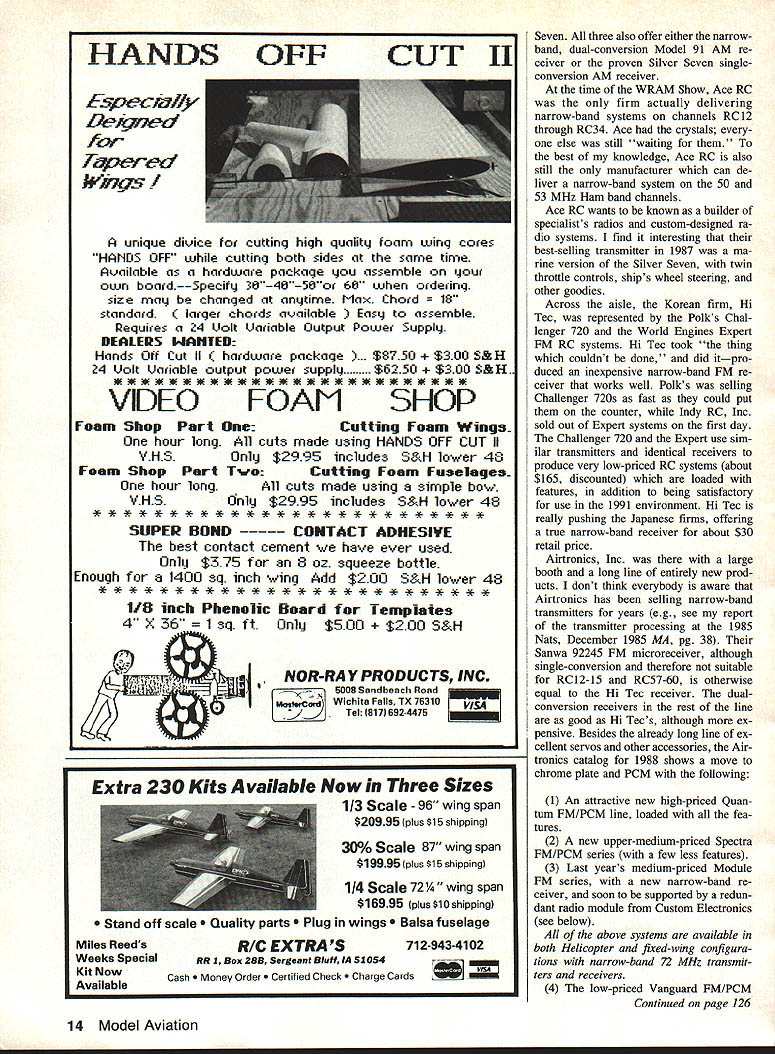
- Hi‑Tec (represented by Polk) and World Engines offered very low‑priced narrow‑band FM systems: Polk’s Challenger 720 and World Engines’ Expert systems.
- Hi‑Tec produced an inexpensive narrow‑band FM receiver that performs well. The Challenger 720 and the Expert use similar transmitters and identical receivers to produce feature‑loaded systems (about $165 discounted) suitable for future requirements.
- Hi‑Tec is pushing to offer a true narrow‑band receiver at a retail price around $30.
Airtronics, Inc.
- Airtronics has been selling narrow‑band transmitters for years and showed a large booth with many new products.
- Their Sanwa 92245 FM microreceiver (single‑conversion) is not suitable for RC12‑15 and RC57‑60 but is otherwise comparable to the Hi‑Tec receiver. The dual‑conversion receivers in Airtronics’ higher lines are as good as Hi‑Tec's but more expensive.
- Airtronics’ 1988 product direction includes a move to chrome plating and PCM, with the following lines:
- A high‑end Quantum FM/PCM line, loaded with features.
- An upper‑medium Spectra FM/PCM series (fewer features).
- The prior medium‑priced Module FM series, now with a new narrow‑band receiver and planned support from a redundant radio module by Custom Electronics.
- These systems are available in helicopter and fixed‑wing configurations with narrow‑band 72 MHz transmitters and receivers.
Other notes and show items
- The transmitter processing at the shows operated at a rate far beyond what a vendor’s service department can normally do because no opening, billing, repacking, or postage is involved.
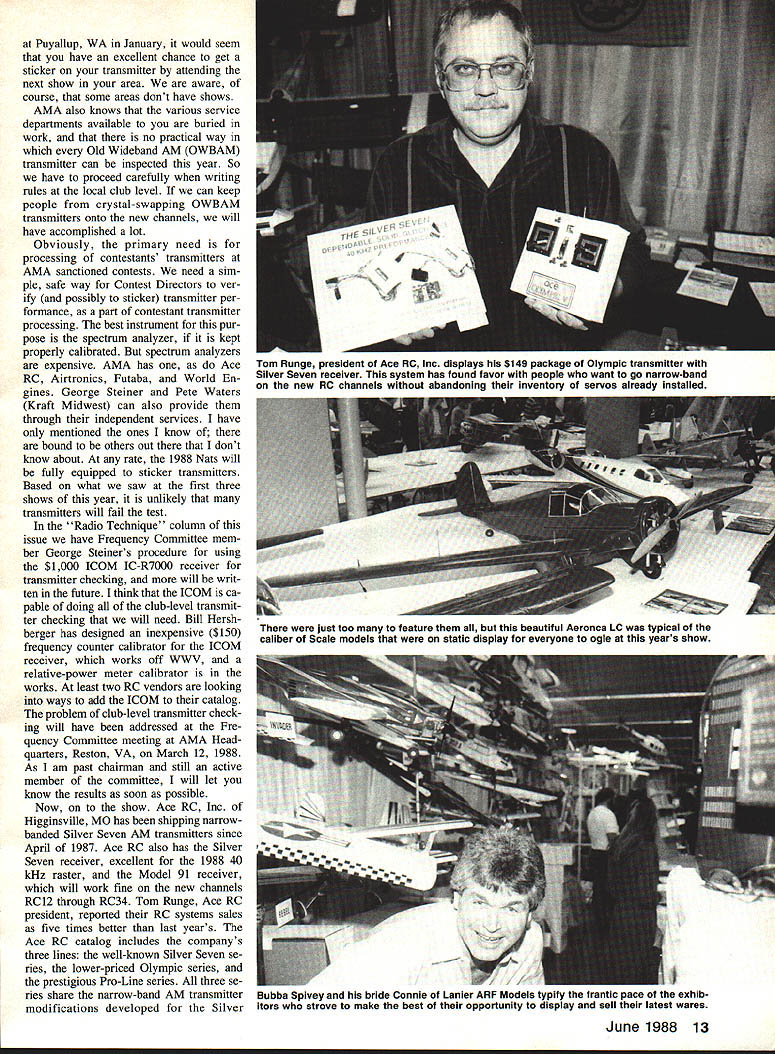
- A notable training concept seen at the show was a small Hirobo Shuttle helicopter fitted with an Astro Flight Cobalt 40H motor, KO gyro, Futaba Conquest RC system, and a fused, ground‑fault‑protected power supply that connects the helicopter by a 100‑ft cable for indoor training. The quiet chopper idea is intended to allow learning inside large buildings away from wind.
Based on tests at the first three shows of the year, it is unlikely that many transmitters will fail the narrow‑band tests. Further developments from vendors and the Frequency Committee’s work should continue to make transmitter checking and compliance easier for clubs and contest organizers.
Transcribed from original scans by AI. Minor OCR errors may remain.

