
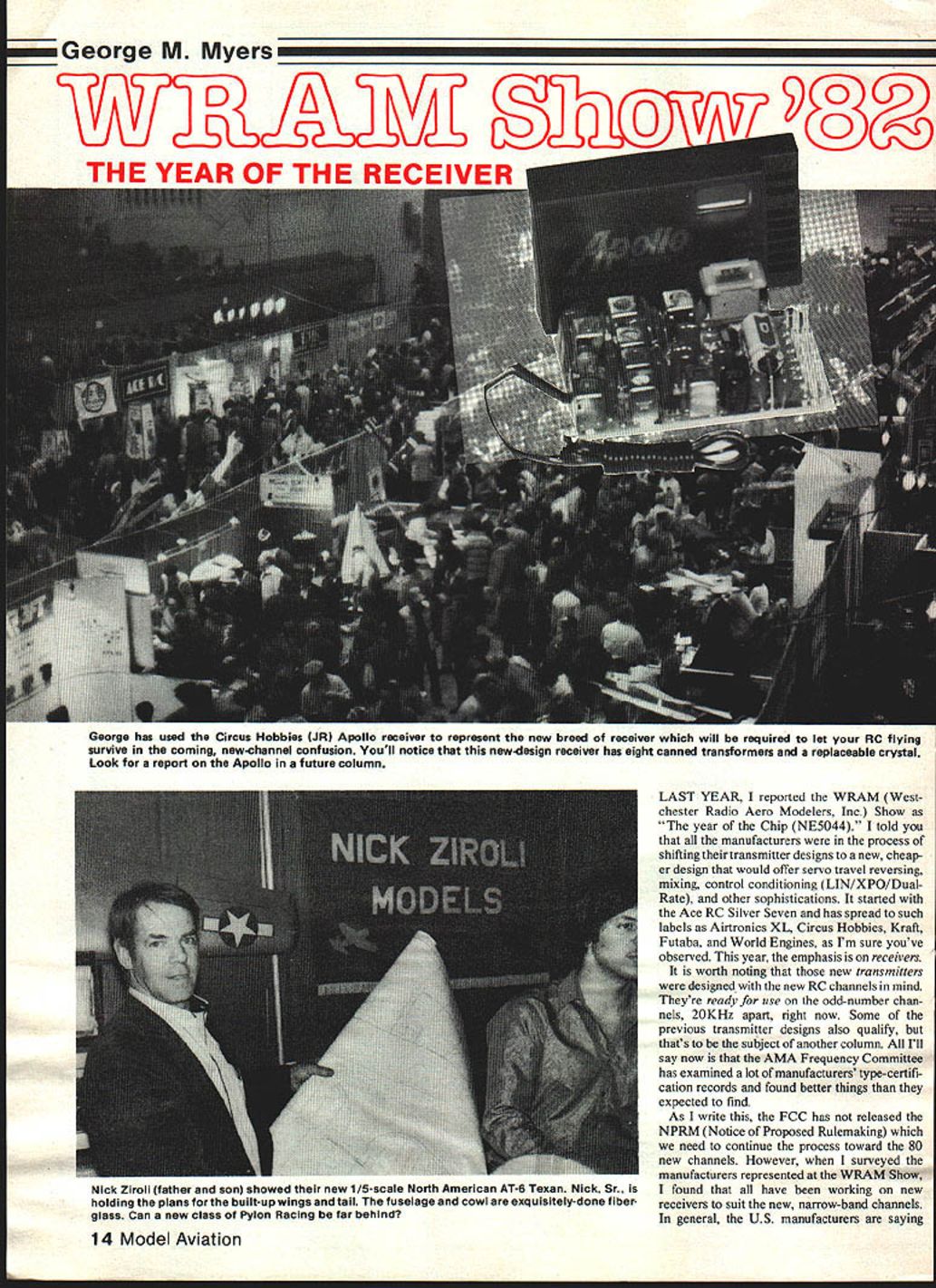
WRAM Show '82: The Year of the Receiver
LAST YEAR I reported the WRAM (Westchester Radio Aero Modelers, Inc.) Show as "The Year of the Chip (NE5044)." I noted that many manufacturers were shifting their transmitter designs to a new, cheaper architecture offering servo-travel reversing, mixing, control conditioning (LIN/XPO/Dual-Rate), and other sophistications. It started with the Ace RC Silver Seven and has spread to such labels as Airtronics XL, Circus Hobbies, Kraft, Futaba, and World Engines. This year, the emphasis is on receivers.
The FCC has released the NPRM (Notice of Proposed Rulemaking) to continue the process toward the 80 new channels. The AMA Frequency Committee has also examined many manufacturers' type-certification records and found better things than expected. At the WRAM Show the manufacturers I surveyed all reported they were working on new receivers to suit the new narrow-band channels. Generally, U.S. manufacturers note that Japanese firms have been selling narrow-band equipment on the European market for years; there is no consensus yet among U.S. manufacturers on the best approach.
Receivers and narrow-band issues
The fundamental issue is receiver bandwidth. Existing receiver designs can't be tuned well enough to survive the narrow-band environment. Narrow-band systems leave proportionally less room to accept transmitter frequency drifting or receiver tuning drift. Voltage regulation helps (the NE5044/NE5045 receiver chips incorporate regulation), but regulation alone isn't enough: temperature changes also cause drift.
Temperature compensation typically requires higher-quality, more expensive components. In some cases it may be necessary to put crystals and other frequency-determining components inside small insulated, heated enclosures ("little ovens") — but ovens are looked upon as a last resort because of cost, weight, and complexity. Most folks see small plastic boxes (called "replaceable modules") as the economic solution.
Synthesizers vs. replaceable crystals
Two main approaches are being discussed:
- Replaceable crystals: each transmitter/receiver channel uses a separate crystal pair.
- Replaceable modules (synthesizers): modules synthesize appropriate frequencies using a common crystal for many channels.
Both approaches use crystals, but the replaceable-crystal design has two significant drawbacks:
- An inventory of crystal pairs for 80 different channels is exceedingly expensive (some say “prohibitively expensive”).
- Crystal manufacturers are reluctant to set up production lines for the relatively small number of hobby crystals needed.
That reluctance reflects a broader trend toward very large manufacturers preferring continuous production of common designs over taking small, specialized jobs.
Most view little ovens as a proven high-precision solution, but they are expensive and heavy. Replaceable modules (synthesizers) are widely seen as the likely economic choice.
Manufacturers' positions
Manufacturers and representatives reported a variety of approaches and preferences:
- Glen Toma (Futaba): FM modules for the "G" series are ready; Futaba intends to phase out AM as soon as possible.
- Circus Hobbies: looking at replaceable crystals and a switch to FM modules.
- Fred Marks (Ace RC; AMA Frequency Committee member): personally opposed to replaceable crystals, prefers AM.
- Butch Lanterman (World Engines): quoted as "working on a synthesized transmitter."
- Bruce Bach (Full Command Systems): advertised "See our synthesized Radio at Toledo!"
- EMS and Litco representatives (Mr. Schwing and Mr. Figelski): favor synthesizers because the crystal cost is prohibitively expensive for small manufacturers.
- MRC: will go with modules.
- Kraft: not saying definitively, but has offered both AM and FM modules for years and is ready for either.
When I asked club members, reactions ranged from boredom to strong opposition; at least one member campaigned against the idea of a frequency-changing switch on a transmitter. One practical compromise is to put the frequency-changing switch on the removable module so the module must be removed to change frequencies. Whatever the approach, frequency control will become a bigger issue, and perhaps the AMA Frequency Committee should prepare a recommended approach — as they have prepared a recommended Phase-In Plan (to protect use of old sets as long as possible) and a Frequency-Flag Plan (to standardize bright, easily distinguishable flags).
Frequency control and monitors
Logic suggests that eventually all transmitters and receivers will have synthesizers and frequency-changing switches. For a few dollars more, each transmitter could include a built-in monitor receiver. Before switching to Transmit, you could switch to Monitor to check that nobody nearby is using the frequency. (This wouldn't protect against interference from farther away, but it would help prevent mutual interference at the field.) The monitor could be incorporated into a switch sequence so you have to pass through Monitor to reach Transmit; being in Transmit would disable the monitor to avoid constant noise.
WRAM Show findings and market timing
My purpose at the WRAM Show was to ask manufacturers what they would say publicly about their response to the impending channel changes. The short answer: anyone selling in the European market is ready for narrow-band radio now (Kraft, Futaba, Sanwa, Circus Hobbies, to name a few). Other manufacturers either said "We're waiting for things to settle out" or told me things in confidence that are about what you'd expect. I think a pretty good selection of narrow-band radios should be available by around Christmas.
World Engines' president John Maloney offered a consumer-friendly statement in his newsletter Scratchpad: "We are going to make the commitment right now that if it is just a single frequency conversion that is wanted, we will convert our equipment right now to the new frequencies and ask for the retail price of the crystals plus a reasonable charge for handling and postage."
District II meeting and outreach
At the District II meeting held at the WRAM Show, John Byrne presided. One suggestion was that each AMA club adopt a school in their area as an outreach program. The idea: the club provides instruction and kit aircraft as a school project, with a teacher as the focal person. The club could pay for AMA membership for a faculty member (arts/crafts teacher, coach, audio/visual leader, etc.). The teacher gets Model Aviation and Chartered benefits; the club gets good PR and a chance to bring young people into the hobby.
The District II meeting also emphasized that AMA clubs need to be proactive in dealing with frequency changes and in working with their local fields to manage the transition. Discussions covered safety, frequency monitoring, and the need for better communication between clubs and manufacturers as the narrow-band era approaches.
Epoxy allergy follow-up
Thanks to all who responded to our request for information about allergic reactions to epoxy glues (from the March 1982 issue). We will follow up after checking leads provided by readers. Meanwhile, if you have experienced an allergic reaction to epoxy, buy a small fan for your workshop and keep the glue off your hands.
Club activities and recruitment ideas
Follow up outreach with planned activities. A few suggestions:
- Use electric race cars to introduce kids to radio systems, batteries, servos, battery testers, field-strength meters, etc. Low injury potential and can be done indoors during non-flying months.
- Depending on age, use the AMA Delta Dart Program to start builders, then progress to Peanut Scale, indoor and outdoor hand-launched gliders, and high-start launches of two-meter sailplanes.
The important point is getting more people involved in model aviation in a pleasant way. You never know where support will come from when facing a noise complaint. Get involved and do something constructive now.
Awards and recognition
At the WRAM Show banquet and awards ceremony, Bob Aberle received two awards:
- The Howard McEntee Memorial Award, conferred annually by the WRAMS on the individual who has contributed most significantly to radio-controlled model aviation in the preceding year.
- The AMA Distinguished Service Award, conferred to recognize exceptional service to the AMA.
Bob has worked extraordinarily hard as AMA Frequency Committee Chairman. He has devoted long hours to correspondence, phone calls, and organizing committee work. As a result of seeing his efforts first-hand, I can say with certainty that the recognition is well-deserved. Please take a moment to congratulate Bob when you meet him.
The job isn't over — we don't have the new frequencies yet, and Bob must carry through the "end game." If you appreciate his work, send a short letter or postcard of thanks to him at the address below; I'll pass them along.
George M. Myers 70 Froehlich Farm Rd. Hicksville, NY 11801
Have a safe month.
Transcribed from original scans by AI. Minor OCR errors may remain.

