
WRAM Show '86
George M. Myers
This report features items of significant interest as seen by the Radio Technique contributing editor.
Trend: Computerized Transmitters
Each year I try to spot a trend. This year the trend that didn't quite make the show was the move toward transmitters that replace many discrete knobs, pots, and switches with low-cost computer control.
- Traditional transmitters with many switches and pots require a lot of hand labor: mounting components, running wires, and drilling holes in PC boards. This increases cost.
- A low-cost computer can store settings such as servo direction, end-point adjustments, mixing arrangements, and more. Instead of loose pots and switches, a keypad can be surface-mounted directly to the PCB, eliminating many holes and wiring bundles.
- Surface mounting (solder tabs instead of drilled holes) is the wave of the future.
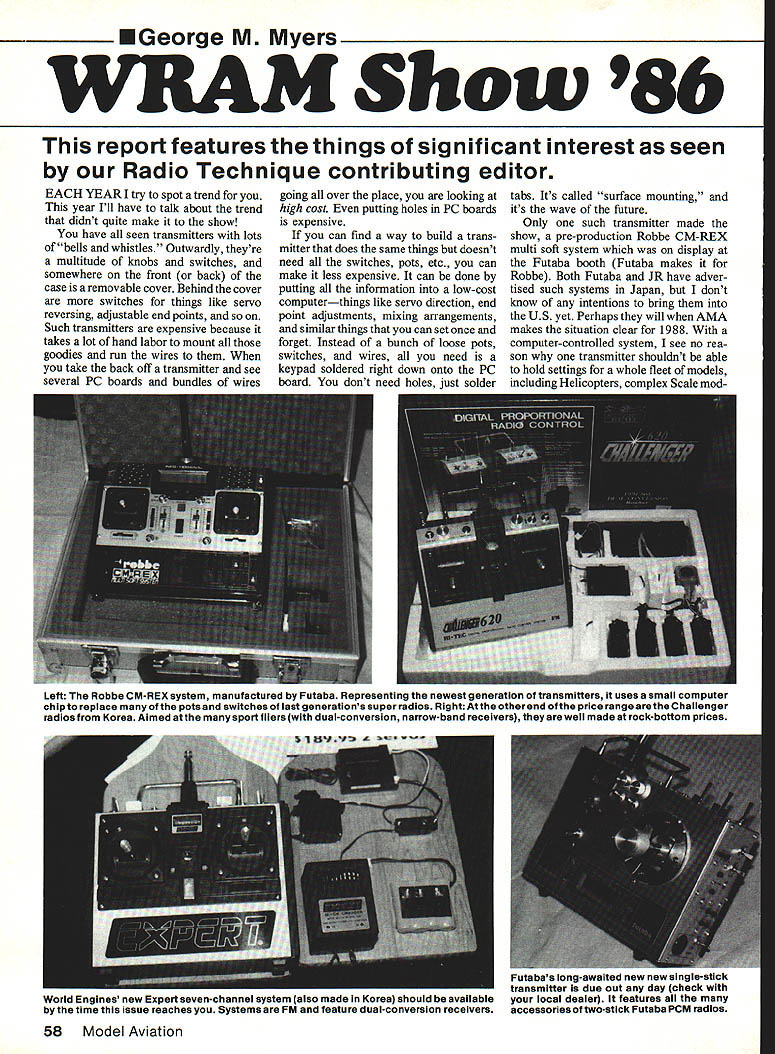
Only one such transmitter was on display at the show: a pre-production Robbe CM-REX multi-soft system shown at the Futaba booth (Futaba manufactures it for Robbe). Futaba and JR have advertised similar systems in Japan; U.S. availability was uncertain. With a computer-controlled system, a transmitter could potentially hold settings for an entire fleet of models, including helicopters and complex scale models.
Featured RC Systems and Equipment
Leaving crystal-ball speculation aside, here are the new and notable systems seen at WRAM Show '86.
- Robbe CM-REX (manufactured by Futaba)
- Pre-production multi-soft system using a small computer chip to replace many pots and switches.
- Represents the newest generation of transmitters with surface-mounted keypad/configuration storage.
- Aristocraft Challenger series (offered by Polk's Hobbies)
- Configurations range from a two-channel dry-battery set for $50 to a complete all Ni-Cd Challenger 620 six-channel, four-servo package.
- Challenger 620 features:
- Conventional-design six-channel FM radio
- Reversing switches on all channels
- Two switch-selected mixing schemes
- Dual-conversion, narrow-band receiver
- Transmitter channel changes via plug-in module in the back
- Receiver channel changes by swapping precision crystals (do not mix manufacturers' crystals)
- Made in Korea; $9 servos rated at 42 in.-oz. output
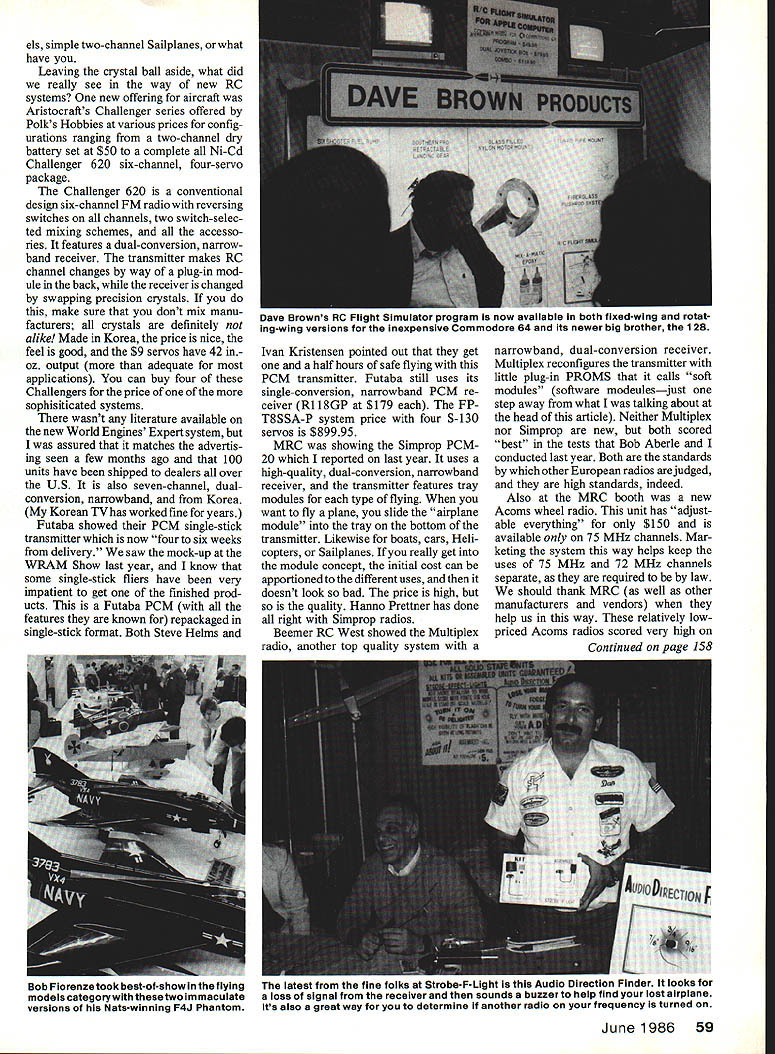
- World Engines Expert system
- Seven-channel, dual-conversion, narrowband system from Korea.
- No literature was available at the show, but the system matched prior advertising; about 100 units had been shipped to U.S. dealers.
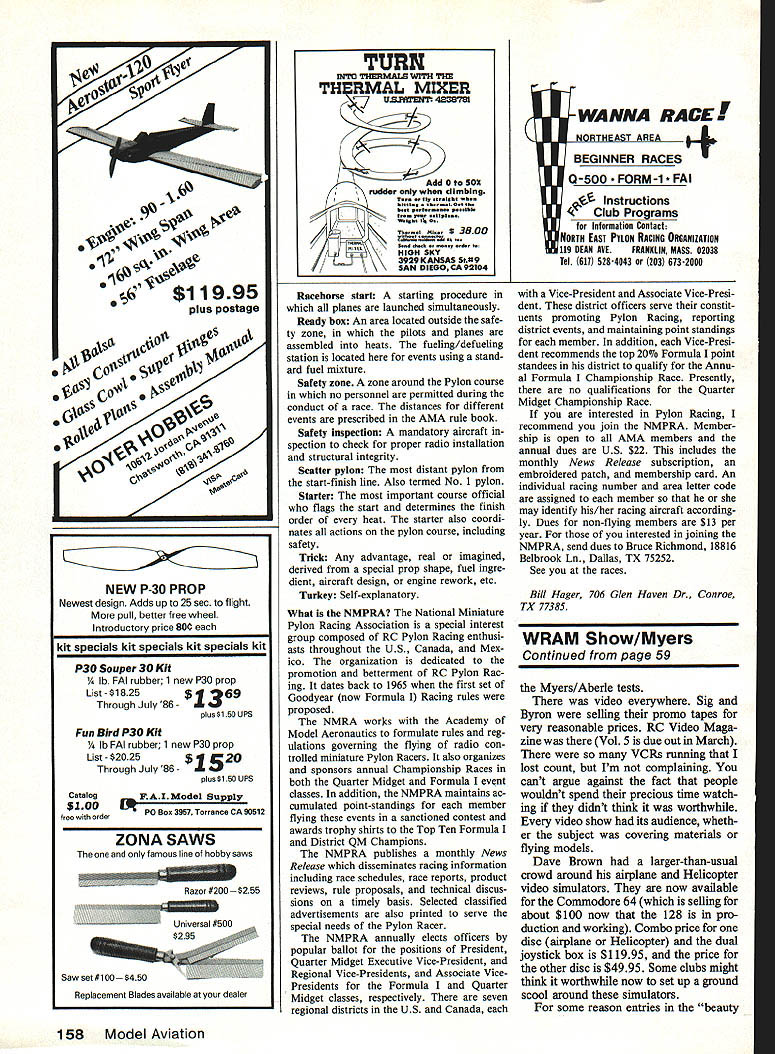
- Futaba PCM single-stick transmitter
- Repackaged Futaba PCM in a single-stick format; production quoted at four to six weeks from delivery (at the time).
- Uses Futaba's single-conversion, narrowband PCM receiver (R118GP, $179).
- FP-T8SSA-P system with four S-130 servos priced at $899.95.
- Reported safe flying time around one and a half hours (per Steve Helms and Ivan Kristensen).
- MRC — Simprop PCM-20
- High-quality, dual-conversion, narrowband receiver.
- Transmitter uses tray modules for different types of flying (airplane, boat, car, helicopter, sailplane). Slide the appropriate module into the bottom tray.
- High initial cost but high quality; modular concept can spread cost across multiple uses.
- Hanno Prettner has successfully positioned Simprop radios in the market.
- Multiplex (shown by Beemer RC West)
- Top-quality system with narrowband, dual-conversion receiver.
- Uses little plug-in PROMs called "soft modules" (software modules) — close to the computerized concept noted above.
- Multiplex and Simprop scored "best" in tests conducted by Bob Aberle and the author the previous year.
- Acorn wheel radio (at MRC booth)
- Offers wide adjustability for about $150.
- Available only on 75 MHz channels (pricing kept separate for 75 MHz and 72 MHz as required by law).
- These relatively low-priced Acorn radios scored well in Myers/Aberle tests.
Video, Simulators, and Accessories
- Video
- Video presence was strong: SIG and Byron were selling promo tapes; RC Video Magazine (Vol. 5 due in March) was present. Many VCRs ran different programs covering materials and flying models.
- Simulators (Dave Brown)
- Airplane and helicopter simulators drew large crowds.
- Now available for the Commodore 64 (selling for about $100) and the Commodore 128 (in production).
- Commodore model lineup about $199. Joystick box $119.95; disk $49.95.
- Clubs might consider using these simulators for ground school.
Contest, Awards, and Show Observations
- Beauty contest entries were fewer than in past years, with some empty display table space. This did not affect model quality.
- Bob Fiorenze won Best in Show for flying models with two versions of his 1985 Nats-winning Cook F4J Phantom (black Playboy Bunny color scheme). Prize was a VCR.
Chargers and Power Equipment
- M.E.N. chargers
- Jerry Jarvis at M.E.N. advised that owners experiencing chargers failing to cut back from high-rate charging with high-capacity batteries (e.g., Sanyo) should return units postpaid for repair and testing; M.E.N. will pay return postage for a flat fee of $5.
- Address: 54 Chestnut Hill, Norwalk, CT 06851.
- High-capacity cells have lower internal resistance when fully charged compared to conventional 500 mAh pencells; a resistor change inside the charger accommodates this.
- M.E.N. chargers operate from 110 VAC.
- M.E.N. also offers a "Red Label" charger for RC car batteries with larger internal components and peak charging current up to 4 amps. The M.E.N. charger is a pulse unit that senses pack voltage between pulses to decide when to transition from high to sustaining rate.
- (Detailed coverage of the M.E.N. charger appeared in Radio Technique, September 1980 MA.)
- Novak Electronics — NEC-1 charger
- New charger for six- and seven-cell car battery packs.
- Constant-current, temperature-sensing charger fused at 7.5 amps.
- Connects to a 12 VDC car battery or power supply.
Industry and Frequency Committee
- Bob Novak (Novak Electronics) was invited to become a member of the AMA Frequency Committee.
- Novak's long history as an RC system designer and his ties to car racing make him well-suited to advise on radios used in crowded racing environments.
(Article text truncated beyond this point in the supplied OCR.)
Transcribed from original scans by AI. Minor OCR errors may remain.

