
WRAM SHOW '87
George M. Myers
Show overview
February 21 and 22 were beautiful, warm, sunny days (the heavy snowstorm held off till Sunday night, as predicted). This year the WRAM Show moved to the Yonkers Race Track, which provided much better parking, modern facilities, and the ability to have everything on one level. As I am somewhat restricted in my movements this year (I am recovering from an illness), I really appreciated the change from the usual three-floor setup.
The new arrangement put three rows of booths at the end containing Byron Originals, Ace RC, the AMA booth, and the food concession. This created some "choke points." The rest of the show had booths two across, which was fine. Taking the whole show into consideration, the layout was much improved.
Display models
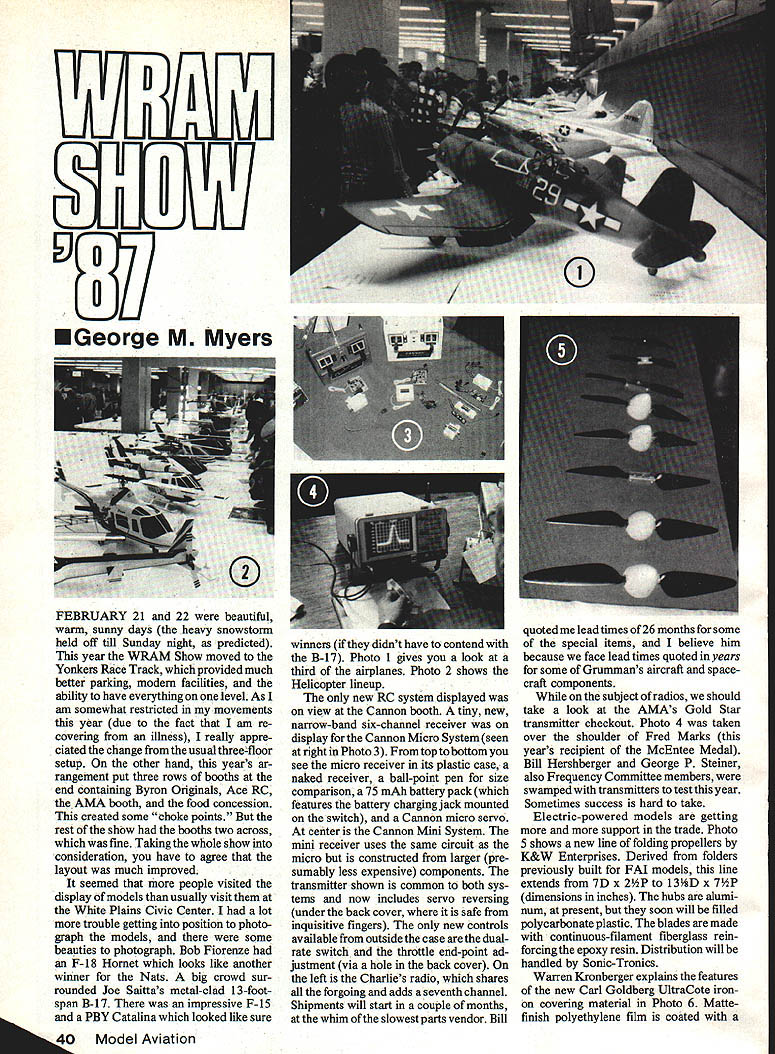
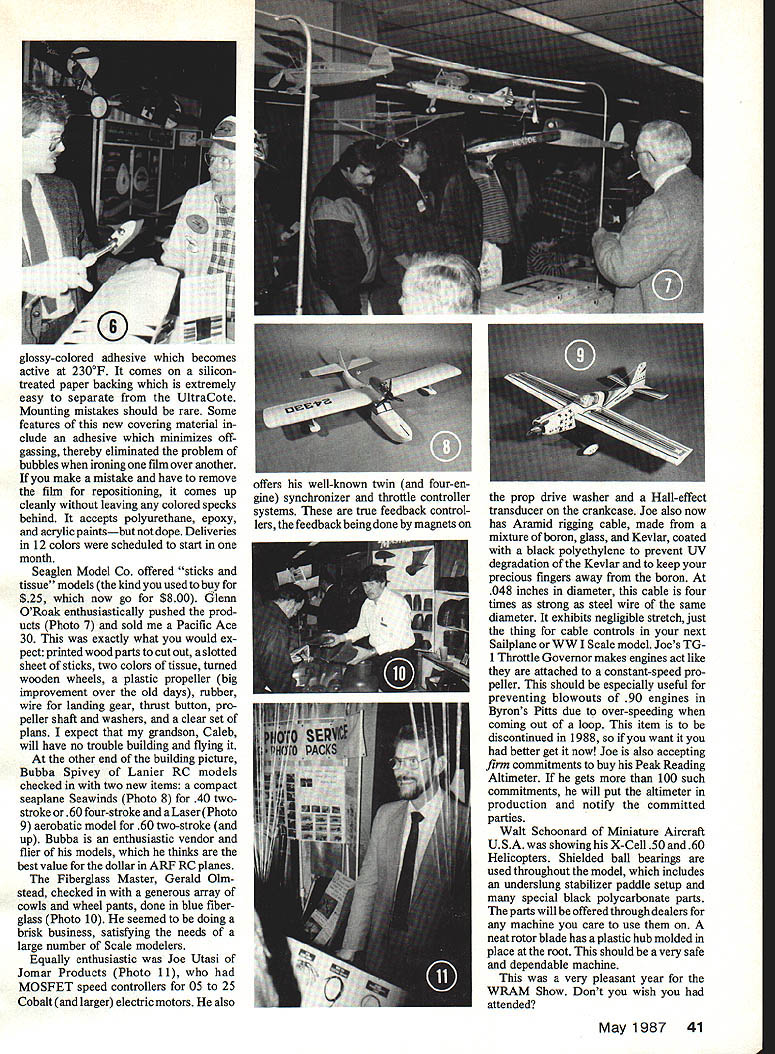
It seemed that more people visited the model display than usually visit them at the White Plains Civic Center. I had a lot more trouble getting into position to photograph the models, and there were some beauties to photograph. Bob Fiorenze had an F-18 Hornet that looks like another winner for the Nats. A big crowd surrounded Joe Saitta's metal-clad 13-foot-span B-17. There was an impressive F-15 and a PBY Catalina which looked like sure winners (if they didn't have to contend with the B-17). (Photo 1 shows three of the airplanes; Photo 2 shows the helicopter lineup.)
RC systems and electronics
The only new RC system displayed was at the Cannon booth. A tiny, narrow-band six-channel receiver was on display for the Cannon Micro System (seen at right in Photo 3). From top to bottom you see:
- the micro receiver in its plastic case
- a naked receiver
- a ball-point pen for size comparison
- a 75 mAh battery pack (the battery charging jack is mounted on the switch)
- a Cannon micro servo
- at center, the Cannon Mini System
The mini receiver uses the same circuit as the micro but is constructed from larger components. The transmitter shown is common to both systems and now includes servo reversing (under the back cover). The only new controls available from outside the case are the dual-rate switch and the throttle end-point adjustment (via a hole in the back cover). On the left is Charlie's radio, which shares all the foregoing and adds a seventh channel. Shipments will start in a couple of months, with some of the slowest parts vendors. Bill quoted lead times of 2–6 months for some special items.
While on the subject of radios, the AMA's Gold Star transmitter checkout was busy. (Photo 4 was taken over the shoulder of Fred Marks, this year's recipient of the McEntee Medal.) Bill Hershberger and George P. Steiner, also Frequency Committee members, were swamped with transmitters to test this year.
Electric power and propellers
Electric-powered models are getting more support in the trade. (Photo 5 shows a new line of folding propellers by K&W Enterprises.) Derived from folders previously built for FAI models, this line extends from 7D x 2P to 13D x 7P (dimensions in inches). The hubs are aluminum at present but will soon be made of polycarbonate. The blades are made with continuous-filament fiberglass-reinforced epoxy resin. Distribution will be handled by Sonic-Tronics.
Covering material — Carl Goldberg UltraCote
Warren Kronenberger explained the features of the new Carl Goldberg UltraCote iron-on covering material. (Photo 6.) Matte-finish polyethylene film coated with a glossy-colored adhesive becomes active at 230°F. The silicone-treated paper backing is extremely easy to separate. UltraCote mounting mistakes should be rare. Some features:
- The adhesive minimizes off-gassing, eliminating problems with bubbling when ironing the film over another layer.
- If you make a mistake and have to remove the film for repositioning, it comes up cleanly with no colored specks left behind.
- It accepts polyurethane, epoxy, and acrylic paints, but not dope.
- Deliveries of 12 colors are scheduled to start next month.
Kits and ARFs
Seaglen Model Co. offered stick-and-tissue models — the kind we used to buy for $25; now they go for $800. Glenn O'Roak enthusiastically pushed the products. The Pacific Ace 30 kit is exactly what you would expect: printed wood parts, cutout slotted sheet, sticks, two colors of tissue, turned wooden wheels, and a plastic propeller — a big improvement over the old days of rubber, wire landing gear, and unclear plans. I expect my grandson Caleb will have no trouble building and flying one.
At the other end of the building, Bubba Spivey of Lanier RC Models showed two new items:
- Seawinds (Photo 8) — a compact seaplane available for .40 two-stroke and .60 four-stroke power
- Laser (Photo 9) — an aerobatic model for .60 two-stroke and up
Bubba, an enthusiastic vendor-flier, thinks these are the best value-for-dollar ARF RC planes.
Fiberglass, speed controllers, and rigging
Fiberglass master Gerald Olinstead displayed a generous array of cowls and wheel pants done in blue fiberglass (Photo 10) and seemed to be doing brisk business.
Joe Utasi of Jomar Products (Photo 11) had MOSFET speed controllers for .05 to .25 (and larger) electric motors. He also offers his well-known twin (and four-engine) synchronizer and throttle controller systems. These are true feedback controllers, using magnets on the prop-drive washer and a Hall-effect transducer on the crankcase.
Joe also now has Aramid rigging cable, made from a mixture of boron, glass, and Kevlar, coated with a black polyethylene to prevent UV degradation and to make handling safer. At .048 inches in diameter, this cable is four times as strong as steel wire of the same diameter and exhibits negligible stretch — ideal for cable controls in sailplanes or World War I scale models.
Joe's TG-1 Throttle Governor makes engines act like they are attached to a constant-speed propeller, useful for preventing over-speed blowouts of .90 engines in Byron's Pitts when coming out of a loop. This item is to be discontinued in 1988, so if you want one you had better get it now. Joe is also accepting firm commitments to buy his Peak Reading Altimeter; if he gets more than 100 commitments, he will put the altimeter into production and notify the committed parties.
Helicopters
Walt Schoonard of Miniature Aircraft U.S.A. was showing his X-Cell .50 and .60 helicopters. Shielded ball bearings are used throughout the model, which includes an underside stabilizer paddle setup and many special black polycarbonate parts. The parts will be offered through dealers for any machine you care to use them on. A neat rotor blade has a plastic hub molded in place at the root. This should be a very safe and dependable machine.
Conclusion
This was a very pleasant year for the WRAM Show. Don't you wish you had attended?
Transcribed from original scans by AI. Minor OCR errors may remain.

