
WRAM Show '89
By George M. Myers
The year 1989 may be remembered for the computer-assisted pilot radio. This is what our "Radio Technique" author surmises after visiting this big annual event.
The forecast on Friday, February 24, was for 10 inches of snow by rush hour. Decision time: should I go to the WRAM Show or wait out the snowfall? Since the van was equipped for the Alaska trip, I reasoned it should be ready for anything. I went to White Plains.
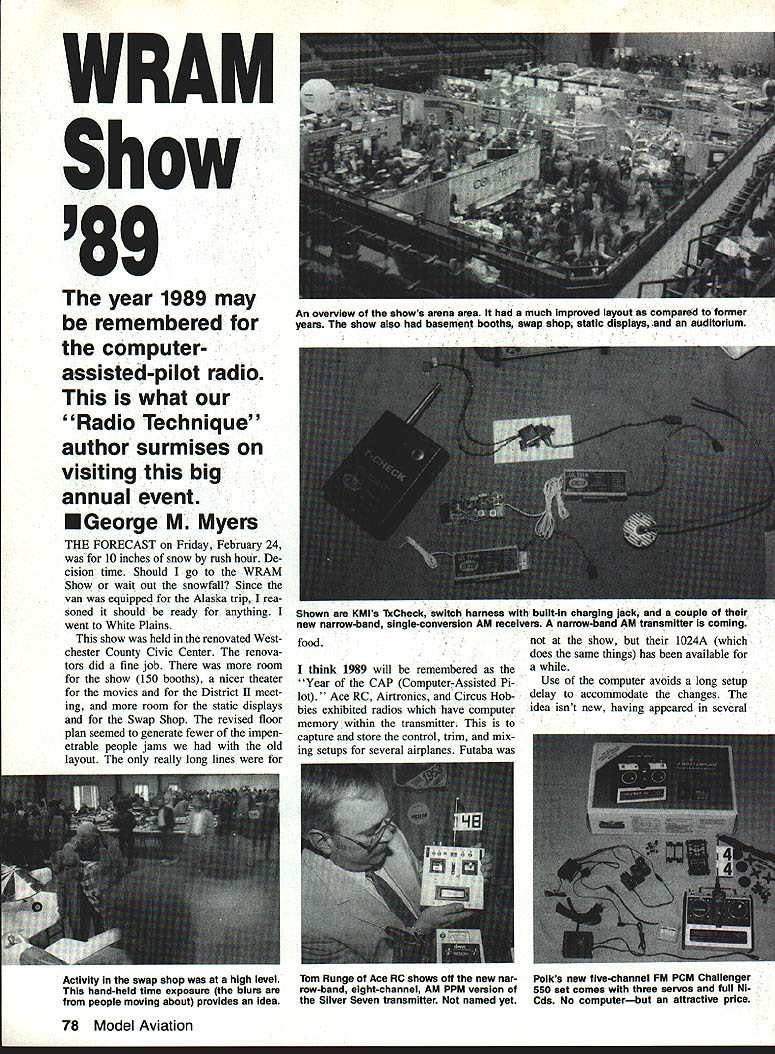
The show was held in the renovated Westchester County Civic Center. The renovators did a fine job: there was more room for the show (about 150 booths), a nicer theater for the movies and for the District II meeting, and more room for the static displays and for the Swap Shop. The revised floor plan seemed to generate fewer of the impenetrable people jams we had with the old layout. The only really long lines were for food.
Computer-assisted transmitters — "Year of the CAP"
I think 1989 will be remembered as the "Year of the CAP (Computer-Assisted Pilot)." Ace RC, Airtronics, and Circus Hobbies exhibited radios which have computer memory within the transmitter to capture and store control, trim, and mixing setups for several airplanes. Futaba was not at the show, but their 1024A (which does the same things) has been available for a while.
Use of the computer avoids a long setup delay when switching aircraft. The idea isn't new — it has appeared in several forms (like Multiplex's plug-in ROMs) — but this is the first year when practically every manufacturer offers one.
Of course, the use of such transmitters brings up the question of additional flight packs, which I discussed extensively in the March 1989 "Radio Technique" column. In most cases, a five-year backup lithium battery avoids memory loss when the main pack is exhausted.
One general comment about all these transmitters: it would be better if a key-operated switch or personal password were required for access to the computer. That way the programs would be protected from casual meddlers.
Ace RC
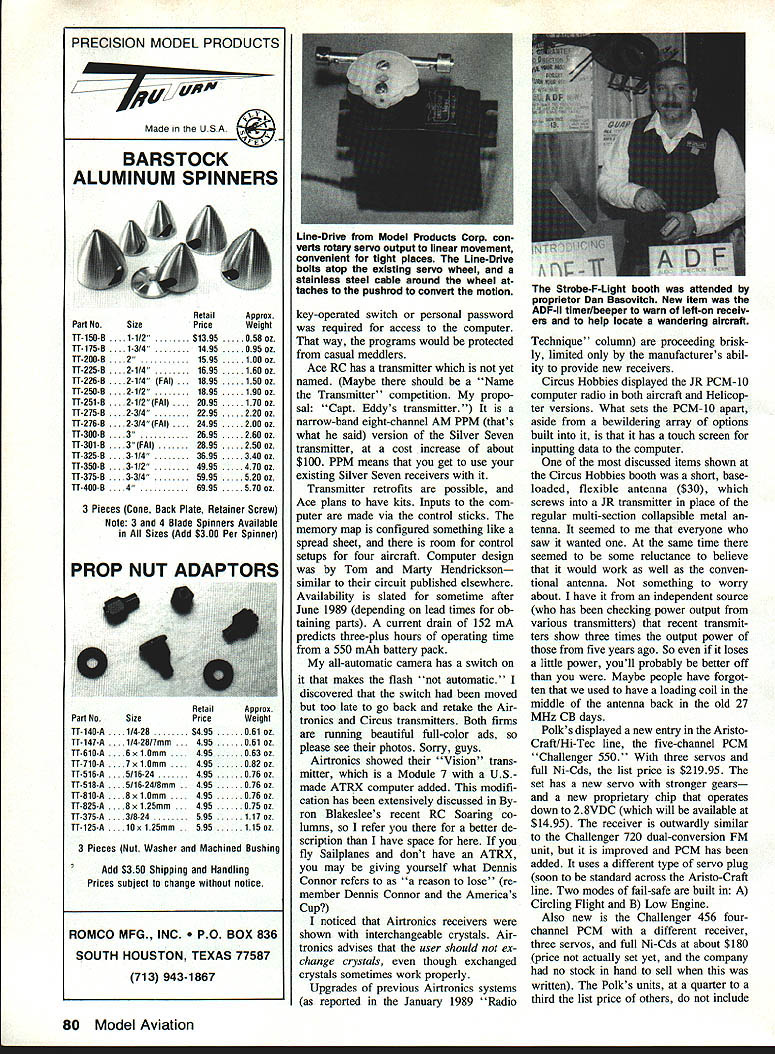
Ace RC has a transmitter (not yet named) that is a narrow-band eight-channel AM PPM version of the Silver Seven transmitter, at a cost increase of about $100. PPM means you can use your existing Silver Seven receivers with it.
Transmitter retrofits are possible; Ace plans to have kits. Inputs to the computer are made via the control sticks. The memory map is configured something like a spreadsheet, and there is room for control setups for four aircraft. Computer design was by Tom and Marty Hendrickson. Availability was slated for sometime after June 1989 (depending on lead times for parts). A current draw of 152 mA predicts three-plus hours of operating time from a 550 mAh battery pack.
(My all-automatic camera has a switch that makes the flash "not automatic." I discovered the switch had been moved too late to retake the Airtronics and Circus transmitter photos. Both firms are running beautiful full-color ads, so please see their photos. Sorry, guys.)
Airtronics
Airtronics showed their "Vision" transmitter, which is a Module 7 with a U.S.-made ATRX computer added. This modification has been extensively discussed in Byron Blakeslee's recent RC Soaring columns, so I refer you there for a fuller description. If you fly sailplanes and don't have an ATRX, you may be crying yourself what Dennis Conner refers to as "a reason to lose."
I noticed that Airtronics receivers were shown with interchangeable crystals. Airtronics advises that the user should not exchange crystals, even though exchanged crystals sometimes work properly.
Upgrades of previous Airtronics systems (as reported in the January 1989 "Radio Technique" column) are proceeding briskly, limited only by the manufacturer's ability to provide new receivers.
Circus Hobbies
Circus Hobbies displayed the JR PCM-10 computer radio in both aircraft and helicopter versions. What sets the PCM-10 apart, aside from a bewildering array of options built into it, is that it has a touch screen for inputting data to the computer.
One of the most discussed items at the Circus Hobbies booth was a short, base-loaded, flexible antenna ($30), which screws into a JR transmitter in place of the regular multi-section collapsible metal antenna. Everyone who saw it seemed to want one, though there was some reluctance to believe it would work as well as the conventional antenna. Not something to worry about: an independent source who has been checking power output reports that recent transmitters show about three times the output power of those from five years ago. So even if the new antenna loses a little power, you’ll probably still be better off than before.
Polk's / Aristo-Craft / Hi-Tec
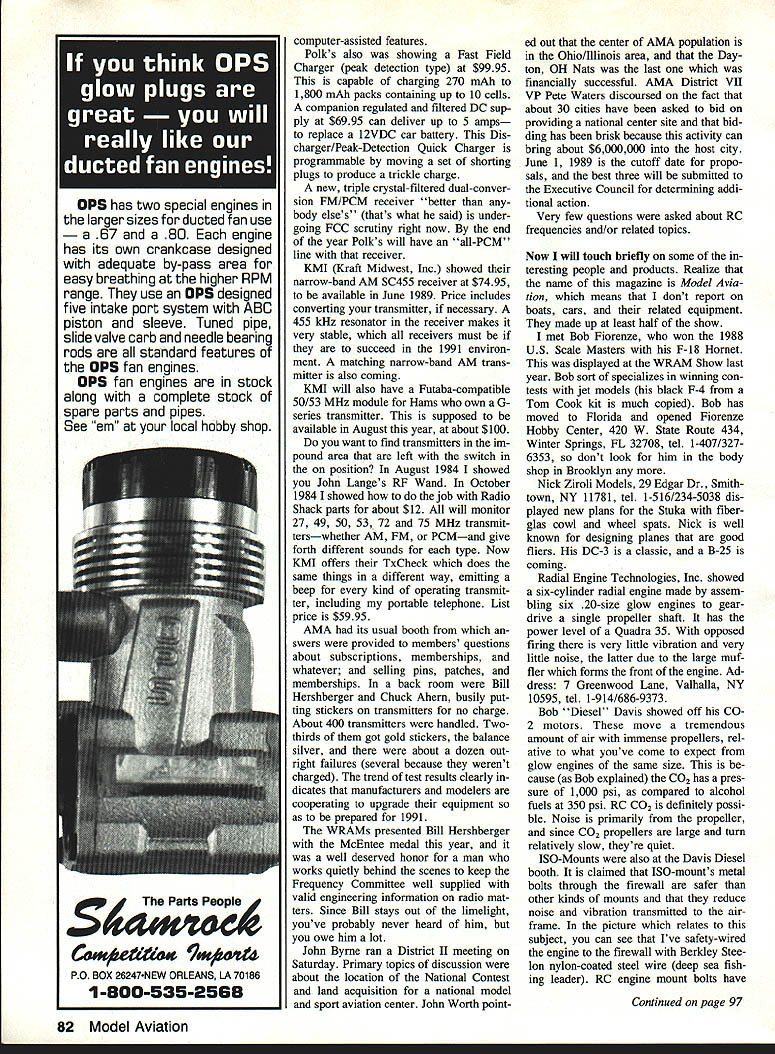
Polk's displayed a new entry in the Aristo-Craft/Hi-Tec line: the five-channel PCM "Challenger 550." With three servos and full Ni-Cds, the list price is $219.95. The set has a new servo with stronger gears and a new proprietary chip that operates down to 2.8 VDC (the chip will be available at $14.95). The receiver is similar to the Challenger 220 dual-conversion FM unit but improved and with PCM added. It uses a different type of servo plug (soon to be standard across the Aristo-Craft line). Two modes of fail-safe are built in: A) Circling Flight and B) Low Engine.
Also new is the Challenger 456 four-channel PCM with a different receiver, three servos, and full Ni-Cds at about $180 (price not finally set at the time of the show). Polk's units, sold at a quarter to a third the list price of others, do not include a receiver battery pack.
Polk's was also showing a Fast Field Charger (peak-detection type) at $99.95, capable of charging packs from 270 mAh to 1,800 mAh containing up to 10 cells. A companion regulated and filtered DC supply at $69.95 can deliver up to 5 amps — to replace a 12 VDC car battery. This Discharger/Peak-Detection Quick Charger is programmable by moving a set of shorting plugs to produce a trickle charge.
A new triple crystal-filtered dual-conversion FM/PCM receiver "better than anybody else's" is undergoing FCC scrutiny. By the end of the year Polk's planned to have an all-PCM line with that receiver.
KMI (Kraft Midwest, Inc.)
KMI showed their narrow-band AM SC455 receiver at $74.95, to be available in June 1989. Price includes converting your transmitter, if necessary. A 455 kHz resonator in the receiver makes it very stable, which all receivers must be if they are to succeed in the 1991 environment. A matching narrow-band AM transmitter is also coming.
KMI will also have a Futaba-compatible 50/53 MHz module for hams who own a G-series transmitter. This was expected in August at about $100.
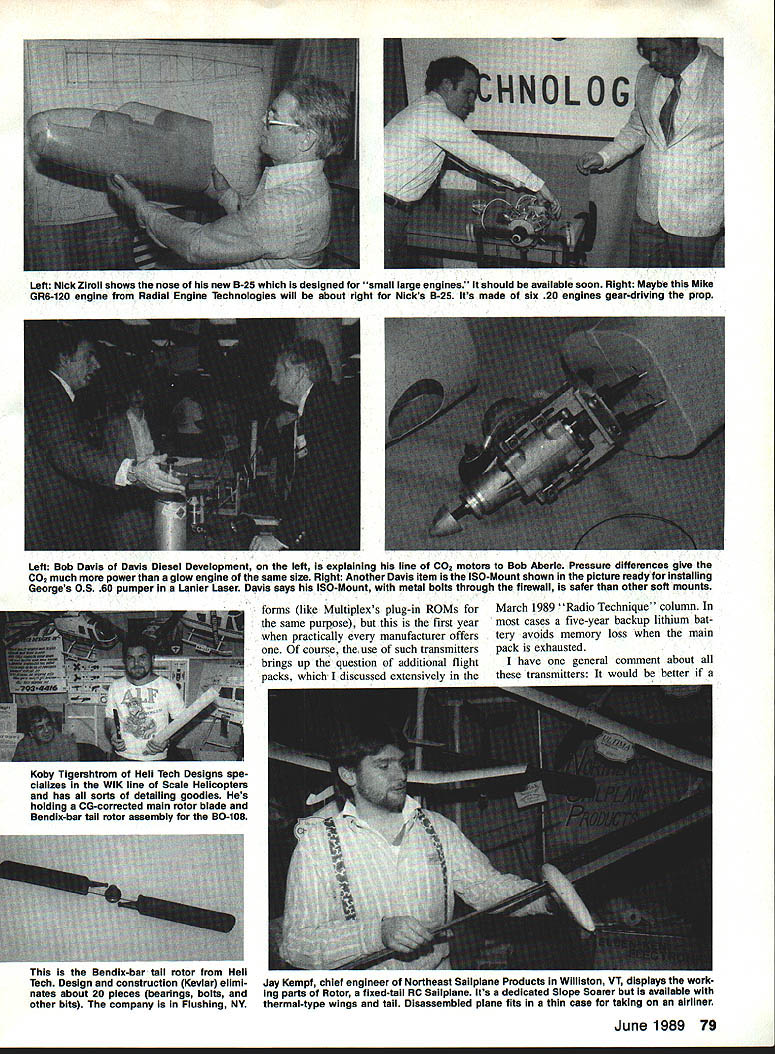
KMI offered the TxCheck, which monitors operating transmitters and emits a beep for every kind of operating transmitter (including portable telephones). Previously I described John Lange's RF Wand (August 1984) and a Radio Shack-based version (October 1984) that will monitor 27, 49, 50, 53, 72, and 75 MHz transmitters — whether AM, FM, or PCM — and give different sounds for each type. KMI's TxCheck does the same in a different way. List price: $59.95.
Monitored frequencies (examples cited):
- 27 MHz
- 49 MHz
- 50 MHz
- 53 MHz
- 72 MHz
- 75 MHz
AMA and frequency testing
AMA had its usual booth answering members' questions and selling pins, patches, and memberships. In a back room Bill Hershberger and Chuck Ahern were busily putting stickers on transmitters for no charge. About 400 transmitters were handled: roughly two-thirds got gold stickers, the remainder silver, and there were about a dozen outright failures (several because they weren't charged). The trend of test results clearly indicates that manufacturers and modelers are cooperating to upgrade equipment in preparation for 1991.
The WRAMs presented Bill Hershberger with the McEntee Medal this year — a well-deserved honor for a man who works quietly behind the scenes to keep the Frequency Committee well supplied with valid engineering information on radio matters. Since Bill stays out of the limelight, you've probably never heard of him, but you owe him a lot.
District II meeting
John Byrne ran a District II meeting on Saturday. Primary topics were the location of the National Contest and land acquisition for a national model and sport aviation center. John Worth pointed out that the center of AMA population is in the Ohio/Illinois area and that the Dayton, OH Nats was the last one which was financially successful. AMA District VIII VP Pete Waters discussed that about 30 cities had been asked to bid on providing a national center site and that bidding had been brisk because this activity can bring about $6,000,000 into the host city. June 1, 1989 was the cutoff date for proposals; the best three would be submitted to the Executive Council for further action.
Very few questions were asked about RC frequencies or related topics.
People and products of interest
Note: the name of this magazine is Model Aviation, which means I don't report on boats, cars, and their related equipment. They made up at least half of the show.
- Bob Fiorenze: winner of the 1988 U.S. Scale Masters with his F-18 Hornet (displayed at last year's WRAM Show). Bob specializes in winning contests with jet models (his black F-4 from a Tom Cook kit is much copied). He has moved to Florida and opened Fiorenze Hobby Center, 420 W. State Road 434, Winter Springs, FL 32708, tel. 1-407-327-6353.
- Nick Ziroli Models: 29 Edgar Dr., Smithtown, NY 11787, tel. 1-516-234-5038. Displayed new plans for the Stuka with fiberglass cowl and wheel spats. Nick is known for designing planes that are good fliers; his DC-3 is a classic, and a B-25 is coming.
- Radial Engine Technologies, Inc.: showed a six-cylinder radial engine made by assembling six .20-size glow engines to gear-drive a single propeller shaft. It has the power level of a Quadra 35. With opposed firing there is very little vibration and very little noise, the latter helped by a large muffler that forms the front of the engine. Address: 7 Greenwood Lane, Valhalla, NY 10595, tel. 1-914-686-9373.
- Bob "Diesel" Davis: showed CO2 motors that move a tremendous amount of air with immense propellers relative to glow engines of the same size. CO2 runs at about 1,000 psi compared to alcohol fuels at about 350 psi, which accounts for the power. RC CO2 is definitely possible. Noise is primarily from the propeller, not the engine; CO2 propellers are large and turn relatively slowly, so they are quiet.
- ISO-Mounts: shown at the Davis Diesel booth. It is claimed that ISO-Mount's metal bolts through the firewall are safer than other kinds of mounts and reduce noise and vibration transmitted to the airframe. RC engine mount bolts have been known to lose their heads, and rubber engine mounts have been known to fail in automobiles and full-scale aircraft. We know that isolators work as claimed, but they are definitely a maintenance item. ISO-Mounts simply pop up into 1/4-inch holes drilled in your firewall and expand like Molly fasteners, making them easy to install and to replace periodically. Davis Diesel Development, P.O. Box 141, Milford, CT 06460.
Strobe-F-Light / ADF-II
Strobe-F-Light, 8405 Avenue N, Brooklyn, NY 11236, added ADF-II to its line (primarily lights for scale models). ADF-II is a countdown/timer-operated beeper that sounds 15 minutes after the receiver is turned on. If you forget to turn off your transmitter, the beeper will warn you; if you lose your plane in tall grass and turn off the transmitter to conserve power, the beeper will still help you find the plane. ADF-II works with PCM (the original ADF sometimes didn't) and beeps for up to 10 hours from a fully charged flight pack.
Transcribed from original scans by AI. Minor OCR errors may remain.

