
WRAM Show '90
By George M. Myers
Overview
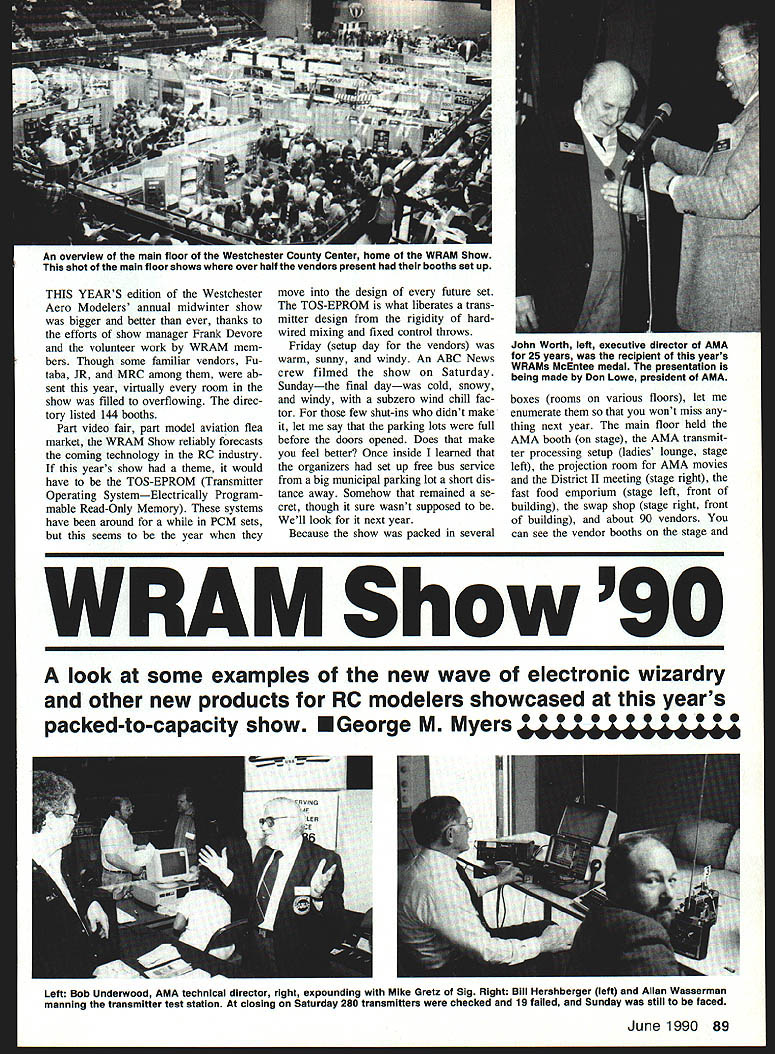
This year's edition of the Westchester Aero Modelers' (WRAM) annual midwinter show was bigger and better than ever, thanks to show manager Frank Devore and the volunteer WRAM members. Although some familiar vendors (Futaba, JR, MRC) were absent, the show filled virtually every room; the directory listed 144 booths. Part video fair, part model aviation flea market, the WRAM Show reliably forecasts coming technology in the RC industry. If the show had a theme, it was the TOS‑EPROM (Transmitter Operating System—Electrically Programmable Read‑Only Memory). These systems have appeared in PCM sets before, but 1990 looks like the year they move into mainstream transmitter design, freeing transmitters from hardwired mixing and fixed control throws.
Weather varied: Friday (vendor setup) was warm and windy; Saturday an ABC News crew filmed the show; Sunday was cold, snowy, and windy with a subzero wind‑chill. Parking lots were full well before opening, and organizers had arranged a free shuttle from a distant municipal lot that most attendees discovered only after arriving.
Show layout
- Main floor: AMA booth (on stage), AMA transmitter processing (ladies' lounge, stage left), projection room for AMA movies and the District II meeting (stage right), fast food area (stage left, front), swap shop (stage right, front), and roughly 90 vendors on and around the arena floor.
- Floor below the arena: another large collection of vendors (low ceiling limited photography).
- Upper floor (stage right): two rooms devoted to models on display.
Even without the crushing crowds, you couldn't see everything in one day.
Awards and displays
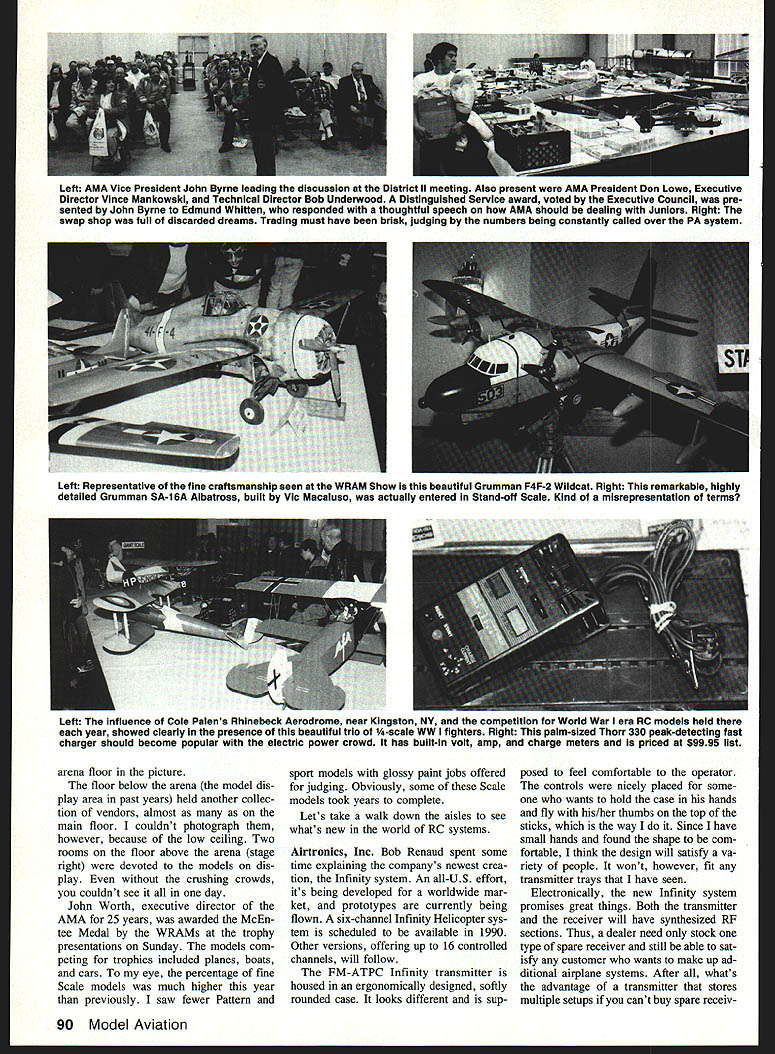
John Worth, executive director of the AMA for 25 years, was awarded the McEntee Medal by the WRAMs at the Sunday trophy presentations. Models competing for trophies included planes, boats, and cars. The percentage of fine Scale models seemed higher this year than in past years; there were fewer Pattern and sport models submitted for judging. Many Scale entries had clearly taken years to complete.
The electronics theme: TOS‑EPROM and synthesized systems
Many manufacturers are moving to transmitters that use TOS‑EPROMs and other programmable elements. Key trends shown at the exhibition:
- Touch‑screen or menu programming to store multiple aircraft configurations.
- Synthesized RF sections in transmitters and receivers to simplify spare-receiver inventory and to offer channel flexibility.
- Computer-like processors in transmitters with higher A/D resolution and programmable channel priorities.
- Exchangeable TOS and aircraft‑configuration (AC) EPROMs to allow software‑style updates and preserve programming when batteries are removed.
These developments promise greater resolution, flexible mixing, and field updateability of transmitter behavior.
Exhibits
#### Airtronics, Inc.
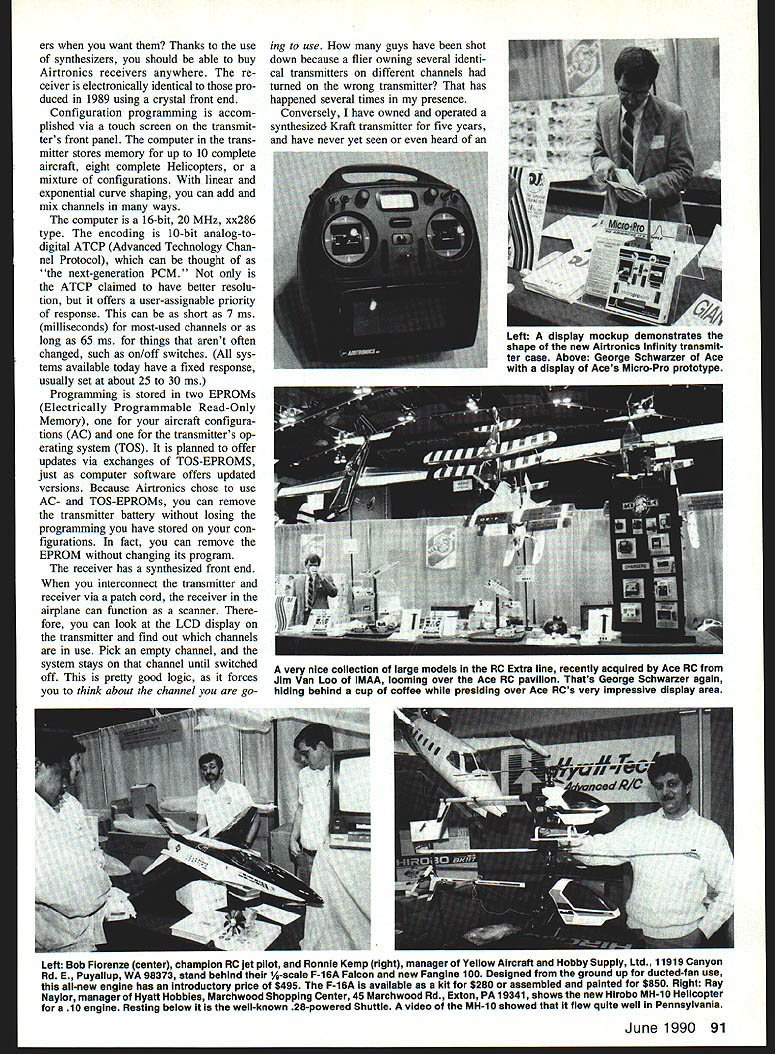
Airtronics introduced the Infinity system, developed in the U.S. for a worldwide market; prototypes are already flying. Highlights:
- Ergonomic, softly rounded case designed for comfortable thumb‑stick operation. May not fit standard transmitter trays.
- Synthesized RF sections planned for both transmitter and receiver.
- Configurations programmed via a front‑panel touch screen.
- Memory stores up to 10 complete aircraft, or eight complete helicopters, or a mixture.
- Linear and exponential curve shaping, and versatile channel mixing.
- Onboard computer: 16‑bit, 20 MHz x286‑type processor.
- Encoding: 10‑bit analog‑to‑digital ATCP (Advanced Technology Channel Protocol) with user‑assignable priority of response (from about 7 ms for frequently used channels up to about 65 ms for rarely changed functions).
- Programming stored in two EPROMs: one for aircraft configurations (AC) and one for the transmitter operating system (TOS). EPROMs can be exchanged for updates; configuration memory remains when the battery is removed.
- When linked to the receiver via a patch cord, the receiver can function as a scanner and the transmitter’s LCD can show which channels are in use; you can then select an empty channel and remain on it until switched off.
- A six‑channel Infinity helicopter system was scheduled for 1990; versions offering up to 16 controlled channels were planned. A synthesized 75 MHz transmitter was planned for 1991.
- Airtronics introduced the 94141 servo: 1.1 oz weight, 42 in‑oz torque, coreless motor, metal gear train, with flange and side mounts. List price $79.95; expected use in sailplane wings.
#### Ace RC, Inc.
Ace RC showed a prototype of the AM‑PWM Micropro 8000 system. Key points:
- Offered as a $175 upgrade for a Silver Seven AM transmitter or as a complete transmitter with metal‑gimbal sticks for $375; availability expected spring 1990.
- RS‑232 port option to exchange aircraft control parameters with an IBM‑compatible computer; option includes an MS‑DOS application to configure transmitter mixing and settings.
- Future options planned for computer simulation of aircraft characteristics and a transmitter box that plugs into a computer game port to test maneuvers.
- Uses a TOS‑EPROM for exchangeable updates and reprogramming of mixing, control throws, servo reversing, etc. Configuration is done via the control sticks used to navigate menus.
- Current RF deck is a Silver Seven plug‑in; plans exist for a modular RF board and for timing module availability with Ace's own FM receiver introduction.
- The Micropro 8000 offers modular expansion: with the modular board installed you gain an additional channel; typical configuration provides six proportional channels and two switched channels, configurable to user needs.
- Ace emphasizes backward compatibility with small 2‑ to 4‑channel microreceivers used by some pilots.
#### Polk's Hobbies
- Polk’s reported a new factory in China.
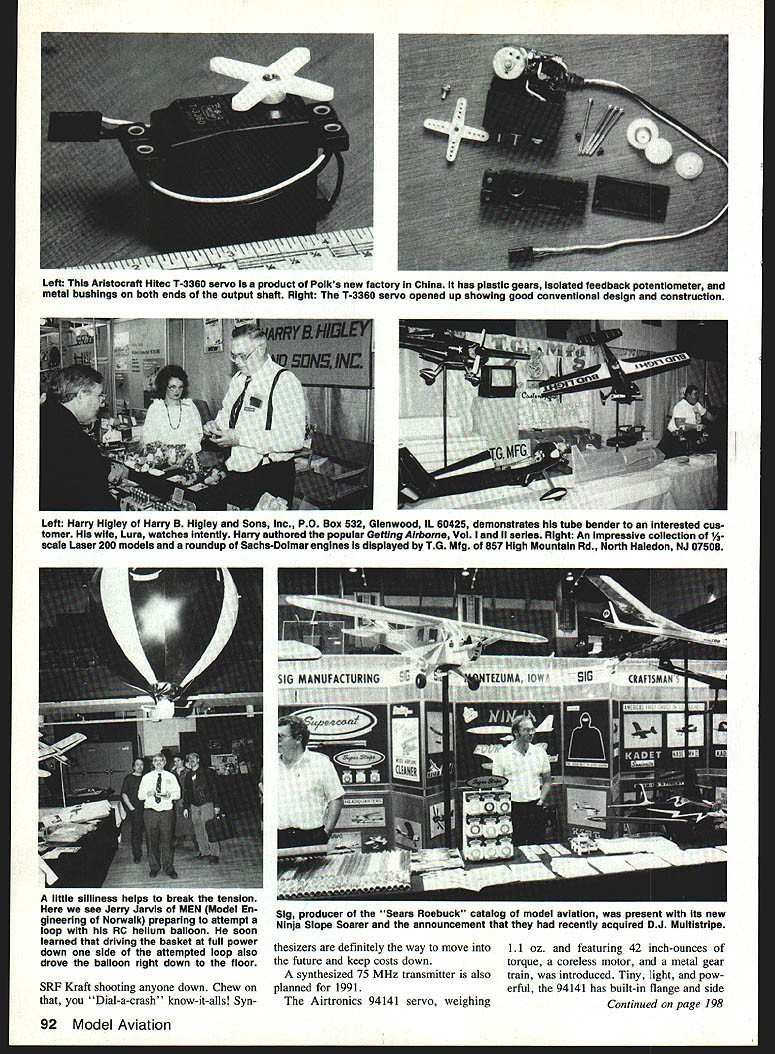
- New servo introduced (model T‑3360), list price $10.95. Features: plastic gears, isolated feedback potentiometer, metal bushings on both ends of the output shaft, lower price point. The case and circuit board were marked "THOR, NY" and the case bore a "Made in China" sticker. No gaskets for dust/moisture protection.
- Two small peak‑detection chargers displayed for electric boat, car, and airplane use (to be used with Polk's CG‑300A High Capacity AC/DC Converter):
- Thorr #330 Peak Detection Fast Charger: 2–6 amps, LCD digital volt/amp meter (switchable), and an LCD cumulative charge meter showing ampere‑seconds delivered.
- Thorr #320: same circuit as the 330 but without digital meters; offered at roughly half the price.
#### Cannon
- Bill and Charlie Cannon have moved to a new location at 2828 Cochran St., Suite 281, Simi Valley, CA 93065.
- Bill Cannon is concentrating on micro RC systems and pursuing an ambitious goal: miniaturize the entire RC system into a package smaller than a typical servo case for indoor RC use.
- Cannon introduced a new covering product called Litestar. Claimed attributes:
- Very light (reported 28 to 80 grams/sq. meter), tough, airtight, waterproof, fuel‑proof, and heat‑shrinkable.
- Attached with an iron‑on adhesive called Balsaloc.
- Works similar to Solarfilm, with minimal shrink; requires careful initial covering.
- Nine colors available: cream, yellow, orange, red, blue, dark green, silver, black, and white. Most colors are translucent except black.
#### Bob Fiorenze
- Fiorenze showed the Fangie 100 ducted‑fan package at an introductory price of $49.95.
- The 3.75‑lb package includes engine, mount, tank, and prop; developed to produce about 6.2 hp at 24,000 rpm on 5% nitro.
- The lightweight fan produces about 15 lb of static thrust with a tailpipe velocity around 230–260 mph.
- This second‑generation ducted fan should allow entry into high‑speed (near 200 mph) models under the right conditions.
Conclusion
The 1990 WRAM Show demonstrated that the RC industry is embracing available technology—programmable transmitter operating systems, synthesized RF, computer interfacing, and miniaturization—to meet the challenges of the new decade. The exhibits suggested that future transmitters will be more flexible, updateable, and computer‑friendly, while other vendors continue to push in micro RC, electric charging, lightweight materials, and high‑performance propulsion.
Transcribed from original scans by AI. Minor OCR errors may remain.

