
Wright Glider
Frank H. Scott
This happy little glider is sure fun for the youngsters—and teaches them something, too. If you have a spare moment, why not make one yourself?
Although the world didn't bother to notice, the course of the world was changed that fateful day in 1903. However, the remarkable success of the Wright Brothers was no accident of fate, but rather was the result of patient research involving their wind tunnel, kites and gliders.
This little model, suggestive of the Wright's 1902 glider, is inspired by one built by Jiri Kalina and appeared in the Czech Modelář magazine. We liked it, and with the spirit of détente have brought the idea back to our shores, Americanizing the ship a bit in the process.
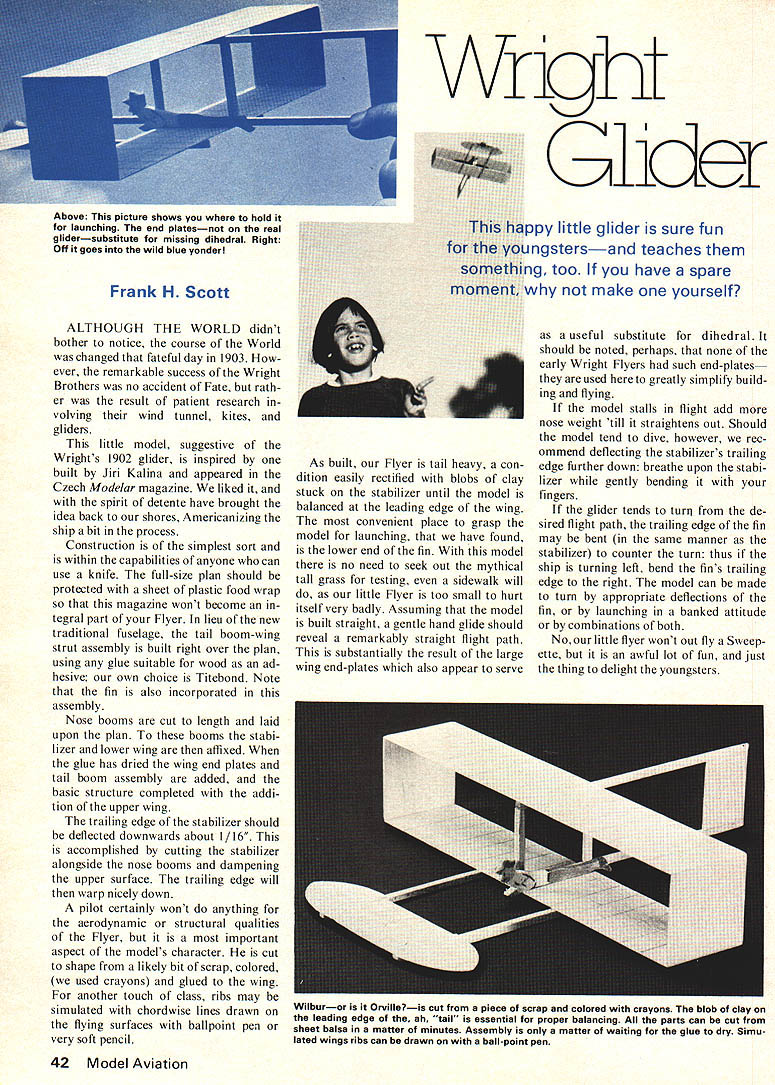
Construction is of the simplest sort and is within the capabilities of anyone who can use a knife. The full-size plan should be protected with a sheet of plastic food wrap so that this magazine won't become an integral part of your Flyer. In lieu of the new traditional fuselage, the tail boom–wing strut assembly is built right over the plan, using any glue suitable for wood as an adhesive; our own choice is Titebond. Note that the fin is also incorporated in this assembly.
Nose booms are cut to length and laid upon the plan. To these booms the stabilizer and lower wing are then affixed. When the glue has dried the wing end plates and tail boom assembly are added, and the basic structure completed with the addition of the upper wing.
The trailing edge of the stabilizer should be deflected downwards about 1/16". This is accomplished by cutting the stabilizer alongside the nose booms and dampening the upper surface. The trailing edge will then warp nicely down.
A pilot certainly won't do anything for the aerodynamic or structural qualities of the Flyer, but it is a most important aspect of the model's character. He is cut to shape from a likely bit of scrap, colored (we used crayons) and glued to the wing. For another touch of class, ribs may be simulated with chordwise lines drawn on the flying surfaces with ball-point pen or very soft pencil.
As built, our Flyer is tail heavy, a condition easily rectified with blobs of clay stuck on the stabilizer until the model is balanced at the leading edge of the wing. The most convenient place to grasp the model for launching, that we have found, is the lower end of the fin. With this model there is no need to seek out the mythical tall grass for testing; even a sidewalk will do, as our little Flyer is too small to hurt itself very badly. Assuming that the model is built straight, a gentle hand glide should reveal a remarkably straight flight path. This is substantially the result of the large wing end-plates which also appear to serve as a useful substitute for dihedral. It should be noted, perhaps, that none of the early Wright Flyers had such end-plates—they are used here to greatly simplify building and flying.
If the model stalls in flight add more nose weight 'till it straightens out. Should the model tend to dive, however, we recommend deflecting the stabilizer's trailing edge further down; breathe upon the stabilizer while gently bending it with your fingers.
If the glider tends to turn from the desired flight path, the trailing edge of the fin may be bent (in the same manner as the stabilizer) to counter the turn; thus if the ship is turning left, bend the fin's trailing edge to the right. The model can be made to turn by appropriate deflections of the fin, or by launching in a banked attitude or by combinations of both.
No, our little flyer won't outfly a Sweepette, but it is an awful lot of fun, and just the thing to delight the youngsters.
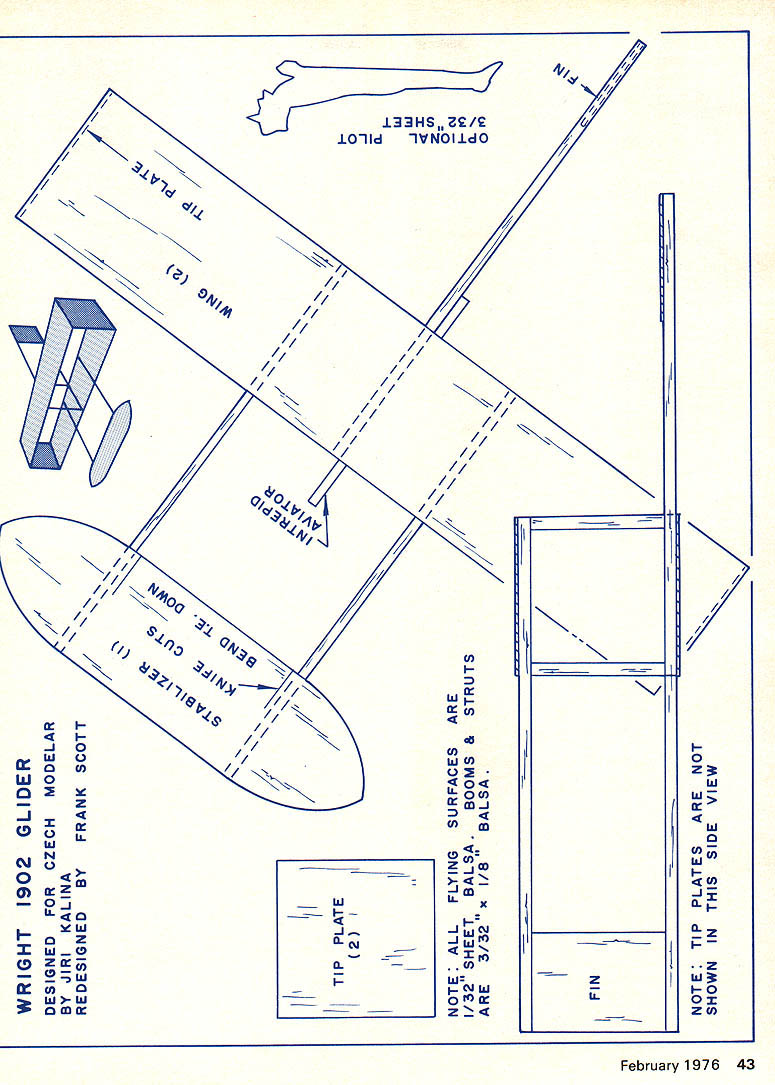
Wright 1902 Glider
WRIGHT 1902 GLIDER DESIGNED FOR CZECH MODELAR BY JIRI KALINA REDESIGNED BY FRANK SCOTT
WING (2)
TIP PLATE (2)
OPTIONAL PILOT 3/32" SHEET
FIN
STABILIZER (1) — KNIFE CUTS — BEND T.E. DOWN
NOSE BOOMS
TIP PLATE (2)
NOTE: ALL FLYING SURFACES ARE 3/32" SHEET BALSA; BOOMS & STRUTS ARE 1/8" BALSA.
NOTE: TIP PLATES ARE NOT SHOWN IN THIS SIDE VIEW.
Transcribed from original scans by AI. Minor OCR errors may remain.

