

X-31: New in the Sky
Don Berliner
Overview
Combining integrated control systems, vectored thrust, and efficient design, the X-31 research airplane expands the maneuvering flight envelope and can maneuver at close range for unprecedented accuracy in targeting enemy planes.
Flat Turns and Enhanced Maneuverability
Student pilots of the world, rejoice: flat turns are in. No longer must you strain to coordinate stick and rudder for perfectly coordinated turns. If tests on the X-31 progress as planned, flat turns—yawing to point the nose without banking—may become a new way to change direction in the air.
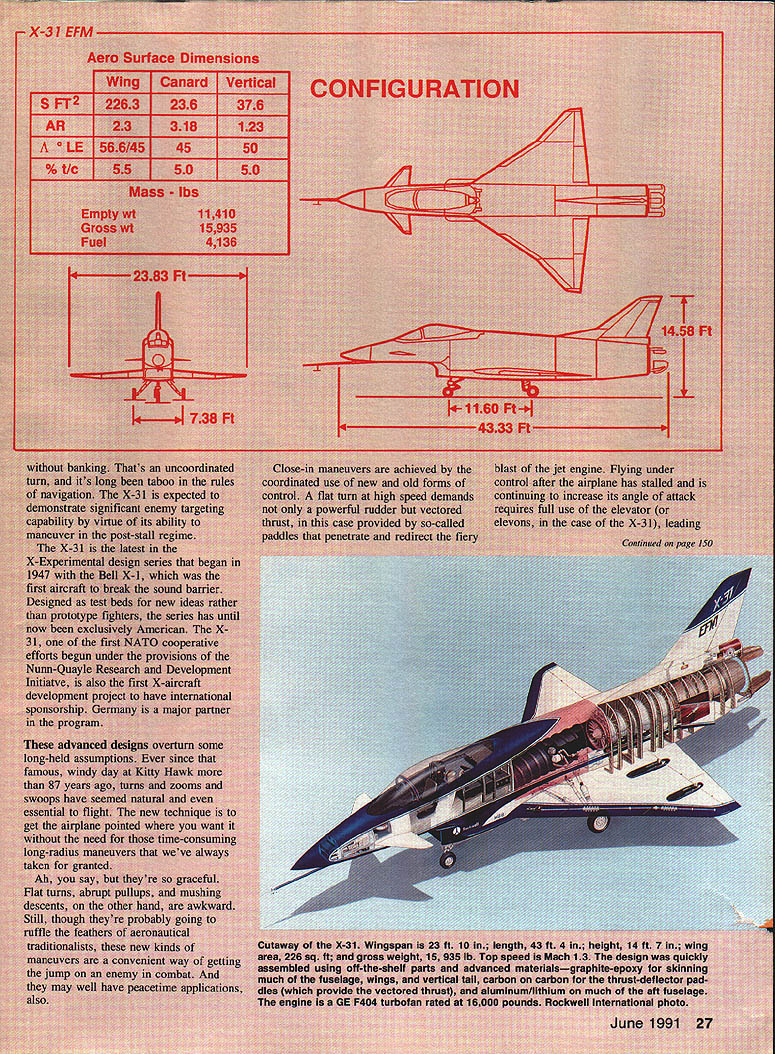
The X-31 is an Enhanced Fighter Maneuverability demonstrator that integrates several technologies—including vectored thrust, integrated control systems, and aircrew assistance—to allow close-in aerial combat beyond normal flight-envelope boundaries. These aircraft will be able to point their noses, and thus their weapons, at an enemy simply by yawing (rotating about the vertical axis) without banking. That's an uncoordinated turn, long considered taboo in navigation, but the X-31 aims to demonstrate significant targeting capability by operating in the post-stall regime.
Technology and Controls
Close-in maneuvers are achieved by coordinated use of new and established controls. A flat turn at high speed demands not only a powerful rudder but vectored thrust provided by paddles that penetrate and redirect the jet exhaust. Maintaining controlled flight after the airplane has stalled and the angle of attack continues to increase requires full use of elevators and elevons (in the X-31's case), or leading-edge flaps and canard surfaces, together with thrust vectoring.
Soviet MiG-29 and Su-27 fighters have demonstrated post-stall maneuverability at air shows, pulling their noses well past the stalling angle while remaining clearly under control at very low speed. Beyond an air-show stunt, this capability allows a fighter to rapidly reduce speed in combat while an opponent passes by and becomes a target.
Development and Partnerships
The X-31 is the latest in the X-Experimental series that began with the Bell X-1 in 1947. Unlike previous X-series projects, the X-31 is an international effort—one of the first NATO cooperative developments under the Nunn-Quayle Research and Development Initiative. Rockwell International’s North American Aircraft division partnered with MBB (Messerschmitt‑Bölkow‑Blohm) of Germany.
Key milestones:
- 1977: MBB introduced the concept of enhanced maneuverability.
- 1983: Rockwell demonstrated vectored thrust on an F-14 Tomcat test bed.
- Mid-1988: Construction of the X-31 began.
- March 1990: First airplane rolled out of the Palmdale, California factory.
- October 11, 1990: First flight of the X-31.
- January 19, 1991: Second X-31 flown by a German pilot.
Use of Off-the-Shelf Parts
Construction time was shortened by using many off-the-shelf components. Major parts sources include:
- Landing gear: Cessna Citation II and General Dynamics F-16
- Canopy, instrument panel, and digital displays: F/A-18 Hornet
- Other parts: LTV A-7 Corsair II; Northrop F-5 and F-20; Bell/Boeing V-22 tilt-rotor V/STOL
- Wing design: borrowed from the MBB experimental European Fighter Aircraft’s clipped double-delta planform
Materials
Advanced materials were used extensively:
- Graphite-epoxy: much of the fuselage skin, wings, and vertical tail
- Carbon/carbon: thrust-deflector paddles
- Aluminum-lithium: much of the aft fuselage
Flight Testing and Mock Combat
After the initial flight-test phase, the X-31s will be used in mock combat. To estimate effectiveness, enhanced-maneuverability devices will remain active on one airplane but be shut down in the other. Later, the pair will engage in simulated combat maneuvers with current American fighters and likely be tested against some Soviet fighters operated at secret test bases in Nevada.
Specifications
- Wingspan: 23 ft. 10 in.
- Length: 43 ft. 4 in.
- Height: 10 ft. 7 in.
- Wing area: 226 sq. ft.
- Empty weight: 11,410 lb.
- Design gross weight: 15,935 lb.
- Fuel load: 4,136 lb. (about 700 gallons)
- Top speed: about Mach 1.3 (≈850 mph at 40,000 ft)
- Powerplant: one GE F404 turbofan engine, rated at 16,000 lb.
Cruise speed and range are of little consequence for a research airplane.
Conclusion
So there you have it: flat turns may be the thing to do in the 1990s. If your instructor objects, tell him you read about it in Model Aviation. If he keeps yelling, you’re on your own—though you might consider swatting him with a rolled-up copy of the magazine only after you’ve landed, come to a complete stop, shut down the engine, and paid his flying-school bill.
Transcribed from original scans by AI. Minor OCR errors may remain.

