
XB-70
Jim Haught
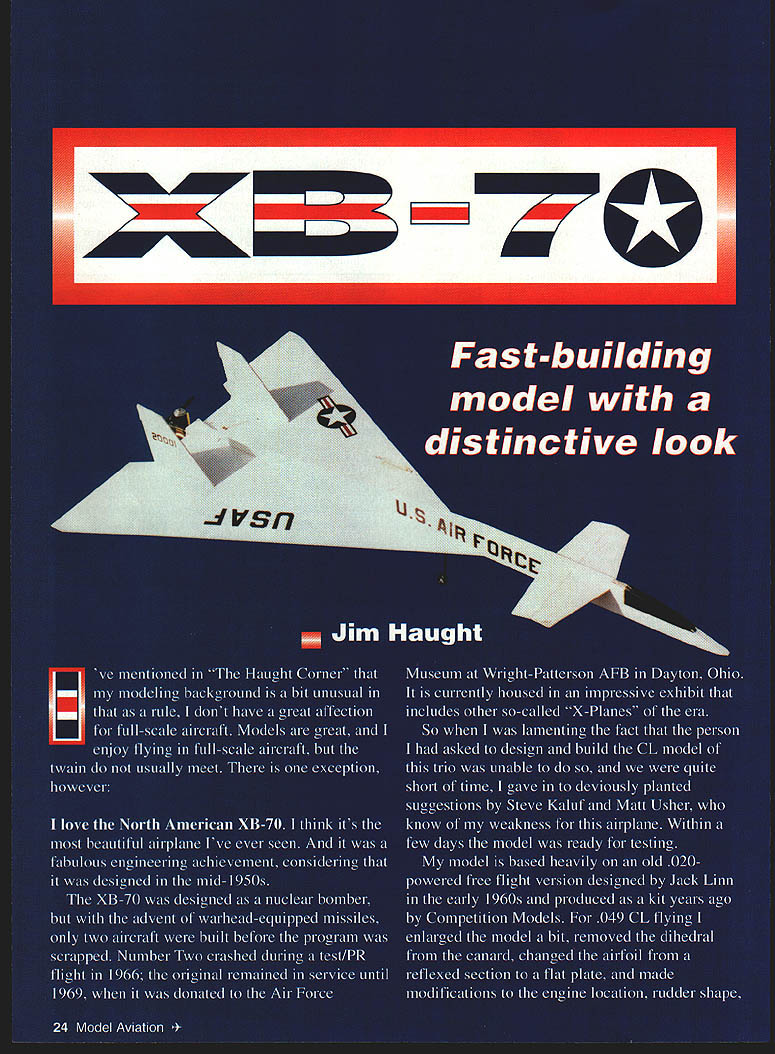
I've mentioned in "The Haught Corner" that my modeling background is a bit unusual in that, as a rule, I don't have a great affection for full-scale aircraft. Models are great, and I enjoy flying in full-scale aircraft, but the twain do not usually meet. There is one exception, however: I love the North American XB-70. I think it's the most beautiful airplane I've ever seen. And it was a fabulous engineering achievement, considering that it was designed in the mid-1950s.
The XB-70 was designed as a nuclear bomber, but with the advent of warhead-equipped missiles, only two aircraft were built before the program was scrapped. Number Two crashed during a test/PR flight in 1966; the original remained in service until 1969, when it was donated to the Air Force Museum at Wright-Patterson AFB in Dayton, Ohio. It is currently housed in an impressive exhibit that includes other so-called "X-Planes" of the era.
So when I was lamenting the fact that the person I had asked to design and build the control-line model of this trio was unable to do so, and we were quite short of time, I gave in to deviously planted suggestions by Steve Kaluf and Matt Usher, who know of my weakness for this airplane. Within a few days the model was ready for testing.
My model is based heavily on an old .020-powered free-flight version designed by Jack Linn in the early 1960s and produced as a kit years ago by Competition Models. For .049 control-line flying I enlarged the model a bit, removed the dihedral from the canard, changed the airfoil from a reflexed section to a flat plate, and made modifications to the engine location and rudder shape.
Steve Kaluf
When Jim Haught asked me to test-fly a control-line model for this issue of Model Aviation I figured I could not get into too much trouble, since the airplane was to be a "beginner's" model. I had not flown control line for several years, and really had done no serious CL flying for more than 12 years.
Understand, Jim is mostly a free flighter, and most of my experience is with RC—not designing a control-line trainer. So I laughed a little, and suggested in a moment of desperation (trying to get Jim to bother someone else) that we do an XB-70. Shortly thereafter, he brought in a set of plans with a bellcrank drawn on it. I knew we were in trouble!
After some preliminary design consultations (like: "Jim, I really think the bellcrank should be on the CG, and yes, I demand that it have landing gear"), Jim proceeded to build the model. I was working on a CL Sig Twister at the time, so control-line stuff was fresh in my mind, and I relayed as much information as possible to Jim.
In less than a week we brought the completed XB-70 in for inspection. Overall everything looked pretty good. We worried over what length to cut the control lines to. I finally decided that 26 feet looked about right, and the lines were cut and the control handle adjusted for neutral elevator. (Don't forget to do this.)
Our next problem was the weather. The Midwest had seen record snowfall that winter. With a deadline getting very close, we decided to give it a try on a less-than-perfect day. The wind was about 8 mph when we got to the circle. By the time we were all set up it was probably up to 10 mph—not great for the first flight of a new model. The circle also had a little snow left on it.
The engine was a little troublesome in the cold weather, but Jim got it running. I ran out to the control handle and checked the controls: up, down, neutral. This is a good habit to get into; you want to be sure you don't pick up the handle upside down, and that your neutral position did not shift.
I signaled to release the model and immediately had to step backward to maintain line tension; the model was trying to turn into the circle. We had been a bit worried about this, since the landing gear had a narrow stance, and the pusher setup did not allow for much airflow over the rudders. The wind immediately blew the model over and toward me. It slid to a safe stop upside down, with no damage. Jim put some right turn into the nose gear and added right thrust to the engine before our next attempt a couple of days later. That day was much warmer, and the wind was only blowing about 5 mph.
We decided to set up so that the model was pointing downwind at the start. This would give it a half lap prior to coming fully into the wind. I wanted to try to keep the model on the ground as long as possible to see if anything would sort itself out prior to getting airborne.
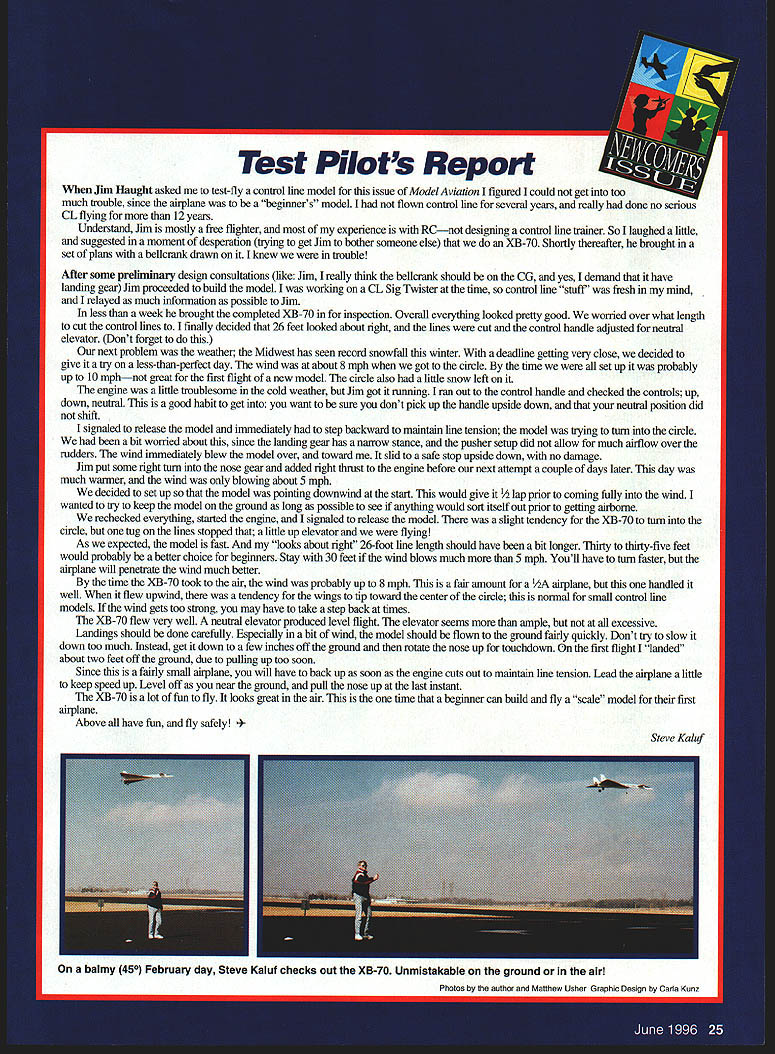
We rechecked everything, started the engine, and I signaled to release the model. There was a slight tendency for the XB-70 to turn into the circle, but once up on the lines it stopped that; a little up elevator and we were flying!
As we expected, the model is fast. My "looks about right" 26-foot line length should have been a bit longer. Thirty to thirty-five feet would probably be a better choice for beginners. Stay with 30 feet if the wind blows much more than 5 mph. You'll have to turn faster, but the airplane will penetrate the wind much better.
By the time the XB-70 took to the air, the wind was probably up to 8 mph. This is a fair amount for a 1/2A airplane, but this one handled it well. When it flew upwind, there was a tendency for the wings to tip toward the center of the circle; this is normal for small control-line models. If the wind gets too strong, you may have to take a step back at times.
The XB-70 flew very well. A neutral elevator produced level flight. The elevator seems more than ample, but not at all excessive. Landings should be done carefully. Especially in a bit of wind, the model should be flown to the ground fairly quickly. Don't try to slow it down too much. Instead, get it down to a few inches off the ground and then rotate the nose up for touchdown. On the first flight I "landed" about two feet off the ground, due to pulling up too soon.
Since this is a fairly small airplane, you will have to back up as soon as the engine cuts out to maintain line tension. Lead the airplane a little to keep speed up. Level off as you near the ground, and pull the nose up at the last instant.
The XB-70 is a lot of fun to fly. It looks great in the air. This is the one time that a beginner can build and fly a "scale" model for their first airplane.
Above all, have fun, and fly safely!
Steve Kaluf
Transcribed from original scans by AI. Minor OCR errors may remain.

