
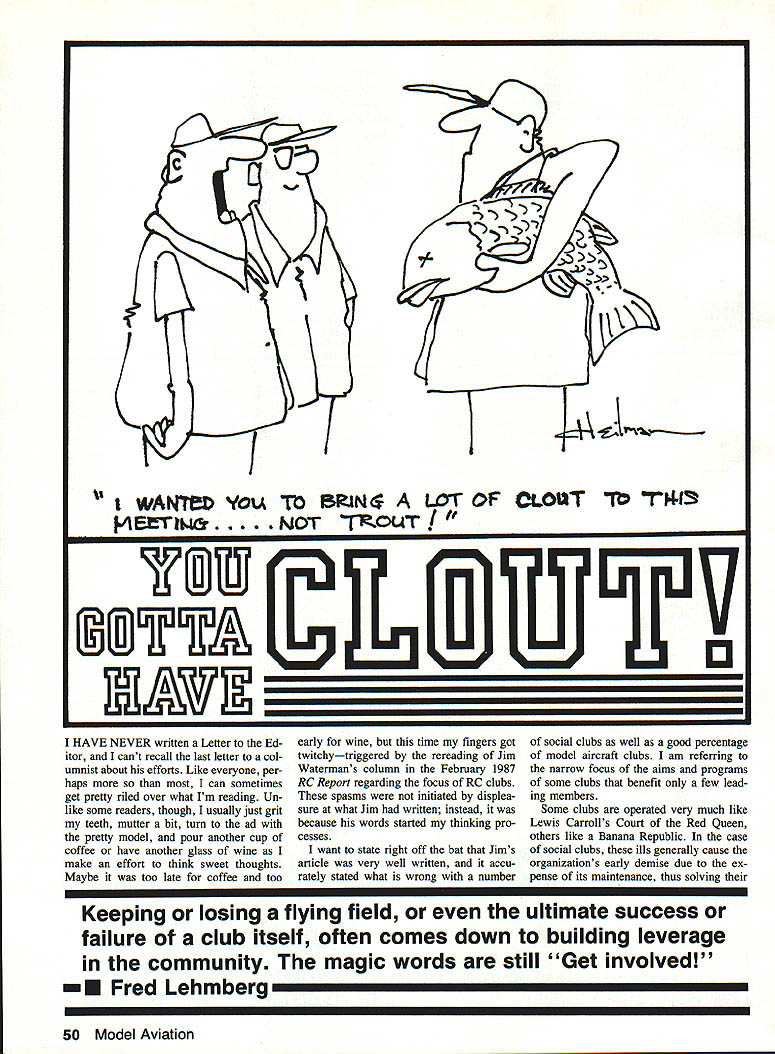
You Gotta Have: Clout!
I have never written a Letter to the Editor, and I can't recall the last letter to a columnist about his efforts. Like everyone—perhaps more so than most—I can sometimes get pretty riled over what I'm reading. Unlike some readers, though, I usually just grit my teeth, mutter a bit, turn to the ad with the pretty model, and pour another cup of coffee or have another glass of wine as I make an effort to think sweet thoughts. Maybe it was too late for coffee and too early for wine, but this time my fingers got twitchy—triggered by the rereading of Jim Waterman's column in the February 1987 R/C Report regarding the focus of R/C clubs.
I want to state right off the bat that Jim's article was very well written, and it accurately stated what is wrong with a number of social clubs as well as a good percentage of model aircraft clubs. I am referring to the narrow focus of the aims and programs of some clubs that benefit only a few leading members.
Some clubs are operated very much like Lewis Carroll's Court of the Red Queen, others like a banana republic. In the case of social clubs, these ills generally cause the organization's early demise due to the expense of maintenance.
Keeping or losing a flying field, or even the ultimate success or failure of a club itself, often comes down to building leverage in the community. The magic words are still "Get involved!"
- Fred Lehmberg
The model club, though, can go on for a long period of time with a large turnover of members, and those leaving seldom criticize the club because they're convinced it's they who are out of step. The runway fees and dues charged to newcomers always seem to supply the means of perpetuating this Alice-in-Wonderland club atmosphere. Instead of providing new members with advice, understanding, and assistance, the self-styled "experts" often subject these "nerds" to ridicule and make a large issue at the club meetings of a novice's blunders. Clubs such as these are too often small ponds where some personalities become big fish. Come to think of it, this has happened in big ponds, too—look at the performance of some of our elected (and appointed) public servants!
Cliques are inherent to any group of more than five people. Generally a single clique will hold sway until the group numbers 10 to 15, when an opposing faction is formed. It's odd, but no matter how large the group size one never sees more than two enduring cliques. The leading (ruling) clique is the one that convinces the membership that it's proposing the Right Thing on almost every issue. Not many issues are lost, since it's very easy for the head clique to change position. We see this in the case of the British Prime Minister, who is really nothing more than the head of a clique.
Just as with national governments, some cliques benefit a club, and others do harm. In a strong, healthy club the cliques will agree with each other on most things but take opposing stands on relatively narrow issues. After elections are over the minor clique supports the major one for the good of the club. If a club is to remain strong, certain problems might be better solved by the minor clique. As an example, Churchill's Conservative party was without doubt the preferred clique for wartime. His faction was quite speedily placed in power when needed—but was replaced as speedily at war's end. I guess the bottom line is whether or not the clique's leaders fit the pants they are wearing. If they do, issues will be handled in a way that serves the membership. If not, the leaders must be replaced.
Perhaps fortunately, all of us cannot be leaders. As the adage goes, "Those who can lead, do so. Those who cannot, follow." The followers, by far the greatest in number, have a big responsibility—that of selection of their leaders.
At the rate clubs are losing flying sites nowadays, it's a necessity that a club has local clout if it is to remain in business. If at local hearings the public officials are told by the representatives of modeling only that they have flown there for 15 years, and that if flying is prohibited the old duffers will no longer have a place to play with their expensive toys, there wouldn't be much hope for success against any well-organized opposition. Again, it's actually a matter of cliques.
What the politicians are paying attention to at such public hearings are criticisms of model flying from naturalist and environmentalist groups. The flying of these models, for example, will disturb the love life of the nearly extinct Downey-textured Double-Breasted Beachbunny. The nature groups even make sweeping statements that our noisy aircraft, some weighing many pounds and flying over 100 mph, are a threat to the inhabitants of the entire county. To make matters worse, the hearing officials always seem to magnify the figures presented to them, so that they end up with a picture in their heads of 100-lb. behemoths zooming around at 199 mph.
The environmentalists have the clear advantage in such disputes—the clout of a well-known organization with political recognition. Representing what's good for the community as a whole, they cogently argue that model flying only benefits the few. The bottom line, really, is the vote potential of the cliques involved.
The Puritan Complex also plays a role. A large part of our voting population exhibits this mentality, which strikes fear in the hearts of politicians. Basically, the Puritan Complex can be defined as the fear that somehow, somewhere, someone is enjoying himself. If this enjoyment is believed (mistakenly or not) to be publicly funded without personal benefit to the Puritan, the complex is compounded. Since latter-day Puritans always seem to be endowed with large vocal capacities and ties to the local media, a pyramid of potential voices is built to the elected hearing officials if they don't show support. All of this ups the clout of the model club's opposition!
Clubs desiring to acquire a new flying site become involved in political skirmishes, too. Let's take the case of a fairly large number of area modelers who organized to obtain a site and develop it into a model airport. The group's leading clique was composed of good management types who respected the club's dignity. The project required a lot of compromise with the city. However, some members were prepared to spend a great deal of personal time on the objective. Of course, the group membership had provided a decent sum for the initiation of the project and site improvement.
The management found a good locale. It was a filled-in dump site on a marsh that, by law, cannot be developed for many years. Such vacant tracts can be used as flying sites until the settling is complete. Since the group was an organized one, application for use approval was in order. At some expense, the club studied the local regulations, learned about the flora and fauna of the adjacent swamp, obtained the opinions of respected naturalists after demonstrations of flying on the site, made sound level measurements—really played the devil's advocate in anticipating the opposition's arguments and preparing appropriate responses. Their major obstacle, they figured, was negotiation with the management of a nearby airport regarding an airspace problem.
At the hearing, the Puritan clique argued against the proposal. It was recommended that site approval be withheld pending the satisfactory results of an environmental report to be funded by the club. Pursuing this, the club discovered that a preliminary study would cost up to $3,000, followed by a complete study costing $10,000 to $50,000!
As a topper, the club also learned that after spending this amount, it would only buy a ticket back to ground zero and the right to have another hearing. The Puritan clique could bring up a point not covered by the study and start the whole thing over again. This, in fact, was what actually happened to the Southern Alameda County Radio Control Club. The club could only fold its tents, swallow the bitter pill, and look for another site. You gotta have Clout!
What is Clout? You will note that I am now capitalizing the word. An organization acquires Clout by involvement within the community, using publicity to make that involvement visible. The groundwork is laid by establishing committees that promote involvement. These subgroups of one to three members will keep a large part of the membership busy and out of trouble as well. Committees should be formed to direct:
- Publicity
- New members
- Youth programs
- Safety
- Community involvement
- Contests
Publicity
This committee should establish contact with the local newspaper and develop a personal relationship with the sports and local events editors. It should regularly submit articles, photos, and information describing club activities (recent, pending, and planned), with input from other committees within the club. The publicity committee should also submit material to the hobby magazines.
New members
This committee should involve the entire membership in the search for new members. More members means more dues, fresh ideas, and potential influence (Clout). Recruit anyone with an interest in model aviation, not just modelers with a record of achievement. These "arm-chair" members can serve in important club functions as committee members, contest officials, and in general operation, freeing active fliers from administrative duties.
An effort should be made to recruit members of service organizations, such as the Rotary, Optimist, and Lions clubs. Because of these groups' contacts with local government and the media, modeling interests can often be put forward in a very positive way. If the interest of the local politicians can be aroused, an honorary membership or two should be considered. If they start flying, however, they should be nicked for the runway fee!
Youth programs
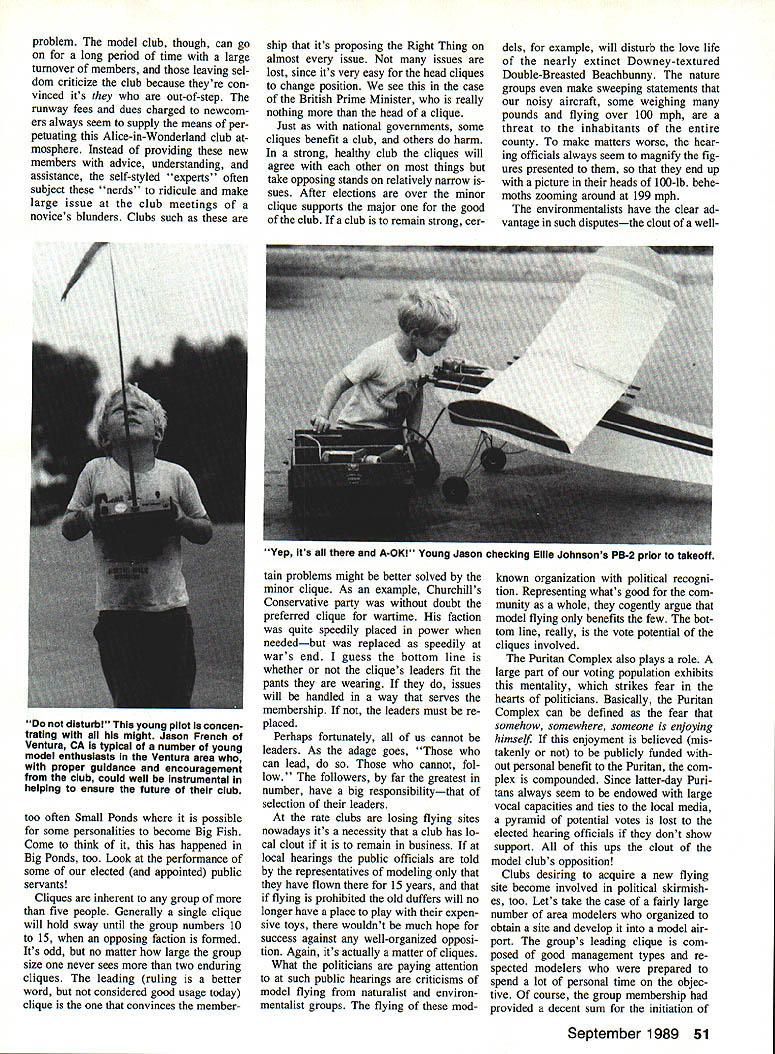
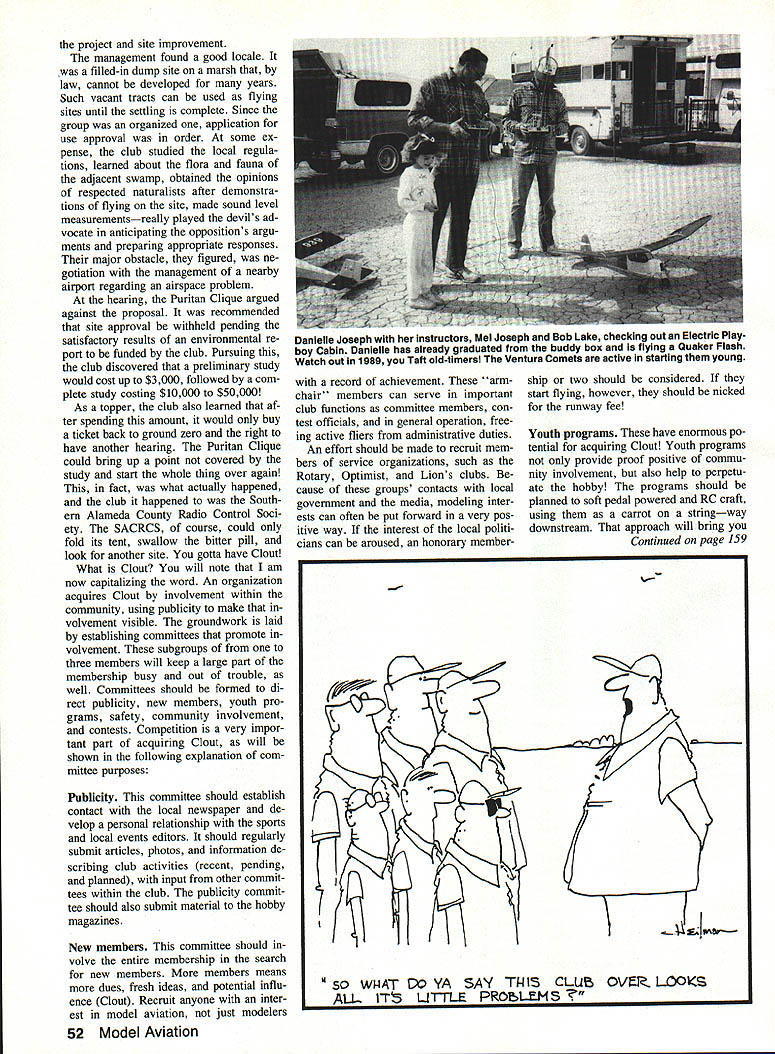
These have enormous potential for acquiring Clout. Youth programs not only provide proof positive of community involvement, but also help to perpetuate the hobby. The programs should be planned to spot a kid toward RC craft, using them as a carrot on a string—way downstream. That approach will bring you better support from the parents.
Use a section of the flying site that will not pose problems, but is close enough to make the kids feel they're a part of the action. Youth-member club status or competition in the early part of the program will provide an incentive. Start off with a hand-launched glider (not a toy one), go to an all-balsa rubber-powered model, then to progressively more difficult rubber models. Subsidizing the materials from the club treasury would be money well invested.
At this point a junior club membership could be made available at low dues. (There must be dues, for learning to pay your way before you play is part of life—or it used to be.) The youth member could then start training on a member's craft and save money for a craft of his own. All of this involvement with young people should be given maximum publicity.
Safety
The duties of this committee are well known. Also, it would be well for the safety committee to handle field marshal assignments and be responsible for review and settlement of safety-related field problems.
Community involvement
The duties of this committee would be to provide displays for local malls and service-club functions, as well as organize any activity that shows the club's presence. Lectures and "how-to" talks at the elementary and high schools can be powerful. Again, this should include a hand-launched glider, a high-performance rubber job, an RC electric model (this could be flown!), and a really classy pattern or scale model. Use a good speaker. This is a good job for one of the arm-chair members. Remember, they can speak—and sometimes very dramatically. They communicate to the maximum potential for the building of Clout!
Contests
With apologies to Jim Waterman, contests are a good way to build Clout. A local flying club is really no different, in principle, than a football club or a baseball club. Given the same press, the modeling club would have as much prestige. A ball club's home city identifies itself with that club. I remember that in New England, the world nearly stopped turning when the Brooklyn Dodgers and the Yankees were playing the Series—and it was a long way from the Big Apple! Work conducted during this period even rose in price—the companies knew their labor force wasn't going to be as productive. Though, as in a model club, only a small percentage of all club personnel were big names, that didn't matter to the fans. Their ball club had Clout!
In every AMA district contests are held all summer long; and of course, there is the National Meet. The club committee should schedule one big meet every year with AMA sanction, publicize it well, and report it well. Every effort should be made to promote public attendance. Make it a circus.
Years ago I was a member of the San Antonio Gas Model Association (pre–WW II) which had an annual meet with a printed program (mostly advertisements from the local merchants) and around $1,000 in prizes donated by the merchants. We were very well known in that town. Our activities were enthusiastically reported by the local newspaper, which made a big thing out of it when one or more of the "San Antonio Boys" did well in a contest in Austin, Houston, Amarillo, etc.
It is important for the publicity committee to establish a personal relationship with the sports editor of the local newspaper and keep him informed. That early San Antonio Gas Model Association could have swatted aside most of the problems facing modern clubs. It had Clout! Perhaps one or two local meets aimed at the public should be arranged. Plan them around a fun-fly format with events such as egg drops, balloon busting, scale, etc. Of course, during these events the field would have to be closed to the members for sport flying, which I hardly think would bother any member unless he showed traces of the Puritan complex. The club must make the public aware of its existence in order to build Clout.
Building community involvement, admittedly, calls for a lot of hard work on the part of your club, but you'll have a voice in maintaining your presence in the community. Making ourselves visible to the public seems, really, to be the only way to enjoy our hobby with minimum restriction and deploy enough Clout to defend ourselves against the Puritans. It's really simple—just find the lift, trim in a little up control, and circle!
Transcribed from original scans by AI. Minor OCR errors may remain.

