
Youthful Modelers Show How It's Done at '92 Junior FF World Championships
Two MiG-21 fighters roared in out of nowhere and zoomed across our flying field, making three low-level passes before they left. As we stood there with our mouths open, we all knew for sure that we were a long, long way from home.
This world competition was very well organized; there were very few problems and no protests. But most of all, it was a great experience for the junior fliers, and they all enjoyed their adventure in a foreign land, whether they won anything or not.
The eastern European competitors were very capable fliers with superb equipment. Not surprisingly, they did most of the winning. Of the others, only France and our boys managed to win Bronze team medals.
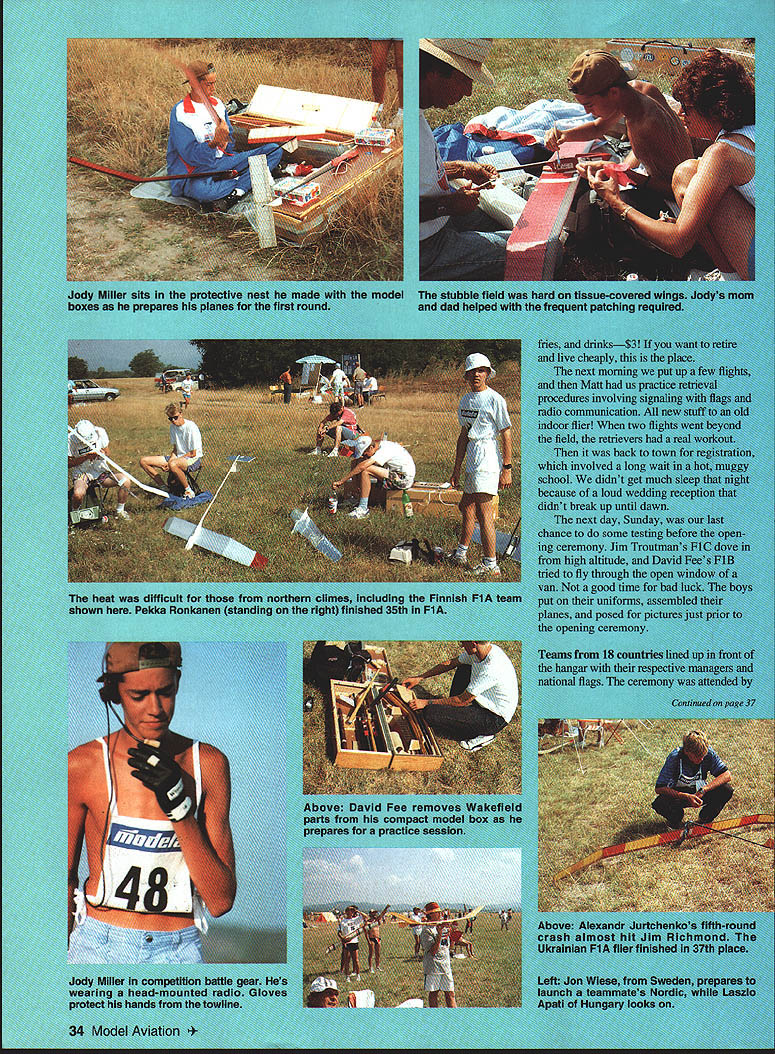
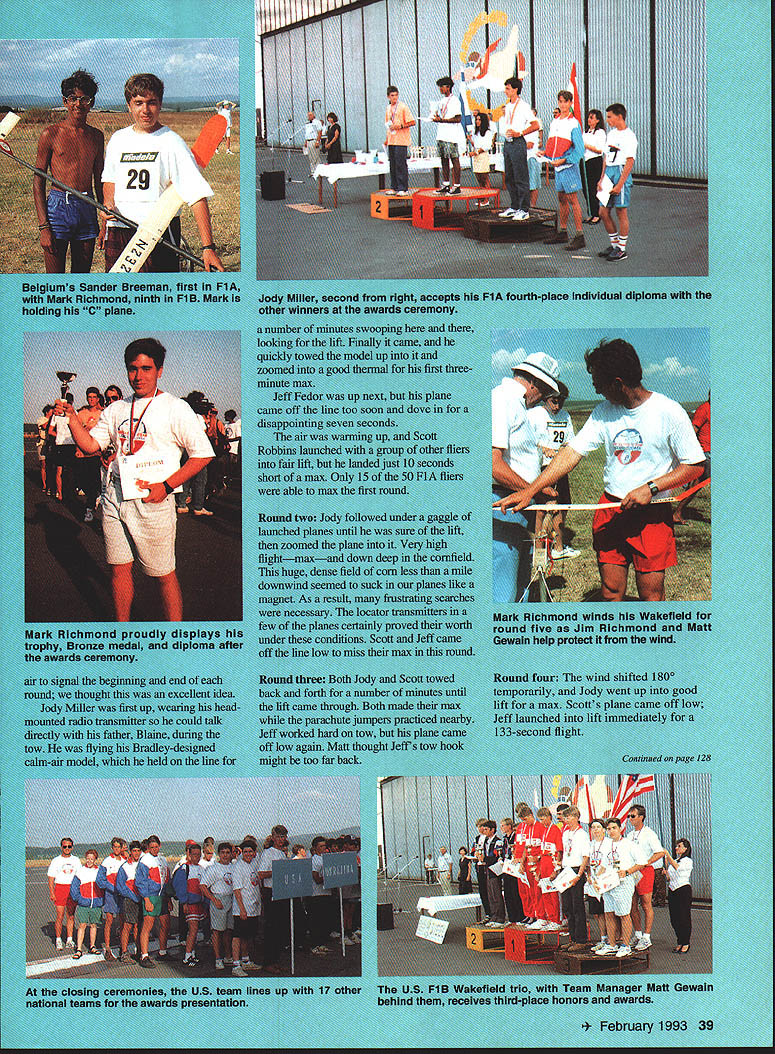
Jody Miller did us proud with his fourth-place individual finish in F1A; he was only one second away from third place. We were pleased with the fine effort put forth by all our team members. Matt Gewain and his wife, Gail, did a superb job of directing our activities throughout the entire program.
Father modelers take note! A priceless experience awaits your sons and daughters if you help them make the junior team. There is no builder-of-the-model rule in FAI, so you can work with your fledgling and pass along your skills.
Our trip began on Wednesday, August 19, 1992, as we converged on Kennedy Airport from different parts of the U.S. We first met Jeff Fedor and his dad, Mike. Jeff was carrying the tiniest carry-on model box we had ever seen. It was only about 20 inches long, yet it contained a complete F1A glider. The magic shrinking model feat was achieved by using a four-piece wing and a two-piece body.
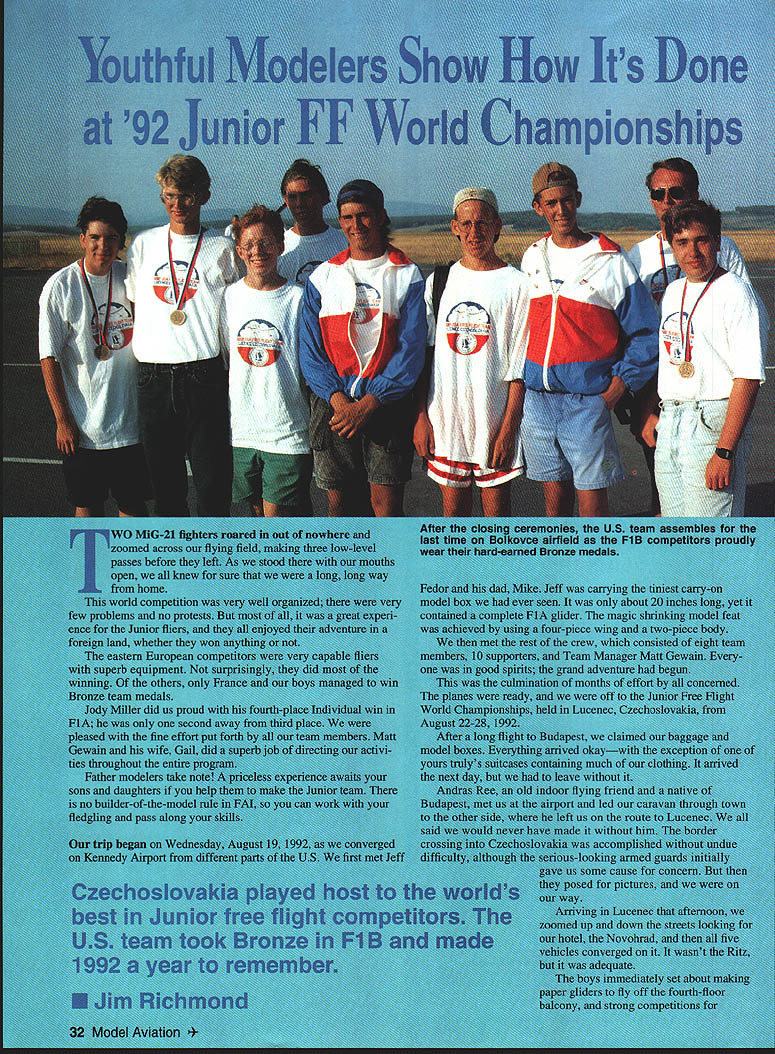
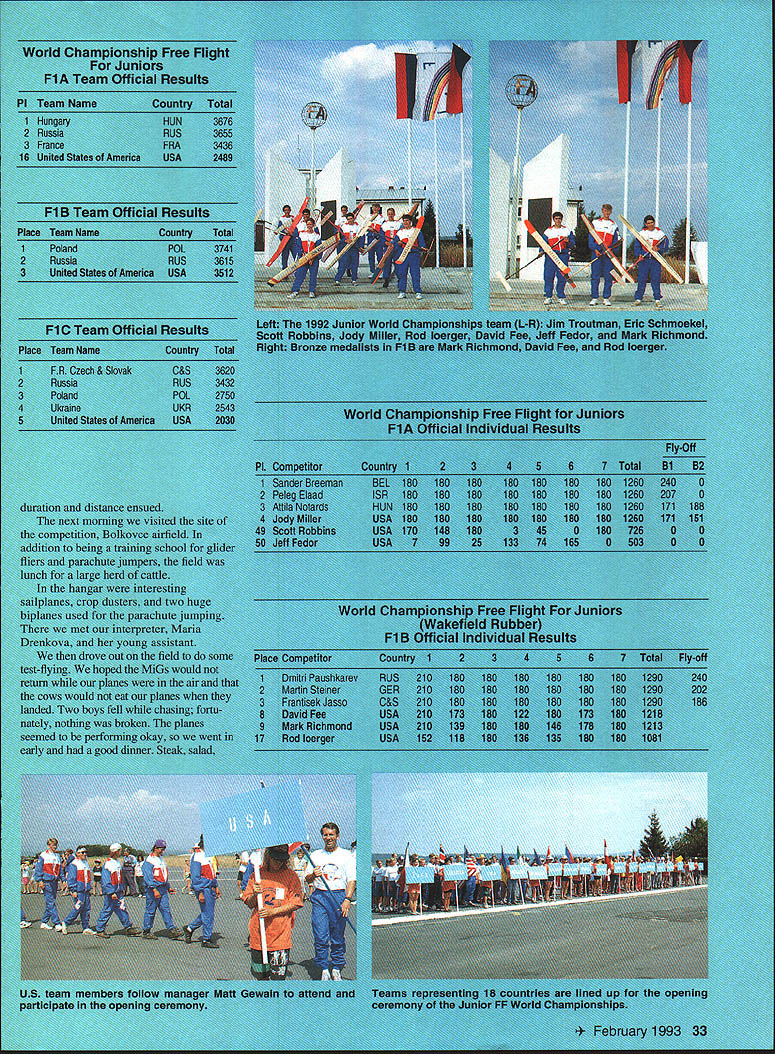
We then met the rest of the crew, which consisted of eight team members, 10 supporters, and Team Manager Matt Gewain. Everyone was in good spirits; the grand adventure had begun.
This was the culmination of months of effort by all concerned. The planes were ready, and we were off to the Junior Free Flight World Championships, held in Lucenec, Czechoslovakia, from August 22–28, 1992.
After a long flight to Budapest, we claimed our baggage and sampled some lovely Hungarian food — with the exception of one of our group's suitcases containing much of our clothing. It arrived the next day, but we had to leave without it.
Andras Recza, an old indoor flying friend and a native of Budapest, met us at the airport and led our caravan through town to the other side, where we left on the route to Lucenec. We all said we would never have made it without him. The border crossing into Czechoslovakia was accomplished without undue difficulty—although the strict-looking armed guards initially gave us some cause for concern, they posed for pictures, and we were on our way.
Arriving in Lucenec that afternoon, we zoomed up and down the streets looking for our hotel, the Novohrad, and then all five vehicles converged on it. It wasn't the Ritz, but it was adequate.
The boys immediately set about making paper gliders to fly off the fourth-floor balcony, and strong competitions for duration and distance ensued.
Czechoslovakia played host to the world's best in junior free-flight competitors. The U.S. team took Bronze in F1B and made 1992 a year to remember.
The next morning we visited the site of the competition, Bolkovce airfield. In addition to being a training school for glider fliers and parachute jumpers, the field was used for a large herd of cattle.
In the hangar were interesting sailplanes, crop dusters, and two huge biplanes used for the parachute jumping. There we met our interpreter, Maria Drenkova, and her young assistant.
We then drove out on the field to do some test-flying. We hoped the MiGs would not return while our planes were in the air and that the cows would not eat our planes when they landed. Two boys fell while chasing; fortunately, nothing was broken. The planes seemed to be performing okay, so we went in early and had a good dinner. Steak, salad, fries, and drinks—$3! If you want to retire and live cheaply, this is the place.
The next morning we put up a few flights, and then Matt had us practice retrieval procedures involving signaling with flags and radio communication. All new stuff to an old indoor flier! When two flights went beyond the field, the retrievers had a real workout.
Then it was back to town for registration, which involved a long wait in a hot, muggy school. We didn't get much sleep that night because of a loud wedding reception that didn't break up until dawn.
The next day, Sunday, was our last chance to do some testing before the opening ceremony. Jim Troutman's F1C dove in from high altitude, and David Fee's F1B tried to fly through the open window of a van. Not a good time for bad luck. The boys put on their uniforms, assembled their planes, and posed for pictures just prior to the opening ceremony.
Teams from 18 countries lined up in front of the hangar with their respective managers and national flags. The ceremony was attended by such dignitaries as FAI General Director Cenek Kepak; president of the Czechoslovakian modeling association, Milan Vydra; Pierre Chaussebourg of FAI; and the mayor of Lucenec, Tibor Kotek. Because of the intense heat, their speeches were much shorter than usual, which was greatly appreciated by all concerned.
After the opening ceremony there were flying demonstrations of RC and control-line models. We also discovered that we needed more F1B rubber motors, which would be impounded when processed a couple of hours later. Good thing we brought the Japanese postal scale. While the motors were being made in our hot van, a Brit came by and said, "Making motors is a bore, isn't it?" The processing activity went very well without problems, including the new motors.
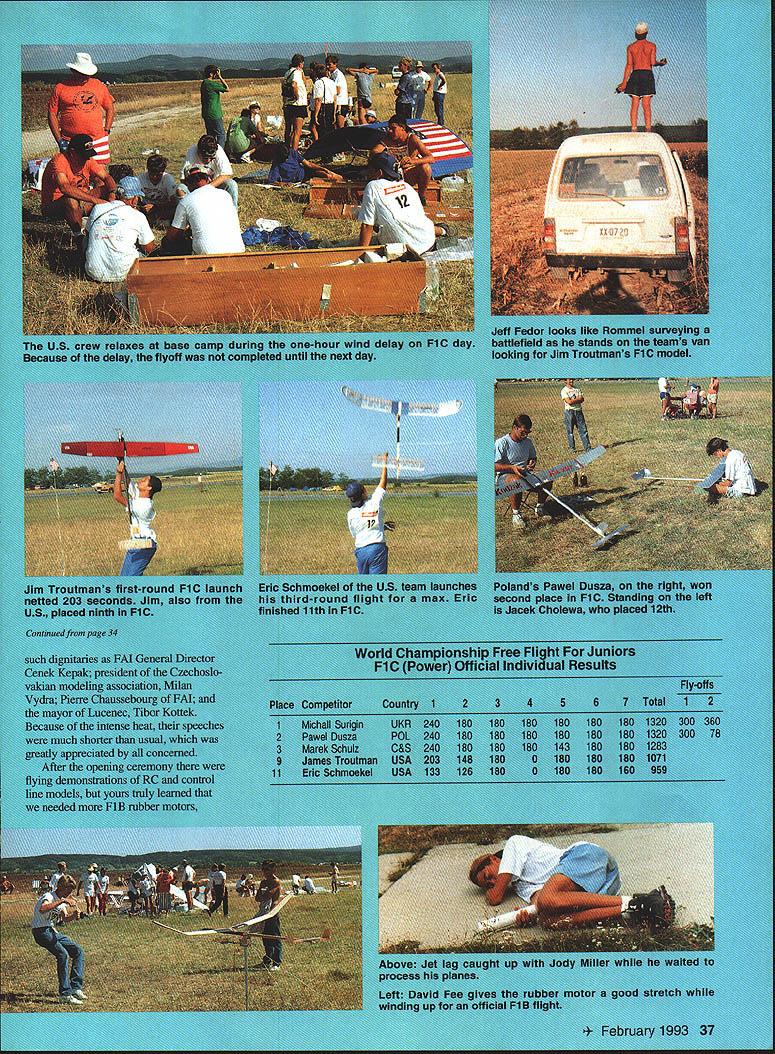
World Championship Free Flight for Juniors — F1C (Power) Official Individual Results
- Place 1 — Michail Surigin, UKR — Rounds: 240, 180, 180, 180, 180, 180, 180 — Total: 1320 — Fly-offs: 300, 360
- Place 2 — Pawel Dusza, POL — Rounds: 240, 180, 180, 180, 180, 180, 180 — Total: 1320 — Fly-offs: 300, 78
- Place 3 — Marek Schulz, C&S (Czechoslovakia) — Rounds: 240, 180, 180, 180, 180, 180, 180 — Total: 1080 — Fly-offs: 180, 180
- Place 9 — James Troutman, USA — Rounds: 240, 180, 180, 180, 180, 180, 180 — Total: 1071
- Place 11 — Eric Schmoekel, USA — Rounds: 133, 126, 180, 0, 180, 180, 160 — Total: 959
F1A — Monday
During most of our days in Lucenec, the temperature ranged between 90° and 95° Fahrenheit with humidity to match—and no air conditioning. For a pleasant change, the dawn of the first day of the competition brought some cool air.
We arrived at the field early, set up our base camp, sent out the retrievers, and had the air beaters (the boys who weren't flying) prepare for action. We would start at pole position #16, between Finland and Spain, and then shift two positions each round.
Round one — 180 seconds: BOOM! An aerial bomb exploded to announce the start of competition. Colored flares were shot into the air, and a number of minutes were spent swooping here and there looking for lift. Finally it came, and one of our boys quickly towed his model into it and zoomed into a good thermal for his first three-minute max.
Jeff Fedor was up next, but his plane came off the line too soon and dove in for a disappointing seven seconds.
The air was warming up, and Scott Robbins launched with a group of other fliers into fair lift, but he landed just 10 seconds short of a max. Only 15 of the 50 F1A fliers were able to max the first round.
Round two: Jody followed under a gaggle of launched planes until he was sure of the lift, then zoomed the plane into it. Very high flight—max—and down deep in the cornfield. This huge, dense field of corn less than a mile downwind seemed to suck in our planes like a magnet. As a result, many frustrating searches were necessary. The locator transmitters in a few of the planes certainly proved their worth under these conditions. Scott and Jeff came off the line low and missed their maxes in this round.
Round three: Both Jody and Scott towed back and forth for a number of minutes until the lift came through. Both made their maxes while the parachute jumpers practiced nearby. Jeff worked hard on tow, but his plane came off low again. Matt thought Jeff's tow hook might be too far back.
Round four: The wind shifted 180° temporarily, and Jody went up into good lift for a max. Scott's plane came off low; Jeff launched into lift immediately for a 133-second flight.
Round five: Jody switched to his modified Czech Mate because of the wind, and the flight was very high, for another max. Scott went up okay, but on an overly tight turn he brought it down in 45 seconds. Jeff's low-launch problems continued, and he was down in 74 seconds. Ukrainian flier Alexandr Yurchenko launched his plane but dove straight in to crash at my feet. Hey, even gliders can be dangerous!
Round six: Jeff went up first for a good flight, but was lost from view below the horizon at 165 seconds. Jody tangled lines with another flier during a mass launch and was able to refly. He went up again and quickly zoomed into a good thermal for yet another max.
Scott first landed in dead air with the line still attached. On his reflight, the glider did a wingover into a dive, and he released the line to save the plane. Miraculously it thermaled away carrying the line and finally landed in the corn two miles away, where it was found only because of its radio. Good flight, but no time was given because of the attached line.
Both Andreas Motsch and Birgit Puttner of the German team dropped this round after an unbroken string of maxes. Birgit was one of the few girls competing in the championships. Both she and her mother, who is an accomplished F1A flier, were enthusiastic participants.
Round seven: One more max, and Jody—along with five other fliers—would be clean for all seven rounds. Everyone watched with apprehension; the thought hit us: this might be Jody's day. He put on his best performance of the contest, and we all gave the plane lots of mental lift as it soared high into the sky for his max and into the flyoff.
Spanish F1A flier Roberto Rodriguez sprained his ankle, and a Finnish chaser suffered from dehydration, so we concluded that F1A flying is hard on contestants, chasers, and moms. We were also surprised to learn that storks do more than deliver babies—a group of them attacked a Finnish F1A model, causing severe damage. Scott made his max, but Jeff's launch problems ended the day for him.
F1A flyoff — 240 seconds: Six contestants maxed out and would have a flyoff that evening. Jody checked the wind velocity at 8–10 mph over the runway. Because of a shift in wind direction, the starting line was rotated 90° to a position perpendicular to the runway. The starting posts were always located in the same area in the approximate center of the airfield; this kind of rotational move was done only when the wind direction changed in the evening flyoffs.
One contestant went up but towed his plane into a tree. Jody slipped his hands into his black-and-white baseball gloves like a doctor preparing for surgery. He held his plane on tow for an extended time looking for lift in the evening air, finally zooming aloft over the runway. Unfortunately, the weak lift gave out, and he was down in 171 seconds. Only the Belgian flier, Sander Breeman, was able to make the four-minute max, and we started to pack it up to leave.
Then we heard that Jody was in a tie for third with Attila Notaros of Hungary, and that a flyoff would be held for the third-place slot. Jubilation all around and preparation for this new effort.
Jody and Attila, both looking for any lift they could find, went up on tow. This head-to-head competition heightened the drama of the situation, and we all waited with bated breath. Finally they both zoom-launched into the sky; as they floated away, it soon became evident that Attila had captured the best part of the lift; he scored 88 seconds against Jody's 151. We were all very proud of Jody for his fine performance — and after a few days of rest, his mother recovered from the ordeal.
The F1A winner, Sander Breeman, is a very personable young man with the good fortune of having a champion F1A flier like Cenny Breeman for his father/coach. The wings on Sander's plane were observed to be covered with sheet balsa—probably over foam, since with backlighting no internal structure could be seen.
One surprise was that the Russians and Ukrainians, with their beautiful high-tech creations, hadn't made the flyoff. It was reported that the Russians had a new wing design for F1A and F1B using narrow slots in the upper surface near the leading and trailing edges. It was said that air goes in the rear slot and out of the forward one to provide a one-minute improvement in flight time! That day we were worried, but, at least in this competition, traditional low-tech prevailed in the winners' circle.
The next morning during breakfast, we received our usual copy of the World Championship Daily News, which contained the results from the prior day's competition as well as other related information, cartoons, advertisements, funny stories, and historical model-plane information. This nice touch reflected the effort and care that went into the organizational effort.
Surprisingly, one story described some details about Joe Foster's 1953 Wakefield win in England. The team's rubber was apparently spoiled because of exposure to excessive heat. In desperation team members removed the elastic from their suspenders and underwear to use in the competition. During the awards ceremony, Joe kept his hands on his hips to hold up his pants.
F1C — Tuesday
Up at 5:15 a.m., shower, meet in the lobby at 6:00, go to breakfast, read the champs daily news, leave for Bolkovce airfield at 6:45, and arrive at 7:00. Set up base camp and equipment, assemble models for the day's competition, send out the chase crews, establish radio communication, and be prepared for the start of the first round at 8:00 a.m. This was our schedule at the beginning of each day of competition. Rounds were one hour in length with five minutes between rounds, and the lunch break was from 12:15 to 1:15.
With only a two-man team for F1C, there was little hope for a team placing; on the other hand, only five countries were flying F1C, and only three had full three-man teams. Jim Troutman placed fourth in F1C in the 1990 Junior World Champs, and now he and his teammate and friend Eric Schmoekel had the same coach—Jim's dad, Mark Troutman. We knew these two boys had great potential, and we had high hopes.
When we arrived at the field, the Russians were already there and were putting up impressive test flights. For them, this was obviously very serious business.
Round one — 240 seconds: We were assigned the end pole position #5, next to Czechoslovakia. Even at this early hour the air was moving at a fair pace, and we knew the four-minute round would give our chasers a workout.
Jim Troutman and his dad consulted their thermistor for a time and then fired up the Lady Lynn's Nelson to a high-pitched scream. The plane climbed but did not transition well. After a few stalls the glide smoothed out but was heading straight downwind. Finally, when the model was almost out of our sight, it turned; the timers, with the aid of binoculars, were able to keep it in sight for 203 seconds.
Eric Schmoekel was next up. His Zingo climbed well; however, the lift wasn't there, and he was down in 133 seconds.
Russian flier Mikhail Kharitonov was seen launching his aluminum-skinned beauty into a fast vertical climb with a good bunt at the top. He was just three seconds short of his max and joined the group of eight fliers who failed to max that round.
Round two — 180 seconds: Jim Troutman had a climb and transition similar to his first flight; some stall at first and a very wide circle in the glide, for a score of 148 seconds. With little help from the air, Eric's flight was a near-duplicate of the first and was down in 126 seconds. Our Russian friend Kharitonov also missed his max with a 172-second flight.
Round three: Jim's climb was very good, and his loop at the top didn't seem to cost him much altitude. This time the plane had a good turn in the glide, and it rode the air well for its first max. Eric's engine couldn't be persuaded to run, so a hasty change was made to install a Nelson plus some tail weight balance. Great climb and transition for his max.
Meanwhile, Kharitonov's climb went off vertical, and his bunt put him straight into the ground. So much for technology! To his credit, he maxed the remainder of the rounds and finished in seventh place.
Round four: This round was our undoing, with both boys having engine overruns and a stuck timer, for a net score of 0–0. The timer on Eric's Zingo stuck, and the plane ran out of fuel high in the sky and glided for miles downwind. Jeff Fedor ran after it for three miles but finally gave out when a large hill loomed in his path. Incredibly, the plane was found by the Italian chasers, who gave it to the British to return that evening.
Rounds five through seven: It was noted that everyone except the Czechs and ourselves used compact handcrank starters. These appeared handier for traveling than the electric starters we were using, but required more effort to operate.
Jim maxed all of these rounds with good, high climbs followed by occasional loops at the top. Eric's fifth-round engine run was only 3.2 seconds. The Pilfered Pearl he was now using instead of the lost Zingo had an excellent AM-type spiral climb and transition that impressed everyone. He maxed rounds five and six, but D.T.ed early at 160 seconds on round seven after a one-hour wind delay.
Polish flier Lukasz Krolcik had some bad luck in round five when his plane rolled over in the climb and dove in after the engine cut, smashing the window of a parked car and narrowly missing a timekeeper.
The flyoff: Jim Troutman's last flight landed deep in a huge cornfield, so we spent the evening hours looking for it. It was eventually found by Mike Fedor.
Mikhail Surigin, of the Ukraine, and Pawel Dzusz, of Poland, were the only fliers with perfect scores; however, because of the prior one-hour wind delay, the flyoff had to be completed the following day. Mikhail Surigin made his five- and six-minute maxes to win the gold medal.
High-tech won, but it had its price. We heard that Polish and Ukrainian F1C models had cracked during practice and competition. Tomorrow would be the first day for F1B, so we hit the hay right after dinner for some much-needed rest.
F1B — Wednesday
After a week of travel, practice, and competition, our day had arrived, and we were wondering if we were really ready for this. The plane was assembled, the stooges were set up, and we would start between Poland and Israel at the eighth pole position. The early air was relatively calm, with little lift indicated.
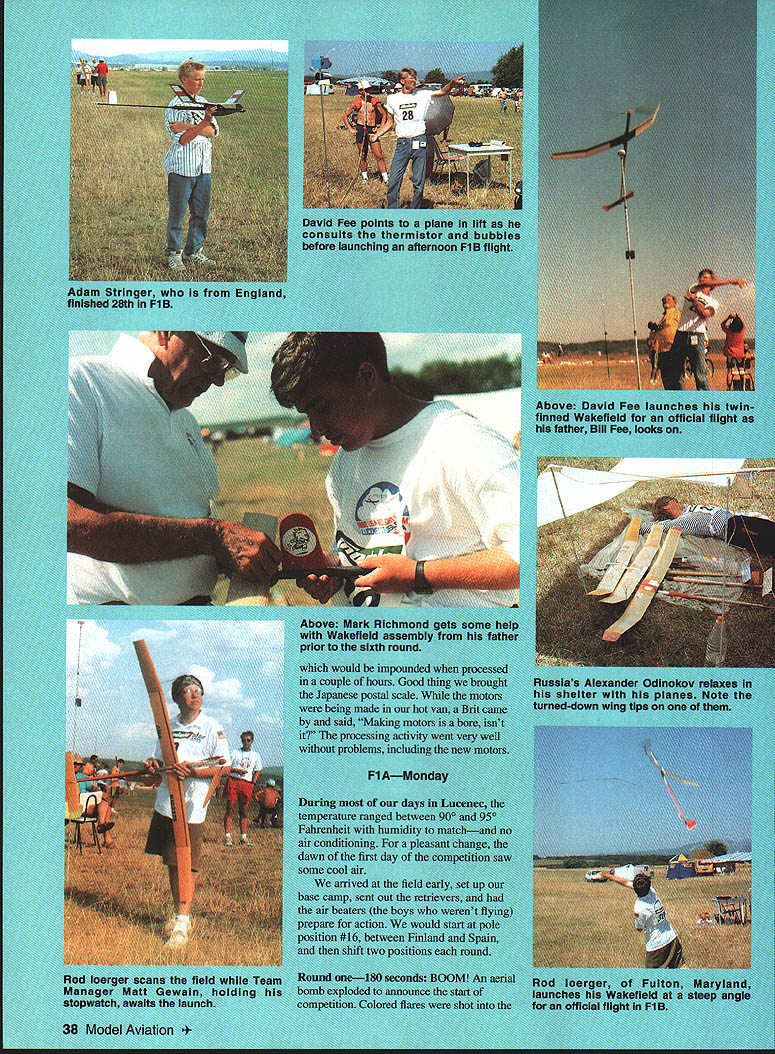
Round one — 210 seconds: It had been determined that Mark Richmond had a good calm-air model, so he was designated to fly first. This long-winged plane was designed to have a long, 60-second motor run at some sacrifice in altitude. Mark started winding up, but a strand broke and a new motor was obtained. After winding in 700 turns, he launched. The power stall didn't help the altitude, but the plane continued up in a straight power run that carried it past the near end of the runway. The air beaters were fresh, and they were working the air enthusiastically. They claimed credit for keeping the plane above a tree as it made its max.
Rod was next in line, and his dad consulted the thermistor and their bubble machine, which was viewed with interest by some of the other participants. He launched to good altitude; however, the lift was still weak and he was down at 152 seconds.
David Fee proved to have a talent for picking air and found enough lift to make his max.
Round two — 180 seconds: The in-between air of this round had everyone fooled, and the entire team failed to max, although David was only seven seconds short.
Round three: Mark's flight was carried high in a thermal for its max, and it DT'ed into the top of some small trees nearby. No damage.
Round four: Mark launched into a boomer with a DT fuse that was closer to four minutes than to three. The wind had come up, and the plane went far downrange, giving the chase crew a chance to show their stuff.
David waited for a time for some good air; he finally elected to give up his turn and rewind. Rod waited and finally launched for a high climb, but the lift gave out and he was down in 136 seconds. David also missed his max with a 122-second flight.
Round five: The wind was really blowing, making thermal picking difficult. Rod went up but was down in 133 seconds. David managed to find some good air and made his max. Mark was still flying his calm-air model; the long, delicate wings had to be held during winding to protect them from the wind. His flight lasted 146 seconds.
Round six: The wind had become very strong and turbulent. David's flight was buffeted down seven seconds short of his max. Rod was able to make his max, but the wing broke when the model landed in a tree. Mark switched to his "C" plane, which had a more powerful climb and stronger wings. It went up well, stalled and bounced in a turbulent thermal, and DT'ed early to disappear behind a hill two seconds short of his max. Dad heard about that short DT fuse!
Round seven: The wind had slacked off, and David went up with a good, high climb into a nice thermal. It looked beautiful up there in the clear sky against the background of fluffy cumulus clouds. Max.
Rod was up next; however, the line of fliers was playing a waiting game, and none wanted to go first to show the others. After a 30-minute hold, Rod launched and made his max. Mark could not get his rubber from the timers until Rod's flight ended, which left him 10 minutes to load, wind, get back to the timers' table, look at the air, and launch. The chasers downwind were really getting concerned. A cheer went up when they saw Mark's plane shoot up into the sky just before the flare signaled the end of the round.
We all were happy that the boys won a Bronze team medal, and we were very proud of them as they stood on the podium the next day with our flag to receive their awards. Jody was also honored for his F1A individual fourth place and was asked to stand with the other winners to receive his diploma.
As a closing touch, the Czechs arranged sight-seeing trips for those of us who were interested. Our group visited a 160-year-old glass factory where beautiful leaded crystal was being handcrafted. The reporter purchased a nice crystal vase to serve as a peace offering to his spouse upon his return!
The banquet was held that evening in the restaurant of our hotel. It was more like a big party with free drinks, hors d'oeuvres, and disco music. A few high-school girls were there for dancing partners, but the boys were enthusiastically engaged in trading T-shirts and other items and had little time for them. The Russians were offering planes and parts for sale at bargain prices, and we bought some interesting items. Thus we said farewell to our new friends from faraway places.
The 1992 Junior World Championships was an adventure to be remembered for a lifetime by the team members and by the parents who shared in the experience. A special thanks to all of you who made it possible by your generous contributions of time, money, and supplies.
The United States team wishes to acknowledge the following:
- The AMA for providing team uniforms and funds as well as handling the necessary paperwork.
- Circus-Circus Enterprises for being the team's primary sponsor.
- Hardy Broderson, Bill Vanderbeek, the Detroit Balsa Bugs, Ken Phair, the Stockton Gas Modelers, and many others for their generous cash contributions.
- Ron McBurnett for donation of carbon-fiber parts.
- Gail Gewain for donating the neat team T-shirts and for serving as assistant team manager.
- Jim Bradley and Dan Earl for donations of supplies.
- Bob Waterman for chairing the fundraising drive and finding good places to eat in Lucenec.
- Matt Gewain for a great job of managing the team.
The junior fliers of today are the future of model aviation, and this kind of activity is the ultimate incentive for them to participate. Continued support for the Junior Free Flight Championships programs by AMA, NFFS, and individual modelers nationwide is strongly recommended. It is hoped that U.S. participation in Junior World Championships programs will expand into other modeling categories as well.
- Jim Richmond
Transcribed from original scans by AI. Minor OCR errors may remain.

