
Zippy Sport
MODEL AIRPLANES keep getting bigger, and full-size airplanes keep getting smaller. In the first case, it's the pure challenge of building bigger; in the latter, the cost of flying has to be kept under control with drastic measures.
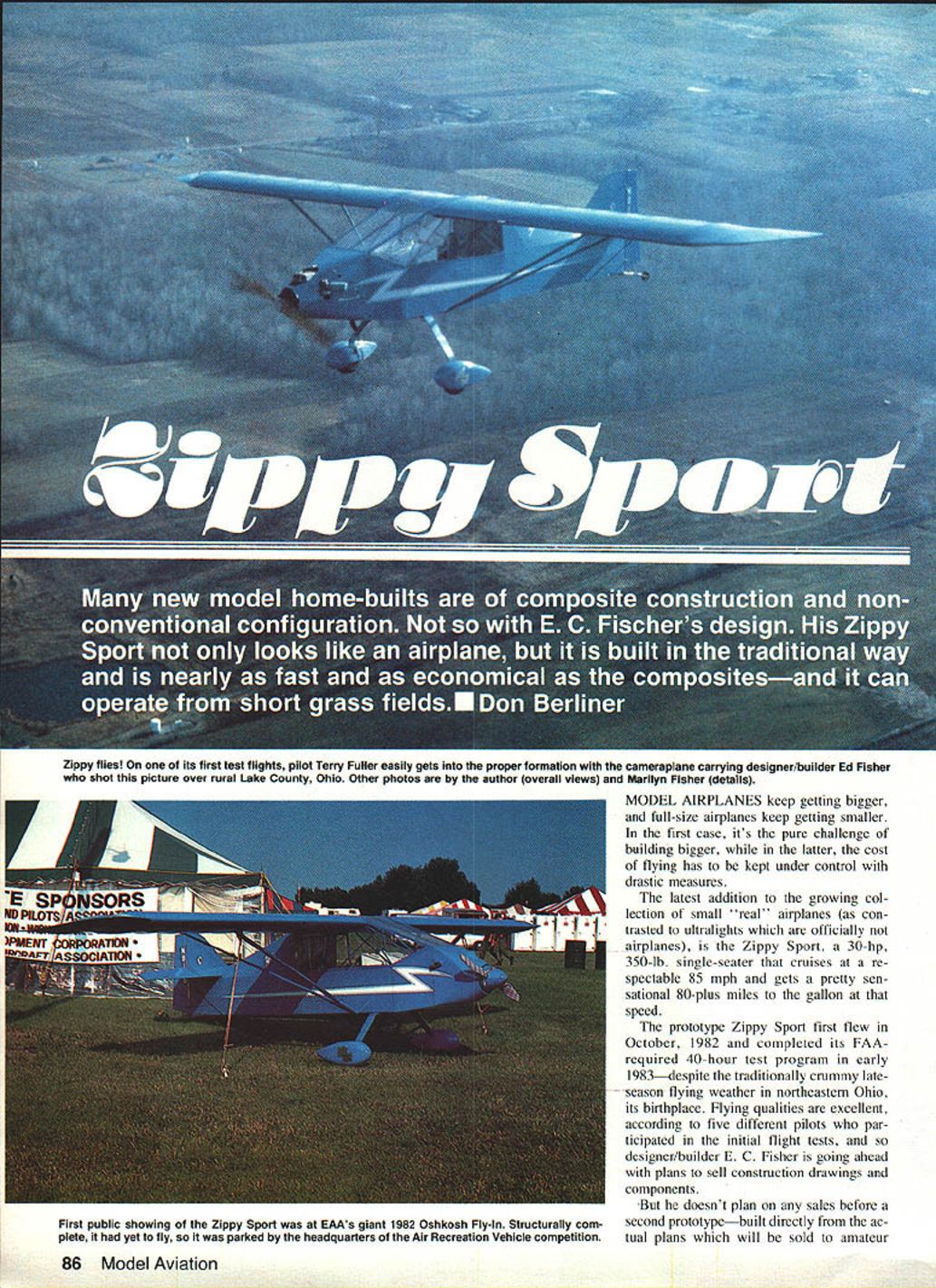
The latest addition to the growing collection of small "real" airplanes (as contrasted to ultralights, which are officially not airplanes) is the Zippy Sport: a 30-hp, 350-lb., single-seater that cruises at a respectable 85 mph and gets a sensational 80-plus miles to the gallon at that speed.
The prototype Zippy Sport first flew in October 1982 and completed its FAA-required 40-hour test program in early 1983—despite the traditionally crummy late-season flying weather in northeastern Ohio, its birthplace. Flying qualities are excellent, according to five different pilots who participated in the initial flight tests, and designer/builder E. C. Fisher is going ahead with plans to sell construction drawings and components.
He does not plan any sales before a second prototype—built directly from the actual plans that will be sold to amateur builders. The prototype has been flown successfully, but Fisher is determined that the prospective builder will know the Zippy Sport he is to build has been tested, since the production version will differ in many respects from the first prototype as a result of test flying.
Designer and background
When you buy an airplane built by Boeing or Cessna, the manufacturer's reputation is a very important part of the package. This is just as true with an amateur design, though the designer's reputation is harder to pin down. Fishercraft, Inc. is a small corporation composed of E. C., his parents, his brother, his grandfather, and a couple of neighbors. Some investigation is required: who is this "E. C." and what does he know about designing and building small airplanes?
Most of his 28 years have been spent among people who build airplanes at home, and the impact of this upbringing shows. In 1965, when he was 10 years old, his dad ("Big Ed") flew the two-seat Stits Skycoupe he had been building in the garage for more than three years. Shortly after it was cleared by the FAA to carry a passenger, E. C. got his first ride in a homebuilt airplane. Two years later the family moved on to other projects.
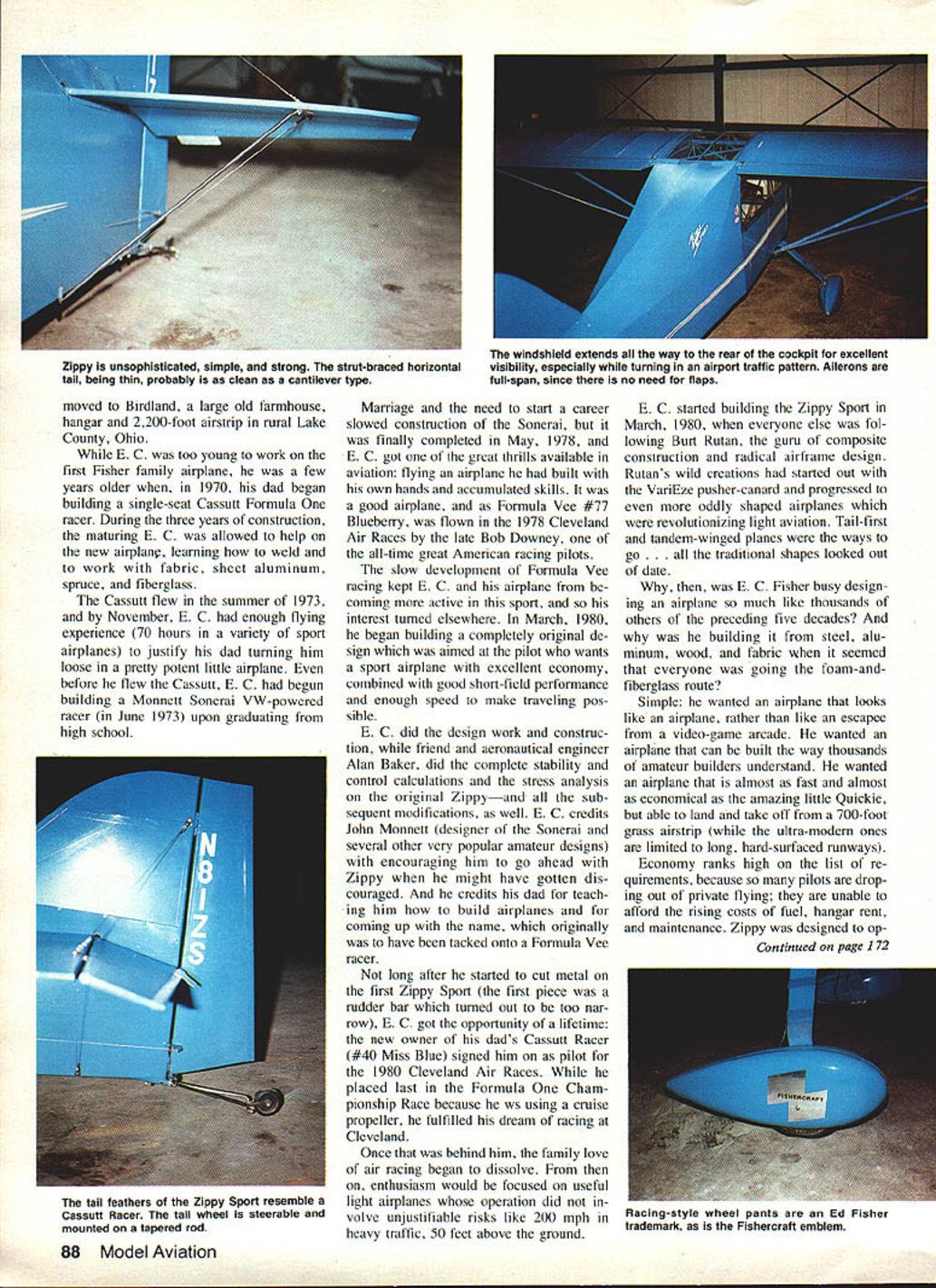
In 1970 Dad began building a single-seat Cassutt Formula racer. During three years of construction the maturing E. C. was allowed to help on the new airplane, learning weld work, fabric, sheet aluminum, spruce, and fiberglass. The Cassutt flew in the summer of 1973. By November E. C. had enough flying experience—70 hours in a variety of sport airplanes—to justify Dad turning him loose in the pretty potent little airplane.
Before he flew the Cassutt, E. C. had begun building a Monnett Sonerai, a VW-powered racer, in June 1973. After graduating high school, marriage, and starting a career slowed construction; the Sonerai was finally completed in May 1978. E. C. gained the thrills available in aviation flying an airplane built with his own hands and accumulated valuable skills.
A good airplane, Formula Vee #77 "Blueberry," was flown in the 1978 Cleveland Air Races by the late Bob Downey, an all-time great American racing pilot. Slow development in Formula Vee racing kept E. C.'s airplane from coming into active sport competition, and his interest turned elsewhere. In March 1980 he began building completely on his own.
E. C. did the design work and construction, while friend and aeronautical engineer Alan Baker did the complete stability and control calculations and the stress analysis on the original Zippy—and all subsequent modifications. E. C. credits John Monnett (designer of the Sonerai and several other popular amateur designs) with encouraging him to go ahead with Zippy when he might have been discouraged. He credits his dad for teaching him how to build airplanes and for coming up with the name, which originally was to have been tacked onto a Formula Vee racer.
Not long after he started cutting metal on the first Zippy Sport (the first piece was a rudder bar which turned out to be too narrow), E. C. got the opportunity of a lifetime: the new owner of his dad's Cassutt Racer (#40 Miss Blue) signed him on as pilot for the 1980 Cleveland Air Races. While he placed last in the Formula One Championship Race because he was using a cruise propeller, he fulfilled his dream of racing at Cleveland.
After that, the family love of air racing began to dissolve. From then on, enthusiasm was focused on useful light airplanes whose operation did not involve unjustifiable risks like 200 mph in heavy traffic, 50 feet above the ground.
Design philosophy
E. C. started building the Zippy Sport in March 1980, at a time when many were following Burt Rutan and the revolution in composite construction and radical airframe design. Rutan's VariEze and other canard/tandem-wing creations had made nontraditional shapes popular.
Why, then, was E. C. Fisher designing an airplane so much like thousands of others of the preceding five decades, and building it from steel, aluminum, wood, and fabric when others were going foam-and-fiberglass? Simple: he wanted an airplane that looks like an airplane, that can be built the way thousands of amateur builders understand, and one that is almost as fast and economical as the Quickie yet able to land and take off from a 700-foot grass airstrip. Economy ranked high because many pilots are dropping out of private flying due to rising costs of fuel, hangar rent, and maintenance.
Zippy was designed to operate on low-cost power and to be inexpensive to build and maintain. It can operate for as little as 1½ cents per mile for fuel (ordinary car gas is perfectly OK for a home-built airplane that uses an uncertified engine). To eliminate the cost of hangar rent, which can run over $100 per month, the standard Zippy Sport will have wings that can easily be folded back for trailering home after a day of flying. Maintenance costs are relatively low for most home-builts, since the FAA permits the builder (who is technically the "manufacturer") to do his own repairs and inspections.
Prototype development and testing
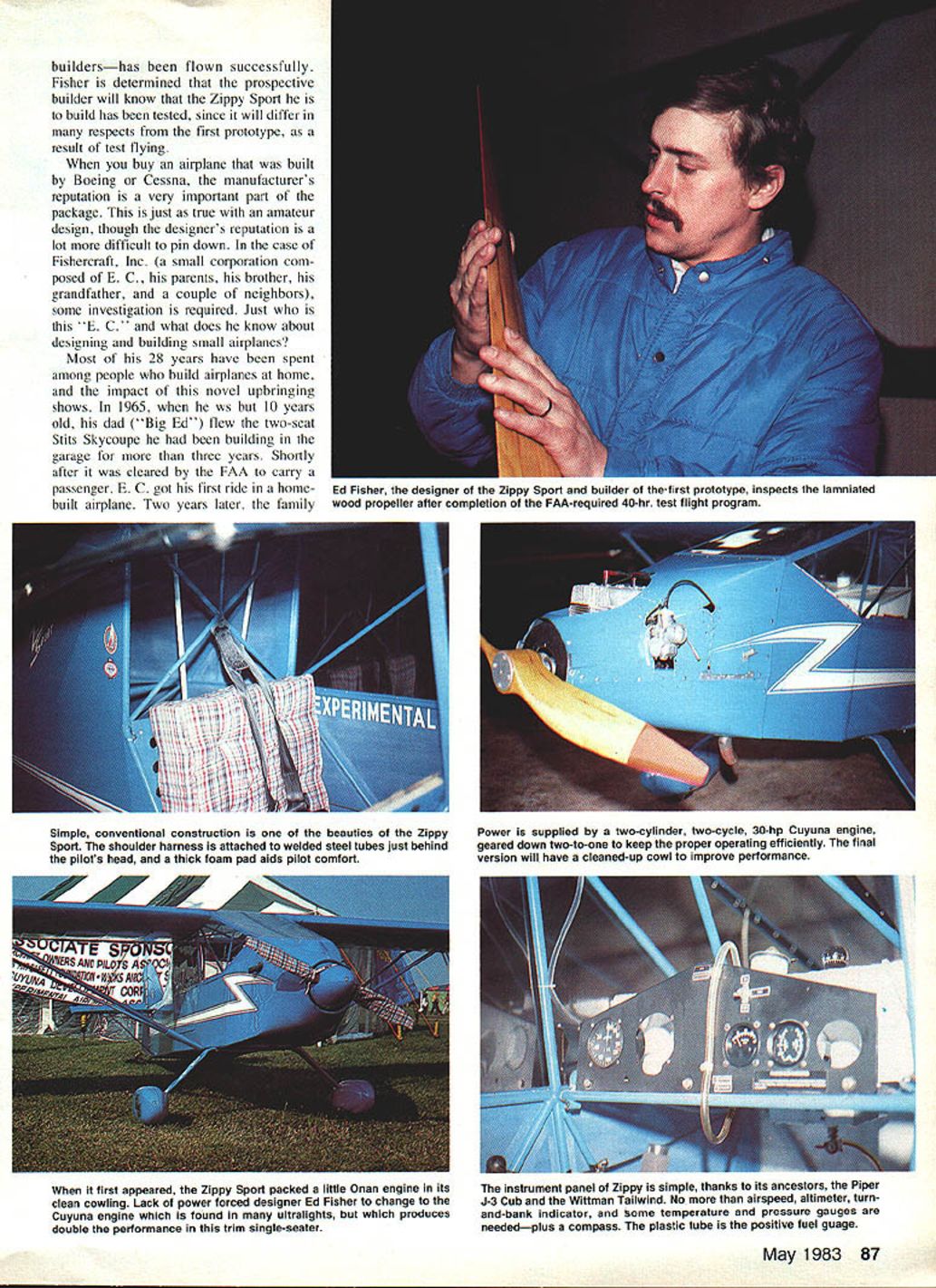
Following 2½ years of construction, delayed by the need to make a living, the prototype Zippy Sport was flown by E. C. on October 9, 1982. One of the last changes prior to initial test flying was the replacement of the original Onan engine (used in the Quickie), which produced barely half its advertised 20 hp, with a 30-hp Cuyuna, geared down 2-to-1. Within a few days several pilots had flown the Zippy Sport and pronounced it a solid airplane.
Takeoff performance, good to begin with, was improved by the addition of three inches to each landing gear strut to raise the wing's angle of attack when in three-point position. It was then able to get off the ground after a run of about 350 feet. A landing speed of around 40 mph makes the Zippy Sport usable on most farm landing strips, as well as every known airport.
Even though the tests were made with a crude cowl—cylinders, exhaust stacks, and the carburetor sticking out in the wind—and few fairings, performance was better than expected: top speed near 100 mph and an honest cruising speed of 85 mph at a fuel consumption of about one gallon per hour. Economy of operation, one of the main goals, had already been achieved.
Another main goal was economy of construction, because if people can't afford to build the Zippy Sport, who cares how little it costs to run? Exact cost depends on the individual's building skill and scrounging talent, but material costs should run around $3,000, plus engine. At a total cost of less than $5,000, it would be less than a new car and less than most ultralights, even though it offers double their performance and is safer to fly.
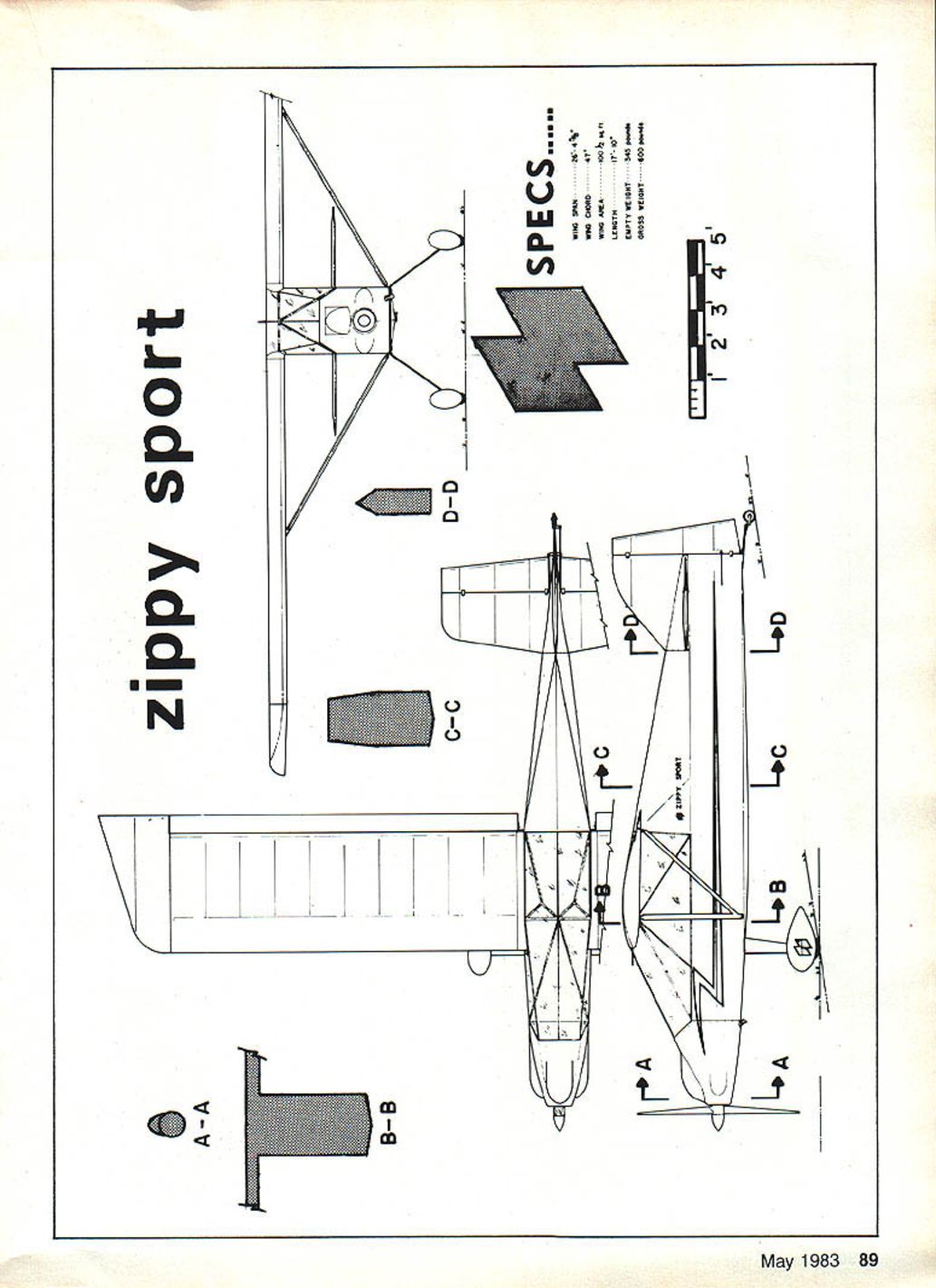
SPECS
Construction and materials
- Fuselage and tail: welded 4130 chrome-molybdenum steel tubing, covered with Grade A cotton or Dacron (builder's choice).
- Wings: spruce spars with plywood ribs on the prototype; sheet aluminum ribs are an option and can be purchased from a supplier.
- Other purchasable/pre-formed parts: fiberglass engine cowl and wheel pants, aluminum 5½-gallon gas tank, spring-steel landing gear.
- Building time: estimated at 550 man-hours.
Performance
- Stall speed (depending on pilot weight): 40–45 mph.
- Rate of climb: 450–500 feet per minute.
- Cruising speed (at 5,000 rpm): 85 mph.
- Top speed (at 5,400 rpm): 100 mph.
- Takeoff roll: 350 feet.
- Landing roll: 650 feet.
- Fuel consumption: about 1 gallon per hour at cruise (roughly 80+ mpg at 85 mph).
Dimensions and weights
- Wingspan: 24 ft. 8 in.
- Wing area: 98 sq. ft.
- Length: 17 ft. 10 in.
- Height: 5 ft.
- Empty weight: 365 lb.
- Gross weight: 610 lb.
Planned changes for production version
- Replace original laminar-flow airfoil with a less exotic NACA 4412 section.
- Slightly increase wing area.
- Replace crude test cowl with a carefully formed fiberglass cowl.
- Alter front fuselage for more usable space.
- Make wings foldable for trailering and storage.
- Other refinements to reduce weight and improve handling.
The prototype is a good airplane but a bit heavy; these changes are intended to produce the definitive version.
No continuing article text on this page; the page contains only plan drawings, diagrams, and captions.
Plans and availability
Once the second prototype has been pronounced a success, the unusually well-drawn plans will be offered for sale as a set for $100. They will include at least 15 sheets of 24 in. by 36 in., a construction manual, and photographs of particularly critical items.
Information is available from:
- Fishercraft, Inc.
- 4356 Narrows Rd., Perry, Ohio 44081
- Phone: (216) 259-4412
Transcribed from original scans by AI. Minor OCR errors may remain.

